Cross-Border Inheritance Tax: A Strategic Analysis of International Fiscal Protocols (2026)
- S Najam
- 10 hours ago
- 13 min read

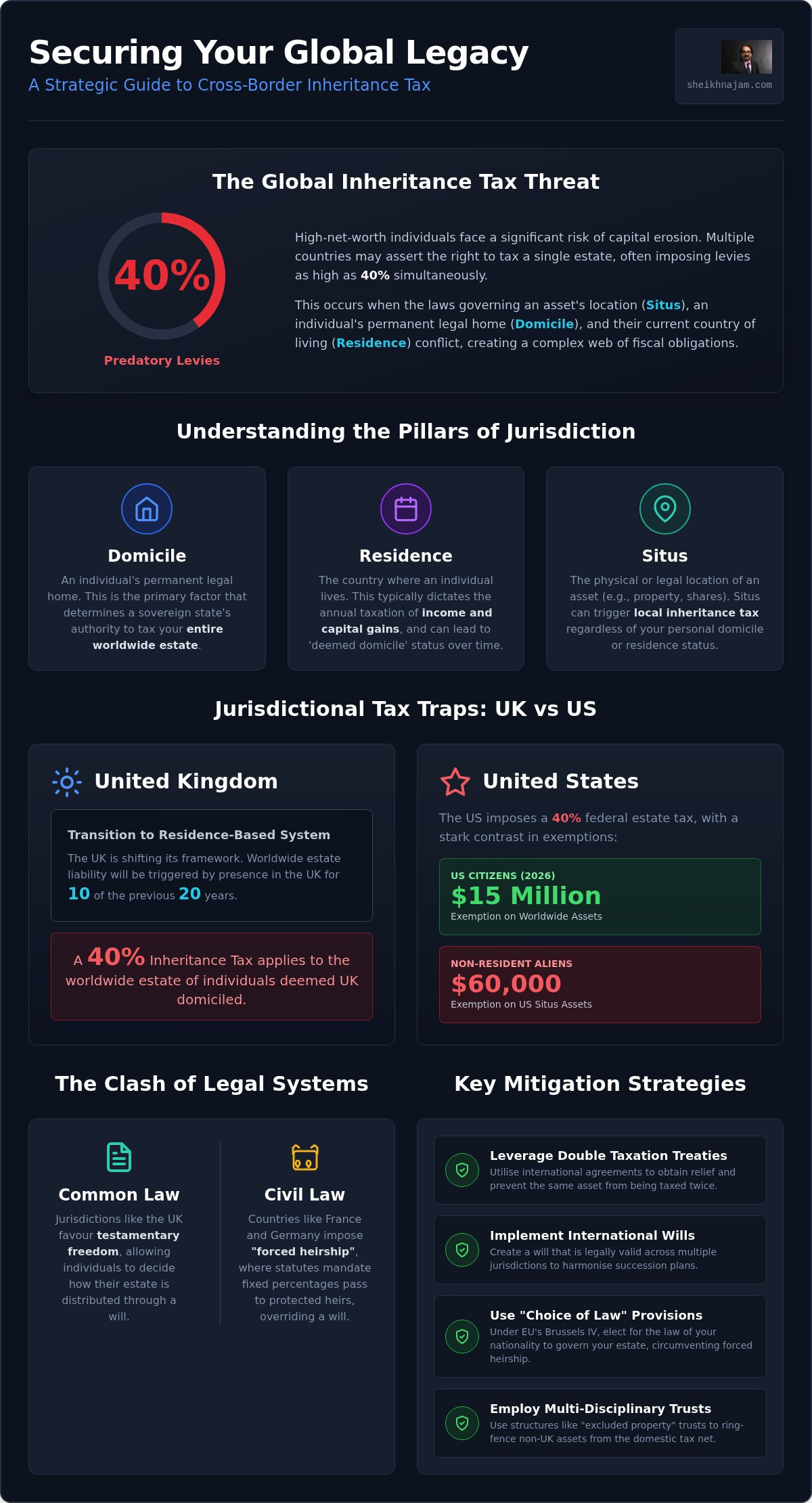
The preservation of a multi-generational legacy is no longer a matter of simple testamentary intent but a high-stakes negotiation against the encroaching fiscal reach of competing sovereign states. You likely recognise that the traditional protections of domicile are eroding, leaving your global estate vulnerable to the predatory 40% levies often imposed by multiple jurisdictions simultaneously. This analysis provides the rigorous framework required to secure your assets against such systemic inefficiencies, offering a definitive roadmap for cross-border inheritance tax mitigation and the strategic alignment of international wills.
We'll explore how the UK's transition to a residence-based system, requiring ten years of presence within a twenty-year look-back period, necessitates a fundamental recalibration of your global footprint. By deconstructing the interplay between US situs assets, which face a 40% burden beyond a mere $60,000 for non-residents, and the stringent civil law protocols of Europe, this reference ensures your estate remains an instrument of legacy rather than a casualty of double taxation. We'll conclude with a precise examination of the most tax-efficient domicile statuses available to the high-net-worth individual in 2026, ensuring the seamless administration of your global interests with absolute precision.
Table of Contents
Defining the Jurisprudential Scope of Cross-Border Inheritance Tax
The phenomenon of cross-border inheritance tax manifests when two or more sovereign entities assert concurrent taxing rights over a single estate, often precipitated by the geographic dispersion of assets or the complex residency status of the deceased. Whilst most Inheritance tax systems operate within clearly defined borders, high-net-worth individuals frequently encounter fiscal friction where the law of the "Situs" (the physical location of the asset) conflicts with the law of "Domicile" (the individual’s permanent legal home). This intersection requires a meticulous, multi-disciplinary approach to prevent the erosion of capital through dual taxation. For immovable property, such as real estate, the principle of Lex Situs typically dictates that the law of the land where the property is situated governs both its succession and its taxation, regardless of the owner’s personal status or general testamentary intent.
The Conflict of Laws: Common Law vs Civil Law Successions
The discord between common law jurisdictions, which generally favour testamentary freedom, and civil law regimes, which often impose "forced heirship," presents a significant risk to estate integrity. In countries like France or Germany, statutes may mandate that a fixed percentage of an estate passes to specific "protected heirs," effectively overriding the instructions within a standard UK will. This is further complicated by the principle of "scission," where movable assets are governed by the law of domicile whilst immovable assets are subject to the local laws of their location. To harmonise these disparate legal frameworks, the implementation of international wills is a critical strategic requirement for ensuring that your legacy is not fragmented by jurisdictional disputes. It's a process that demands absolute precision to ensure validity across multiple legal theatres.
Fiscal Sovereignty and the Right to Tax
Managing cross-border inheritance tax requires a deep understanding of how states assert their fiscal sovereignty through various triggers, including the residence of the deceased, the residence of the beneficiaries, or the location of the assets themselves. For instance, the United States maintains a unique nationality-based taxation system that can subject the worldwide assets of US citizens to a 40% estate tax, even if they've been long-term residents of the United Kingdom. Conversely, non-resident aliens face a 40% US federal estate tax on "situs" assets exceeding a mere $60,000 threshold, which is a stark contrast to the $15 million exemption enjoyed by US citizens in 2026. Fiscal domicile serves as the definitive legal nexus that determines which sovereign state holds the ultimate authority to tax an individual’s worldwide estate.
The Critical Interplay of Domicile, Residence, and Situs
Within the complex architecture of UK fiscal policy, domicile remains the pre-eminent determinant of an individual’s exposure to inheritance tax. Whilst residence dictates the annual taxation of income and gains, domicile establishes the legal nexus for a 40% levy on the entirety of one’s worldwide estate. This exposure becomes particularly acute under the "deemed domicile" provisions, which dictate that any individual resident in the UK for at least 15 of the previous 20 tax years is treated as domiciled for all inheritance tax purposes. Such a transition fundamentally alters the fiscal profile of a global estate, often necessitating a proactive and profound restructuring of assets to mitigate the impact of cross-border inheritance tax. For those who have not yet reached this threshold, the strategic utilisation of "excluded property" trusts remains a sophisticated mechanism to ring-fence non-UK assets from the domestic tax net.
The concept of "Situs" further complicates this landscape, as the physical or legal location of an asset can trigger immediate liability regardless of the owner’s personal domicile. For instance, holding US-situated securities or real estate can invoke significant obligations under the IRS rules on estate tax for nonresidents, where the exemption threshold for non-citizens is notably restrictive compared to the generous allowances afforded to US domiciliaries. Identifying the precise situs of intangible assets, such as digital holdings, corporate interests, or private debts, requires a level of meticulousness that only a multi-disciplinary approach can provide. It's a field where minor administrative oversights can lead to major fiscal consequences.
Domicile of Origin vs Domicile of Choice
Shedding a domicile of origin is a legal undertaking of significant gravity, requiring far more than mere physical relocation to a foreign territory. HMRC maintains an exceptionally rigorous burden of proof, demanding clear and cogent evidence of a "permanent and indefinite" intention to reside in a new jurisdiction. For globally mobile professionals, documenting this intent through a private wealth advisory framework is essential to avoid the retrospective reclassification of their estate. It's not enough to simply live abroad; one must demonstrate the severance of social, economic, and political ties to the original jurisdiction with absolute clarity.
Residence Protocols and the Statutory Residence Test
Whilst domicile is the primary anchor, tax residency as defined by the Statutory Residence Test (SRT) plays a critical secondary role in the valuation and administration of global estates. The application of split-year treatment can offer temporary relief during periods of transition, yet the compliance burden of managing multi-jurisdictional residency often leads to administrative friction. Precision in tracking days spent in each territory is paramount to ensuring that residency status doesn't inadvertently accelerate a transition to deemed domicile status. If you require a detailed review of your current standing, you may request a formal status assessment to discuss your specific jurisdictional profile.
Strategic Analysis of Double Taxation Treaties and Fiscal Protocols
Double Taxation Treaties (DTTs) constitute the primary legal instrument for resolving the jurisdictional overlaps that lead to cross-border inheritance tax liabilities. These bilateral agreements establish a clear hierarchy of taxing rights, determining which sovereign state possesses the "first bite" at the estate’s value, typically based on the situs of immovable property or the specific residency of the deceased. Where both jurisdictions assert a claim based on domicile, "tie-breaker" clauses provide a methodical resolution by evaluating factors such as the individual’s permanent home, centre of vital interests, and habitual abode. This structured approach prevents the inequitable scenario where a single asset is subjected to the full weight of two separate fiscal regimes, ensuring the total tax burden doesn't exceed the amount due in the higher-tax jurisdiction.
The distinction between treaty relief and unilateral relief is fundamental to sophisticated estate preservation. Treaty relief is an entitlement prescribed by international agreement, often providing more generous exemptions or lower rates than domestic law might otherwise allow. It's a mechanism that requires proactive invocation during the probate process, as tax authorities rarely apply these benefits automatically. Understanding the specific priority rules within these treaties is essential to ensuring that credits are correctly applied, thereby protecting the estate from the erosion of capital that occurs when multi-jurisdictional claims are left uncoordinated.
OECD Model Conventions vs Comprehensive Treaties
The United Kingdom maintains a sophisticated network of inheritance tax treaties, ranging from historical comprehensive conventions with nations such as France, Italy, and India, to modern agreements influenced by the OECD Model Tax Convention. Whilst older treaties often contain idiosyncratic provisions reflecting the bilateral relations of their era, the OECD framework promotes administrative cooperation and information exchange to combat fiscal evasion. For a more granular examination of these instruments, one should consult a strategic analysis of international fiscal protocols to understand how specific treaty nuances affect asset protection. These protocols are essential for high-net-worth individuals whose portfolios span multiple continents, providing the legal certainty required for long-term succession planning.
Unilateral Relief: The Fallback Mechanism
In instances where no formal treaty exists between the United Kingdom and a foreign jurisdiction, the estate must rely upon unilateral relief as a secondary safeguard against cross-border inheritance tax. This mechanism, codified within UK law, allows for a credit to be claimed against UK inheritance tax for taxes paid abroad on assets situated in that foreign territory. However, unilateral relief is inherently limited; it may not cover local or state-level taxes that lack a national equivalent, nor can it resolve fundamental disputes over domicile status. The credit granted under this mechanism is strictly limited to the lower of the two tax liabilities attributable to the specific foreign asset. This ensures the relief provided doesn't exceed the actual UK tax due on that portion of the estate, requiring precise valuation and meticulous reporting to HMRC.
Navigating the EU Succession Regulation and Third-Country Complications
The Brussels IV Regulation (EU 650/2012) represents a cornerstone of European private international law, offering a mechanism for individuals to harmonise the succession of their global assets. Whilst this regulation doesn't dictate the applicable cross-border inheritance tax, it provides the vital authority for a testator to elect the law of their nationality to govern their entire estate. By making an "express declaration" within a will, UK nationals can effectively bypass the "forced heirship" regimes prevalent in civil law jurisdictions such as France or Italy. These regimes often mandate that a fixed portion of the estate passes to specific descendants, a requirement that frequently conflicts with the testamentary freedom traditionally enjoyed under English law. Failure to make this election can result in the default application of the law of "habitual residence," which may trigger unintended fiscal and legal consequences.
One of the most intricate challenges in this area is the doctrine of "Renvoi," where the conflict-of-law rules of one jurisdiction refer a matter back to the laws of another. This can create a circularity of legal reference that complicates probate and delays the distribution of assets. To ensure a UK will is recognised as a valid "Choice of Law" instrument within the Eurozone, it must be drafted with absolute precision to exclude any ambiguity. If the choice is deemed invalid, the estate risks being governed by local laws that don't align with the testator's strategic objectives, potentially increasing the overall exposure to local levies and administrative friction.
Post-Brexit Realities for UK Estates
Since the UK's withdrawal from the European Union, its status as a "third state" has altered the procedural landscape for the recognition of UK probate. Whilst UK nationals still benefit from the choice-of-law provisions under Brussels IV, the administrative burden of proof has increased significantly. Crucially, the notarial authentication of testamentary documents is now a mandatory requirement for their acceptance by many foreign registries and financial institutions. In certain jurisdictions, the use of separate "Situs Wills" remains a prudent strategy to ensure the seamless transition of immovable property without the delays associated with domestic probate recognition.
Executing the Choice of Law
The formal requirements for an express declaration are stringent; relying on an implied choice is a high-risk strategy that often invites litigation amongst heirs. Disgruntled beneficiaries may seek to challenge the validity of a choice of law to invoke more favourable forced heirship rules. In such instances, the intervention of contentious probate specialists is required to defend the testator's intent and resolve multi-jurisdictional disputes. To secure your international assets against these complexities, you should consult our specialist advisory team for a comprehensive review of your cross-border testamentary arrangements.
Multi-Disciplinary Structuring for Global Estate Preservation
The effective preservation of a global estate requires the seamless integration of trusts, foundations, and corporate vehicles to consolidate asset management across disparate legal systems. This multi-disciplinary approach ensures that complex portfolios don't fall into the administrative gaps between jurisdictions, particularly when addressing the intricacies of cross-border inheritance tax. Maintaining rigorous financial crime compliance and Anti-Money Laundering (AML) standards is essential during every multi-jurisdictional transfer to protect the legality and reputation of the estate. By centralising control through sophisticated legal structures, you can achieve a level of fiscal stability that traditional, fragmented planning cannot provide.
Digital Asset Structuring in International Estates
Jurisdictional ambiguity remains a significant challenge for digital assets like cryptocurrencies, private keys, and intellectual property. Defining the legal "situs" of these holdings for tax purposes is often a matter of intense debate, yet utilising digital asset trusts can facilitate a transition that bypasses traditional probate entirely. High-value digital holdings now face stringent reporting requirements, necessitating meticulous record-keeping to satisfy international tax authorities and compliance protocols. Precision in this area is paramount to avoid the sudden imposition of local levies on assets that lack a physical location.
The Notarial Function in International Succession
The strategic role of a notary is indispensable for the authentication of corporate instruments and the verification of "Lasting Powers of Attorney" for use by foreign financial institutions. These institutions often demand absolute certainty regarding the validity of documents executed in the United Kingdom, and notarial verification provides the necessary level of international legal weight. Achieving legal certainty through professional verification ensures that your fiduciaries can act decisively across borders without the delays of administrative challenges. It's a meticulous process that reinforces the structural integrity of your estate.
Strategic Dispute Prevention
To avoid the public nature and high costs of court litigation, dispute resolution strategies such as mediation and arbitration offer a private, authoritative forum for resolving inheritance conflicts. These methods are particularly effective in cross-border contexts where family wealth and reputation are at stake, allowing for a strategic resolution that preserves the family legacy. You should secure your global legacy with expert cross-border inheritance tax planning to ensure your affairs are handled with absolute precision and multi-disciplinary foresight.
Securing Global Legacies Through Strategic Jurisdictional Alignment
The successful navigation of cross-border inheritance tax requires a synthesis of academic rigour and practical foresight, ensuring that the interplay between domicile, residence, and asset situs is managed with absolute precision. We've established that the mitigation of dual taxation depends not only on the robust application of international treaties but also on the strategic election of law under frameworks like Brussels IV. By integrating meticulous notarial authentication with sophisticated trust structures, you protect your estate from the administrative friction and fiscal erosion inherent in multi-jurisdictional successions.
As a Member of the Society of Trust and Estate Practitioners (TEP) and a Notary Public appointed by The Court of Faculties, Sheikh Najam provides the elite expertise required for high-value international tax mitigation. Every structural decision is informed by a deep understanding of the evolving fiscal protocols that govern global wealth in 2026. You don't have to face these complexities without a master advisor by your side. Consult with Sheikh Najam TEP for Expert Cross-Border Estate Structuring to ensure your international affairs are handled with the gravitas they deserve. Your legacy remains secure when precision meets strategy.
Frequently Asked Questions
What is the definition of cross-border inheritance tax in UK law?
In the context of the United Kingdom's fiscal regime, cross-border inheritance tax refers to the concurrent application of inheritance tax by multiple sovereign jurisdictions upon the same deceased estate. This typically occurs when a testator possesses assets situated in a foreign territory whilst remaining domiciled within the UK. Under the Inheritance Tax Act 1984, the UK asserts a right to tax the worldwide assets of any individual who is domiciled or deemed domiciled within its borders.
Can I choose which country’s inheritance tax laws apply to my global estate?
You cannot simply elect which taxation regime applies to your assets, as fiscal liability is a matter of mandatory statutory law rather than personal preference. Whilst the Brussels IV Regulation allows you to choose the law of your nationality to govern the succession and distribution of your estate, this choice doesn't extend to taxation. Fiscal sovereignty remains with the individual states, which determine liability based on the physical location of assets and your specific domicile status.
How do double taxation treaties protect my heirs from dual tax hits?
Double taxation treaties function as bilateral conventions that establish a clear hierarchy of taxing rights between the United Kingdom and participating foreign states. These agreements typically provide credits for taxes paid in the country where the asset is situated, ensuring that the same value isn't fully taxed twice. By utilising these protocols, your heirs can mitigate the impact of cross-border inheritance tax, as the treaty dictates which jurisdiction has the primary right to levy the estate.
What happens if there is no tax treaty between the UK and the country where my assets are located?
Where a formal bilateral treaty is absent, the estate must rely upon unilateral relief as provided under domestic UK legislation. This mechanism allows the executors to claim a credit against the UK inheritance tax liability for any equivalent tax paid to the foreign authority on assets situated abroad. It's essential to recognise that this relief is strictly limited to the lower of the two tax charges, requiring meticulous documentation to satisfy HMRC's evidentiary standards during probate.
Is my digital currency portfolio subject to UK inheritance tax if I live abroad?
Your digital currency portfolio remains subject to UK inheritance tax if you maintain a UK domicile, regardless of your physical residence. HMRC generally treats intangible digital assets as being situated in the jurisdiction where the owner is domiciled. If you've been resident in the UK for fifteen of the previous twenty years, you'll be treated as deemed domiciled, bringing your entire global cryptocurrency holdings into the scope of the 40% UK inheritance tax net.
How does my domicile status affect the tax liability of my foreign property?
Your domicile status serves as the definitive anchor for your global tax liability. If you are domiciled in the UK, the state claims a right to tax your entire worldwide estate, including immovable property located in foreign jurisdictions. Conversely, if you are non-domiciled and have not yet met the deemed domicile threshold, the UK’s taxing rights are generally restricted to assets physically situated within its borders, offering a significant window for strategic international tax planning.
What is the role of a Notary Public in administering an international estate?
A Notary Public provides the essential authentication required for testamentary documents to be recognised by foreign registries and financial institutions. Their role involves the formal verification of wills, powers of attorney, and corporate instruments, ensuring these documents possess the necessary legal weight for use across borders. Without this professional authentication and the subsequent apostille, foreign authorities often refuse to acknowledge the validity of UK-executed documents, leading to significant delays and administrative friction during estate administration.
Can I use a trust to avoid cross-border inheritance tax complications?
Trusts are a sophisticated instrument for consolidating global assets and can provide continuity that bypasses the need for multiple grants of probate. For non-domiciled individuals, the creation of an "excluded property trust" can effectively ring-fence foreign assets from the UK inheritance tax regime, even if the individual later becomes deemed domiciled. These structures must be established with absolute precision to ensure they comply with both UK anti-avoidance legislation and the specific trust laws of the foreign jurisdiction involved.


Comments