Family Wealth Protection Trust: Purpose, Structure and Payments

A trust preserves family wealth through structured control, not automatic protection from tax or claims. A Family Wealth Protection Trust is a legally binding arrangement in which trustees manage assets for beneficiaries under terms set by the person creating it. In a discretionary trust, trustees decide how and when to distribute assets. Trust services for family wealth preservation can help align control, succession and beneficiaries’ needs, while tax consequences depend on the trust’s structure and assets.
It is understandable to expect a trust to do more than hold assets: its terms can shape who benefits, when support is provided and how wealth is managed across generations. Yet the distinction between retaining enjoyment of assets and transferring legal control is central, as are the trustees’ powers and the tax treatment that follows.
This article explains the purpose and structure of a family wealth protection trust, how trustees may make payments, and how trusts can contribute to wealth preservation and tax planning. It also addresses the limits: a trust is not a universal shield, and its suitability depends on the family’s objectives, assets and circumstances.
Table of Contents
Can the trustees of the settlement make payments to my beneficiaries?
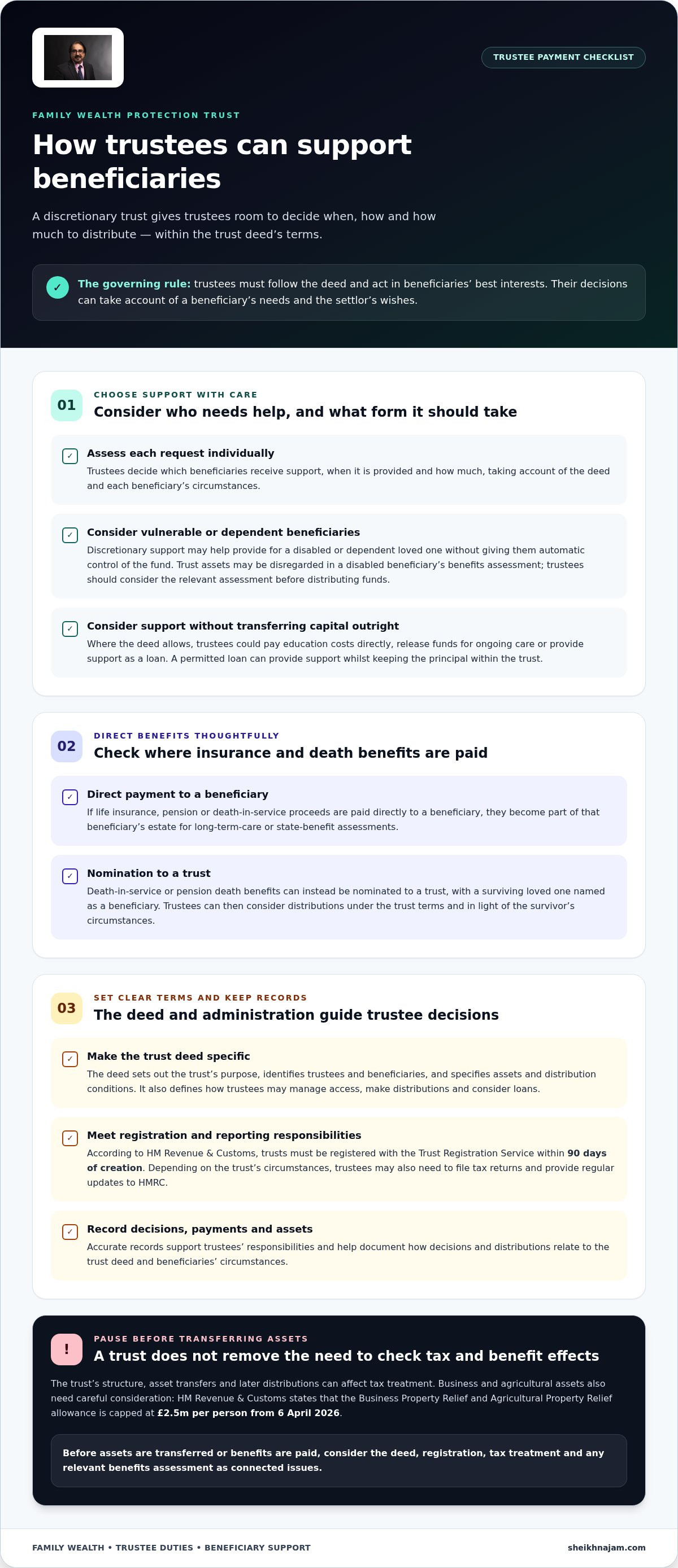
Yes. Trustees of a discretionary trust decide when and how to distribute funds, within the trust deed’s terms. They can consider a beneficiary’s needs and the settlor’s wishes before making payments.
Discretionary support for vulnerable beneficiaries
A discretionary trust lets trustees decide which beneficiaries receive support, when they receive it and how much. This can help provide for a disabled or dependent loved one without giving them automatic control of the fund. Assets held in a Family Wealth Protection Trust may be disregarded when assessing a disabled beneficiary’s benefits. Before distributing funds, trustees should consider the beneficiary’s needs and the relevant benefits assessment.
Life insurance, pension and death-in-service benefits need careful direction. If proceeds are paid directly to a beneficiary, they become part of that beneficiary’s estate for long-term-care or state-benefit assessments. Death-in-service or pension death benefits can instead be nominated to a trust, with a surviving loved one named as a beneficiary. Trustees may then distribute funds at their discretion, in line with the trust terms and the survivor’s circumstances. For families coordinating cross-border assets or managing Canadian pensions, wealth specialists such as egwealth.ca offer comprehensive pre- and post-retirement planning to ensure retirement capital aligns with longer-term wealth preservation strategies.
Managing access, distributions and loans
The trust deed defines how trustees may manage access, make distributions and consider loans. For example, trustees could pay education costs directly or release funds for ongoing care, rather than transfer capital outright. If the deed permits a loan, it can provide support while keeping the principal within the trust. Trustees can consider each beneficiary’s request in light of the trust deed and the circumstances.
UK trustees must act in beneficiaries’ best interests and follow the trust deed. According to HM Revenue & Customs, trusts must be registered with the Trust Registration Service within 90 days of creation. Trustees may also need to file tax returns and provide regular updates to HMRC, depending on the trust’s circumstances. Accurate records of decisions, payments and trust assets support these responsibilities.
Setting up a trust involves defining its purpose, identifying trustees and beneficiaries, and specifying assets and distribution conditions in a trust deed. Signing and witnessing formalises the document and makes it binding under English law. Legal and tax advice should address the deed, asset transfers, registration and tax treatment as connected issues, particularly where inheritance and benefits are both relevant.
Business and agricultural assets also require attention: according to HM Revenue & Customs, the Business Property Relief and Agricultural Property Relief allowance is capped at £2.5m per person from 6 April 2026. That cap may affect how trustees plan distributions or manage qualifying assets. A trust’s payment powers do not remove the need to consider tax consequences before assets are transferred or benefits are paid.
What Role Do Trusts Play in Wealth Preservation and Tax Efficiency?
A trust can organise how assets pass to children and grandchildren, but its tax treatment depends on its structure and purpose. For 2026/27, the standard UK Inheritance Tax nil-rate band is £325,000, according to HM Revenue & Customs.
Planning inheritance for children and grandchildren
Inheritance planning for children and grandchildren uses a will or trust to determine who benefits and when. A trust can ring-fence assets until a child reaches an age specified in its terms, allowing trustees to manage the funds in the meantime. This can be useful when a young beneficiary needs support for education or care rather than immediate access to capital.
For an estate above the nil-rate band, Inheritance Tax is charged at 40%, according to HM Revenue & Customs. Placing assets into a trust does not automatically remove tax: the transfer, trust type and later distributions all affect the position. Lifetime gifts are another planning route; potentially exempt transfers generally depend on the donor surviving the seven-year period for the gift to fall outside their estate.
Planning across generations
Multi-generational planning coordinates asset ownership and succession so wealth can support more than one generation. A trust deed can specify how trustees manage assets, provide for children and grandchildren, and direct remaining funds to later beneficiaries. This structure can also help keep business or agricultural assets within a family succession plan.
Tax treatment remains central. Income retained in a trust is taxed at 45% for non-dividend income and 39.35% for dividends. Some trusts may use tax exemptions or reliefs, whilst other structures can create additional tax liabilities. A family should therefore compare the intended succession route with the trust’s income, capital gains and Inheritance Tax consequences before transferring assets.
Care-fee planning requires separate scrutiny from Inheritance Tax planning. In England, a local authority may treat a home placed in trust to avoid care costs as deliberate deprivation of assets and include its value in a care-fee assessment. There is no fixed period limiting how far back the authority can look. The seven-year Inheritance Tax rule does not provide a safe harbour for care assessments, so transferring a main residence solely to avoid fees is rarely advisable.
Business and agricultural assets also face changing relief rules: from 6 April 2026, the Business Property Relief and Agricultural Property Relief allowance is capped at £2.5m per person. Professional advice can assess how that cap interacts with the family’s assets, intended beneficiaries and succession timetable. For a considered review of Inheritance Tax planning and trust structures, the relevant questions include who retains control, which beneficiaries may benefit, and how each proposed transfer is taxed.
What is a Family Wealth Protection Trust?
A Family Wealth Protection Trust is a legally binding arrangement in which trustees manage assets for beneficiaries under terms set by the settlor. Its practical effect depends on which assets enter the trust, the trustees’ powers and the conditions for distributions.
Holding and managing family assets
Once assets are transferred, trustees hold and administer them under the trust deed, rather than as beneficiaries’ personal property. The deed can specify investment powers, permitted payments and who may benefit. For example, trustees managing a property portfolio can retain it collectively and distribute income under the settlor’s instructions. Central administration can reduce disputes between heirs about selling or dividing individual properties.
Trustees must act within the deed and in beneficiaries’ interests. Families should identify each asset clearly, state its intended purpose and record any change in ownership. An asset merely described in a plan is not necessarily controlled by the trust.
Asset protection and ring-fencing
Ring-fencing means separating assets held under trust from beneficiaries’ personal ownership, with trustees controlling their administration. This can help limit exposure to claims against a beneficiary, including claims connected with divorce, but it does not provide automatic immunity. The trust’s terms, the circumstances of the transfer and who retains control all affect how the arrangement operates.
When assessing a professional trustee, examine how the proposed role fits the deed, how decisions will be documented and how distributions will be administered. Clear records of transferred assets and trustee decisions help distinguish trust property from a beneficiary’s own estate. Proper administration matters as much as the original drafting.
Protecting wealth for future generations
A trust can preserve assets for children and grandchildren by restricting access or setting conditions for distributions. The deed might allow trustees to fund education or care while retaining capital for later beneficiaries. This can support continuity between generations, rather than passing the entire fund to one person at once.
Trustees can also manage assets for a beneficiary who loses mental capacity, within the settlor’s original wishes. Families should specify who may benefit, what purposes payments may serve and where remaining funds should pass. These choices give trustees a framework for administering wealth over time, rather than relying on informal family understandings.
Spousal bypass and second marriages
A spousal bypass trust is commonly structured to hold assets for a surviving spouse’s potential benefit while preserving the trust fund for children or other named beneficiaries. It may be relevant in a second marriage, where a settlor wishes to provide for a new spouse without leaving the ultimate destination of family assets unresolved.
The deed should define the surviving spouse’s access, the trustees’ discretion and the remainder beneficiaries. A trust created before cohabitation may also state how assets are intended to benefit children if a relationship ends. Trusts can help protect wealth from third-party claims, including divorce claims, but do not prevent bankruptcy or guarantee protection from every creditor. The structure must reflect the family’s circumstances and the settlor’s wishes.
Discretionary trust structure for family wealth
A discretionary trust gives trustees authority to decide which beneficiaries receive assets and when. Its structure should reflect the family’s intended control, investment approach and succession objectives.
Comparing trust types
Bare, discretionary and life interest trusts allocate control and beneficiary interests differently. In a bare trust, the beneficiary has an absolute right to the assets; in England and Wales, that right typically takes effect at age 18. A life interest trust gives one person income during their lifetime, with capital passing to others afterwards. A discretionary trust gives trustees discretion over distributions, making it more adaptable where beneficiaries’ needs may change.
That distinction matters when comparing a trust with a family investment company. A trust places management with trustees for beneficiaries, whereas a company holds assets through its corporate structure and ownership interests. A will or lifetime gift may also suit a family seeking direct succession rather than ongoing trustee control. The right comparison depends on the desired control, beneficiary access and tax consequences of each transfer.
Lifetime and dynasty-style trusts
A lifetime discretionary trust is established while the settlor is alive, allowing assets to be managed under the deed before their death. A UK dynasty-style trust can preserve a fund for successive generations, with trustees deciding how beneficiaries benefit. For UK trusts created on or after 6 April 2010, the perpetuity period can be up to 125 years.
Multi-generational arrangements require attention to trustee continuity and governance. The deed can name successor trustees and specify how remaining funds may pass to later beneficiaries. Appointing at least two trustees is recommended when establishing a multi-generational trust. Shared oversight can support investment and distribution decisions while keeping them within the settlor’s stated wishes.
Trustees may manage and invest trust assets strategically, but their powers come from the deed and applicable duties. A deed can define investment authority, beneficiary classes and the circumstances for payments. For example, trustees could retain a family business interest, distribute income to one beneficiary and preserve capital for others. Clear terms help trustees balance competing interests without treating the fund as any beneficiary’s unrestricted property.
Discretionary management does not itself ensure savings or tax efficiency. Trusts may have income tax, capital gains tax and Inheritance Tax implications, while a family investment company has a different ownership and governance framework. Families should compare how each structure handles control, succession and tax before transferring assets; consulting wealth management and tax planning professionals, such as Timothy Roberts & Associates, LLC, can help align overarching financial strategies with individual family goals. The deed, asset type and beneficiaries’ needs determine the practical consequences.
Wealth preservation trust purpose and structure
A wealth preservation trust is designed around a defined purpose, not simply the transfer of assets. The deed records the trustees, beneficiaries, asset-management arrangements and conditions for distributions. For example, a family may seek to retain a property portfolio for future generations while allowing trustees to manage income and respond to beneficiaries’ changing needs. The structure works only when its legal terms match that purpose.
Begin with the assets and the intended outcome. A property portfolio can be held and managed collectively, which may reduce disputes between heirs about selling or dividing individual properties. The deed can also specify how trustees should manage assets if someone loses mental capacity, in line with that person’s original wishes. These provisions turn family intentions into a framework trustees can apply.
Asset transfers must be reflected in legal ownership. Designated assets come under the trust’s control when their ownership is changed; simply naming an asset in family discussions does not complete the transfer. Trustees then manage it under the deed, keeping trust property distinct from beneficiaries’ personal assets. This separation can help manage exposure to third-party claims, including divorce-related claims, but it is not an absolute shield.
The structure also determines who can benefit and how much flexibility trustees have. A deed may authorise distributions for specified purposes, retain income within the trust or allow funds to pass to beneficiaries named by the settlor. For instance, trustees could retain a property and distribute its income rather than divide it between heirs. Clear conditions help prevent uncertainty when beneficiaries’ interests differ.
Trustees need workable governance as well as clear powers. Appointing at least two trustees is recommended for a multi-generational trust, allowing shared oversight of administration and decisions. The deed should address trustee succession, investment management and how decisions will be recorded. These provisions matter if a trustee dies or becomes unable to act, because continuity supports the trust’s original purpose.
Tax consequences must be considered alongside asset protection. A trust may have income tax, capital gains tax and Inheritance Tax implications, depending on its type and assets. Placing an asset in trust does not itself mean tax liabilities will fall. The transfer, retained enjoyment, trust terms and later distributions all affect the analysis, so a structure focused solely on reducing tax may not serve the family’s wider aims.
The practical test is whether each clause connects an asset to a beneficiary, purpose and management power. Review the deed against the family’s succession plans, property holdings and potential claims, then identify any mismatch before transferring ownership. For advice on aligning a trust’s purpose with its legal structure, discuss your family trust arrangements.
Sheikh Najam TEP: Notarial Services
Sheikh Najam TEP can assist when trust and estate planning requires coordinated legal and tax consideration. Its Notarial & Cross-Border Legal Services are relevant when documents connected with family or international affairs require notarial attention. Private Wealth & Succession can address how proposed arrangements relate to the estate’s tax position.
Consider professional advice when establishing a trust, transferring assets, reviewing trustee powers or coordinating succession across jurisdictions. Private Wealth & Succession can help bring the deed, beneficiaries’ interests and intended distributions into a coherent structure. Financial Crime & Compliance Advisory is also available when compliance considerations form part of the wider matter.
Contact Sheikh Najam TEP to discuss your trust or notarial requirements.
Set a considered course for your family’s wealth
The next step is to turn broad intentions into decisions trustees can apply: who should benefit, what purposes the assets should serve, and how the arrangement should respond as family circumstances change. A clear statement of those priorities gives legal drafting and tax analysis direction, rather than treating the trust deed as an isolated document.
Choosing trust services for family wealth preservation means considering the deed alongside ownership, succession and tax consequences. Sheikh Najam TEP offers Trust and Estate Planning and Inheritance Tax Planning to address those connected questions, as well as Notarial Services where relevant documents require notarial attention. The appropriate focus depends on the decisions your family needs to make.
Contact Sheikh Najam TEP to discuss your family’s trust and estate planning. A deliberate conversation can help you identify the questions that should guide your next steps.
Frequently Asked Questions
Can the trustees be changed?
Yes, a trustee may be replaced if the trust deed or applicable legal process permits it. Review the deed for a retirement, removal or appointment power, then follow its procedure and record the change. A named successor may take over when a trustee dies; if the deed names no successor, a court may appoint one. The replacement should receive the trust records and details of ongoing decisions.
Should I put my home in a trust to avoid care home fees?
Putting a home in trust solely to avoid care fees is rarely advisable. In England, a local authority may treat the transfer as deliberate deprivation of assets and include the home’s value in a care-fee assessment. There is no fixed period limiting how far back the authority can look. Before taking action, consider the home’s ownership, your reasons for transferring it and the effect on your future control.
What are the risks?
Key risks include losing direct control of transferred assets, creating unexpected tax consequences and leaving trustees with unclear instructions. The treatment of trust income, capital gains and Inheritance Tax depends on the trust type and assets. A poorly aligned deed can also cause disagreement over distributions or trustee decisions. Before transferring assets, map each one to the intended beneficiaries, decision-making powers and ongoing administration responsibilities.
What happens when the settlor dies?
The settlor’s death does not, by itself, mean trust assets must be distributed immediately. Trustees continue to administer the fund under the deed, which may direct payments, retain assets or provide for successor beneficiaries. Read the will and trust together to identify which assets belong to the estate and which were transferred into the trust. Trustees should then address outstanding administration and tax matters.
What is a trust and how does it work?
A trust is an arrangement in which trustees hold and manage assets for beneficiaries under terms established by a settlor. For example, a settlor might transfer investments into a trust and authorise trustees to use income for a child’s education. The deed defines who may benefit and the trustees’ powers. Trustees administer the assets according to those terms, rather than treating them as their personal property.
What is the double trust structure and why is it important?
“Double trust” is a descriptive label that does not, on its own, identify the legal or tax effect of an arrangement. It commonly refers to linked trust arrangements, but their precise operation depends on each deed, the assets transferred and the parties’ roles. This distinction matters because benefits, control and tax treatment follow the documents and transactions, not the label. Review both deeds together before relying on the structure.
What trust services are available in the UK for preserving family wealth?
Advice may cover trust creation, succession objectives, tax implications and cross-border documents, depending on the matter. Sheikh Najam TEP’s relevant services include Private Wealth & Succession and International Corporate Tax & Structuring. Notarial & Cross-Border Legal Services may be relevant to international documentation, while Dispute Prevention & Resolution addresses conflict-related matters. The appropriate work depends on whether your immediate concern is planning, an international issue or a dispute.
How do UK family trusts work, and what assets can they hold?
Trustees manage assets transferred into a family trust for the beneficiaries and purposes described in its deed. Depending on the arrangement, assets may include cash, investments, property, business interests or insurance proceeds. Each transfer needs to be reflected in ownership and administration records. For instance, a property portfolio can be held collectively, with the deed guiding how trustees manage it and apply income for beneficiaries.



Comments