Financial Crime Compliance for Trusts: Strategic Framework
- S Najam
- 20 hours ago
- 11 min read

The era of the "silent trust" has been irrevocably dismantled by a global regulatory architecture that views opacity not as a privilege of privacy, but as a primary risk indicator for illicit activity. For the modern trustee, the pursuit of financial crime compliance for trusts is no longer a peripheral administrative task; it's the fundamental pillar upon which modern asset preservation and global reputation are built. You likely feel the weight of this shift, as the administrative burden of the Trust Registration Service (TRS) and the increasingly granular nature of anti-money laundering (AML) directives transform once-private arrangements into subjects of intense institutional scrutiny.
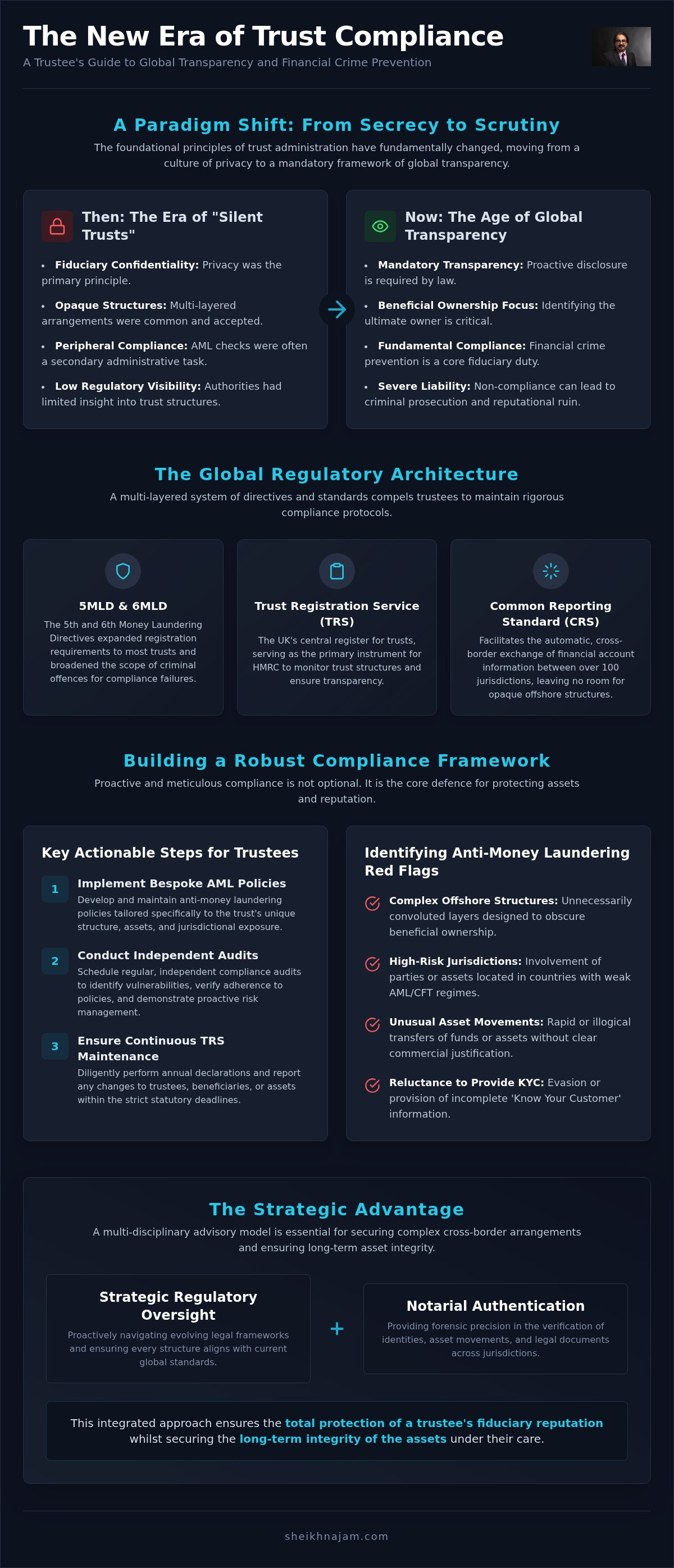
This article provides a comprehensive analysis of the evolving regulatory landscape, offering trustees and high-net-worth individuals the strategic insights required to navigate these complex fiduciary obligations with absolute precision. We shall examine the nuances of current AML frameworks, explore the intersection of notarial authentication with cross-border compliance, and establish a clear roadmap for ongoing monitoring. By aligning your structures with these rigorous standards, you ensure the total protection of your fiduciary reputation whilst securing the long-term integrity of the assets under your care.
Table of Contents
The Evolving Landscape of Financial Crime Compliance for Trusts
The historical veil of fiduciary confidentiality, once the cornerstone of international estate planning, has been systematically dismantled by an uncompromising architecture of global transparency. Regulators now scrutinise trust structures with unprecedented intensity. They view these vehicles as potential conduits for money laundering or terrorist financing amongst shifting geopolitical tides. Consequently, financial crime compliance for trusts has evolved from a discretionary administrative function into a mandatory strategic imperative. The paradigm has changed. Failure to maintain these standards doesn't merely result in financial penalties; it exposes trustees to severe criminal liability and permanent reputational devastation.
The Shift Towards Global Transparency
The implementation of the Fifth and Sixth Money Laundering Directives (5MLD and 6MLD) represents a watershed moment for fiduciaries. These directives have effectively redefined trust administration by enshrining the concept of beneficial ownership as the primary metric for regulatory oversight. Under 5MLD, the requirement for registration became nearly universal, whilst 6MLD expanded the scope of predicate offences. This ensures that even negligent compliance failures can be met with criminal prosecution. This domestic rigour is amplified by the Common Reporting Standard (CRS), which facilitates the automatic exchange of financial information between jurisdictions, leaving no room for the opaque multi-layered structures that once defined the sector.
Defining the Scope of Financial Crime Prevention Advisory
Sophisticated advisory must clearly distinguish between legitimate international tax planning and illicit financial behaviour. While the former remains a valid pursuit for wealth preservation, the latter invites the full weight of regulatory intervention. The role of the Strategic Polymath is to identify these multi-disciplinary risks before they manifest as legal crises. This requires ensuring that every asset movement is authenticated and every beneficiary is vetted with forensic precision. It's about more than just ticking boxes; it's about institutional integrity. Financial Crime Prevention Advisory is a proactive shield for legacy preservation, designed to secure the trust against the encroaching tide of global scrutiny.
Statutory Frameworks and the Trust Registration Service (TRS)
The Trust Registration Service (TRS) has transitioned from a nascent administrative database into the primary instrument of the United Kingdom's transparency architecture. By 2026, the rigour of this regime has matured, necessitating that trustees move beyond a superficial understanding of their filing duties. The distinction between registrable and non-registrable trusts is no longer merely a matter of tax liability; it's a strategic legal categorisation that determines a structure's vulnerability to regulatory intervention. This statutory framework serves as the central nervous system for financial crime compliance for trusts, ensuring that every fiduciary arrangement is visible to the relevant authorities.
Ongoing maintenance remains the most significant hurdle for long-term compliance. While the initial registration provides a snapshot of the trust’s architecture, the requirement for annual declarations and event-driven updates demands constant vigilance. Any change in the composition of beneficiaries, the appointment of a new trustee, or a shift in the underlying asset base triggers a reporting obligation. Failure to update these records within the specified statutory periods is increasingly viewed by HM Revenue and Customs (HMRC) not as a clerical oversight, but as a deliberate attempt to obscure the flow of capital.
Registrable Express Trusts: A Compliance Mandate
Identifying which 'complex' trusts fall under the mandatory registration requirement is a task that demands high-level legal analysis. Most express trusts, regardless of their tax status, now face a registration mandate. The HMRC penalty regime has become increasingly punitive, shifting from modest financial fines to more aggressive enforcement actions that can jeopardise the trust's standing with financial institutions. Trustees must implement a meticulous process for gathering 'Ultimate Beneficial Owner' (UBO) data, ensuring that the identity and tax residency of all parties are documented with forensic accuracy. If you're uncertain about the status of your current arrangements, discussing your specific trust architecture with a specialist advisor is a prudent step toward risk mitigation.
Data Accuracy as a Fiduciary Duty
Inaccurate registration is a significant red flag for regulators, often interpreted as a signal of underlying financial impropriety or an attempt to facilitate money laundering. Professional advisory plays a critical role in ensuring that the data submitted to the TRS is not only complete but also legally robust. This integrity is particularly vital for multi-jurisdictional structures where TRS data may be cross-referenced with international disclosures. By utilizing professional notarial services, trustees can authenticate compliance documentation to a standard that is recognised by foreign registries and institutional counterparts alike. This level of precision reinforces the practitioner’s standing as a diligent fiduciary, protecting the trust from the reputational fallout of unintended compliance breaches.
Mitigating AML Risks in Multi-Jurisdictional Trust Structures
Multi-jurisdictional trust structures, by their inherent complexity, introduce a degree of jurisdictional friction that regulators often interpret as a precursor to illicit activity. In this environment, financial crime compliance for trusts requires a shift from passive oversight to active forensic stewardship. Trustees must be adept at identifying 'red flags' such as sudden, high-value settlements from jurisdictions with weak anti-money laundering frameworks or beneficiary distributions that deviate from established patterns of wealth enjoyment. The challenge of 'Know Your Customer' (KYC) protocols is significantly amplified in multi-layered offshore entities where the interposition of shell companies can obscure the ultimate source of control.
Fiduciaries must recognise that the 'failure to prevent' offences under modern statutory regimes place the evidentiary burden squarely on their shoulders. Maintaining robust Source of Wealth (SoW) and Source of Funds (SoF) documentation isn't merely an administrative preference but a vital legal defence. It requires an exhaustive narrative of how the settlor’s wealth was historically generated, supported by primary documentation that withstands international scrutiny. Without this granular level of detail, the trust remains vulnerable to being categorised as a high-risk vehicle, potentially leading to the freezing of assets or the termination of essential banking relationships.
Cross-Border Compliance and Double Taxation Protocols
Navigating the conflict between divergent jurisdictional compliance standards requires a sophisticated understanding of international fiscal law. The strategic application of double taxation treaties serves as an essential mechanism for ensuring transparency whilst protecting the trust’s fiscal efficiency. By aligning the trust’s operational reality with these treaties, trustees can mitigate the risk of an unintended 'Permanent Establishment' designation. Such a designation often triggers aggressive tax investigations that can spiral into broader financial crime enquiries if the underlying documentation is found wanting.
Digital Assets and Modern Fiduciary Risk
The inclusion of cryptocurrency, NFTs, or other decentralised holdings within a trust introduces unique compliance challenges that traditional frameworks are often ill-equipped to handle. Ensuring the traceability of digital asset transfers is paramount; every 'on-ramp' and 'off-ramp' must be documented with the same rigour as a traditional bank transfer to prevent the co-mingling of verified and unverified funds. Through specialist digital asset structuring, a practitioner can create a clean compliance audit trail that reconciles the pseudonymity of the blockchain with the absolute transparency required by modern fiduciaries. This proactive approach ensures that digital wealth doesn't become an insurmountable liability during future regulatory audits or estate distributions.
Implementing a Robust Financial Crime Prevention Framework
The transition from theoretical adherence to operational excellence requires the deployment of a bespoke architectural framework that transcends generic checklists. Effective financial crime compliance for trusts necessitates a dynamic policy tailored specifically to the unique risk profile of the estate, accounting for asset volatility and jurisdictional exposure. For high-value estates, the implementation of independent compliance audits serves as a critical fail-safe; it provides an objective verification of the trust's resilience against regulatory penetration. Fiduciaries must recognise that their liability is personal and non-delegable. They cannot hide behind corporate veils or third-party administrators when systemic failures occur. Thus, comprehensive oversight and the utilisation of sophisticated screening technology for sanctions and Politically Exposed Persons (PEP) lists are mandatory components of modern governance. These tools provide real-time alerts that allow trustees to react with the necessary speed to shifting global sanctions regimes.
The Trust Risk Assessment Process
A rigorous assessment serves as the foundation of this framework, moving through three distinct phases of enquiry:
Evaluating the nature of assets and geographic footprint: Identifying whether holdings include high-risk classes, such as certain digital assets or property in uncooperative jurisdictions, is the first step in risk stratification.
Assessing the profile of the settlor and beneficiaries: This involves conducting deep-dive due diligence into the source of wealth and any potential political or reputational associations that might trigger enhanced due diligence (EDD) requirements.
Documenting the rationale for high-value transactions: Creating a contemporaneous record that justifies every significant movement of capital ensures that the trust's activities remain consistent with its stated objectives and legal parameters.
Internal Controls and Reporting Obligations
Internal controls must be sufficiently robust to facilitate the immediate filing of a Suspicious Activity Report (SAR) should any transaction fail the 'reasonable grounds' test. Central to this defence is the 'Compliance Register', a meticulously maintained record that serves as a primary shield against regulatory enquiry. It demonstrates a history of active management rather than passive observation. Maintaining a high standard of financial crime compliance for trusts requires that these internal controls are reviewed at least annually to reflect the latest statutory amendments. When internal conflicts arise from compliance failures or divergent interpretations of fiduciary duty, the role of mediation and dispute resolution becomes paramount. These mechanisms allow for the resolution of contentious issues without inviting the destructive scrutiny of public litigation. To ensure your framework is both legally sound and strategically resilient, you should consult with a specialist advisor to review your current internal controls.
The Sheikh Najam Approach: Strategic Fiduciary Compliance
The Sheikh Najam methodology transcends the siloed nature of traditional legal practice by integrating legal, financial, and notarial expertise into a singular, cohesive strategy. This multi-disciplinary command is essential for navigating the labyrinthine requirements of financial crime compliance for trusts, where a failure in one domain, such as notarial authentication, can compromise the integrity of an entire international structure. By adopting the role of the Strategic Polymath, the practice ensures that every regulatory hurdle is anticipated and neutralised before it becomes a threat to the estate. This proactive advisory serves a dual purpose; it secures the trust against external regulatory penetration whilst simultaneously preventing the conditions that lead to contentious probate litigation. A trust that's built upon a foundation of absolute compliance is inherently more resilient to internal challenges from beneficiaries or external claims from third parties. Compliance, in this context, is the ultimate form of asset protection.
Bespoke Regulatory Advisory for HNWIs
For international families, the intersection of tax efficiency and financial crime prevention is where the most significant risks reside. A bespoke framework must account for the unique geographic footprint of the family's assets, ensuring that jurisdictional variations don't create gaps in the compliance record. Meticulous governance is the only way to ensure long-term stability amongst shifting global standards. It's about securing the legacy through precision rather than mere adherence. Every policy we develop is a reflection of the settlor's specific intent, hardened against the scrutiny of modern financial intelligence units.
Next Steps: Securing Your Trust's Future
In the current regulatory climate, an immediate compliance review isn't merely advisable; it's a fundamental requirement for the responsible trustee. The use of professional notarial authentication for cross-border compliance documents provides an additional layer of institutional weight that's recognised by global registries and financial institutions alike. To ensure your structures are fully aligned with the latest standards, you're invited to consult with Sheikh Najam TEP for a confidential assessment. Securing your trust's future begins with a forensic analysis of its current standing, ensuring that your legacy remains unassailable for generations to come.
Securing Fiduciary Integrity in an Era of Transparency
The transition from traditional fiduciary secrecy to a regime of absolute transparency represents the most significant shift in estate administration in recent history. We've explored how the 2026 Trust Registration Service requirements and the forensic demands of multi-jurisdictional AML protocols have elevated the role of the trustee to that of a strategic compliance officer. Maintaining financial crime compliance for trusts is no longer a peripheral obligation; it's the primary mechanism for safeguarding a family's global standing and wealth.
By integrating the expertise of a TEP designated practitioner with specialist Financial Crime and Compliance Advisory and the authoritative weight of Notarial Services appointed by the Court of Faculties, you ensure your structures remain unassailable. This precision doesn't just mitigate risk; it builds a foundation of institutional trust. You're invited to secure your fiduciary legacy with a strategic compliance review by Sheikh Najam TEP. With the right multi-disciplinary command, you can face the evolving regulatory landscape with absolute confidence and strategic foresight.
Frequently Asked Questions
What are the primary financial crime risks associated with family trusts?
The primary risks involve the exploitation of fiduciary structures for money laundering, terrorist financing, and the concealment of illicitly obtained capital. Regulators specifically scrutinise trusts for potential 'layering' schemes, where multiple jurisdictions and complex ownership tiers are used to obscure the ultimate source of funds. These risks are amplified when assets move between high-risk regions or when beneficiary distributions lack a clear, documented rationale within the trust's established purpose.
Does every UK trust need to register with the HMRC Trust Registration Service (TRS)?
Most express trusts, including non-taxable ones, are now subject to mandatory registration with the HMRC Trust Registration Service (TRS). While certain exclusions exist for charitable trusts or those created by specific legislation, the vast majority of private family arrangements must comply. Failure to register within the statutory timeframes or to update the register following an 'event-driven' change can lead to significant financial penalties and increased regulatory scrutiny of the trust's broader compliance framework.
How often should a trustee conduct a financial crime risk assessment?
Trustees should conduct a formal financial crime risk assessment at least annually to ensure the structure remains resilient against evolving regulatory standards. This periodic review must be supplemented by 'event-driven' assessments whenever a significant change occurs, such as the appointment of a new beneficiary, the introduction of high-value assets, or a shift in the trust's geographic footprint. This proactive approach ensures that financial crime compliance for trusts is maintained as a dynamic, rather than static, administrative function.
What is the difference between tax avoidance and financial crime in trust management?
Tax avoidance involves the strategic use of legitimate legal frameworks to mitigate fiscal liability, whereas financial crime encompasses illegal acts such as tax evasion, money laundering, and fraud. The distinction lies in the legality of the underlying methodology and the transparency of disclosure. While fiduciaries may pursue tax efficiency through inheritance tax planning, they must ensure that such arrangements don't inadvertently mirror the characteristics of illicit financial behaviour, which could trigger a criminal investigation.
Can a trustee be held personally liable for a trust's compliance failure?
A trustee carries personal, non-delegable responsibility for the trust’s adherence to all relevant statutory obligations. Should a compliance failure occur, particularly one involving gross negligence or a deliberate breach of anti-money laundering regulations, the trustee can be held personally liable for financial penalties and, in severe cases, criminal prosecution. This personal exposure underscores the necessity of engaging specialist advisory to ensure that all internal controls are robust and that every fiduciary action is meticulously documented.
How do international sanctions affect the administration of cross-border trusts?
International sanctions regimes impose immediate legal restrictions on the administration of assets associated with designated individuals or entities. For cross-border trusts, this requires rigorous, ongoing screening of all settlors, beneficiaries, and protectors against global sanctions lists. Any nexus to a sanctioned jurisdiction can result in the freezing of trust assets and the termination of banking relationships. Trustees must act with absolute precision to ensure they don't inadvertently facilitate transactions that violate these complex geopolitical mandates.
What documentation is required to prove the 'Source of Wealth' for a trust?
Proving the 'Source of Wealth' (SoW) requires a comprehensive narrative supported by primary evidentiary documentation that traces the historical accumulation of the settlor’s total net worth. This includes audited financial statements, property sale contracts, inheritance documentation, or records of significant investment gains. Trustees must ensure this data is not only current but also authenticated to a standard that satisfies both domestic regulators and international financial institutions during the rigorous 'Know Your Customer' onboarding process.
How does digital asset structuring impact financial crime compliance?
Digital asset structuring introduces unique complexities regarding the traceability and valuation of decentralised holdings such as cryptocurrency. To maintain financial crime compliance for trusts, fiduciaries must reconcile the pseudonymity of blockchain transactions with the absolute transparency required by anti-money laundering frameworks. This involves documenting the provenance of the digital wealth and ensuring that all transfers into the trust are verified through rigorous audit trails. Such precision prevents the co-mingling of assets and secures the trust's long-term standing.


Comments