Notarising a Power of Attorney: A Strategic Framework for International Authentication

The assumption that a standard domestic Lasting Power of Attorney possesses the inherent legal efficacy to manage assets in a foreign jurisdiction is a precarious misconception that frequently precipitates catastrophic administrative failure. Consequently, the process of notarising a power of attorney for use abroad requires far more than a perfunctory signature; it demands a sophisticated understanding of the Hague Apostille Convention and the specific evidentiary requirements of the destination state. You're likely aware that the slightest discrepancy in documentation can lead to immediate rejection by foreign land registries or financial institutions, causing significant delays in high-value transactions.
By adopting a strategic framework for authentication, you'll gain absolute certainty that your legal mandates will be recognised across borders, integrating seamlessly with your broader estate planning and wealth preservation objectives. This analysis explores the critical distinctions between domestic and international instruments, the precise mechanics of the FCDO legalisation chain, and the nuanced protocols required to ensure your authority remains unimpeachable in any global jurisdiction. We'll also examine the implications of the Powers of Attorney Act 2023 and the transition towards digital identity verification within this elite legal landscape.
Table of Contents
The Strategic Distinction Between Domestic and International Powers of Attorney
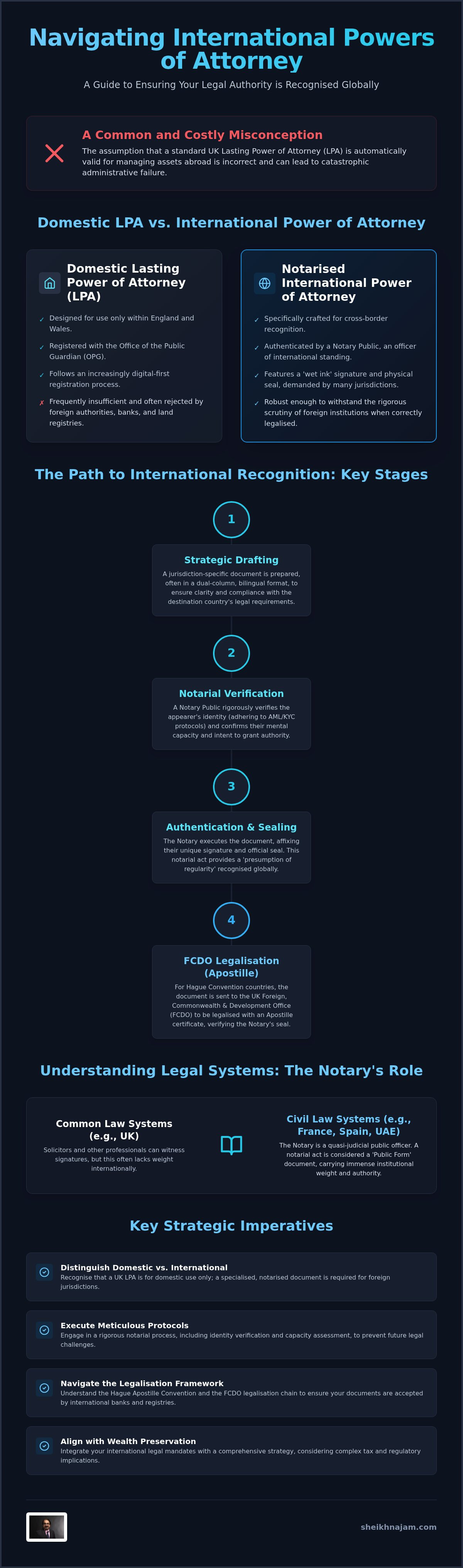
The legal efficacy of a Power of Attorney is fundamentally tethered to the specific sovereign jurisdiction in which it is intended to operate. Whilst a Lasting Power of Attorney (LPA) serves as the primary domestic instrument for delegating authority within the borders of England and Wales, its utility diminishes significantly upon crossing those borders. For individuals managing sophisticated global interests, notarising a power of attorney is not merely an administrative preference; it's a mandatory legal protocol required for cross-border recognition. A Notary Public operates as a public officer of international standing, wielding a seal and signature recognised by global treaties and foreign consulates in a manner that domestic solicitors simply cannot replicate. This is a critical distinction for the globally mobile client who requires their mandates to carry weight across multiple legal systems.
High-value international transactions, such as the disposal of foreign real estate or the execution of complex corporate resolutions, mandate a tier of verification that transcends the perfunctory witnessing of a signature. Formal authentication involves a comprehensive, multi-disciplinary review of the appearer’s capacity, identity, and specific intent. This ensures the resulting legal instrument is sufficiently robust to withstand the rigorous scrutiny of foreign land registries and institutional compliance departments. Without this level of notarial intervention, documents are frequently rejected, leading to costly delays and the potential collapse of time-sensitive negotiations involving cross-border assets.
Common Law vs. Civil Law Jurisdictions
In numerous civil law jurisdictions, including France, Spain, and the UAE, the Notary is viewed as a quasi-judicial figure of immense institutional weight. These legal systems frequently mandate that significant legal acts be executed in 'Public Form,' a standard that domestic UK registrations do not satisfy. The notarial act provides a 'presumption of regularity,' effectively bridging the divide between disparate legal traditions. It offers a level of structural certainty that is indispensable for the protection of high-value assets and the seamless transition of authority across borders, providing an authoritative seal of approval that is respected by foreign judiciaries.
The Limitations of the Domestic Lasting Power of Attorney
The registration process facilitated by the Office of the Public Guardian (OPG), whilst essential for domestic affairs, is frequently insufficient for the requirements of foreign authorities. Many international registries specifically demand 'wet ink' notarial seals and physical signatures on original parchment, contrasting with the increasingly digital-first approach of UK domestic registrations. Strategically, it's prudent to draft a jurisdiction-specific Power of Attorney in parallel with a domestic LPA. This dual-layered approach ensures that global asset management remains uninterrupted by the procedural idiosyncrasies of local banks or government departments. For those seeking to integrate these instruments into a broader wealth strategy, exploring specialist areas of international advisory is essential.
The Rigorous Process of Notarial Authentication and Verification
The protocol for notarising a power of attorney constitutes a rigorous exercise in legal due diligence that extends far beyond the mere witnessing of a signature. At its inception, the process demands the meticulous verification of the appearer’s identity, adhering to stringent Anti-Money Laundering (AML) and Know Your Customer (KYC) protocols that reflect the elite standards of preeminent legal practice. This preliminary stage is fundamental in mitigating the risks associated with financial crime and ensuring that the instrument remains unimpeachable during international scrutiny. Precise identification is the cornerstone upon which all subsequent legal authority is constructed, providing the necessary assurance to foreign institutions that the document is legitimate.
Central to this evidentiary framework is the verification of mental capacity. For high-net-worth individuals, this assessment serves as a critical safeguard, preempting future challenges to the validity of the power of attorney that could arise in contentious probate or trust disputes. The Notary Public must be satisfied that the donor acts of their own free will, entirely absent of undue influence amongst the parties involved, a requirement that carries profound weight when dealing with vulnerable or elderly donors. It's the practitioner’s solemn duty to ensure the donor fully comprehends the specific scope and the long-term legal implications of the authority being granted, thereby preserving the integrity of the donor’s global estate against potential exploitation.
Verifying Corporate and Representative Authority
In the context of complex commercial structures, the Notary’s remit expands to include the verification of corporate authority. This entails a forensic examination of constitutional documents and the specific board resolutions authorising the signatory to act on behalf of the legal entity. Often, the Notary is required to certify that a company remains in 'Good Standing' within its home jurisdiction, a process that is intrinsically linked to the strategic role of a notary public for company documents. Such precision ensures that corporate resolutions are recognised as valid by foreign counterparties and regulatory bodies alike, facilitating seamless international commerce.
The Notarial Certificate: A Formal Act of State
The culmination of this process is the drafting of the notarial certificate, which must be precisely tailored to meet the linguistic and formal requirements of the receiving state, often under the framework of the Hague Apostille Convention. The Notary's personal seal and signature serve as an internationally recognised mark of truth, transforming a private document into a 'Public Instrument.' In 2026, a Public Instrument is defined as a document that carries its own proof of authenticity and is accepted as evidence of the facts it contains without further proof. The necessity of notarising a power of attorney with such meticulousness reflects the modern transition towards heightened global transparency. For those requiring a bespoke consultation on complex cross-border mandates, this approach provides the structural security required for global asset management.
Navigating the Legalisation and Apostille Framework
The act of notarising a power of attorney constitutes the foundational layer of a more comprehensive evidentiary chain, frequently necessitating subsequent legalisation to achieve full operational validity within a foreign legal order. This multi-staged process ensures that the document’s authenticity is verifiable not only by the individual notary but also by the sovereign state that commissioned them. In the United Kingdom, this verification is facilitated by the Foreign, Commonwealth & Development Office (FCDO), which maintains a definitive register of notarial signatures and seals to prevent the circulation of fraudulent legal instruments across international borders.
The Hague Convention of 5 October 1961 Abolishing the Requirement of Legalisation for Foreign Public Documents introduced a streamlined mechanism for international document exchange amongst over 120 member states. This protocol replaces the arduous chain of embassy attestations with a single certificate known as an Apostille. In 2026, the FCDO continues to offer both traditional paper apostilles at a fee of £45 and e-Apostilles for £35, providing a digital-first solution for jurisdictions that have modernised their administrative infrastructure. This framework serves as a vital bridge, allowing a power of attorney executed within a domestic practice to be recognised with absolute certainty in disparate jurisdictions from the European Union to South America.
The Apostille Protocol
An Apostille serves a specific, narrow function: it certifies the authenticity of the Notary’s signature, the capacity in which they acted, and the identity of the seal affixed to the document. It doesn't, however, validate the underlying content of the power of attorney itself, which remains the responsibility of the drafting practitioner. For those navigating the Legalisation of Documents for International Use, strategic timing is essential. Obtaining the Apostille promptly following the act of notarising a power of attorney is critical, as certain foreign land registries and financial institutions impose strict expiry windows on the validity of the legalisation certificate, sometimes as short as ninety days.
Consular and Embassy Attestation
For jurisdictions that are not party to the Hague Convention, such as China, Vietnam, or Qatar, the authentication process remains significantly more complex, requiring a multi-layered approach to validation. This often involves a sequential chain of authorities: the Notary Public, followed by the FCDO, the relevant Chamber of Commerce where commercial interests are involved, and ultimately the consular section of the destination state’s embassy. Each embassy maintains bespoke requirements regarding document formatting and translation. Mitigating the risk of rejection in these high-stakes environments demands proactive pre-verification with foreign counsel to ensure that the instrument complies with the specific civil codes and administrative expectations of the terminal jurisdiction.
Strategic Preparation for Multi-Jurisdictional Validity
The legal efficacy of notarising a power of attorney is fundamentally contingent upon the precision with which the instrument is tailored to the specific statutory requirements of the terminal jurisdiction. It is a precarious assumption to believe that a document drafted according to English common law principles will be readily accepted within a civil law framework without significant structural modification. To mitigate the risk of administrative rejection, the adoption of bilingual or dual-column formats is often imperative. This approach ensures that both the certifying Notary and the foreign official, whether a land registrar in Spain or a bank manager in the UAE, possess a clear and unambiguous understanding of the authority being delegated, thereby facilitating a seamless transfer of legal power.
Strategic foresight must also be applied to the 'Duration of Power.' Whilst English law allows for enduring authority through specific registration, many foreign jurisdictions impose strict expiry dates on notarised instruments, occasionally as brief as six months from the date of execution. Coordination with foreign legal counsel is therefore essential to ensure that the 'Powers' granted remain enforceable under local property or banking laws, preventing the collapse of high-value transactions due to procedural expiration. This meticulous alignment between jurisdictions is the hallmark of a sophisticated cross-border legal strategy.
Drafting Considerations for HNWIs
For high-net-worth individuals, the complexity of modern wealth management requires the incorporation of specific clauses for the administration of digital assets or international trust interests. It is vital that any such instrument aligns seamlessly with the donor’s International Wills to avoid potentially catastrophic testamentary conflicts. Practitioners must also distinguish between 'General' powers, which grant broad administrative discretion, and 'Special' powers, which are restricted to specific acts such as the disposal of a particular asset. In international commerce, the latter is often preferred by foreign registries for its specificity and reduced risk profile.
A Checklist for the Notarial Appointment
The notarial appointment represents the critical point of execution, demanding the presence of original documentation to satisfy rigorous verification standards. Appearers must provide valid passports and recent proof of address, alongside original title deeds where property transactions are contemplated. For corporate entities, the Notary must review the Articles of Association and the Minutes of Meetings that formally record the resolution to grant power. If the donor is not entirely fluent in the language of the document, the presence of a qualified interpreter is a mandatory safeguard to ensure informed consent. To ensure your documentation meets these exacting standards, you may contact our chambers for a comprehensive review of your international mandate.
The Sheikh Najam Approach: Multi-Disciplinary Notarial Advisory
The practice of Sheikh Najam TEP transcends the conventional boundaries of administrative document certification, offering instead a sophisticated integration of notarial authentication with elite international tax and estate planning. Whilst many practitioners treat the act of notarising a power of attorney as a standalone clerical task, it's fundamentally the nexus where private wealth management meets sovereign legal recognition. This multi-disciplinary perspective ensures that every instrument isn't only valid in form but also strategically aligned with the donor’s global financial interests. It's a level of oversight that provides the command and control necessary for managing high-value assets across disparate legal systems.
One of the primary advantages of this integrated approach is the proactive assessment of the tax implications inherent in granting authority over global assets. The delegation of power can, in certain jurisdictions, inadvertently trigger tax residency issues or reporting requirements that a standard notary wouldn't identify. By operating at the intersection of trust law, financial crime compliance, and notarial practice, Sheikh Najam provides a robust framework for strategic dispute prevention. This meticulousness ensures that powers of attorney are sufficiently resilient to withstand challenges in complex contentious probate scenarios, where the validity of an agent's actions often becomes the focal point of high-stakes estate litigation.
Integrated Private Wealth Strategy
Within this elite framework, notarising a power of attorney is positioned as a vital component of a comprehensive inheritance tax mitigation plan. The "Strategic Polymath" approach allows for the navigation of multi-jurisdictional regulatory landscapes whilst maintaining the highest standards of global compliance and reporting. This ensures that the delegation of power doesn't compromise the structural integrity of a client’s international trust interests or digital asset holdings. It's a methodical process that prioritises stability and long-term security over administrative convenience.
Securing Your International Affairs
The brand projects an image of institutional weight, providing the gravitas and academic rigour required for City-level legal authentication. Every notarial act is treated with a commitment to precision and tradition, ensuring that the resulting public instrument carries the necessary authority to be accepted by the world’s most stringent financial and regulatory bodies. This sharp, strategically focused advisory is designed to reassure a sophisticated audience that their most complex affairs are being handled with absolute multi-disciplinary expertise. To ensure your global mandates are executed with this level of precision, you may Consult with Sheikh Najam TEP for bespoke notarial and estate advisory.
Strategic Command Over Your Global Legal Mandates
The successful management of international assets requires an authentication framework that transcends the perfunctory. The process of notarising a power of attorney constitutes the critical mechanism for bridging disparate legal systems, ensuring your authority remains unimpeachable within both common law and civil law jurisdictions. By integrating notarial acts with sophisticated international tax and trust planning, you secure your estate against the risks of administrative rejection and future litigation. This multi-disciplinary approach transforms a standard document into a robust public instrument of immense institutional weight.
Precision in cross-border affairs is not merely a preference; it's a prerequisite for the preservation of high-value wealth. Sheikh Najam TEP, a practitioner appointed by the Court of Faculties and a specialist in International Tax and Contentious Probate, provides the authoritative oversight required for these complex mandates. You're invited to secure your global interests by booking a specialist consultation with Sheikh Najam TEP to ensure your international affairs are handled with absolute rigour. Establishing this level of structural security today ensures your global legacy remains protected and operational for years to come.
Frequently Asked Questions
Can a standard UK solicitor notarise a Power of Attorney for use abroad?
A standard solicitor generally lacks the specific commission and seal required for international notarial acts. Only a Notary Public, appointed by the Court of Faculties, possesses the authority to create public instruments recognised globally. Whilst some solicitors also hold notarial commissions, the functions remain distinct. For international mandates, the notarial seal is the essential evidentiary requirement demanded by foreign land registries and financial institutions to confirm the document's validity and legal efficacy.
What is the difference between an Apostille and notarisation?
Notarisation is the primary act of authentication performed by a Notary Public, who verifies the identity, capacity, and specific intent of the signatory. Conversely, an Apostille is a certificate issued by the Foreign, Commonwealth & Development Office (FCDO) that verifies the Notary's own signature and seal. It is a secondary layer of authentication required under the Hague Convention to ensure the document is legally valid for use within member states, simplifying international document exchange significantly.
How long does it take to notarise and legalise a Power of Attorney in 2026?
The timeframe is contingent upon the required level of legalisation. The initial act of notarising a power of attorney typically occurs during a single scheduled appointment. However, subsequent legalisation by the FCDO currently takes approximately 2-3 working days for an e-Apostille, whilst paper apostilles may take longer depending on postal services. Consular legalisation for non-Hague states can extend this process by several weeks due to the bespoke administrative protocols of individual embassies.
Do I need to be present in person for the notarial appointment?
Physical presence is generally mandatory to satisfy the Notary's rigorous identity and capacity verification protocols. Whilst the Powers of Attorney Act 2023 introduced digital-first systems for domestic instruments, international notarial practice usually requires 'wet ink' signatures witnessed in person. This ensures the absence of undue influence and confirms the donor’s full comprehension of the instrument's implications. Some jurisdictions may permit remote notarisation, but this remains subject to the strict acceptance criteria of the terminal state.
Will a notarised Power of Attorney expire?
Under English law, a power of attorney remains valid until it's revoked or the donor loses capacity, unless it's an enduring or lasting instrument. However, foreign jurisdictions often impose their own temporal restrictions. Many overseas land registries and banks refuse to accept notarised documents that are older than six months. It's therefore essential to coordinate with foreign counsel to ensure the instrument's validity period aligns with the specific timelines of the intended high-value transaction.
Can a Notary Public verify my mental capacity to sign a document?
Assessing mental capacity is a fundamental duty of the Notary Public. This assessment is conducted during the meeting to ensure the donor understands the nature and legal effect of the document they're signing. For high-net-worth individuals, this verification provides a robust defence against future allegations of incapacity or undue influence. In complex cases, the Notary may require a formal medical report to supplement their own professional observations and ensure absolute legal certainty.
What is consular legalisation and when is it required?
Consular legalisation is a multi-layered authentication process required for countries that aren't signatories to the Hague Apostille Convention. This procedure involves the document being sent first to the FCDO and then to the relevant foreign embassy or consulate for further attestation. It's a more traditional and time-consuming chain of verification necessitated by the civil codes of states such as China, Qatar, or Vietnam to confirm the document’s legitimacy before it can be accepted.
Can I notarise a Power of Attorney that is written in a foreign language?
A Notary can authenticate documents in foreign languages, provided they're satisfied with the donor’s understanding of the content. This often involves using a dual-column or bilingual format to ensure clarity for all parties involved. If the donor isn't fluent in the document's language, a qualified interpreter must be present. notarising a power of attorney in this manner ensures the instrument remains effective in the target country whilst simultaneously meeting the necessary UK evidentiary standards.


Comments