Statutory Residence and Domicile Rules in the UK: A Strategic Overview (2026)
- S Najam
- 4 hours ago
- 12 min read

The fundamental dissolution of the centuries-old non-domiciled regime marks a definitive epoch in British tax history, necessitating a total recalibration of how high-net-worth individuals approach their global estates. You likely recognise that the current residence and domicile rules have transcended mere administrative procedure to become a high-stakes exercise in multi-jurisdictional risk management. The apprehension surrounding the Statutory Residence Test is entirely justified, particularly as the threshold for worldwide inheritance tax exposure now rests upon a ten-year residency look-back period.
This strategic overview promises a meticulous deconstruction of these legislative shifts, offering the precise clarity required to mitigate double taxation and preserve wealth across borders with absolute rigour. We'll examine the transition to the four-year Foreign Income and Gains regime, the nuances of the Temporary Repatriation Facility, and the implications of the frozen inheritance tax nil-rate bands through 2031, providing the authoritative command necessary to navigate this new fiscal reality. By aligning multi-disciplinary legal expertise with these updated regulatory requirements, you can ensure that your global presence remains a source of security rather than a liability.
Table of Contents
Distinguishing Residence from Domicile in UK Jurisprudence
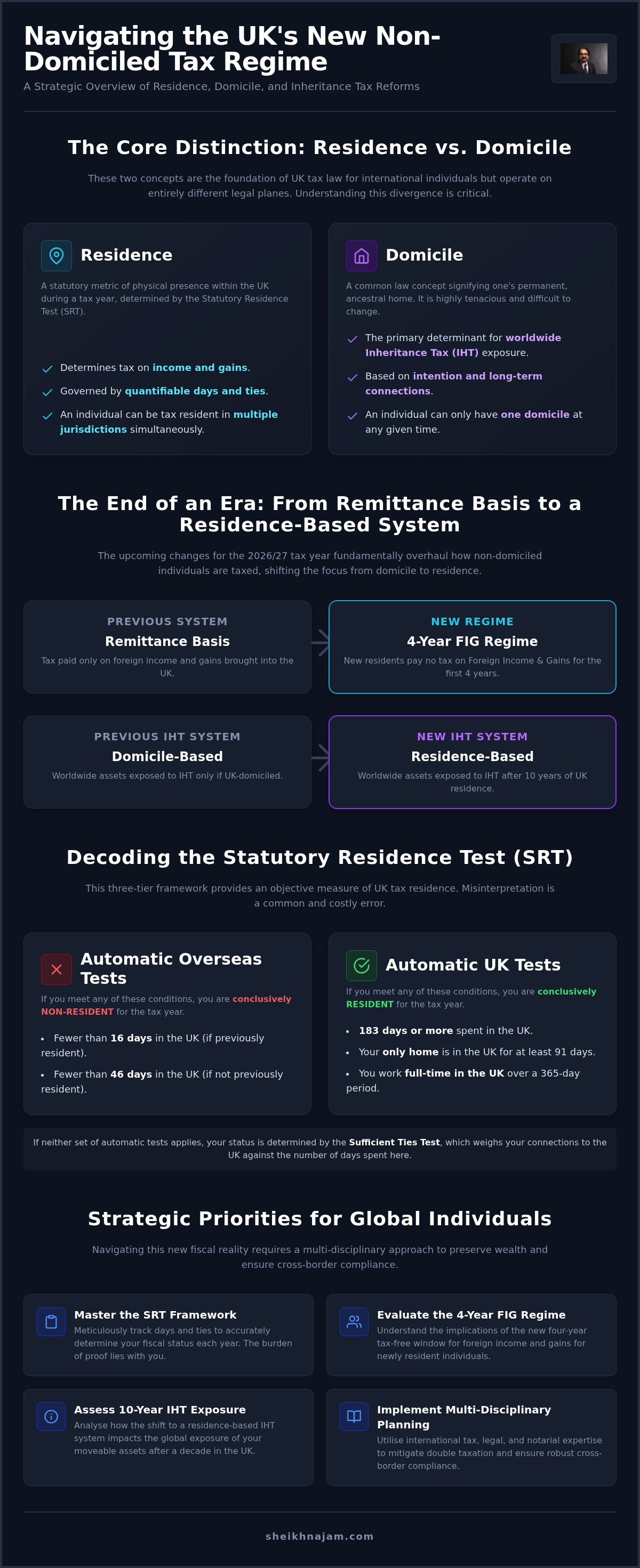
In the sophisticated architecture of UK tax law, the distinction between residence and domicile represents the most critical divergence for the globally mobile individual. While the residence and domicile rules are often conflated in colloquial discourse, they operate on entirely different legal planes. Residence is a statutory construct, primarily governed by physical presence and quantifiable ties within a specific tax year. Conversely, the legal concept of domicile is a creature of common law, signifying an individual’s ultimate, permanent ancestral home. It’s entirely possible to maintain tax residency in multiple jurisdictions simultaneously, yet the law dictates that a person may possess only one domicile at any given time. This distinction is not merely academic; it carries profound fiscal weight. Residence typically determines the immediate taxation of income and gains, whereas domicile remains the primary determinant for worldwide inheritance tax exposure.
The Legal Nature of Domicile of Origin
Every individual acquires a domicile of origin at birth, typically derived from the father if the parents are married, or the mother if they aren't. This status is remarkably tenacious and difficult to shed. UK courts have historically set an exceptionally high bar for displacing a domicile of origin, often viewing it as a "clinging" legal shadow that remains even during decades of international residence. If an individual abandons a domicile of choice without immediately acquiring a new one, the domicile of origin automatically revives. This inherent tenacity ensures that the UK often maintains a long-term interest in an individual’s global estate, regardless of how many years they've spent abroad, unless a total and permanent severance is legally established.
Acquiring a Domicile of Choice
Transitioning to a domicile of choice requires a rigorous two-fold demonstration: actual physical presence in a new jurisdiction (factum) coupled with a clear, unequivocal intention to reside there permanently or indefinitely (animus manendi). Proving this shift involves a significant evidentiary burden, as the individual must demonstrate they've severed all meaningful ties to their previous home and established a new "centre of gravity" elsewhere. In this context, formal notarial declarations and the meticulous documentation of one’s personal, social, and economic life are indispensable. Such evidence serves to authenticate the subjective intent, providing a robust defence against potential challenges from HMRC regarding one's fiscal status. Without such meticulous records, the Revenue is likely to argue that the individual remains UK-domiciled, bringing their entire worldwide asset portfolio into the scope of the 40% inheritance tax charge.
The Statutory Residence Test (SRT): Deciphering the Framework
The Statutory Residence Test (SRT) serves as the definitive legislative mechanism for determining an individual's fiscal presence in the United Kingdom. Introduced to provide objective certainty, it replaces the historical reliance on subjective judicial precedents with a structured, three-tier inquiry. For high-net-worth individuals, mastering the nuances of the residence and domicile rules is paramount, as misinterpretation often leads to unintended tax liabilities. A common misconception persists that the 183-day rule is the sole metric of residency; however, the SRT’s complexity means one can be deemed a resident with significantly fewer days if specific ties or conditions are met. Meticulous record-keeping is therefore the bedrock of any robust tax strategy, as the burden of proof regarding physical presence remains firmly with the taxpayer.
The Automatic Overseas and UK Tests
The inquiry commences with the Automatic Overseas Tests. An individual is conclusively non-resident if they spend fewer than 16 days in the UK, provided they were resident in one of the three preceding tax years, or fewer than 46 days if they were non-resident throughout that same period. Conversely, the Automatic UK Tests trigger residency if an individual spends 183 days or more in the country, or if their "only home" is in the UK for a period of at least 91 days. Working full-time in the UK over a 365-day period also establishes automatic residency. These bright-line rules demand rigorous day-counting, as even a single day’s discrepancy can shift one’s entire fiscal profile and expose global income to the UK's progressive tax rates.
The Sufficient Ties Test: A Strategic Analysis
Where automatic tests prove inconclusive, the Sufficient Ties Test provides a secondary layer of scrutiny, evaluating five distinct connections: family, accommodation, work, the 90-day tie, and the country tie. The number of ties required to establish residency is inversely proportional to the number of days spent in the UK; the more time one spends onshore, the fewer ties are needed to trigger a residency status. We define the "tie" concept as a sophisticated measure of an individual's social and economic integration into British society. Given the changes to the taxation of non-domiciled individuals effective from April 2025, the interaction between these ties and the new residence-based regime requires meticulous oversight. Maintaining a detailed log of flights, work diaries, and lease agreements isn't merely good practice; it’s a vital component of a compliant wealth preservation strategy. For those managing complex cross-border interests, seeking specialist fiscal counsel ensures that every day spent in the UK is strategically accounted for within the broader estate plan.
The Enduring Significance of Domicile in International Estate Planning
In the refined discipline of cross-border wealth management, domicile remains the pivot upon which succession law, or lex domicilii, turns for moveable property. Whilst the residence and domicile rules have undergone substantial transformation, your domicile continues to dictate which jurisdiction’s probate laws govern your global cash, securities, and personalty. For those whom the law deems UK-domiciled, HMRC asserts a claim over the estate on a "worldwide basis," applying a 40% inheritance tax charge to all global assets. Conversely, individuals domiciled outside the UK may still benefit from the protection of "excluded property," which shields non-UK assets from this domestic fiscal net. Managing these intricate, multi-jurisdictional interests effectively requires the strategic implementation of international wills to ensure that testamentary intentions are enforceable across divergent legal systems.
Deemed Domicile and the Residency Threshold
The statutory concept of "deemed domicile" has historically functioned as a mechanism to bring long-term residents into the UK inheritance tax net once they've been resident for 15 out of the previous 20 tax years. However, as of 2026, this landscape has fundamentally shifted towards a stricter residence-based model where worldwide IHT exposure is triggered after only 10 years of UK residency. This evolution in the fiscal framework means the strategic window for wealth restructuring has narrowed considerably. It's imperative for globally mobile individuals to evaluate their status well before hitting this tenth-year anniversary, as failing to do so can result in the unintended permanent capture of a global asset portfolio within the UK’s tax jurisdiction.
Domicile and Trust Governance
The settlor’s domicile at the precise moment of a trust’s inception remains a cornerstone of its long-term tax profile and legal resilience. Historically, "Excluded Property Trusts" allowed non-domiciled individuals to settle non-UK assets into a structure that remained outside the scope of UK IHT, even if the settlor subsequently acquired a UK residency status. Maintaining the integrity of such structures in the current climate requires rigorous adherence to financial crime compliance for trusts, particularly regarding transparency and evolving reporting standards. Precision in documenting the settlor's domicile of origin and any subsequent domicile of choice is vital to ensuring the trust’s enduring fiscal integrity against potential HMRC challenges.
Navigating the Evolving Landscape for Non-Domiciled Individuals
The definitive abolition of the remittance basis on 6 April 2025 represents the most significant paradigm shift in British fiscal policy for over two centuries. This transition from a domicile-based system to a strictly residence-based regime requires a total recalibration of how globally mobile individuals manage their international wealth. Under the current residence and domicile rules, the long-standing concept of "non-dom" status has been superseded by a framework that prioritises the duration of UK residency over ancestral ties. Whilst some critics suggested this would trigger a mass exodus of capital, the UK remains an unparalleled global hub due to its institutional stability, the sophisticated national legal infrastructure, and the presence of world-class professional services. For the discerning investor, the challenge isn't the presence of tax, but the management of complexity through precise, multi-disciplinary planning.
The Four-Year FIG Regime: A Strategic Window
New arrivals to the UK can now avail themselves of the Foreign Income and Gains (FIG) regime, which provides a comprehensive 100% tax relief on foreign income and gains for their first four years of residency. To qualify for this elite status, an individual must have been a non-UK resident for at least 10 consecutive tax years prior to their arrival. It's crucial to understand that this relief isn't applied automatically; it requires a formal professional election to be made for each tax year in which the individual wishes to claim the benefit. This four-year window offers a vital period for wealth restructuring, allowing individuals to bring capital into the UK without the historic complications of "segregation of funds" or unintended remittance charges that plagued the previous system.
Succession Planning in a Post-Remittance Era
The implications for inheritance tax (IHT) are equally profound, as the system has moved toward a residence-based model where worldwide assets fall within the UK net after 10 years of residency. Perhaps more significantly, the law now imposes a 10-year "tail" on IHT exposure, meaning an individual remains subject to UK inheritance tax on their global estate for a full decade after they've ceased to be a UK resident. This extended period of fiscal exposure necessitates the use of sophisticated international structures to maintain capital efficiency. For many, this involves using a Dutch holding company for UK residents to manage cross-border asset portfolios whilst ensuring compliance with both domestic and international regulations. Given the intricacies of these 2026 updates, securing expert international tax planning is the only certain way to protect your legacy from unnecessary erosion.
Strategic Fiscal Governance for Globally Mobile Private Clients
The governance of a multi-jurisdictional estate demands a robust, multi-disciplinary framework that transcends mere compliance, integrating sophisticated tax planning with the rigorous evidentiary standards of notarial law. Within this high-stakes environment, the residence and domicile rules function not as isolated statutes but as the foundation of a broader international strategy. Optimising global efficiency requires the meticulous application of double taxation treaties, which serve to prevent the duplication of fiscal burdens across divergent jurisdictions. A critical, yet frequently neglected, component of modern fiscal governance is the integration of digital asset structuring within the settlor's broader residence framework. Given the decentralised nature of such holdings, their legal situs for succession purposes often defaults to the owner’s domicile, necessitating precise testamentary coordination to avoid jurisdictional conflicts. Proactive, annual status reviews are essential to preempt potential HMRC challenges, ensuring that every claim regarding one’s fiscal presence is supported by a contemporaneous audit trail of physical presence and intent.
The Role of Notarial Services in Status Verification
A Notary Public, appointed by the Court of Faculties, provides the essential layer of international authentication required to validate declarations of domicile before foreign judicial and tax authorities. In the context of cross-border probate disputes, a notarial certificate serves as a primary evidentiary instrument, confirming the legal validity of an individual’s status and the governing succession law applicable to their moveable property. This level of authentication is particularly vital when displacing a domicile of origin or asserting the protections of an international treaty. For high-value individuals requiring a definitive assessment of their fiscal standing, booking a specialist consultation ensures that the evidentiary burden is met with absolute precision, shielding the estate from future litigation or regulatory scrutiny.
Mitigating Financial Crime and Compliance Risks
The determination of residence and domicile status carries profound implications for Anti-Money Laundering (AML) and Know Your Customer (KYC) reporting obligations across the global financial system. Financial institutions increasingly scrutinise the fiscal "centre of gravity" of high-net-worth clients to ensure alignment with UK regulatory standards and international transparency protocols. Failure to maintain a clear, documented status can lead to significant friction in capital mobility and heightened exposure to compliance audits. The Strategic Polymath, acting as a Master Advisor, provides the requisite command and control over these complex affairs, harmonising global asset portfolios with the national regulatory landscape. This methodical approach ensures that wealth preservation is achieved through a synthesis of academic rigor and strategic foresight, providing a sense of enduring security for the most complex international estates.
Securing Your Fiscal Legacy in a Residence-Based Era
The fundamental shift in the United Kingdom’s fiscal landscape necessitates a definitive transition from reactive compliance to proactive, multi-disciplinary governance. You've seen how the dissolution of the remittance basis and the introduction of a residence-based inheritance tax model require a granular understanding of the current residence and domicile rules to avoid unintended global exposure. By meticulously managing your Statutory Residence Test ties and utilising structured vehicles like international wills, you can ensure your estate remains both compliant and resilient against evolving HMRC scrutiny.
Navigating these intricacies requires the command of a Strategic Polymath who operates at the intersection of international tax planning and notarial law. As a Trust and Estate Practitioner (TEP) appointed by The Court of Faculties, I specialise in the precise governance of multi-jurisdictional private wealth and the mitigation of cross-border tax liabilities. For bespoke guidance on complex residence and domicile frameworks, arrange a confidential consultation with Sheikh Najam TEP. Taking these strategic steps today provides the absolute precision needed to safeguard your global interests and ensure your legacy remains secure across all borders.
Frequently Asked Questions
What is the primary difference between residence and domicile in the UK?
Residence is a statutory metric based on physical presence and quantifiable ties within a tax year, whereas domicile is a common law status reflecting one's permanent ancestral home. Under the current residence and domicile rules, you can be resident in multiple countries simultaneously but possess only one domicile. This distinction is vital because residence dictates immediate income tax liability, whilst domicile remains the primary determinant for the application of succession laws to moveable property.
How does the Statutory Residence Test (SRT) work for frequent travellers?
Frequent travellers must navigate the SRT’s three-tier structure, which includes the Automatic Overseas, Automatic UK, and Sufficient Ties tests. For those spending between 46 and 182 days in the UK, residency is often determined by the number of specific ties, such as accommodation or work, relative to their day count. Meticulous tracking of midnights spent onshore is essential, as even a minor miscalculation can trigger an unintended UK residency status and subsequent global tax exposure.
Can I be a UK resident but remain non-domiciled for tax purposes?
It's legally possible to be a UK resident whilst maintaining a non-UK domicile of origin. However, the fiscal advantages of this status were fundamentally curtailed by the 2025 reforms. Whilst you remain non-domiciled in a legal sense, you're taxed on your worldwide income and gains after four years of residency unless you qualify for specific transitional reliefs. After ten years, your global estate falls within the UK inheritance tax net regardless of your ancestral domicile.
What are the inheritance tax implications of being "deemed domiciled"?
Since the April 2025 reforms, the concept of "deemed domicile" for inheritance tax has been replaced by a strictly residence-based test. Individuals who've been UK resident for at least 10 of the last 20 tax years are now subject to UK inheritance tax on their worldwide assets. This shift removes the historical protection non-doms enjoyed, making long-term residency the primary trigger for a 40% charge on global estates exceeding the available nil-rate bands.
How do UK double taxation treaties protect globally mobile individuals?
Double taxation treaties provide a formal mechanism to prevent the same income or gains from being taxed by two different jurisdictions. These international protocols allow globally mobile individuals to claim tax credits or exemptions in the UK for taxes already paid abroad. By strategically aligning your affairs with these treaties, you can optimise your fiscal efficiency and ensure that your multi-jurisdictional wealth is protected from punitive, overlapping tax demands across divergent and often conflicting legal systems.
What happens to my non-dom status under the new 2026 rules?
The traditional non-dom status, specifically the remittance basis of taxation, was abolished on 6 April 2025 and replaced with a residence-based regime. Under the current 2026 framework, new arrivals benefit from a 100% relief on foreign income and gains for their first four years, provided they were non-resident for the preceding decade. Long-term residents no longer have access to the remittance basis, meaning their global income is now subject to UK residence and domicile rules.
Is it possible to change my domicile of origin to a domicile of choice?
You can displace a domicile of origin by acquiring a domicile of choice through the combination of physical presence and a demonstrable intent to remain in a new jurisdiction indefinitely. This process requires an unequivocal severance of ties with your previous home and the establishment of a new centre of gravity. Proving this change in the UK courts involves a heavy evidentiary burden, often requiring formal notarial declarations to document your subjective intent.
Why do I need a Notary Public for international probate and domicile matters?
A Notary Public provides the necessary international authentication to validate your domicile and residency status for foreign judicial authorities. In matters of international probate, foreign courts often require a notarial certificate to confirm the validity of a will or the legal status of an estate’s beneficiaries. This official verification ensures that your cross-border affairs are recognised globally, facilitating the seamless administration of assets and the resolution of multi-jurisdictional disputes with absolute legal certainty.


Comments