A Strategic Treatise on International Commercial Arbitration: Navigating Global Dispute Resolution (2026)

The pervasive assumption that a robustly drafted contract alone secures the integrity of a cross-border enterprise is a precarious fallacy that many high-net-worth entities discover only when a complex dispute arises within an unfamiliar, distal jurisdiction. You likely recognise the inherent vulnerability in relying upon foreign court systems, where the threat of protracted, public litigation often culminates in judgements that remain entirely unenforceable across sovereign borders. This strategic treatise provides an authoritative analysis of international commercial arbitration, offering a sophisticated methodology to ensure your global commercial interests are shielded by more than mere intent.
By mastering the jurisprudential complexities inherent in the 2026 ICC Rules of Arbitration and the strategic application of the New York Convention, which currently facilitates enforcement across 172 contracting states, you'll gain the high-level command necessary to mitigate multi-jurisdictional risks. We shall examine the rigorous frameworks of arbitral proceedings, the nuanced selection of seats, and the vital role of notarial precision in securing international legal validity for your most sensitive instruments. This analysis establishes a definitive framework for choosing between arbitration and litigation; it ultimately instils the meticulous foresight required for absolute asset preservation and the resolution of transnational commercial disputes with absolute precision.
Table of Contents
The Evolution of Transnational Friction: Why International Commercial Arbitration is Essential
The Jurisprudential Framework: Understanding the New York and Hague Conventions
Transnational Litigation versus International Arbitration: A Strategic Comparison
Proactive Risk Mitigation: Drafting Robust Dispute Resolution Clauses
The Polymathic Approach: Harmonising Arbitration with Wealth Governance
The Evolution of Transnational Friction: Why International Commercial Arbitration is Essential
The transition from localised commercial activity to complex, multi-jurisdictional ventures has rendered traditional domestic litigation increasingly obsolete for the sophisticated global actor. National courts, whilst technically proficient within their own sovereign boundaries, frequently lack the jurisdictional elasticity required to manage disputes spanning multiple continents and legal traditions. For the globally mobile professional, early-stage strategic intervention isn't merely a preference; it's a structural necessity to avoid the entanglements of parochial legal systems that often prioritise local interests over contractual certainty. National courts frequently falter here. Their reach is limited.
Discretion and confidentiality represent the primary currencies of high-value dispute resolution. Unlike the public record of court proceedings, the arbitral process ensures that sensitive commercial data and reputational integrity remain protected from public scrutiny. This meticulous approach to privacy is essential for high-net-worth individuals whose affairs require the absolute precision of a master advisor to manage the complexities of global friction without exposing their strategic interests to the public domain.
The Rise of Multi-Jurisdictional Commercial Complexity
Contemporary commerce is defined by intricate supply chains and the rapid proliferation of digital assets, factors that complicate contractual liability beyond the scope of traditional statutes. Multi-party shareholder agreements and partnership conflicts now frequently involve entities registered in disparate jurisdictions, creating vectors where conventional legal frameworks falter. When assets are decentralised or intangible, the risk of conflicting judgements in different territories becomes a tangible threat to capital preservation. Traditional litigation cannot easily resolve these overlapping claims. It's too rigid.
Strategic Advantages of the Arbitral Process
Choosing international commercial arbitration allows parties to bypass the perceived or actual 'home court advantage' inherent in foreign litigation. This process provides a neutral forum where parties may exercise autonomy in selecting arbitrators who possess specific technical or commercial expertise, ensuring the adjudicatory body understands the underlying economic reality of the dispute. A comprehensive Overview of International Arbitration reveals that this autonomy is fundamental to maintaining the equilibrium of transnational trade. Key advantages include:
Neutrality: Establishing a level playing field by avoiding the procedural biases of foreign national courts.
Specialised Expertise: The ability to appoint arbitrators with deep knowledge of specific sectors, such as digital asset structuring or international tax governance.
Enforceability: Leveraging the New York Convention to ensure awards are recognised across 172 contracting states.
By utilising international commercial arbitration, high-net-worth entities secure a bespoke resolution mechanism that prioritises efficiency and technical accuracy over the protracted timelines of state-funded judiciaries.
The Jurisprudential Framework: Understanding the New York and Hague Conventions
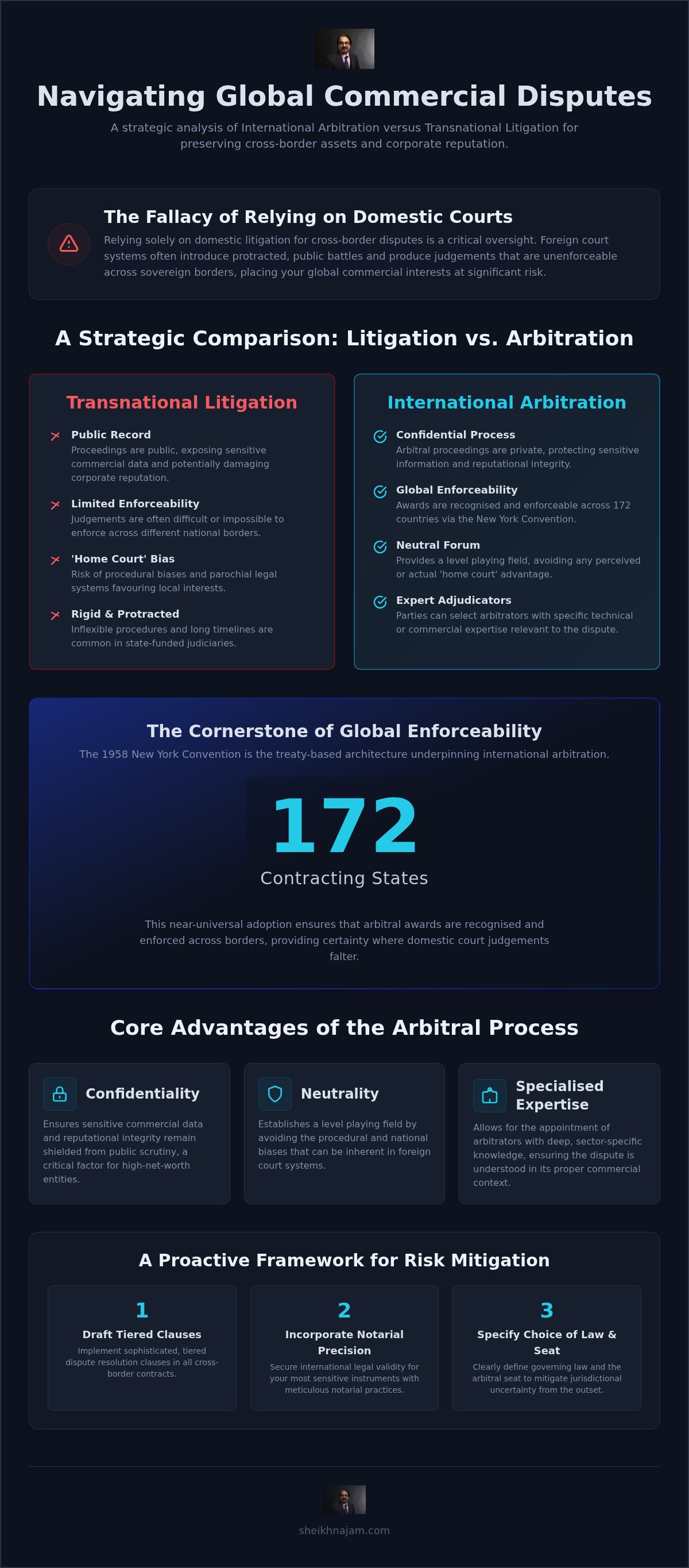
The efficacy of international commercial arbitration is fundamentally predicated upon a robust, treaty-based architecture that transcends the inherent limitations of national judiciaries. At the summit of this framework sits the 1958 New York Convention, an instrument that has achieved near-universal adoption with 172 contracting states as of September 2026. This convention serves as the cornerstone of global enforcement; it mandates that domestic courts recognise and enforce foreign arbitral awards, provided they adhere to specific procedural standards. Whilst the UNCITRAL Model Law offers a skeletal structure for national arbitration statutes, it's the interplay between these international treaties and the lex loci arbitri (the law of the seat) that provides the requisite certainty for high-value transnational transactions.
As we navigate the landscape of 2026, the Hague Judgments Convention (2019) has introduced a new layer of complexity regarding the enforcement of court-based decisions. Although the UK's ratification has bolstered the recognition of certain civil judgements, it doesn't yet match the historical weight or the streamlined enforcement mechanism provided by the New York Convention. For the discerning practitioner, understanding how Private International Law determines the 'proper law' of a contract is essential to prevent the fragmentation of legal obligations across competing jurisdictions. For those seeking to fortify their contractual frameworks against such jurisdictional ambiguities, engaging a specialist practitioner is the definitive step toward security.
The Doctrine of Enforceability Across Borders
Arbitral awards possess a unique legal fluidity, allowing them to transcend sovereign boundaries more effectively than traditional court judgements, which often face the obstacle of 'limping judgements' that remain unrecognised in distal territories. This global portability is a primary reason why, as noted by Harvard Law School on International Arbitration, sophisticated entities prefer private tribunals over state courts. The selection of the 'seat' of arbitration is a decision of paramount strategic importance; it determines the procedural law governing the dispute and the extent of judicial intervention permitted by local courts.
Conflict of Laws and Jurisdictional Selection
Determining the governing law of a contract amongst competing legal systems requires a meticulous analysis of choice of law clauses, which serve as a primary defence against future litigation risk. Without a clearly defined lex causae, courts may apply the doctrine of Forum Non Conveniens to stay proceedings in favour of a more appropriate forum, often leading to significant delays and increased expenditure. Strategic precision in these early drafting stages ensures that the chosen legal framework aligns with the client's broader wealth governance and asset preservation objectives.
Transnational Litigation versus International Arbitration: A Strategic Comparison
The strategic selection between transnational litigation and private adjudication represents a pivotal juncture in global dispute management. Whilst national judiciaries offer a traditional route, they often impose a rigid procedural architecture that fails to account for the velocity and technical nuance of modern commerce. In contrast, international commercial arbitration provides a centralised mechanism, allowing parties to consolidate multi-front conflicts into a single, neutral seat. This avoids the fiscal attrition of concurrent proceedings in disparate jurisdictions, where conflicting procedural rules and parochial biases can jeopardise the ultimate outcome. The UNCITRAL Model Law has been instrumental in harmonising these standards, yet the true value lies in the jurisprudential 'finality' of the award. Unlike court judgements, arbitral awards are generally immune to merit-based appeals, ensuring a definitive resolution that protects the commercial timeline and prevents the exhaustion of resources through endless litigation cycles.
Procedural flexibility further distinguishes the arbitral process, as it allows for the meticulous customisation of the 'rules of engagement'. Parties possess the autonomy to determine the language of the proceedings, the number of arbitrators, and the specific evidentiary standards applied to the dispute. This level of command is unattainable in state-funded courts, where litigants must adhere to generic civil procedure rules that may not suit the intricate requirements of high-value commercial transactions. It's a matter of control. You decide the framework, not the state.
Confidentiality and Public Record Considerations
High-value partnership disputes often involve sensitive financial structures that would suffer irreparable harm if exposed to the public record. Transnational litigation is inherently transparent, risking shareholder value and corporate reputation through public disclosure of sensitive data. Arbitration maintains a strictly 'closed-door' environment, ensuring that proprietary information and internal discord remain confidential. This privacy is only breached in limited circumstances, such as when national courts must intervene for the purpose of enforcement or to challenge the validity of an award under exceptional grounds.
Enforcement and Asset Preservation Frameworks
The enforcement of a foreign court order is frequently an exercise in jurisdictional frustration, whereas a New York Convention award benefits from a streamlined global recognition framework. Beyond final awards, the arbitral process allows for sophisticated interim measures and injunctions to secure assets whilst proceedings are pending. Furthermore, the strategic deployment of anti-suit injunctions remains a potent tool to restrain parties from initiating parallel court actions in breach of their agreements. This multi-disciplinary approach to asset preservation distinguishes international commercial arbitration as the superior vehicle for protecting cross-border interests with absolute precision.
Proactive Risk Mitigation: Drafting Robust Dispute Resolution Clauses
The efficacy of international commercial arbitration begins not at the point of conflict, but at the initial inception of the contractual relationship. The meticulous inclusion of precise jurisdiction and choice of law provisions represents a non-negotiable requirement for any high-value transnational agreement. These clauses establish the legal bedrock upon which all future resolutions rest, ensuring that parties aren't left to the unpredictable vagaries of competing legal systems or the procedural inadequacies of distal courts. For those seeking a deeper command over these preliminary stages, exploring strategic insights on dispute prevention and resolution provides the necessary multi-disciplinary perspective to safeguard long-term commercial interests with absolute precision.
Future-proofing these clauses requires a profound understanding of evolving digital asset landscapes and the shifting regulatory tides that govern them. As high-value assets increasingly migrate to decentralised ledgers and complex trust structures, arbitration agreements must be drafted with the necessary elasticity to encompass these intangible forms of property whilst maintaining strict compliance with international tax governance and financial crime standards. This foresight prevents the fragmentation of legal obligations when digital wealth intersects with traditional jurisdictional boundaries, ensuring a seamless adjudicatory path regardless of the asset's physical or digital location.
Asset Tracing and Worldwide Freezing Orders
Identifying and securing assets in distal jurisdictions remains one of the most formidable challenges in global dispute resolution. Utilising international legal networks to obtain disclosure orders is essential for unravelling complex corporate and trust structures that may be used to obfuscate wealth or shield capital from enforcement. A Mareva injunction is a court-issued freezing order that prevents a defendant from dissipating or removing assets from a jurisdiction to ensure that a future arbitral award or judgement remains satisfiable. This proactive measure is a critical component of a comprehensive asset preservation strategy, providing the security necessary to pursue a claim through to its ultimate conclusion.
Mediation as a Sophisticated Pre-Arbitral Tool
The rise of the Singapore Convention has elevated international commercial mediation to a status comparable with international commercial arbitration, providing a formalised framework for the global enforcement of mediated settlements. Incorporating tiered dispute resolution clauses, often referred to as 'Med-Arb', allows for a structured, hierarchical escalation from private, confidential negotiation to binding, final adjudication. This tactical arrangement offers maximum flexibility; it enables parties to preserve essential commercial relationships and avoid the acrimony of public battles whilst resolving high-value claims with minimal structural disruption. Integrating these mechanisms into a broader, multi-disciplinary wealth governance strategy ensures that every facet of your commercial affairs is managed with strategic foresight. To secure your contractual frameworks against the threat of future friction, consult with a specialist advisor to draft bespoke resolution clauses that reflect your unique international standing.
The Polymathic Approach: Harmonising Arbitration with Wealth Governance
The resolution of high-stakes commercial disputes often requires a lens that extends beyond the immediate contractual friction, particularly when such conflicts threaten the integrity of international trust and estate structures. A settlement reached within an international commercial arbitration may appear favourable in isolation, yet it can inadvertently trigger adverse fiscal consequences or breach the fiduciary duties of trustees if the settlement's structure isn't meticulously aligned with the client's broader wealth governance. This is where the 'Master Advisor' provides essential command; they ensure that the outcome of a dispute doesn't compromise long-term inheritance tax planning or capital preservation. To understand the risks when these silos collide, you may explore our strategic analysis of contentious probate and estate litigation.
The Notarial Function in International Evidence Gathering
The evidentiary weight of documents in foreign arbitral tribunals is often contingent upon their formal authentication. Notarised and apostilled documents serve as the gold standard for global legal validity, ensuring that corporate resolutions and powers of attorney are recognised without procedural challenge. This precision is vital in cross-border litigation, where the authenticity of a signatory or the capacity of a corporate entity can become a central point of contention. For a comprehensive overview of these requirements, refer to A Treatise on Professional Notarial Services for International Affairs.
Securing the Future: Integrated Multi-Disciplinary Advisory
Protecting trust assets from commercial claims requires a governance framework that is both robust and elastic. The synergy between international tax planning and dispute resolution ensures that any settlement is fiscally efficient and compliant with evolving global transparency standards. By adopting this integrated approach, high-net-worth individuals can resolve multi-jurisdictional conflicts whilst maintaining the sanctity of their private wealth structures. Whilst international commercial arbitration provides the mechanism for resolution, it's the underlying advisory that preserves the legacy. You are invited to explore our specialist areas of multi-disciplinary legal advisory to understand how we harmonise these complex fields.
Securing Global Interests through Jurisprudential Precision
The transition toward private adjudication represents a definitive shift in how sophisticated entities manage the inherent risks of transnational friction. Success in international commercial arbitration is predicated upon more than mere legal argument; it requires the meticulous harmonisation of robust contractual drafting, notarial authentication, and integrated wealth governance. By utilising a tiered approach that incorporates mediation and strategic seat selection, you ensure that your commercial resolutions don't trigger unintended fiscal vulnerabilities within your international trust or estate structures. This multi-disciplinary foresight is the hallmark of the master advisor, providing the security needed to navigate the complexities of 2026 and beyond.
As a Specialist Public Officer and Notary Public with deep expertise in international tax and estate governance, I provide the strategic command of complex commercial mediation necessary to shield your global interests. Whether you're future-proofing digital asset structures or resolving high-value partnership disputes, your affairs demand absolute precision. Instruct Sheikh Najam TEP for strategic advisory on your international commercial dispute to ensure your legacy remains protected across every border. Your strategic advantage begins with a single, authoritative decision.
Frequently Asked Questions
What is the primary difference between international commercial arbitration and litigation?
Arbitration is a private, contractual method of dispute resolution where parties select a neutral tribunal, whereas litigation is conducted in state-funded courts under the public record. International commercial arbitration offers superior procedural flexibility and confidentiality, allowing parties to appoint arbitrators with specific technical or sector expertise. Unlike court judgements, arbitral awards are generally final with limited scope for appeal, providing a definitive conclusion to transnational friction that national courts often lack the jurisdictional reach to manage efficiently.
How do UK courts determine which country's law applies to a commercial contract?
UK courts determine the governing law of a contract primarily through the express 'choice of law' provision stipulated by the parties during the drafting stage. In the absence of such a clause, the court applies the principle of the 'closest connection', identifying the law of the country where the party performing the characteristic obligation has their habitual residence. This analysis is governed by retained EU regulations and common law principles to ensure contractual certainty across competing legal systems.
Is an international arbitral award automatically enforceable in the United Kingdom?
Arbitral awards aren't automatically enforceable but benefit from a streamlined recognition process under the New York Convention and the Arbitration Act 1996. A party must apply to the High Court to have the foreign award recognised as a judgement. Once registered, the award possesses the same legal weight as a domestic court order, facilitating the seizure of assets or other enforcement measures across the United Kingdom's jurisdiction with absolute precision and authoritative weight.
What is a 'choice of court' agreement and why is it strategically vital for business owners?
A choice of court agreement is a contractual provision where parties pre-emptively select a specific national judiciary to resolve future disputes. It's strategically vital because it mitigates the risk of 'forum shopping' and provides jurisdictional certainty, ensuring that high-value commercial interests aren't subjected to the procedural idiosyncrasies of an unfavourable legal system. This foresight is a cornerstone of robust proactive risk mitigation, allowing business owners to maintain strategic command over potential litigation outcomes.
Can mediation be used effectively in high-value international commercial disputes?
Mediation is highly effective in high-value disputes, particularly when integrated into a tiered 'Med-Arb' framework that escalates to international commercial arbitration only if necessary. The Singapore Convention now provides a formalised mechanism for the global enforcement of mediated settlements, allowing entities to resolve complex conflicts whilst preserving essential commercial relationships. This approach results in significant fiscal efficiency and avoids the reputational attrition associated with protracted, public legal battles, ensuring that settlements remain confidential and secure.
How does a notary public assist in the process of international commercial arbitration?
A notary public serves as a specialist public officer who authenticates the execution of legal instruments, corporate resolutions, and powers of attorney for use in foreign arbitral tribunals. This authentication ensures that evidence meets the rigorous formal requirements of distal jurisdictions and international treaties. By providing notarised and apostilled documents, the practitioner secures the international legal validity of sensitive data, preventing procedural challenges regarding the capacity or identity of the parties involved in the dispute.
What are the risks of 'forum shopping' in international commercial law?
Forum shopping involves the strategic attempt to initiate proceedings in the jurisdiction most likely to provide a favourable outcome, yet it often leads to jurisdictional fragmentation and increased expenditure. The primary risks include the invocation of the Forum Non Conveniens doctrine, which can stay proceedings in favour of a more appropriate forum, and the potential for conflicting 'limping' judgements. Such fragmentation jeopardises asset preservation and complicates the eventual enforcement of multi-front commercial claims across sovereign borders.
How can I protect my international assets during a pending commercial dispute?
Protecting international assets during a pending dispute requires the strategic deployment of interim measures, such as Mareva injunctions or worldwide freezing orders. These court-issued mandates prevent a defendant from dissipating or removing assets from a jurisdiction before a final award is rendered. Additionally, disclosure orders are utilised to unravel complex corporate and trust structures, ensuring that assets remain identifiable and secure throughout the duration of the adjudicatory process, providing the necessary security for eventual enforcement.



Comments