Duties of an executor in the UK and what you need to do

An executor’s authority is not permission to distribute an estate at their discretion. If you are asking what are the duties of an executor in the UK, the core duty is to protect and administer the deceased’s money, property and possessions, settle valid debts and taxes, then distribute what remains according to the will. The executor may also need to obtain a grant of probate before dealing with certain assets.
The role involves more than carrying out a relative’s wishes: it carries legal and financial responsibilities, and an executor may be personally liable if an error causes loss to the estate. This article explains an executor’s powers and duties, how probate applications work, and what is involved in valuing assets, addressing liabilities and distributing an estate. It also covers the care needed when there are complex assets, trusts, tax questions or potential claims, so you can understand the responsibilities before deciding how to proceed.
Table of Contents
Distributing the estate
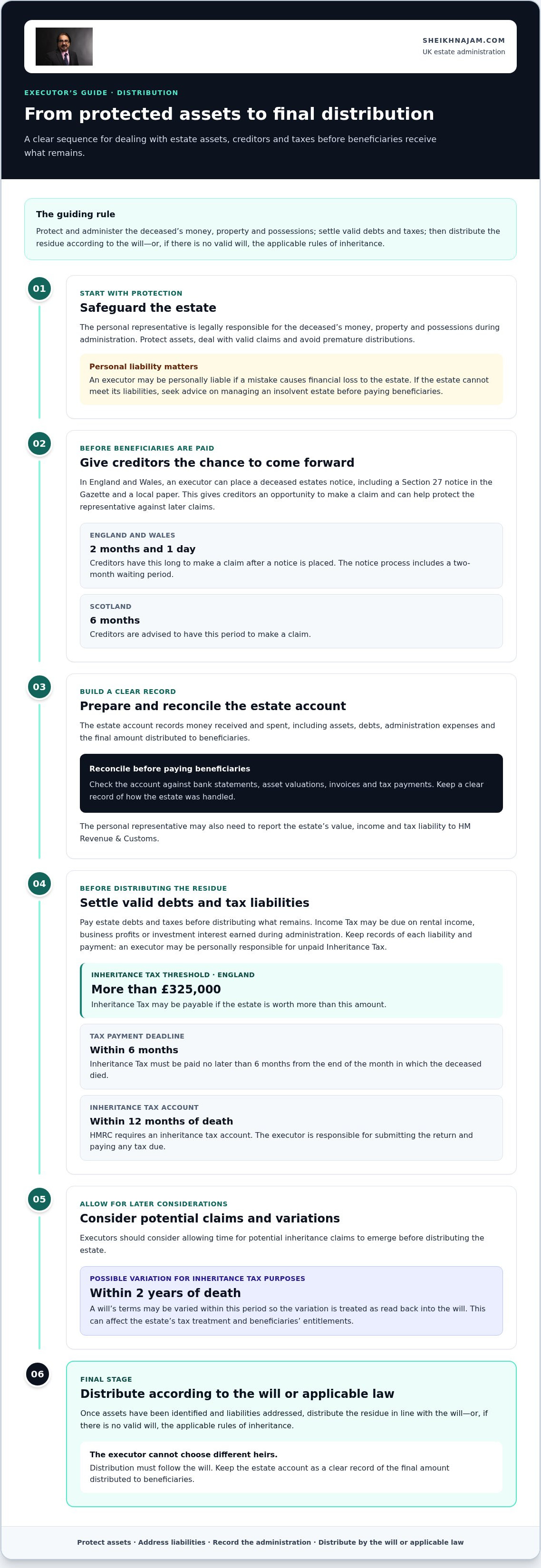
Distribution is the final stage of estate administration, after assets have been identified and liabilities addressed. The personal representative must follow the will or, if there is no valid will, the applicable rules of inheritance.
Responsibility for estate assets
A personal representative is legally responsible for the deceased’s money, property and possessions during estate administration. This means protecting assets, dealing with valid claims and avoiding premature distributions. An executor may be personally liable if a mistake causes financial loss to the estate. If the estate cannot meet its liabilities, seek advice on managing an insolvent estate before paying beneficiaries.
Creditors must be considered before beneficiaries receive their inheritance. In England and Wales, an executor can place a deceased estates notice, including a Section 27 notice in the Gazette and a local paper. This gives creditors an opportunity to come forward and can help protect the representative against later claims. Creditors have 2 months and 1 day to make a claim after a notice is placed in England and Wales; in Scotland, creditors are advised to have 6 months. The notice process includes a two-month waiting period.
Estate accounts and distribution
An estate account records money received and spent, including assets, debts, administration expenses and the final amount distributed to beneficiaries. It provides a clear record of how the estate was handled. Before paying beneficiaries, reconcile the account with bank statements, asset valuations, invoices and tax payments. The executor cannot choose different heirs: distribution must follow the will.
Pay estate debts and taxes before distributing the residue under the will or applicable law. The personal representative may also need to report the estate’s value, income and tax liability to HM Revenue and Customs. Income Tax may be due on rental income, business profits or investment interest earned during administration. Keep records of each liability and payment, as an executor may be personally responsible for unpaid Inheritance Tax.
In England, Inheritance Tax may be payable if the estate is worth more than £325,000, according to HM Revenue & Customs. Inheritance Tax must be paid no later than 6 months from the end of the month in which the deceased died. HMRC requires an inheritance tax account within 12 months of death. The executor is responsible for completing and submitting the return and paying any tax due.
Distribution also requires careful attention to potential inheritance claims. Executors should consider allowing time for potential claims to emerge before distributing the estate. A will’s terms may be varied for inheritance-tax purposes within 2 years of the deceased’s death, so the variation is treated as read back into the will, according to UK legislation. This can affect the estate’s tax treatment and the beneficiaries’ entitlements.
Applying for a Grant of Probate
A grant of probate gives an executor legal authority to deal with the deceased’s estate. Whether you need one, or a different form of authority, depends on where the deceased lived and how the assets are held.
Applying for probate or confirmation
In England and Wales, applying for probate means seeking formal authority to administer an estate under a will. Scotland uses confirmation, and the process also differs in Northern Ireland. The distinction matters because application and document requirements depend on the relevant jurisdiction. An executor named in the will may apply, but is not obliged to take on the role.
Before applying, identify the correct applicant and establish what the estate contains. You may need to value property, money and possessions, and determine whether Inheritance Tax is due. Some assets cannot be dealt with until the personal representative provides the appropriate grant. A grant may not be needed for a smaller estate, usually one worth less than £5,000; in Northern Ireland, a small estate is usually valued at less than £10,000.
Once the required documents have been submitted, an executor will usually receive a grant of probate or letters of administration within 4 weeks. In England, the probate application fee is £300, with £1.50 charged for each extra official copy of the grant. An executor may also have to pay some Inheritance Tax before probate is granted, so the estate’s liquidity can affect how the application proceeds.
Legal authority to act
A grant of probate is the legal document that enables an executor to deal with estate assets requiring formal authority. It matters because financial institutions and others may require the grant before releasing or transferring assets, even though the will names the executor. The grant supports the executor’s authority; it does not allow them to disregard the will or act for personal gain.
If there is no valid will, an administrator must apply for Letters of Administration before administering the estate. If the sole named executor cannot or will not act, a beneficiary may apply for Letters of Administration with the will annexed. An executor who declines the appointment can sign a Deed of Renunciation, allowing another executor to apply. Alternatively, power may be reserved for an executor who is not applying immediately.
Do not treat the application as a routine formality if the will, applicant or estate raises a dispute. A specialist can help clarify the appropriate route and the documents required, particularly where an executor’s authority is contested. For assistance with a complex application or estate administration, you can seek probate and estate administration support.
Can an executor transfer assets without selling them?
An executor may transfer an estate asset rather than sell it, but must first account for debts, taxes and expenses. How the asset is dealt with depends on the will, the estate’s liabilities and the beneficiaries’ rights. To identify and pay the deceased’s debts and expenses, investigate their financial records, establish valid liabilities, then pay them before distributing the estate under the will or law.
Start with a documented inventory of the deceased’s assets and liabilities. Review bank statements, loan agreements, utility bills, tax records and creditor correspondence. Contact relevant institutions to confirm balances and identify payments due. Record each debt, its supporting documents, the creditor and any dispute. This gives the executor a basis for assessing which claims are valid and how much money must remain available.
Debts and taxes take priority over distributions to beneficiaries. The executor should settle valid liabilities from estate funds before transferring the residue. These may include household bills, loans, tax liabilities and administration expenses. Keep invoices, payment confirmations and correspondence with creditors. If estate funds are insufficient, the executor must follow the legal order for paying debts, as claims do not all have equal priority.
Investigate uncertain claims carefully before paying them. For example, a creditor’s demand may conflict with the deceased’s account records, or an invoice may relate to services provided after death. Ask for supporting documents, compare dates and amounts, and record why the claim is accepted or disputed. A deceased estates notice can invite creditors to come forward, but it does not replace reviewing claims or addressing liabilities already identified.
If the estate appears insolvent, pause distributions to beneficiaries and establish the extent of the shortfall. Seek advice on managing an insolvent estate, since paying one creditor ahead of another may prejudice creditors with a higher legal priority. Preserve estate funds and records while assessing the position. The payment order is especially important when the available assets cannot meet all liabilities.
Section 39 of the Administration of Estates Act 1925 gives executors a right to sell or transfer estate property. A transfer may therefore be considered instead of selling an asset, provided the executor respects the will and has dealt with the estate’s liabilities. For example, a property or investment may be transferred as part of an entitled beneficiary’s inheritance, rather than converted into cash first.
Before arranging a transfer, establish the asset’s ownership, value and any restrictions on its disposal. Compare the proposed transfer with the will’s terms and the estate account, and document the transaction. If the asset must be sold to meet debts or taxes, a transfer cannot take precedence over those obligations. The executor’s decision should preserve the estate’s ability to satisfy valid claims before beneficiaries receive their inheritance.
Finding the will and arranging the funeral
After a death, the executor’s first practical tasks include locating the will, protecting the deceased’s property and arranging the funeral. The order matters: the will identifies the appointed executor and may record funeral wishes, while prompt action helps preserve estate assets.
Finding the will
Finding the latest will establishes who is appointed and which instructions govern the estate. Check the deceased’s papers, home files and correspondence, and contact any solicitor who prepared or held documents for them. Preserve the original will and any codicils together, as the executor needs the relevant documents when administering the estate.
Once found, read the will carefully for the executor appointment, funeral directions and any trust provisions. If more than one executor is named, establish who is willing to act and keep the other appointed executors informed. The will can help identify beneficiaries and gifts, but it does not establish the estate’s value for inheritance tax or replace the accounts needed during administration.
At the same time, secure the deceased’s property and records. Arrange access to the home, protect valuables and gather papers relating to bank accounts, investments, insurance and household bills. These records help identify assets and obligations. Keep a record of keys, documents and items removed from the property, including who holds them and why.
Arranging the funeral
The executor is responsible for arranging the funeral, even if the will contains no specific instructions. Funeral directions can inform the arrangements, but in England an executor is not legally required to follow the deceased’s exact wishes. Consider any recorded preferences alongside practical arrangements and the estate’s available funds.
Death registration is a separate initial task. In England and Wales, the person responsible for registering the death must do so within 5 days. In Scotland, a death must be registered within 8 days. Identify who will undertake registration, then retain the resulting documents, since they may be needed for funeral arrangements and subsequent estate administration.
Keep funeral invoices and proof of payment with the estate records. These documents help track expenditure and prepare accurate accounts. If someone else pays an expense initially, record the payer, amount and receipt, and distinguish that payment from the executor’s personal funds. Clear records also help explain estate outgoings to beneficiaries.
Funeral arrangements and estate administration can proceed alongside one another, but they serve different purposes. The funeral addresses immediate arrangements; the will, asset records and accounts support the executor’s ongoing responsibilities. Preserve both sets of documents so decisions about debts, inheritance tax and distribution can be traced to reliable records.
Executor powers and responsibilities
An executor’s powers are not unrestricted: in England and Wales, they arise from the will and statute. The executor must act in the interests of the estate and its beneficiaries, not for personal gain. This duty still applies when the executor is also a beneficiary, who must consider everyone entitled under the will.
The role combines authority with accountability. An executor may collect assets, arrange their sale or transfer, and employ agents or professionals where needed. Section 23 of the Trustee Act 2000 provides a basis for employing agents; section 31 of the same Act provides for reimbursement of expenses. Keep estate money separate from personal funds, and retain invoices and bank statements to evidence each transaction.
Co-executors should agree how financial assets will be held and administered. Before making withdrawals from an estate bank account, decide how payments will be authorised and recorded. They should also agree which assets to sell and when. Written agreement helps prevent inconsistent instructions to banks, investment managers or property agents, particularly when executors disagree about timing.
Personal liability is a central risk. An executor may be liable if a mistake causes financial loss to the estate or if they act in their own interests. Before distributing assets, keep a clear record of decisions, supporting documents and notices sent to relevant parties. If the will is unclear or a beneficiary challenges an action, a solicitor can help assess the executor’s duties and options.
An executor who has started administering the estate generally cannot simply step down. Ill health or a family emergency may provide a good reason, while voluntary agreement or a court order may remove an executor who acts in their own interests or persistently fails to administer the estate. Section 35 of the Trustee Act 1925 is cited as a basis for seeking court directions where guidance is needed.
Practical safeguards help keep the administration accountable:
Secure the deceased’s property promptly and keep an inventory of possessions.
Record decisions about sales, transfers and payments, including the reasons for each decision.
Keep estate funds in a separate account and reconcile statements against the estate records.
Claim only reasonable estate expenses, supported by receipts and payment records.
A professional executor may charge for time spent administering an estate under sections 28 and 29 of the Trustee Act 2000. A lay executor may charge for time only if the will contains a charging clause authorising it. If your responsibilities involve complex assets, co-executors or disagreement over a decision, seek advice on executor responsibilities.
Sheikh Najam TEP: Notarial Services
Sheikh Najam TEP provides Notarial Services and advises on estate matters involving formal documents for use overseas. An executor handling an international estate may need documents authenticated for a foreign institution or authority; notarial services can address this requirement.
Where administration also involves tax exposure, trusts or complex estate assets, Inheritance Tax Planning and Trust and Estate Planning can address these connected considerations. The appropriate support depends on the issue: document formalities, estate administration, tax planning and trust arrangements each require a distinct assessment. This is particularly relevant when the deceased held assets across jurisdictions or the will interacts with existing trust structures.
For guidance on the notarial or estate-related issues arising in your role, contact Sheikh Najam TEP.
Take a considered next step
Understanding what are the duties of an executor in the UK is the starting point. Next, establish which decisions need attention first and what information supports them. Where the estate involves overlapping personal, financial or international considerations, a measured review can identify issues that need coordinated attention, rather than treating each document or asset in isolation.
Sheikh Najam TEP offers Inheritance Tax Planning, Trust and Estate Planning and Notarial Services. These services may be relevant when estate administration raises connected tax, trust or document requirements. To take the next step, identify the decision facing you, the documents available and the point requiring professional attention.
To discuss your circumstances, contact Sheikh Najam TEP. A clear, considered approach can help you move forward with greater confidence.
Frequently Asked Questions
What is an executor of a will?
An executor is the person appointed in a will to administer the deceased’s estate. They deal with assets and liabilities and carry out the will’s instructions. A will-maker must name at least one executor and may appoint up to four; an executor must be over 18. For anyone asking “what are the duties of an executor in the UK?”, the practical answer is that the role involves administering the estate for those entitled under the will.
Are executors subject to timelines or deadlines?
There is no fixed legal deadline for completing estate administration, and it may take a year or more. Specific obligations have their own timeframes, so executors should track each deadline rather than assume there is one completion date. Understanding what are the duties of an executor in the UK also means keeping these obligations in view, particularly when tax reporting, creditor claims or unresolved assets affect progress.
Can an executor keep family out of the deceased’s home, and for how long?
An executor may need to control access to the deceased’s home while securing the property and accounting for belongings. This does not establish a standard period for excluding relatives. A practical approach is to arrange access for a defined purpose, such as collecting personal belongings, and record what is removed. If access could affect estate property or prompt a dispute, document the concern and obtain legal guidance before taking a position.
Can an executor live in the deceased’s house?
Being appointed executor does not make the deceased’s home the executor’s property or give them a personal right to occupy it. The house remains an estate asset to be dealt with under the will and in the beneficiaries’ interests. An executor who is also a beneficiary must still act impartially. Consider any proposed occupation transparently, recording its effect on the estate and other beneficiaries.
Can an executor withhold money from a beneficiary?
An executor may retain estate funds needed for outstanding liabilities, tax, expenses or unresolved claims. This differs from withholding an inheritance without an estate-related reason or changing the will’s distribution. Record the amount retained, the obligation it covers and the basis for any later payment. A beneficiary can request an explanation of the administration and the timing of their entitlement.
Can executors resolve disputes between beneficiaries?
Executors can communicate with beneficiaries and clarify information about the estate, but must not decide inheritance rights according to personal preference. The will determines distribution unless it is lawfully varied or a court directs otherwise. If a disagreement concerns interpretation, a missing beneficiary or a disputed claim, record the issue and preserve disputed funds. Mediation may help beneficiaries explore a resolution without requiring the executor to take sides.
How does probate work if the named executor has died?
If the named executors have died and no substitute can act, another eligible person may need to apply to administer the estate. The Non-Contentious Probate Rules 1987 set out the priority order for applicants when named executors have died or no substitute is named. Who may apply depends on the will and estate circumstances; a relative does not automatically become executor or receive authority to administer the estate.
Is an executor personally liable for mistakes?
An executor may be personally liable if a mistake causes financial loss to the estate. Examples include making an incorrect payment or distributing assets before addressing liabilities. Keep estate funds separate, retain supporting records and document the reasons for significant decisions. Claims alleging failure to perform executor duties correctly may be brought for up to 12 years after the death, making careful records relevant even after the estate has been distributed.



Comments