Notarising Documents for Use in China: What Checks Are Needed

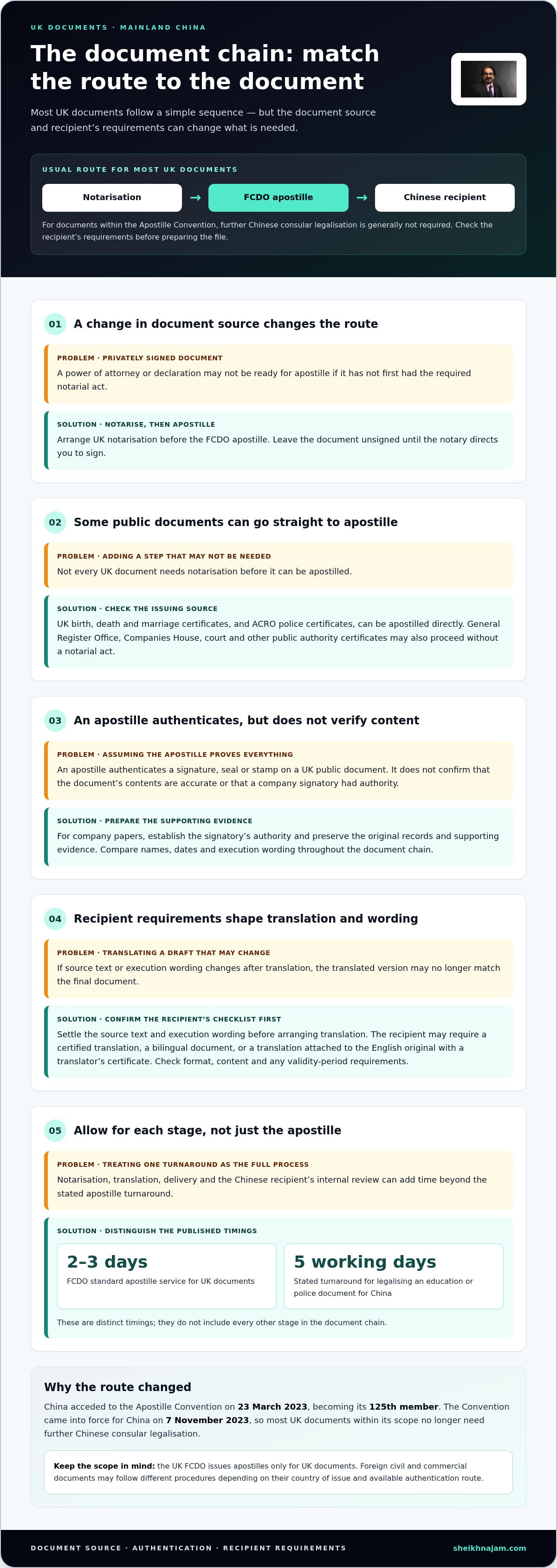
For most UK documents, notarising documents for use in China means having the document notarised and then obtaining an apostille from the Foreign, Commonwealth and Development Office (FCDO). Because China participates in the Apostille Convention, further consular legalisation is generally not required, although some UK public documents can be apostilled without prior notarisation.
For a cross-border business matter, the apostille is only one part of the preparation. The document’s purpose, the signatory’s identity and authority, and the Chinese recipient’s requirements for wording, format and translation can all affect what needs to be done before submission.
This article explains when notarisation is required, how the FCDO apostille process works, and what identity checks apply when an individual or company signs. It also covers practical factors that can affect timing and acceptance, helping you prepare the document chain before a filing, transaction or corporate decision proceeds.
Table of Contents
FCDO apostille legalisation
For UK documents intended for mainland China, the usual sequence is notarisation followed by an apostille from the Foreign, Commonwealth and Development Office (FCDO).
UK apostille acceptance and Chinese translation
Yes. China accepts UK apostilles under the Hague Apostille Convention, so most documents do not need additional consular legalisation. UK documents may also need Chinese translation, depending on the recipient’s requirements. The recipient may ask for a certified translation, a bilingual document, or a translation attached to the English original with a translator’s certificate.
The People’s Republic of China acceded to the Apostille Convention on 23 March 2023, becoming its 125th member. The Convention, formally titled the Convention of 5 October 1961 Abolishing the Requirement of Legalisation for Foreign Public Documents, came into force for China on 7 November 2023. These dates explain why procedures for Chinese documents changed in late 2023.
For a UK document, the steps depend on its source. A privately signed power of attorney or declaration normally needs notarisation before it can be apostilled. By contrast, UK birth, death and marriage certificates, and ACRO police certificates, can be apostilled directly. Certificates from the General Register Office, Companies House, a court or another public authority may also proceed without a notarial act.
An apostille authenticates the signature, seal or stamp on a UK public document. It does not verify the document’s contents. This distinction matters for corporate papers: the apostille confirms the relevant official authentication, not the accuracy of company statements or a signatory’s authority. Where required, notarisation can address the signing or execution of a document.
Chinese public documents intended for use in the United States follow the Convention route when they fall within its scope: an apostille from a Chinese Foreign Affairs Office replaces US consular authentication. US documents sent to mainland China also use the Convention’s apostille framework where applicable. The UK FCDO issues apostilles only for UK documents.
Notarising and apostilling timescales
The FCDO’s standard apostille service for UK documents takes 2-3 days. The stated turnaround for legalising an education document or police document for China is 5 working days. These are distinct timings: notarisation, translation, delivery and the Chinese recipient’s internal review can add time to the full process.
When notarising documents for use in China, settle the source text and execution wording before arranging translation. This avoids translating a draft that may later change. The recipient’s requirements for format, content, translation and validity period shape the sequence, particularly when a filing deadline or transaction depends on acceptance.
Whether foreign documents need consular legalization for use in China
For UK documents within the Apostille Convention, an FCDO apostille generally replaces Chinese consular legalisation. The key factors are the document’s origin, purpose and the Chinese recipient’s requirements.
Consular legalisation for documents used in China
Since November 2023, most UK documents for mainland China follow the apostille process rather than further legalisation by a Chinese embassy or consulate. Privately signed declarations and powers of attorney normally require a UK notarial act before authentication. The apostille route applies to documents within the Convention’s scope; identify the issuing authority and intended use before preparing the file.
Foreign civil and commercial documents may follow different procedures depending on their country of issue and the authentication route available there. The Convention does not make every international record identical: a company certificate, personal declaration and court document may each have different authentication requirements. For business filings, obtain the Chinese recipient’s written checklist, including any requirements for form, content, translation or validity period.
Documents that may be refused
Chinese embassies and consulates do not accept foreign-related notarial deeds or commercial certificates issued by domestic authorities for consular legalisation if they have been taken abroad without legalisation. The sequence matters: complete the required local authentication before sending a document abroad for consular processing.
An apostille authenticates a signature, seal or stamp, not the document’s substance. It does not establish that a company record is accurate, that a signatory had authority or that a filing meets the recipient’s substantive rules. Preserve the original records and supporting evidence, and compare names, dates and execution wording across every document in the chain.
Notary requirements and consular authentication in the UK
A UK notary public is normally required for privately signed declarations and powers of attorney intended for overseas use. By contrast, certain UK public documents, including birth, death and marriage certificates, can proceed directly to apostille. For most UK documents under the Convention, Chinese Embassy or consulate authentication in the UK is not an additional step.
The Chinese Consulate General in Mumbai illustrates why procedures can vary by location. Under the stated Indian process for documents intended for use in China, the document is first notarised by a local Notary Public, then attested by the Section Officer, Home Department, Government of Maharashtra Mantralaya, Mumbai, before submission to the Consulate General. That consulate does not accept documents for direct notarisation. This is an India-specific route, not the UK apostille process.
Correct sequencing protects the legal utility of international records by avoiding an incomplete authentication chain. For a transaction or filing involving several documents, a focused legal enquiry about document requirements can help clarify the relevant notarial steps.
China’s Public Notary Office and its role
China’s Public Notary Office belongs to a different legal and administrative system from a UK notary public. It is a subordinate agency of the Ministry of Justice of the People’s Republic of China. For UK readers, this distinction matters: a Chinese notary office and a UK notary public perform roles within their respective jurisdictions, and their documents are not interchangeable merely because both use the word “notary”.
The history of China’s public notary system helps explain its present institutional role. The Republic of China enacted legislation establishing a public notary system in 1935. The People’s Republic continued developing that system in 1951, before activity languished during 1958 and 1959 and virtually stopped over the following two decades. These changes reflect a domestic institutional history, not a requirement that UK documents pass through a Chinese notary office.
After market economic reforms began in 1978, the system gained renewed importance. In 1979, the Chinese central government enacted legislation for Public Notary Offices to be established in municipalities, provincial cities, prefecture-level cities and towns. By 1982, China had put the laws and regulations for its public notary system in place. These milestones describe the development and legal framework of China’s own notarial institutions.
In practice, Chinese notary institutions handle foreign-related civil and commercial documents as well as domestic matters. A notarial deed or certificate issued in China may support a transaction or administrative process abroad. The receiving country’s authentication rules determine whether it also needs an apostille or another form of legalisation. The issuing office’s role and the receiving authority’s requirements are separate steps.
This distinction matters when a document is issued in the UK. A UK certificate, declaration or company document does not become a document issued by a Chinese Public Notary Office simply because it will be used in China. Identify who issued the document, who signed it and what the Chinese recipient needs to establish. A Chinese public notary’s deed and a UK notarial certificate, for example, come from different issuing authorities.
Before preparing a cross-border file, separate documents issued in China from those signed or issued in the United Kingdom. Then map each item to its authentication route and recipient. China’s Public Notary Office provides context for Chinese notarisation, while a UK notary public authenticates relevant UK documents. Keeping these roles distinct helps prevent the wrong authority or procedure being applied to a certificate, contract or signed declaration.
Identity checks and signing in a notary's presence
For a UK notarial appointment, prepare your identification before presenting a document for signature. A UK notary will usually need to see an original, valid photographic identity document and proof of your current residential address. A passport and recent address document allow the notary to compare your identity details with the name and particulars in the paperwork.
Names must match across your identity evidence and the document. If your passport name differs from the name on a certificate, provide a declaration stating that both names refer to the same person. For example, a certificate issued before a surname change may not match your current passport. The declaration explains the discrepancy but does not alter the certificate.
For a power of attorney or declaration, leave the signature line blank until the appointment unless you have been specifically instructed otherwise. The notary must be able to observe the required execution, rather than simply receive a document already signed elsewhere. Bring the complete document, including schedules and attachments, so the signing can be considered in context.
Identity: bring an original, valid photographic document, such as a passport.
Address: bring proof of your current residential address.
Execution: keep the relevant signature fields unsigned until instructed.
Name discrepancy: prepare a declaration linking different names shown on your records.
Can documents be notarised remotely or by a solicitor in the UK for use in China? Remote electronic notarisation may be possible for certain documents and recipients, but it is not a universal substitute for an in-person appointment. A solicitor’s ordinary witnessing or certification is not the same as a notarial act. Where notarisation is required, a notary public must handle the document.
The recipient’s rules and the document’s form determine whether remote execution is suitable. A video appointment used by a notary institution in China does not, by itself, establish that a UK document can be notarised remotely. For a document destined for China, consider whether the receiving organisation accepts electronic execution and whether the required signature, seal and format can be produced that way.
Identity checks also support the later legalisation process. When issuing an apostille, the Foreign, Commonwealth and Development Office verifies the relevant UK notary’s status. The apostille authenticates a signature, seal or stamp, not the document’s contents. A name mismatch or incomplete execution can therefore cause problems before an apostille is issued. Resolve these details at the signing stage and retain the final signed version for submission.
Notarization for cross-border business
For business documents, the key decision is whether each item is private, public or corporate. That classification determines the appropriate authentication steps and what the Chinese recipient must be able to establish.
Documents requiring notarisation for China
Documents commonly requiring notarisation and legalisation include university degree certificates, marriage and birth certificates, ACRO criminal conviction certificates, and corporate records such as a certificate of incorporation. Not every document needs a notarial act: UK public certificates may be apostilled directly. Identify the issuing authority and intended use before choosing the route.
Privately signed declarations and powers of attorney normally need a notarial act before overseas use. The original document, its execution wording and the Chinese recipient’s requirements determine how it should be prepared.
Requirements for powers of attorney and certificates
A power of attorney should be complete but unsigned when presented, unless the notary has instructed otherwise. The notary observes the signature and authenticates the relevant execution. For corporate powers, the notary must establish that the signatory has authority to bind the company, using appropriate company records or other supporting evidence.
UK birth, death and marriage certificates, and ACRO police certificates, can be apostilled directly. Assess a certificate issued by a government body by its source and form, rather than treating it as a privately signed declaration.
Requirements for educational documents
A degree certificate for China may require legalisation, but the authentication route depends on how the education document was issued and what the recipient requires. Establish whether the original certificate, a university-issued replacement or another official record is needed. The distinction between a university document and a copy can affect the next step.
Translation requirements also depend on the Chinese recipient. It may ask for a certified translation, a bilingual document, or a translation attached to the English original with a translator’s certificate.
For a company submission, align the signatory’s authority, document wording and supporting records before execution. A certificate of incorporation alone may not establish that a particular individual can sign for the company. The notary’s review of authority supports authentication of the signature; an apostille does not guarantee the recipient will accept the document’s content.
Set the document sequence before arranging translation or delivery. Finalise the source text and execution wording first, then arrange any required translation and authentication. Apostille processing, translation, delivery and the recipient’s internal review can each affect the timetable. A written checklist from the Chinese recipient helps identify format, content and filing requirements early.
For a transaction involving company records or powers of attorney, discuss the document’s notarial requirements before execution.
Sheikh Najam TEP: Notarial Services
Sheikh Najam TEP provides Notarial Services for individuals and businesses preparing documents for use overseas, including documents that require notarial attention. This may be relevant to a power of attorney, declaration or corporate document connected with China, where the document’s purpose and the recipient’s requirements shape the necessary steps.
Where documents relate to succession or the administration of assets across borders, notarial requirements may sit alongside wider Private Wealth & Succession or inheritance tax planning considerations. Aligning execution and authentication with the broader legal context can help you plan the document process coherently.
For advice on a document intended for China, contact Sheikh Najam TEP to discuss your requirements.
Prepare your documents with clarity
A considered approach to notarising documents for use in China begins before execution: align the document’s purpose, signatory and intended recipient with the wider transaction or personal matter. This is particularly valuable when an overseas filing relates to a corporate decision, estate plan or transfer of family assets. Addressing those connections early helps ensure the document is considered as part of the matter, not as an isolated administrative task.
Sheikh Najam TEP provides Notarial Services and advises on related Private Wealth & Succession and inheritance tax planning matters. Where a document forms part of a broader succession or asset-planning arrangement, considering its role in that framework can inform the decisions that follow.
Set out the document’s intended use and the recipient’s requirements, then take the next step with a clear understanding of the matter’s context. Contact Sheikh Najam TEP about your documents to discuss the appropriate way forward. Careful preparation can place your cross-border plans on a more considered footing.
Frequently Asked Questions
Is it necessary to have documents legalised if they will be sent to and used in China?
Usually, a UK document needs authentication before use in mainland China, but additional Chinese consular legalisation is generally unnecessary under the Apostille Convention. The appropriate route depends on who issued the document and what the receiving organisation requires. For example, a privately signed authority may need a notarial act, whereas certain official certificates can proceed directly to apostille.
How do I get started?
Begin by obtaining the Chinese recipient’s written document checklist. Identify the issuing body, the document’s purpose, the required language and any format or validity conditions. Then assemble the original document and supporting records, such as evidence of a company signatory’s authority. Finalise the wording and execution arrangements before commissioning a translation, so the translated text matches the document that will actually be signed or submitted.
Can notarial deeds be legalised by Chinese embassies or consulates after being taken abroad but not yet legalised?
No. Chinese embassies and consulates do not accept foreign-related notarial deeds or commercial certificates issued by domestic authorities after they have been taken abroad without legalisation. In practice, authentication must be completed in the correct order before the document leaves its issuing country. For a UK document, determine the applicable UK authentication route before sending it overseas.
What kind of documents shall not be accepted for legalisation?
Chinese embassies and consulates do not accept foreign-related notarial deeds or commercial certificates issued by domestic authorities that have been taken abroad without legalisation. This applies to documents presented for consular legalisation after an incomplete authentication process. It does not mean every document is automatically refused: the issuing authority, destination and applicable apostille or legalisation procedure determine how it should be prepared.
What is the attestation process?
Attestation authenticates an official signature, seal or stamp so a document can be presented abroad. For a UK document, first establish whether it needs a notarial act or can proceed as a public document. Complete the required UK authentication, then arrange any translation and delivery required by the Chinese recipient. Attestation does not certify the truth of the document’s contents.
What is the cost?
The cost depends on the document type, whether a notarial act is needed, the number of documents, translation requirements and delivery arrangements. Pricing is available upon consultation. A public certificate that can proceed directly to apostille requires different preparation from a privately signed document that needs notarisation, so identifying the document and its intended use helps define the work.
What is the process for notarising and legalising UK documents for use in China?
First, classify each item as a privately signed document or an official public record. Arrange notarisation where required, then submit the document for the relevant UK authentication. Certain UK birth, death and marriage certificates, and ACRO police certificates, can proceed directly to apostille. Before submission to China, align any translation, format and supporting records with the recipient’s requirements.
How do I get a UK document apostilled by the FCDO for China?
The Foreign, Commonwealth and Development Office is the UK authority that issues apostilles. Prepare the original document and establish whether it needs notarisation first. For a private declaration, arrange the notarial act before applying; eligible public certificates may be submitted directly. The FCDO apostille authenticates the relevant signature, seal or stamp, so confirm that the document’s form and accompanying translation meet the Chinese recipient’s requirements.



Comments