Inheritance Dispute Solicitor: A Strategic Guide to Estate Claims in 2026

Could an estate be distributed before you have established whether a concern about a will or inheritance has a sound legal basis? When family relationships are under strain, delay can narrow practical options, while an ill-judged step may intensify the conflict. An inheritance dispute solicitor can help assess the issue, the estate and the urgency before you decide what to do.
It is understandable to feel uncertain: a perceived unfairness is not necessarily a legal claim, and a dispute need not proceed to court. The right analysis depends on the facts, the parties’ interests and the legal framework that applies. First, clarify whether the concern relates to a will’s validity, provision from an estate, a trust or the way the estate is being administered.
This guide explains when specialist contentious probate advice may be appropriate, what information can help assess your position, and why timing may matter while estate administration continues. It also compares negotiation, mediation and arbitration with court proceedings, without assuming litigation is inevitable. The aim is a clear, proportionate strategy based on the evidence and the circumstances of the estate.
Table of Contents
What an inheritance dispute solicitor can help with: identifying the real issue
How an inheritance dispute is framed: facts, jurisdiction and legal route
Assessing an inheritance dispute: evidence, risks and realistic objectives
Resolving an inheritance dispute: when negotiation, mediation or proceedings may fit
Working with Sheikh Najam TEP on a contentious probate matter
What an inheritance dispute solicitor can help with: identifying the real issue
An inheritance dispute is a disagreement concerning an estate, a will, a trust or the way any of these is being administered. The term covers several different types of conflict, so the first useful step is to identify the legal issue rather than treating every family disagreement as the same problem. The wider concept of Inheritance concerns the transfer of a person’s estate after death; a contentious probate assessment focuses on the specific decisions, documents and interests in dispute.
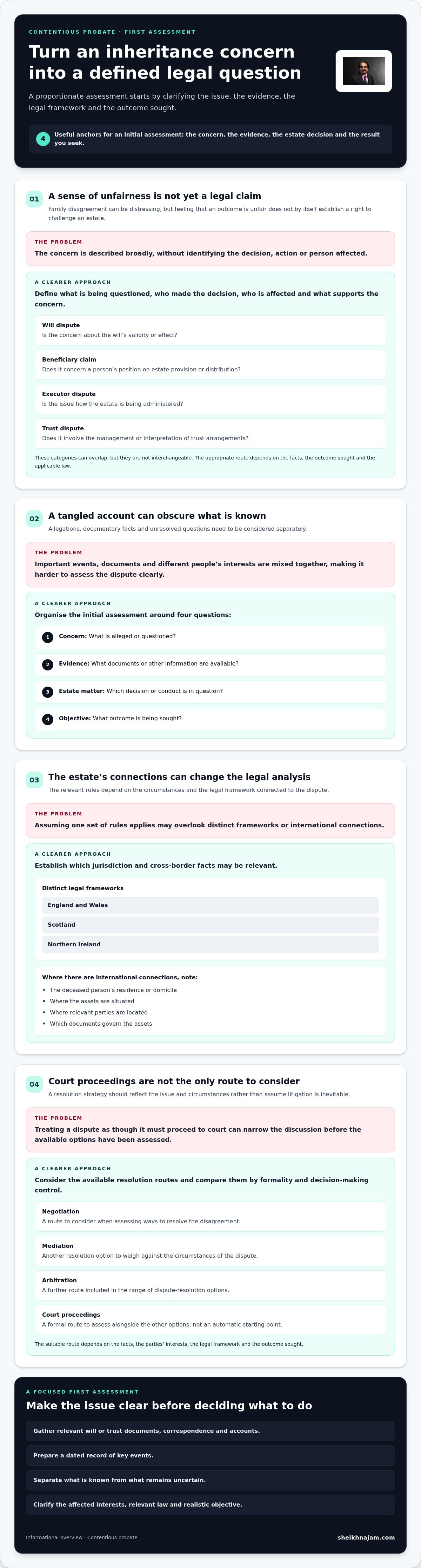
For example, a contested will dispute concerns the validity or effect of a will; a beneficiary claim concerns a person’s position in relation to estate provision or distribution; an executor dispute focuses on how the estate is being administered; and a trust dispute concerns the management or interpretation of trust arrangements. These categories can overlap, but they are not interchangeable. The right route depends on the facts, the outcome sought and the law governing the matter.
Which disagreements can become contentious probate matters?
Contentious probate may arise when people disagree about a will, the distribution of an estate, an executor’s decisions or the administration of a trust. A family disagreement, even one that is deeply distressing, does not by itself establish a legal claim. To clarify the issue, identify the decision or action in question, who made it, who is affected and what information supports the concern. A broader analysis of probate litigation can help explain how such disputes are assessed and pursued.
Who may need advice about an inheritance dispute?
Beneficiaries, executors and trustees may seek advice when a decision, competing interpretation or administration concern affects their position. A person who believes an estate decision affects them may also want to understand whether a legal route is available. However, being related to the deceased, or feeling that the outcome is unfair, does not automatically confer a right to challenge the estate. Standing and potential remedies depend on the type of claim and the applicable law.
An inheritance dispute solicitor can examine the information available, clarify the parties’ respective interests, explain potential options and represent a client in a formal dispute. For an initial assessment, gather the will or trust documents, relevant correspondence, accounts and a dated record of key events. This material helps distinguish what is known from what remains uncertain; it does not, on its own, determine whether a claim will succeed.
Jurisdiction is fundamental. England and Wales, Scotland and Northern Ireland have distinct legal frameworks, and the relevant rules depend on the circumstances of the dispute. If assets, parties or documents connect with more than one country, the analysis may require additional care. A measured assessment therefore establishes the nature of the disagreement, who is affected, what evidence exists and which legal framework applies before treating any course of action as appropriate.
How an inheritance dispute is framed: facts, jurisdiction and legal route
A sound initial assessment separates three matters that are often conflated: what the client is concerned about, what the available evidence establishes and what outcome they are seeking. A disagreement over an executor’s decision, for example, may concern the administration of the estate, the interpretation of a document or the effect of a decision on a particular beneficiary. Each possibility calls for its own analysis. The language used within a family should not be mistaken for the legal question.
Contentious probate is dispute resolution concerning a deceased person’s estate. That description is broad, but the appropriate legal route depends on the specific dispute, the interests affected and the applicable law. An inheritance dispute solicitor can organise the issues into a coherent assessment, distinguishing allegations from documentary facts and identifying which questions require further investigation.
Why jurisdiction and cross-border facts matter
England and Wales, Scotland and Northern Ireland have distinct legal frameworks. Where an estate has international connections, the analysis may also need to consider the deceased person’s residence or domicile, where assets are situated, the location of relevant parties and the documents governing those assets. No single connection necessarily answers every question. The applicable law and forum must be assessed against current rules and the circumstances.
International wills, overseas property, foreign trusts or beneficiaries living abroad can add legal and administrative complexity. For instance, an estate may include property in one country while the deceased lived elsewhere and the will was prepared in a third jurisdiction. Record these facts clearly rather than treating them as incidental background. A dispute that appears straightforward within one family may raise separate questions about which rules apply and how decisions can be implemented.
From a family concern to a defined legal question
To make an initial discussion more precise, organise the information into four categories: the concern or allegation, the documents and other evidence available, the estate decision or conduct in question, and the outcome sought. This helps distinguish what is known from what is inferred, without assuming that a suspicion is established or that a particular remedy is available.
The same family conflict can raise different questions for different parties. A beneficiary may want to understand the effect of a distribution, while an executor may be concerned about how to respond to competing requests. If disagreement centres on estate accounts or liabilities, it may also be necessary to distinguish administration questions from tax treatment. GOV.UK explains Inheritance Tax in the UK; tax guidance, however, does not determine who is entitled to inherit or resolve a separate dispute about an estate decision.
Before seeking advice, prepare a concise chronology, list the documents you hold and state what you hope to achieve. Where the facts, parties or assets span more than one jurisdiction, a focused discussion about the estate dispute can help clarify which issues require legal analysis and what information may be useful next.
Assessing an inheritance dispute: evidence, risks and realistic objectives
A deeply felt grievance deserves careful consideration, but it is not, by itself, proof of a legal claim. A sound assessment tests the concern against the available evidence, decisions made in administering the estate, the parties affected and the outcome being sought. This distinction can prevent understandable distress from being mistaken for a conclusion about legal rights.
The assessment should recognise uncertainty. The strength of a position, the work required, the likely duration and any eventual outcome depend on the facts and applicable law. An inheritance dispute solicitor can help evaluate those variables, but no document or initial account can guarantee a particular result. Early analysis helps identify what is known, what remains to be established and which steps may be proportionate.
What information helps clarify an estate dispute?
Gather relevant records where available, without assuming that any one item proves or defeats a claim. A focused bundle might include:
The will and any documents relevant to its interpretation or administration.
Correspondence between beneficiaries, executors, trustees and professional advisers.
Estate accounts, distribution information or trust records relevant to the concern.
A dated chronology of key events, decisions and communications.
Keep records in their original form, including emails and attachments, and avoid altering or annotating source documents. When providing information to an adviser, use a secure method and explain where it came from; a clear record of provenance can help establish context. The chronology need not be exhaustive at first. Distinguish direct knowledge from recollection, inference or information reported by another person.
How objectives shape a proportionate strategy
The right next step depends in part on what you want to achieve. You may be seeking information about the estate, clarification of a decision, correction of an administrative issue, protection of an interest or a formal remedy. These objectives are not equivalent. Identify the practical result sought before choosing how to pursue it.
For example, a concern about the handling of a trust may require a different assessment from disagreement about a will or a distribution. Where the issue involves possible fiduciary responsibilities, consider the circumstances and relevant records carefully; a general overview of breach of trust analysis may help explain why the trust’s terms and administration matter. The Inheritance (Provision for Family and Dependants) Act 1975 is another example of legislation relevant to certain estate claims, although whether it applies depends on the individual circumstances.
It is reasonable to worry that formal legal action could deepen family conflict. That risk is a reason for disciplined assessment, not for assuming that silence is always safer. Sheikh Najam TEP handles contentious probate matters, including disputes concerning wills and trusts. Considering the estate context, parties, evidence and objective together can help distinguish a request for information from a dispute that may need a more formal response.
Resolving an inheritance dispute: when negotiation, mediation or proceedings may fit
Choosing a resolution route is a strategic decision, not an automatic progression towards court. The appropriate approach depends on the legal and factual issues, the parties’ willingness to engage, the estate’s circumstances and the result sought. An inheritance dispute solicitor can help assess these factors and explain the differences between informal discussions, facilitated negotiation and formal proceedings.
Direct negotiation allows parties or their representatives to exchange proposals without a mediator. It can be less formal and may leave the parties with substantial control over the process and any agreement, although progress depends on meaningful engagement.
Mediation introduces an independent mediator to facilitate discussion. The mediator helps the parties explore possible resolutions but does not decide the dispute; whether to reach an agreement remains with the parties.
Court proceedings provide a formal process for determining unresolved legal issues. The court controls that process and makes decisions within its jurisdiction, so proceedings may be considered when informal routes have not resolved the dispute or a formal determination is required.
What mediation can and cannot achieve
Mediation can give parties a structured setting in which to identify points of agreement, clarify outstanding issues and consider practical options. It may enable discussion that has become difficult through direct family communication, but it cannot compel a settlement or guarantee a particular result. Any resolution depends on the parties’ informed agreement and the circumstances of the dispute.
Sheikh Najam TEP provides mediation and arbitration services and handles contentious probate matters. This experience can inform consideration of dispute-resolution options alongside the estate issues. The routes are different: a mediator facilitates discussion, while arbitration involves a decision-maker determining the issue in accordance with the process agreed or applicable. Suitability depends on the dispute and the parties’ objectives.
When formal proceedings may need consideration
Where a material legal issue remains unresolved, a party is unwilling to engage or an estate concern appears urgent, formal advice may be needed on available procedural options. Proceedings should not be treated as the default response: their suitability depends on the legal merits, evidence, potential consequences and outcome sought. Nor should anyone assume that issuing a claim will automatically preserve assets or secure a particular result.
Timing, cost, procedure and available remedies vary according to the claim and jurisdiction. Legal deadlines may apply, so concerns about delay should be raised promptly and assessed against current, jurisdiction-specific rules. A measured review can help establish whether negotiation remains viable, whether mediation could assist or whether formal steps warrant consideration. It should also identify what further information is needed before a decision is taken.
If you are weighing these routes, contact Sheikh Najam TEP to discuss your inheritance dispute and the resolution options that may fit its circumstances.
Working with Sheikh Najam TEP on a contentious probate matter
A contentious probate matter may involve overlapping questions about a will, trust, estate administration and the conduct of a dispute. Sheikh Najam TEP handles these matters, allowing the relevant issues to be considered together rather than treating each document or decision in isolation. For someone considering an inheritance dispute solicitor, the first step is to establish what has happened, who is affected and what they hope to achieve.
An initial discussion is an opportunity to outline the known facts, unresolved concerns and outcome sought. You do not need to begin with a complete evidential record or a fixed view about whether court proceedings are appropriate. A focused account can help identify which matters require further analysis and which may be clarified through additional information.
What to prepare before an initial discussion
A concise summary is more useful than an unstructured collection of correspondence. Where available, prepare the following material and distinguish what you know directly from what you understand or dispute:
A brief, dated chronology of significant events and decisions.
The roles of the people involved, such as beneficiary, executor or trustee.
Relevant wills, trust documents, estate correspondence, accounts or records of decisions already taken.
A short statement of the immediate concern and the result you would ideally seek.
Preserve original records and their context, including attachments to emails. If a document is missing or a point is uncertain, identify that rather than filling the gap with an assumption. This gives an adviser a clearer basis for assessing the material and determining what further information may be relevant.
What a tailored contentious probate strategy considers
Advice and strategy are tailored to the matter. An assessment may consider the legal issue, available evidence, parties’ respective interests, applicable jurisdiction and practical objective. It should also consider possible resolution routes in context, including whether communication, mediation or another form of dispute resolution could be appropriate. No particular process or outcome can be assumed in advance.
Sheikh Najam TEP handles formal disputes concerning wills and trusts, alongside probate and estate administration. Experience in civil dispute resolution, mediation and arbitration can inform how a matter might be addressed while keeping the estate context in view. Where assets, parties or documents have international connections, those facts may also need to be incorporated into the analysis.
Preparation does not require you to reach a legal conclusion. A clear account of the concern, the records available and the decision you want examined provides a sound basis for discussing the matter and considering proportionate next steps.
To outline your circumstances and the outcome you are seeking, arrange a discussion about your matter.
Make your next step a considered one
Before deciding how far to take an estate disagreement, consider what a satisfactory and workable outcome would look like for you. That objective can keep subsequent decisions focused, particularly where family relationships are under pressure or estate administration is continuing. Seeking advice from an inheritance dispute solicitor need not mean committing to litigation; it can help you understand your position and make a more informed choice about what follows.
Sheikh Najam TEP handles contentious probate matters, including formal will and trust disputes. Mediation and arbitration expertise can inform consideration of resolution options. This approach brings the legal issue together with the practical question of how the parties might address it, without presuming that one route will suit every matter.
If you’re ready to set out the circumstances and the outcome you’re seeking, discuss your inheritance dispute with Sheikh Najam TEP. A clear, measured starting point can help you approach the next decision with greater confidence.
Frequently Asked Questions
Can someone challenge a will if they are not named as a beneficiary?
Possibly, but being omitted from a will does not by itself give someone a right to challenge it. The relevant question is whether their relationship to the deceased and the circumstances give them a recognised legal route. For example, certain claims for financial provision are governed by statutory eligibility rules in England and Wales, which differ from other types of will dispute. A specialist assessment should identify the claim being considered before any challenge is pursued.
Is probate automatically stopped when an inheritance dispute is raised?
No. Raising an objection informally does not, by itself, necessarily prevent a grant being issued or estate administration continuing. The effect depends on the steps taken, the nature of the concern and the applicable jurisdiction. If you learn that an application is imminent or a distribution is being considered, record what you have been told and seek prompt advice about the procedural options. Do not assume that notifying a relative or executor has formally suspended the process.
How long does an inheritance dispute take to resolve?
There is no standard timeframe. A dispute involving a small number of clear issues may progress differently from one requiring extensive records, expert evidence, multiple parties or analysis of overseas assets. The parties’ willingness to exchange information and consider proposals can also affect progress. Once the issues are understood, an inheritance dispute solicitor can identify likely stages, but any estimate depends on developments and cannot be a guaranteed completion date.
Can an inheritance dispute be settled without going to court?
Yes, some disputes are resolved without a court determination, through direct negotiation or mediation. For instance, parties may agree a practical adjustment after clarifying an account or resolving a disagreement about how an estate decision should be implemented. Mediation provides a structured opportunity to explore proposals, but the mediator does not impose a settlement and the parties decide whether to agree. If discussions do not resolve the legal issue, formal proceedings may still need consideration.
What evidence should I keep during an inheritance dispute?
Keep relevant records in their original form, including letters, emails with attachments, estate accounts and notices about decisions or distributions. A dated note of a conversation can help preserve your recollection, provided you distinguish it from a contemporaneous written record. Avoid deleting messages, editing files or circulating sensitive material more widely than necessary. The significance of each item depends on the issue in dispute, so retain its context and let an adviser assess its relevance.
Can an inheritance dispute involve assets held in another country?
Yes. An estate dispute may involve overseas property, financial assets, trust arrangements or parties based abroad. For example, a will made in one country may relate to assets situated in another, raising questions about which legal system governs a particular issue and how an estate decision can be implemented. These matters require case-specific analysis; the location of an asset alone may not answer every question. Preserve relevant foreign documents and identify where the assets and parties are situated.



Comments