Trust Disputes: A Strategic Guide to Resolving Complex Trust Conflicts

What if the most decisive first step in a trust conflict is not issuing a claim, but establishing what the trust requires and what the evidence shows? A search for trust disputes may begin with a concern about fairness or a trustee’s conduct. The right response, however, depends on the parties’ roles, the trust instrument and the governing law.
It is understandable to worry that delay or strained communication could put trust assets or beneficiaries’ interests at risk. Acting before the facts are clear may also intensify the conflict or distract from a proportionate solution. An early assessment can help distinguish a serious legal issue from a disagreement that may be addressed through careful communication, while identifying any matter that needs prompt attention.
This guide explains how to assess the nature and urgency of a dispute, organise relevant evidence and compare routes to resolution. It also considers how trust questions may overlap with estate administration or contentious probate, and where negotiation, mediation, arbitration or court proceedings may fit. Sheikh Najam TEP advises on trusts and estates, contentious probate and dispute resolution, bringing these issues together to help you identify an informed next step.
Table of Contents
Trust disputes: what conflicts arise and who may be affected?
A trust dispute concerns the interpretation, validity or administration of a trust, or the interests and entitlements it creates. A disagreement becomes a legal dispute when competing positions raise a question that needs resolution, but court proceedings are not always necessary. The trust instrument, any amendments and the surrounding circumstances help establish what the disagreement concerns and which responses may be available.
Start by identifying the decision, omission or trust provision in question, then separate established facts from assumptions. A beneficiary’s concern may warrant an explanation or further scrutiny, but concern alone does not prove misconduct, establish a breach of trust or determine the appropriate remedy. The broader framework of Trust Law Overview may help explain different trust arrangements, although the governing law of a particular trust must be considered separately.
Which disagreements can develop into trust disputes?
Disagreements may concern what a provision means, how trustees have administered assets, whether a proposed distribution is consistent with the trust terms, or how a decision affecting beneficiaries was reached. A conflict may also arise over the validity of the trust or an amendment. These issues can overlap: a dispute about administration, for example, may turn on the interpretation of a particular clause.
It is important to distinguish a concern from an actionable allegation. A decision that disappoints a beneficiary does not, by itself, show that a trustee acted improperly. The relevant powers, decision-making process, information available and circumstances all need to be examined. Where the allegation is that a trustee failed to comply with an obligation, the issues may involve breach of trust. The analysis depends on the facts, as explained in this guide to breach of trust disputes.
How a party’s position shapes the dispute
The parties may have different interests and different access to information. Trustees administer the trust within the applicable framework. Beneficiaries may seek clarity about their interests or a decision affecting them. A settlor’s intentions may be relevant to interpreting the instrument, subject to the governing law and the trust’s terms. None of these roles, on its own, establishes who is right.
Include a protector or another office-holder in the analysis only where the instrument gives that person a relevant function. In some cases, a third party’s dealings with trust assets may also matter. The practical questions are who has a legally relevant interest, what authority or obligation applies, and what information is available to each party. The governing law, trust instrument and each person’s status can affect the answers, so do not assume that rules and procedures apply uniformly across the United Kingdom. Assessing these points helps define the dispute before deciding how to address it.
How trust terms, fiduciary duties and evidence shape the dispute
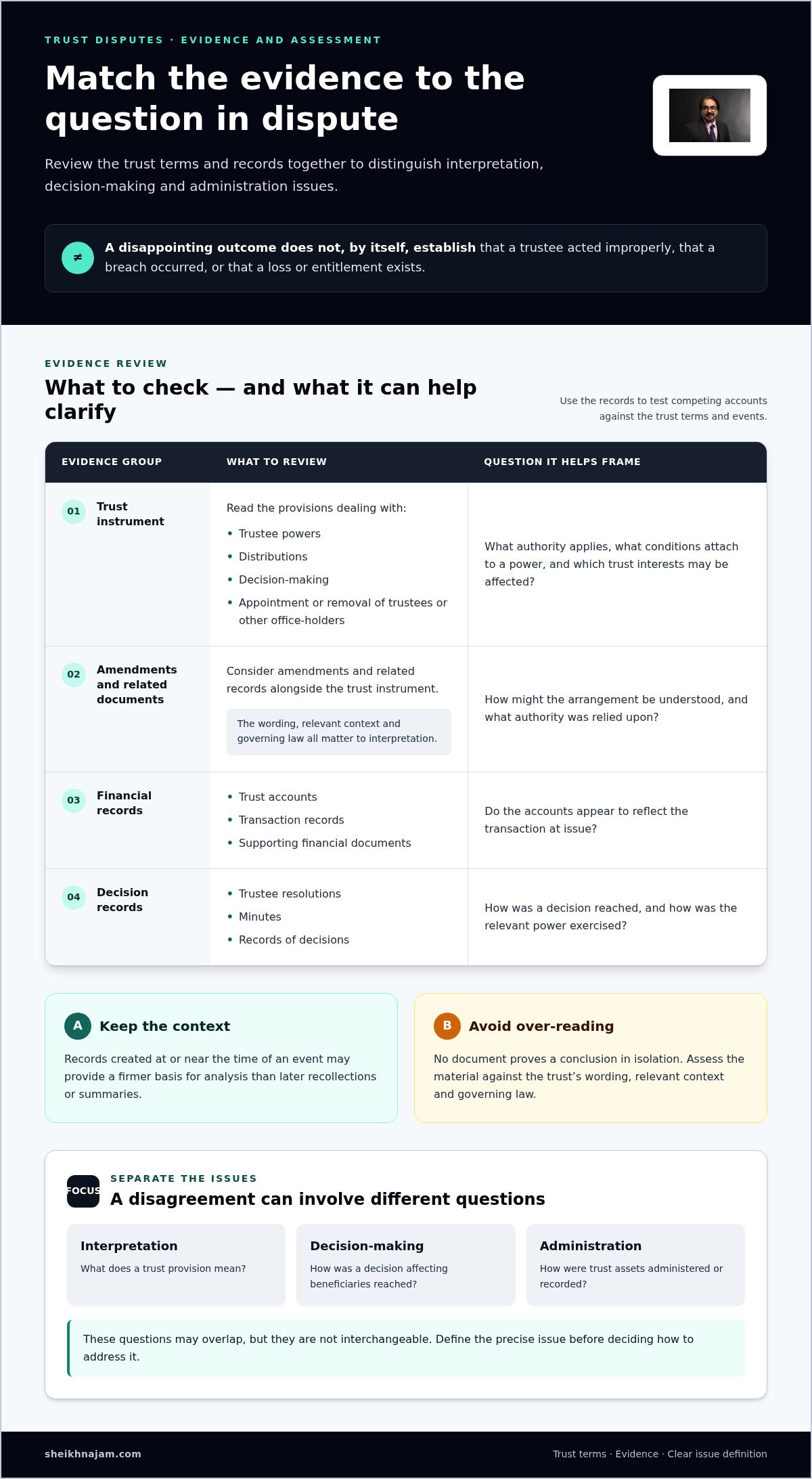
A sound assessment starts with the documents that created and govern the trust, not with one party’s interpretation of events. The trust instrument, amendments and related records provide the framework for identifying the powers available, how decisions may be made and which interests may be affected. The trust instrument and contemporaneous records are central because they allow competing accounts to be tested against the terms and events at the time.
This framework helps separate the questions in dispute. The issue may concern the meaning of a clause, the exercise of a power, the administration of assets or an allegation that a trustee failed to comply with an applicable duty. These questions can overlap, but they are not interchangeable. Disagreement with an outcome does not, by itself, establish a breach, loss or entitlement.
What should the trust instrument and related documents establish?
Review the provisions dealing with trustee powers, distributions, decision-making and any process for appointing or removing trustees or other office-holders. Then consider amendments and related documents, which may help explain the arrangement or the authority relied upon. No single document necessarily resolves every question. Interpretation depends on the wording, relevant context and governing law, so the analysis must be specific to the trust.
For example, if a beneficiary disputes a distribution decision, examine the terms governing that decision, any conditions attached to the power and the record of how it was exercised. If the concern is that the trust accounts do not appear to reflect a transaction, the focus is different. Defining the precise issue helps prevent a question of interpretation from being mistaken for an allegation about administration or conduct.
What evidence can clarify the parties’ competing accounts?
Assemble evidence in a way that preserves its context. Records created at or near the time of an event may provide a firmer basis for analysis than later recollections or summaries, although no document proves a conclusion in isolation. Relevant material may include:
Trust accounts, transaction records and supporting financial documents.
Trustee resolutions, minutes and records of decisions.
Correspondence concerning instructions, distributions or objections.
Valuations and other records relevant to the assets or decisions in question.
Read these materials alongside a chronology. A resolution may record what was decided, while correspondence or contemporaneous notes may show what information was considered and the sequence of events. Keep original records intact and distinguish direct evidence from recollection or later interpretation. If the documents or parties’ roles leave material questions unresolved, a focused review with trust dispute advisers can help define the issues and next steps.
Which route can resolve a trust dispute proportionately?
The appropriate route depends on the issue to be resolved, who needs to participate, the information available and the outcome sought. A proportionate strategy does not assume that negotiation is always preferable or that proceedings are inevitable. It considers whether a route can address the substantive disagreement, protect relevant interests and provide an outcome the parties can use.
The trust’s governing law and terms, the urgency of the issue and the position of potentially affected beneficiaries may all influence that assessment. Confidentiality, enforceability, participation and formality vary according to the process, any arrangements made and the circumstances. A dispute involving a pressing decision or parties who cannot agree may need a different response from one centred on an explanation of accounts.
When might negotiation or mediation be considered?
Direct negotiation can give parties control over the discussion and its pace, particularly when they can exchange relevant information and define the issue in dispute. Mediation adds an independent facilitator who helps structure discussions and explore settlement. It is facilitated negotiation, not a guaranteed settlement or a binding decision in itself. Its suitability depends on whether the parties can engage meaningfully and whether the necessary information and participants are available.
Mediation may help parties clarify competing objectives, test possible compromises or preserve a working relationship, but it is not appropriate in every case. Before proceeding, consider who needs to take part, what information can be shared and whether a proposed agreement can properly address the interests affected. The guide to resolving trust disputes through mediation provides further context on this route.
When might arbitration or court proceedings be relevant?
Arbitration is a more formal, private decision-making process, but it depends on an appropriate agreement or other applicable legal basis. Whether it can resolve the particular issues, bind those affected and produce an effective outcome requires case-specific analysis. Court proceedings may be relevant when a judicial determination or orders are sought, or when the dispute cannot be resolved through consensual routes.
Negotiation: Flexible and party-led, but dependent on constructive engagement and sufficient disclosure.
Mediation: Facilitated and settlement-focused, with no decision imposed by the mediator.
Arbitration: A formal determination route where an appropriate basis exists, subject to the trust’s circumstances and applicable law.
Court proceedings: A formal route for judicial decisions or orders, with procedure and participation shaped by the relevant jurisdiction.
These routes are not interchangeable. A proposed settlement may need to be recorded or formalised to achieve the intended effect. Do not assume that it will be private or enforceable in every circumstance. Similarly, an urgent concern does not, by itself, identify the correct procedure. Consider the governing law, forum, procedural rules and potential impact on beneficiaries before choosing a route, so that the response addresses the dispute rather than simply escalating it.
What to prepare before taking action in a trust dispute
Preparation can make an initial assessment more focused and help identify whether the matter needs prompt attention. Organise the available information without trying to resolve contested legal questions yourself. Preserve relevant records in their original form, handle sensitive material securely and avoid unnecessary circulation. Do not alter, delete or selectively withhold documents.
How to organise the facts and documents
Build a clear record that another person can follow. Separate what a document or dated communication establishes from your recollection, assumptions and questions. Include relevant events even if they complicate your account: a balanced chronology is more useful than an incomplete narrative.
Preserve the records. Gather the trust instrument, amendments, accounts, correspondence and decision records relevant to the concern. Keep originals intact and note where each item came from.
Create a chronology. Record the dates of decisions, communications, transactions and other events, with a brief description and a reference to any supporting document.
Identify the parties. List the trustees, beneficiaries and any other person whose role or interests may be relevant. Distinguish what is known from what remains uncertain.
Define the concern. State the decision, action or omission in question, why it matters and what clarification or outcome you seek. Mark unresolved issues as questions, not established facts.
Store the material securely and keep a record of later additions. If documents contain sensitive personal or financial information, restrict access to those who need it for the assessment. Careful handling preserves context and reduces the risk that a partial or altered record will obscure what happened.
What immediate risks should be identified?
Alongside the underlying disagreement, identify events that may affect the trust before the issue is resolved. Note any imminent trustee decision, proposed distribution, asset transfer or change in the management of trust property. Also record concerns about confidentiality, family relationships and continuity of administration, as these may shape how discussions should proceed.
Record the date and nature of any decision or transaction believed to be imminent.
Identify assets or administrative matters that may be affected, without assuming a particular protective measure is available.
Flag any stated deadline, notice or procedural step for prompt, case-specific review.
Deadlines and protective options depend on the particular claim, governing law and relevant jurisdiction. Do not assume that a timetable applying to one dispute applies to another. Prompt legal assessment is important where delay may affect rights, assets or trust administration.
If the trust dispute intersects with estate administration, the probate context may also matter. A strategic analysis of contentious probate considers estate litigation more broadly, without making will validity the focus of preparing for a trust dispute.
To discuss the documents, chronology and immediate concerns with Sheikh Najam TEP, contact the practice about your trust disputes London.
How specialist advice can move a trust dispute towards resolution
A focused assessment brings the trust’s terms, the parties’ roles, the available evidence and the desired outcome into one coherent analysis. This helps identify which issues are established, which need further information and which depend on the governing law or procedural context. The objective is not to presume a particular outcome, but to determine what options are realistically available and what decision should come next.
This joined-up approach can be particularly relevant when trust administration overlaps with an estate or contentious probate matter. Sheikh Najam TEP advises on trust disputes, contentious probate and dispute resolution, bringing those areas together where the facts call for it. The assessment may consider the trust instrument and records alongside the interests affected, the practical consequences of delay and the parties’ objectives.
What a focused assessment should clarify
An initial review should define the central issue, identify the people whose roles or interests matter and establish which documents are needed to assess the competing positions. It should distinguish a concern about an outcome from a specific question about interpretation, decision-making or administration. That distinction helps determine what further evidence is needed and prevents assumptions from becoming the basis of an unnecessarily broad dispute.
Objectives need equal precision. A party may seek an explanation, a particular decision, protection of an interest or a resolution that allows administration to continue. These aims can differ, and the same process may not address them all. Consider potential risks, including effects on trust assets, relationships and ongoing administration, alongside the evidence and procedural context.
Advice depends on the trust terms, the quality and completeness of the evidence, the parties’ legal positions and the governing law. It can then identify whether further information is needed and whether direct discussions, mediation, arbitration or formal proceedings merit consideration. Mediation or arbitration may form part of a tailored strategy where appropriate, but neither is suitable or available in every dispute.
Taking the next step with Sheikh Najam TEP
A concise account can make an initial discussion more productive. Set out the nature of the trust, the parties involved, the central concern and any decision, distribution or procedural deadline that may need attention. Identify the outcome you hope to achieve and note what remains uncertain. You do not need to determine the legal character of the dispute before describing the facts.
Sheikh Najam TEP’s work across trust and estate matters, contentious probate, mediation and arbitration provides relevant context for assessing the issues and strategic options. Tailored advice can help evaluate the evidence and possible routes to resolution, but cannot promise a particular result. To discuss the facts and next steps, submit a confidential case enquiry.
Make your next decision with a clear strategy
The next step in a trust conflict need not be a commitment to proceedings. It is a decision about what needs clarification, what must be protected and which resolution route suits the interests involved. For those considering trust disputes London, a focused discussion can turn an uncertain concern into a defined set of questions and a proportionate plan informed by the trust terms, evidence and applicable legal context.
Sheikh Najam TEP brings together advice on trust disputes and contentious probate with mediation and arbitration experience, so potential resolution routes can be considered in the context of the facts. Any strategy must be grounded in the available evidence and governing law, and cannot promise a particular result. A clear account of the central concern, the parties involved and any immediate issue provides a constructive basis for deciding what comes next.
Discuss your trust dispute with Sheikh Najam TEP and take the next step with greater clarity and confidence.
Frequently Asked Questions
Can a beneficiary challenge a trustee’s decision?
Yes, a beneficiary may be able to challenge a trustee’s decision, but whether a challenge is justified depends on the trust instrument, the decision and the applicable law. For example, assess a decision about a distribution against the power relied upon and the circumstances in which it was exercised. Disappointment with the result alone does not establish that the decision was unlawful. Before making a formal challenge, clarify the concern and the outcome sought.
Can a trustee be removed during a trust dispute?
Possibly, but a trustee’s removal depends on the trust terms, the trustee’s role and the circumstances. An instrument may give a named person or office-holder power to appoint or remove trustees. If it does not, a formal legal process may need consideration. A request to replace a trustee should identify the practical concern, such as an inability to administer the trust effectively, rather than treating removal as an automatic consequence of disagreement. The applicable law and jurisdiction matter.
How long does a trust dispute take to resolve?
There is no reliable standard timetable for resolving a trust dispute. A disagreement involving a small number of parties and a defined issue may progress differently from a matter with extensive records, a complex trust structure or assets across borders. Negotiation or mediation may follow a different sequence from arbitration or court proceedings. Any estimate should be treated as provisional and revised if new evidence, parties or procedural issues emerge.
What happens if a trust dispute involves assets in more than one country?
For a cross-border dispute, identify the relevant connections before assuming which law or forum applies. The trust’s governing law, where assets are held, the parties’ locations and any dispute-resolution arrangements may all be relevant. The rules and procedures of different jurisdictions can vary, and one country’s approach may not answer every issue. Organising the facts early can help identify which legal questions are connected and which need separate assessment.
Can a trust dispute be settled without going to court?
Yes, some trust disputes may be resolved without court proceedings through direct negotiation or mediation, where those routes suit the parties and issues. Arbitration may also be considered if there is an appropriate agreement or legal basis. Settlement still requires careful attention to who has authority to agree, whose interests may be affected and how the resolution should be documented. A negotiated outcome is not automatically binding on every person connected with the trust.
Are there time limits for bringing a trust dispute?
Potential time limits depend on the legal basis of the issue, relevant events, the governing law and the jurisdiction. A dispute about one decision may engage different considerations from a claim based on another set of facts, so do not rely on a general timeframe. Keep records of dates, notices and decisions, and seek case-specific advice promptly if action is proposed or a deadline may be approaching. Delay can affect the options available.
What documents should I gather for a trust dispute?
Start with the executed trust instrument and any amendments, then identify records relevant to the specific issue, such as accounts, trustee decisions and correspondence. If the concern relates to a distribution, for example, note the date, the communication received and any supporting account entry. Keep original documents unchanged and organise copies securely. Avoid circulating sensitive material unnecessarily, and label recollections or later summaries clearly so they are not mistaken for records created at the time.



Comments