Trustee Removal: Legal Grounds, Procedures and Practical Steps

If you are researching trustee removal, the first question is not simply whether a trustee should go, but whether there is a lawful route to remove them. A strained relationship or serious allegation may prompt urgent concern, but neither necessarily justifies removal. The key issue is whether the proposed step is lawful and supports the proper administration of the trust and the beneficiaries’ interests.
It is understandable to be uncertain about who has the power to act, what conduct may justify removal and whether court proceedings could deepen conflict or disrupt the trust. This article explains how to identify the applicable route, what evidence and procedural safeguards may matter, and how to assess proportionate next steps.
Start with the trust instrument, which may specify who can appoint or remove trustees. Then consider statutory routes under the Trustee Act 1925 and, where its conditions are met, section 19 of the Trusts of Land and Appointment of Trustees Act 1996. If court intervention may be necessary, the legal threshold, supporting evidence and possible role of mediation all need careful consideration. Assessing these issues at the outset can help protect the trust’s administration while addressing legitimate governance concerns.
Key Takeaways
Identify the type of trust and review the governing instrument first. It may determine who can remove or replace a trustee and what procedure they must follow.
Compare the available routes, including any power in the deed, statutory mechanism or court application, before deciding how to proceed.
Conflict or loss of confidence alone may not justify removal. Assess whether the trustee’s conduct affects the trust’s administration, their duties or the beneficiaries’ interests.
Gather the trust instrument, appointment records, relevant correspondence and administration documents. Then consider alternatives and how the trust will continue to operate.
Removal does not resolve every dispute or determine separate liability. Plan for a successor, an orderly handover and the trust’s ongoing administration.
Table of Contents
What Does Removing a Trustee Mean for a Trust?
Removing a trustee ends that person’s office and authority to act in that capacity. It is separate from appointing a successor: removal concerns how a trustee leaves office, while appointment concerns who takes on the role and how that appointment must be made. The two steps may be dealt with together, but one does not automatically complete the other.
A trustee holds and administers trust property under the terms of the trust. Their responsibilities may include safeguarding assets and making decisions for beneficiaries. The general concept of trusteeship is outlined in Trustee, but the route in a particular case depends on the governing instrument and applicable law, not a general description.
Dissatisfaction alone does not automatically establish a lawful route for removing a trustee. Assess the circumstances against the trust’s terms and the effect of the proposed change on its proper administration. Removing a trustee without ensuring that someone has authority to manage assets, make decisions and meet obligations may create further difficulties. Continuity and the appointment of a successor therefore need separate attention.
Who may seek a trustee’s removal?
The answer depends on the trust instrument and the legal mechanism available. A deed may give a specified person, such as a settlor or protector, an express power. It may also assign a role to co-trustees or another authorised appointor. Beneficiaries may have rights or a route to seek court intervention in particular circumstances, but being affected by a trustee’s decisions does not, by itself, give them unilateral power to remove that trustee.
Identify the source of authority before taking action or saying that removal has taken effect. A person’s connection with the trust, whether as beneficiary, settlor or co-trustee, is not the same as a power expressly conferred by the deed or available under law.
Why the trust deed is the starting point
Review the complete trust instrument, including amendments and documents recording later appointments. Look for provisions covering removal, retirement, appointment and replacement. Note who may exercise each power and whether the deed sets conditions, notice periods, written-form requirements or decision-making procedures.
Interpret the wording in the context of the particular trust. A clause that appears to grant a broad power may still prescribe how it must be exercised. Avoid relying on an isolated sentence or assuming that a procedure for retirement also authorises compulsory removal.
The trust’s structure matters too. A private trust, charitable trust and arrangement in which a company acts as trustee may involve different governing documents, decision-makers and administrative consequences. In a corporate arrangement, removing the company as trustee is distinct from changing its directors or officers. Those internal changes do not, by themselves, resolve the company’s position under the trust. Careful analysis of the instrument and circumstances is central to a proportionate approach to trustee disputes.
Which Legal Routes Can Remove or Replace a Trustee?
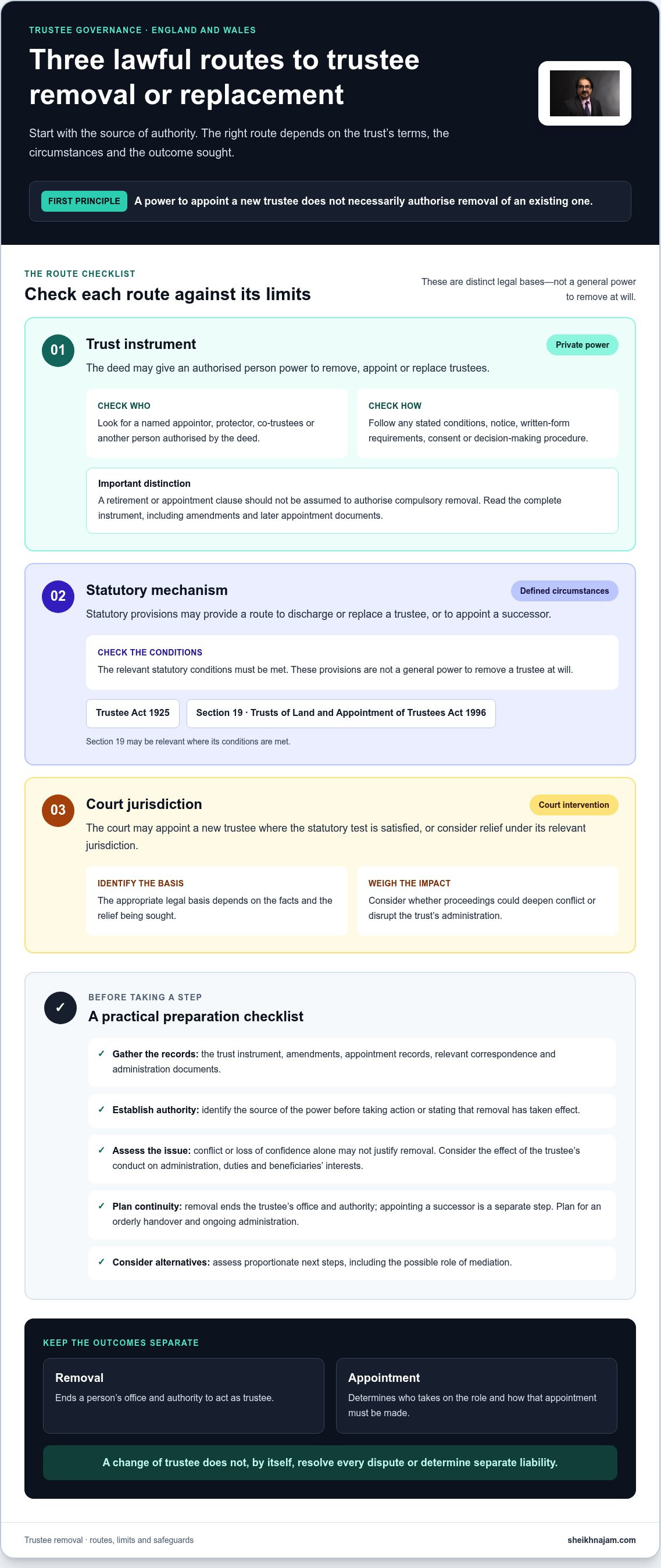
In England and Wales, the route depends on the trust’s terms, the circumstances behind the proposed change and whether the aim is to end a trustee’s office, appoint a successor or do both. These are related but distinct outcomes. A power to appoint a new trustee does not necessarily authorise the removal of an existing one.
The trust deed defines any private power, statutory provisions may enable a change in specified circumstances, and the court can intervene where its jurisdiction is properly engaged. This comparison is a starting point, not a substitute for interpreting the instrument and applicable law.
Can the trust instrument provide a removal power?
An express clause may identify who can exercise a removal power, such as a named appointor, protector or another authorised party. It may also state whether a replacement must be appointed at the same time and prescribe written notice, consent, a decision-making process or other formalities. Read the deed as a whole, including amendments and appointment documents. A clause dealing with retirement or new appointments should not be assumed to authorise compulsory removal.
When might statutory or court powers apply?
Under section 36 of the Trustee Act 1925, a trustee may be replaced without court involvement in specified circumstances, including death, remaining outside the United Kingdom for more than a year, or being unfit or incapable of acting. This provision is conditional, not a general remedy for disagreement. Section 41 empowers the court to appoint a new trustee where doing so is expedient and it is difficult or impracticable to make the appointment without the court’s assistance. It concerns appointment and should not be treated as an automatic finding of misconduct or liability.
Section 19 of the Trusts of Land and Appointment of Trustees Act 1996 may also allow beneficiaries who are of full age and capacity and absolutely entitled to the trust property to direct retirement and appointment in writing, where the instrument has not nominated a person to appoint trustees. Its conditions must be met.
Charitable trusts require separate analysis of the charity’s governing document and applicable charity law. The Charity Commission’s statutory role may be relevant. Where a trustee is a company, company-law procedures concerning its directors are distinct from changing the company’s office as trustee. Scottish legal materials must not be applied as though they state the law of England and Wales.
For a trustee removal London matter, begin by identifying the governing instrument and proposed legal basis. This can help distinguish an available power from a court application. Sheikh Najam TEP advises on trust disputes. Read more about trust dispute advice.
Are Conflict or Misconduct Enough to Justify Trustee Removal?
Disagreement between a trustee and beneficiaries, or a loss of confidence in the trustee, does not by itself establish that removal is justified. A court application is not a way to choose the trustee whose decisions beneficiaries prefer. The central concern is generally whether the trustee’s continued appointment is inconsistent with the proper administration of the trust and the beneficiaries’ interests. The applicable test depends on the legal route and the trust’s circumstances.
An allegation does not prove a breach of duty. Assess concerns against the trust instrument, the trustee’s responsibilities and evidence of what actually happened. A contested relationship may be relevant if it obstructs administration, but it does not guarantee court-ordered removal. The court considers the facts and practical consequences of the relief sought, rather than treating either side’s assertions as established.
What circumstances may warrant closer legal analysis?
Different concerns call for different evidence. An alleged breach of trust may require examination of transaction records, decisions and communications. An asserted conflict of interest may turn on the trustee’s personal involvement and its effect on impartial decision-making. A pattern of missed administrative tasks or failure to respond may matter if it impedes the trust’s work, while an isolated delay may need different consideration.
Incapacity or inability to act must be assessed under the legal route relied on, rather than assumed from age, illness or disagreement. Persistent deadlock may also matter if trustees cannot make decisions needed to manage assets or meet obligations. Even then, consider the cause, duration and effect of the impasse, and whether it can be addressed without removal.
How are beneficiaries’ interests considered?
The analysis focuses on proper administration, not personal preference alone. Ask whether the trust can continue to be managed effectively, whether decisions can be made impartially, and whether removing a trustee would disrupt essential functions or leave a gap in authority. The trust’s purposes and the position of beneficiaries as a whole may also inform the assessment.
For example, a beneficiary’s objection to an investment decision is not, without more, proof that the trustee has acted improperly. The decision may need to be considered in light of the trustee’s powers, the information available and the reasons recorded. Conversely, a sustained inability to administer the trust or a substantiated conflict affecting decision-making may raise more serious concerns. Neither example determines the outcome. Both show why the facts and legal basis must be assessed together.
Before advancing a removal case, separate documented events from interpretation and identify how each concern has affected administration or beneficiaries. This helps clarify whether the issue is alleged misconduct, incapacity, deadlock, persistent non-performance or a practical need for replacement, and whether removal is proportionate to the problem.
How Should You Prepare for a Trustee Removal Application?
Preparation should establish both the legal basis for the proposed change and how the trust will continue to function if it proceeds. A focused record separates documented events from disagreement or inference and helps the decision-maker understand the practical consequences. Work through these steps in order:
Identify the trust. Confirm its nature, governing law and current trustees. Assemble the trust instrument, amendments and appointment records to establish the context for assessing authority and the trust’s ongoing requirements.
Review the proposed authority. Locate the relevant deed provision or statutory route, then record who may act and any conditions, notices, consents or formalities that appear to apply. Do not assume that a power to appoint a successor also authorises removal.
Assemble relevant records. Gather appointment documents, trust accounts, decisions, correspondence and administration records. Prepare a chronology of requests, responses and significant events, with references to supporting material.
Assess alternatives. Consider whether the concern can be addressed through clearer processes, a trustee discussion or another proportionate resolution. The right approach depends on the dispute, its urgency and the trust’s circumstances.
Plan continuity. Consider the proposed successor and how authority, records and current administration will be handed over lawfully, so the trust can continue to manage its affairs.
What evidence and documents should be organised?
Organise the material so each concern can be linked to a deed provision, responsibility or practical consequence. Separate primary records, such as dated correspondence or account entries, from interpretation and untested allegations. Preserve relevant documents and communications lawfully, maintain their original context and avoid selective extracts that could obscure what was said or decided. A clear chronology can reveal gaps as well as support a concern.
What should be considered before formal proceedings?
Check the instrument for notice, consent or decision-making requirements, and consider whether those steps can be followed without prejudicing the trust. Mediation or another suitable form of dispute resolution may offer a proportionate route, although it will not resolve every issue or replace a necessary formal application. Sheikh Najam’s trust dispute resolution experience informs consideration of both court proceedings and non-court options.
Before taking action, map out the transition: who can exercise authority during the change, which records and financial information must be transferred, and what decisions need attention in the interim. Reviewing the evidence, legal route and continuity plan together can help clarify risks and proportionate next steps in a trustee removal matter. Explore advice on trust removal concerns.
What Happens After Removal, and When Should You Seek Advice?
Removal changes who holds office; it does not, by itself, resolve the dispute that led to the change or determine whether a trustee has breached a duty. Any separate claim concerning past conduct, loss to the trust or a trustee’s liability must be considered on its own facts and legal basis. The practical priority is to secure a valid transition and keep the trust functioning.
How can trust administration continue after a change?
A successor must be appointed under the trust instrument or applicable legal mechanism. Coordinate the outgoing trustee’s departure with that appointment so the trust is not left without the authority or capacity needed to administer its affairs. The precise steps depend on the deed, the assets involved and the basis on which the trustee leaves office.
A structured handover should cover the records and responsibilities needed for uninterrupted administration, including:
Trust documents, appointment records, accounts and correspondence.
Information about assets, liabilities, ongoing transactions and pending decisions.
Access to relevant accounts, records and administrative systems, where authorised.
Outstanding obligations, reporting requirements and matters requiring prompt attention.
The successor and continuing trustees should be able to identify what has been transferred, what remains outstanding and who is responsible for each pending matter. Keeping a clear record of decisions and handover steps supports oversight and reduces the risk that an administrative gap becomes another source of conflict. Handle confidential or sensitive material in accordance with the trustee’s authority and the trust’s requirements.
When can specialist dispute advice assist?
Advice may be useful where authority to remove is disputed, the legal test is uncertain, material evidence is contested or the proposed route depends on the court’s jurisdiction. It can also help distinguish a removal issue from separate allegations about a trustee’s past conduct. The appropriate approach depends on the facts: mediation may help resolve a dispute, while court proceedings may be necessary where agreement cannot properly secure the trust’s administration.
Sheikh Najam advises on trust disputes and contentious probate. Its dispute-resolution experience informs consideration of both non-court options and litigation. Where an alleged breach is central, assess the relevant duties, records and events carefully. An allegation alone does not establish liability, and the appropriate analysis depends on the trust’s circumstances and the evidence available.
Consider not only whether removal has taken effect, but also whether a successor is in place, essential records have been transferred and any separate dispute remains unresolved. A measured review of those issues can clarify possible next steps without presuming a particular outcome. Discuss your trust dispute and possible next steps.
Choose a Proportionate Path Forward
A change in trusteeship can shape the trust’s governance and relationships beyond the immediate dispute. Before committing to a course of action, consider what a workable outcome requires: clear authority, effective administration and a process that addresses the underlying concern without creating avoidable uncertainty.
Sheikh Najam TEP advises on trust disputes and contentious probate, and offers mediation and arbitration as dispute-resolution options. This experience can inform a careful assessment of the issues and routes that may be appropriate in the circumstances, without presuming how a dispute should be resolved.
If you are considering trustee removal London, a focused discussion of the trust’s circumstances can help clarify the questions to address and possible next steps. Discuss your trust dispute and possible next steps.
Frequently Asked Questions
Can beneficiaries remove a trustee without going to court?
Beneficiaries do not automatically have unilateral power to remove a trustee without court involvement. The trust instrument may grant a removal power to beneficiaries or another authorised person, but an informal vote or collective objection is not a substitute for exercising a valid power in the required way. Before acting, check the complete instrument, including amendments, and establish who holds the authority, what conditions apply and whether the relevant legal route is available.
What grounds may justify removing a trustee?
Whether removal may be justified depends on the trust, the route relied on and the evidence. An alleged breach, incapacity, persistent inability to act or conduct that impairs proper administration may warrant legal assessment, but none is automatically decisive. For example, a missed administrative task may have a different significance from a continuing failure that prevents necessary decisions. Disagreement or dissatisfaction alone does not ensure removal, and an allegation is not proof.
Can a trustee be removed if the trust deed has no removal clause?
Yes. The absence of an express removal clause does not necessarily end the analysis. A statutory mechanism or the court’s jurisdiction may be relevant, depending on the trust and circumstances, but neither guarantees that a trustee will be removed. The applicable law matters too: rules in Scotland or another jurisdiction should not be treated as governing an England and Wales trust. Identify the trust’s governing law and the precise relief sought before choosing a route.
Can a trustee be removed for breach of trust?
An alleged breach may support consideration of removal, but removal and a separate claim for liability are distinct questions. Relevant evidence might include transaction documents, trustee decisions and records showing the effect on administration. The trust terms, beneficiaries’ interests and nature of the alleged breach may all matter. A legal assessment must consider the particular facts. An allegation alone does not establish that a breach occurred or determine the outcome.
Does the Trustee Act 1925 apply to every trust removal dispute?
No. Provisions of the Trustee Act 1925 may be relevant to some trust situations in England and Wales, but the appropriate route depends on the trust and circumstances. Sections 36 and 41 address different statutory mechanisms, so neither should be treated as a universal removal power. Charity, corporate and international arrangements may require separate analysis of their governing documents, legal structure and applicable law before the Act’s relevance can be assessed.
Can a charity trustee be removed using the same process as a private trust trustee?
Not necessarily. A charity’s governing document, legal form and regulatory context may affect the process, so guidance about charity trustees should not be applied as a universal rule for private trusts. Charity Commission guidance addresses charity governance. Where the charity is a company, company-law procedures relating to directors may also be relevant. Distinguish removal from the charity trustee role from changes to a charitable company’s directors, as these are separate matters.
How long does it take to remove a trustee through the court?
There is no reliable general timetable. Duration depends on the legal route, evidence required, procedural steps and whether the application is contested. A deed-based process and court proceedings involve different requirements, and delays may arise if authority or material facts are disputed. Rather than relying on an assumed timeframe, identify the steps still required and plan how decisions, payments and other trust administration will continue while the matter is unresolved.



Comments