Executor Liability in the UK: Duties, Risks and Practical Safeguards

Could a decision made in good faith still expose an executor’s personal assets? The possibility of executor liability is a legitimate concern, particularly where tax remains unpaid, estate assets are distributed too soon or beneficiaries challenge a decision. But an adverse outcome alone does not necessarily establish a breach of duty. The care taken, information available and way decisions were recorded may all matter.
Executors must balance the proper administration of the estate with beneficiaries’ interests, creditor claims and tax obligations, often under time pressure. An administrative error can have consequences beyond the estate itself, but not every mistake creates personal liability. This article explains when liability may arise, which duties need particular attention and how clear records, informed decisions and carefully timed distributions can reduce avoidable risk.
It also considers how tax, administration and disputes can intersect, and when specialist probate or contentious-estate advice may be appropriate. Probate and intestacy rules differ across England and Wales, Scotland and Northern Ireland, so identifying the relevant jurisdiction is an important first step in assessing an executor’s position.
Table of Contents
Executor liability: what personal responsibility means in estate administration
Executor liability is the potential personal exposure of an executor to a claim for loss caused by a breach of duty in administering an estate. It does not mean that an executor automatically becomes responsible for every debt owed by the deceased, or for every reduction in the estate’s value. The executor administers estate assets; personal liability is a separate question, which arises where the executor’s conduct is alleged to have breached an applicable duty and caused loss.
This distinction matters. A debt owed by the deceased is ordinarily dealt with as part of the estate administration, rather than being proof that the executor owes the debt personally. A beneficiary or creditor might, however, allege that the executor’s own act or omission caused additional loss. Whether that allegation has merit depends on the relevant duty, the circumstances, and evidence of causation and loss. A demand or complaint, by itself, does not establish liability.
Who is an executor, and when does responsibility begin?
An executor is appointed by a will to administer the deceased’s estate. Where there is no effective executor able to act, an administrator may instead be appointed under the applicable procedures. Terminology and authority differ across the UK. Scotland, for example, uses distinct terms and processes, while probate procedures also differ between England and Wales and Northern Ireland. A general overview of the role appears under Executor (law), but the rules in the relevant jurisdiction govern a particular estate.
Responsibility concerns the period of administration, from the death until estate assets have been properly dealt with and transferred. In practice, this means taking reasonable care of property and financial assets while the estate is identified, liabilities are considered and entitlements are administered. The precise steps, and when formal authority is required, depend on the jurisdiction and circumstances.
Estate liability versus an executor’s personal exposure
A deceased person’s valid debts are generally dealt with from estate assets, in accordance with the applicable rules. If the estate cannot meet all claims, the order and treatment of those claims can become legally significant. An executor should not assume that each creditor is entitled to payment in full, or that a claim against the executor personally will succeed.
Personal exposure instead turns on the executor’s own conduct. The central questions are whether a duty applied, whether it was breached, and whether that breach caused a quantifiable loss. An asset falling in value does not, without more, prove misconduct: the result may reflect market conditions rather than an unreasonable decision. By contrast, a failure to take appropriate care of estate property could invite scrutiny if it caused avoidable damage or loss. Evidence of the information available and the steps taken at the time is therefore central to assessing executor liability.
The distinction is not simply between a successful and unsuccessful administration. It is between the estate’s obligations and a substantiated allegation that the executor’s breach caused loss. Any assessment must take account of the facts and the law applicable in the relevant UK jurisdiction.
Which executor duties can give rise to personal liability?
An executor’s responsibilities extend beyond transferring assets to beneficiaries. The way estate property is preserved, financial information is established, tax obligations are addressed and distributions are made can all become relevant if a loss is alleged. A useful legal formulation is: personal liability may arise where an executor breaches an applicable duty and that breach causes loss, subject to the law and circumstances of the particular estate. A poor outcome alone does not establish each of those elements.
The standard of care and the procedures governing an estate depend on its circumstances and jurisdiction. In broad terms, the principal areas requiring attention are:
Asset preservation: identify estate property, protect it from avoidable damage or loss, and manage it appropriately during administration.
Accurate administration: establish what the estate owns and owes, maintain reliable accounts, and record material decisions and transactions.
Creditors and tax: identify relevant claims and consider tax reporting and payment obligations before treating the estate as ready for distribution.
Beneficiary distributions: apply the will or other applicable rules correctly, taking account of liabilities and the estate’s position before transferring assets.
Protecting assets and keeping reliable estate records
Practical care starts with a clear record of the estate’s assets and their condition, followed by proportionate steps to safeguard them. Depending on the asset, this might mean securing property, maintaining suitable insurance or monitoring an investment during administration. Delay can matter if it exposes an asset to avoidable deterioration or expense. Undocumented action can also make it harder to explain why a decision was reasonable based on the information available at the time.
Keep contemporaneous records of valuations, correspondence, payments, decisions and the reasons for significant choices. These records can help distinguish an unavoidable change in value from loss that may be attributed to neglect or an inadequately considered step.
Debts, tax reporting and distributions to beneficiaries
Before distributing the estate, an executor should establish known debts and consider whether further liabilities or tax obligations remain. The GOV.UK guidance on estate administration outlines practical responsibilities during this process. Tax is not a single category: Inheritance Tax concerns the transfer of value on death, while Income Tax and Capital Gains Tax may arise in connection with estate income or gains during administration. Which returns, calculations or payments are required depends on the estate and applicable rules.
A premature distribution may leave insufficient estate funds to meet a liability identified later, potentially exposing the executor to a claim. An incorrect distribution may also require recovery from a recipient, although the legal position depends on the facts and relevant law. Executor liability is therefore assessed by examining the duty owed, the executor’s conduct, whether that conduct caused loss, and the evidence supporting the allegation. Where tax treatment, creditor claims or beneficiary entitlements are uncertain, advice on complex estate administration concerns can help clarify the position before funds are distributed.
Executor liability: common assumptions and the facts that change the analysis
Concerns about personal exposure can lead executors to treat every complaint as evidence of wrongdoing, or to assume that good intentions provide complete protection. Neither approach is reliable. The analysis turns on the authority under which a decision was made, each executor’s conduct, the duty applicable in the relevant jurisdiction and whether an alleged breach caused loss. A beneficiary’s dissatisfaction may warrant a response, but it does not by itself establish a legal claim.
Assumption
What changes the analysis
An estate has lost value, so the executor must be liable.
A fall in value may result from market conditions or other events outside the executor’s control. The question is whether an actionable breach caused the loss.
Any mistake creates personal liability.
The nature of the error, the duty engaged, the consequences and the possibility of correction all matter.
A beneficiary’s objection proves misconduct.
An objection is an allegation, not a finding. The evidence and the executor’s authority and decision-making must be examined.
All co-executors are automatically liable for one person’s act.
Each executor’s role and conduct require assessment under the law governing the estate. Liability should not be assumed to be automatic or identical.
Does every mistake make an executor personally liable?
No. A minor clerical error that is promptly identified and corrected may be materially different from a failure that breaches a duty and causes financial harm. An inaccurate entry in an estate account, for example, does not by itself establish that assets were lost. An unexplained payment or an avoidable failure to protect property may require closer scrutiny. Good intentions are relevant context, but do not by themselves establish that the executor met the applicable standard.
Assessment requires more than identifying an imperfect decision. It asks what the executor was authorised and required to do, what information was available at the time, whether the conduct fell short of the relevant duty, and what loss followed as a result. Citizens Advice on executor duties summarises practical responsibilities, but the legal effect of a particular error depends on its facts and governing law.
How can beneficiaries’ claims and co-executor conduct affect exposure?
A beneficiary may question a valuation, delay or distribution, but the concern must be distinguished from proof of breach and resulting loss. Where several executors are appointed, relevant questions may include who made the decision, what was agreed or authorised, whether another executor participated, and whether any executor raised concerns or took steps to address them. A signature or appointment alone does not give a complete account of an individual’s conduct.
Procedure and legal terminology differ across England and Wales, Scotland and Northern Ireland. A conclusion reached under one jurisdiction’s rules should not be presented as universal UK law. In a contested estate, executor liability is best assessed against the will, administration records, correspondence and applicable jurisdiction, rather than inferred from a poor outcome or accusation alone.
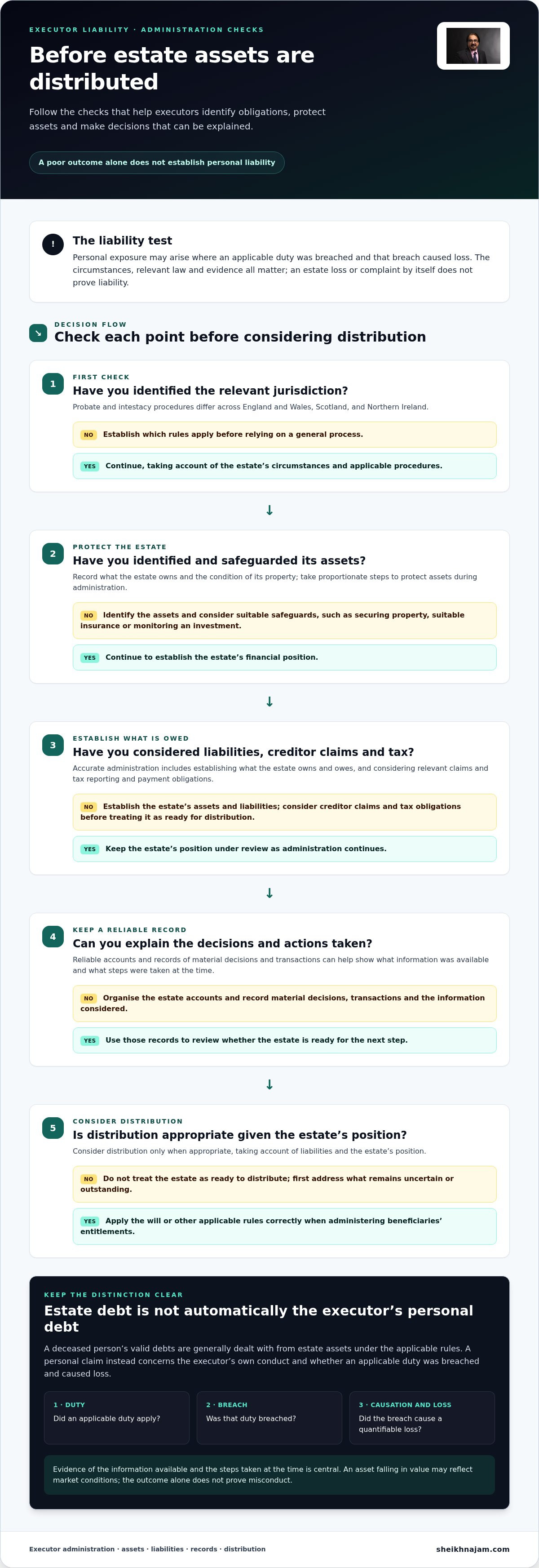
How executors can reduce liability risk through careful administration
Risk is best managed through a consistent process, rather than relying on memory or leaving difficult decisions until distribution. The appropriate steps depend on the estate and its jurisdiction, but a disciplined sequence can reveal missing information and unresolved issues before they become harder to address.
Identify the estate: establish what assets and liabilities may exist, including property, financial accounts, investments, personal possessions and any interests held through trusts or overseas arrangements.
Preserve assets: take proportionate steps to protect estate property during administration. Depending on the asset, this may involve securing it, arranging maintenance or reviewing how it is being managed.
Establish liabilities: investigate known debts and consider relevant tax obligations before treating the estate as ready for distribution.
Record material decisions: retain supporting documents and note the information and reasoning behind significant choices, particularly where there is uncertainty or disagreement.
Distribute only when appropriate: check that the proposed distribution reflects the will or applicable rules and takes account of the estate’s known position.
This sequence is not a guarantee against a claim. It can, however, help executors make informed decisions and identify when further assessment is needed.
A defensible decision-making and record-keeping process
Keep valuations, correspondence, statements, invoices, tax documents and records of receipts and payments together in a clear, retrievable form. An estate account can show how assets were received, what expenditure was made and what remains for distribution, allowing beneficiaries and co-executors to follow the administration. For a material decision, record the options considered, relevant advice or valuation evidence, and the reason for the course taken.
Good records provide evidence of the process. They do not make an otherwise improper decision lawful or cure a breach of duty. Their value is that they allow a decision to be assessed in context, rather than reconstructed from incomplete recollections after a disagreement has arisen.
Where several representatives are acting, agree practical arrangements for handling funds, approving expenditure and communicating significant decisions. If a beneficiary disputes a proposed step, preserve the correspondence and clarify the point in issue before proceeding. Advice on contentious probate matters may be relevant where a disagreement concerns the will, administration or entitlement to estate assets.
When complexity warrants professional support
Independent valuations may be proportionate where assets are unusual, illiquid or disputed. Tax advice may be appropriate where the estate includes complex tax questions, and specialist legal input can help clarify authority or duties where the will, beneficiaries or administration are contested. Cross-border assets, trusts, disputed wills and uncertainty about how tax and estate obligations interact are reasons to assess the issues before committing to a course of action.
In a high-value or complex estate, probate administration, tax treatment and contentious claims may affect one another. An allegation of breach of duty may also require consideration of whether trust-related obligations are engaged, without assuming that every executor decision raises a breach of trust issue. Where the analysis is uncertain, seek advice on a complex estate administration issue before implementing the disputed decision or distribution.
Resolving executor liability concerns in complex estates
Executor liability concerns call for a measured assessment, not an assumption that any adverse result creates personal responsibility or that appointment under a will provides complete protection. The practical questions are what the executor was authorised and required to do, what decisions were made, and whether any alleged breach caused loss. An early review can also distinguish urgent matters, such as preserving an asset or addressing an outstanding tax issue, from a longer-running disagreement about a beneficiary’s entitlement.
What an initial executor-liability assessment should clarify
A structured review should establish the executor’s appointment and authority, the stage reached in administration, the decisions already taken and the records available to explain them. It should then identify the specific alleged loss and test it against the duty said to apply, the executor’s conduct and the evidence of causation. The governing law matters: probate and estate rules differ across England and Wales, Scotland and Northern Ireland, so identify the relevant jurisdiction at the outset.
This process can help separate matters requiring immediate attention from issues needing a fuller dispute analysis. A proposed distribution, for example, may need to be considered alongside a creditor claim or unresolved tax question. A beneficiary’s challenge to the interpretation of a will may require a distinct examination of the will and the basis of the claim. Treating these as connected but separate questions helps avoid decisions based on an incomplete picture.
Taking the next step on a disputed or complex estate
Prompt advice may be appropriate where a distribution is imminent, a creditor’s claim remains unresolved, a beneficiary alleges misconduct, or the estate includes trusts, cross-border assets or complex tax considerations. Administration, tax and dispute issues can overlap: a matter affecting the estate’s available funds may also influence the timing or basis of a proposed distribution. Sheikh Najam TEP advises on probate and estate administration, inheritance tax, trusts and contentious probate, bringing relevant perspectives to complex estate matters. The practice’s specialist estate and dispute advice addresses connected administration and dispute concerns.
Before an assessment, assemble the will and any relevant grant or appointment documents, an outline of assets and liabilities, estate accounts, correspondence and a chronology of material decisions. If time is pressing, identify the immediate decision and any deadline or proposed transaction so it can be considered alongside the wider history. This does not predetermine whether a claim will succeed. It provides a sounder basis for understanding the executor’s position and the steps that may be appropriate under the applicable law.
If a beneficiary dispute, tax issue or proposed distribution raises concerns, request advice on your executor-liability concerns for a tailored assessment of the estate’s circumstances.
Take a considered next step on estate administration
Uncertainty about executor liability need not be resolved by assumption or by allowing a difficult decision to drift. A constructive next step is to examine the particular estate, the decision at issue and the available evidence, so that any response is grounded in the facts rather than apprehension or pressure from interested parties.
Where administration concerns intersect with inheritance tax, trusts or a beneficiary dispute, advice should account for those connected issues together. Sheikh Najam TEP advises on probate and estate administration, inheritance tax and trusts, as well as contentious probate and trust or will disputes. This breadth is relevant where an executor’s responsibilities are being questioned or the estate’s next steps are contested.
If you are facing a complex estate decision or a disputed claim, discuss your executor-liability matter with Sheikh Najam TEP. An evidence-led assessment can help you approach the next stage with greater clarity and confidence.
Frequently Asked Questions
Can an executor be held personally liable for estate debts?
Usually, valid debts are met from the estate, not from an executor’s own funds. Personal exposure may arise if an executor mishandles administration, for example by distributing assets when a known liability remains and the estate then cannot meet it. A creditor’s claim does not automatically make the executor personally responsible. The debt, the estate’s available assets, the executor’s conduct and the applicable jurisdiction all require consideration.
Can beneficiaries sue an executor for negligence or breach of duty?
Yes. A beneficiary may bring a claim alleging that an executor’s failure to meet a duty caused loss, but an allegation is not proof. A beneficiary might, for example, challenge a transaction made without adequate authority or question an unexplained payment from estate funds. The executor’s appointment, records, decision-making and the alleged financial consequence will be relevant. The legal route and applicable rules depend on the estate’s jurisdiction and circumstances.
Is an executor liable if estate assets lose value during administration?
Not automatically. An investment may decline because of market movements, or a property may require expenditure to preserve it. Neither fact alone establishes personal liability. The issue is whether the executor’s handling of the asset fell below the relevant duty and caused avoidable loss. Evidence such as investment statements, maintenance records and the timing of decisions can help distinguish an external change in value from loss connected to the executor’s conduct.
Can an executor pay beneficiaries before all estate taxes are settled?
They should not distribute simply on the assumption that the final tax position will be covered. In England and Wales, HMRC may pursue an executor for an Inheritance Tax shortfall where estate assets have been distributed before the liability is settled. An interim payment may be considered only after assessing known liabilities, available funds and a prudent reserve. Tax treatment and procedure can vary, so obtain advice where amounts remain uncertain.
What happens if one of several executors refuses to act?
A co-executor’s refusal does not necessarily mean the estate cannot proceed, but the remaining executor should not assume they can act alone in every respect. Depending on the jurisdiction and stage of administration, formal options may include a co-executor renouncing the role or another arrangement for authority to be reserved. Clarify the position before signing documents, dealing with estate assets or making a distribution, as procedures and terminology differ across the UK.
Can an executor resign after probate has been granted?
An executor generally cannot treat resignation after a grant as a simple informal withdrawal. The grant may establish authority to administer the estate, so stopping work or transferring tasks without following the relevant process can create uncertainty about who is authorised to act. The available procedure depends on the jurisdiction, the number of representatives and the stage of administration. Obtain advice before ceasing to act, particularly if assets or claims remain unresolved.
When does an executor’s responsibility for an estate end?
Routine administration will generally conclude once estate assets have been properly dealt with, liabilities addressed and entitlements transferred. Completion does not necessarily erase potential responsibility for earlier decisions, and later-discovered assets, tax matters or claims may require attention. There is no single answer suitable for every UK estate: the will, administration history and relevant jurisdiction matter. Keep the final accounts and supporting records so the administration can be explained if questions arise.


Comments