Trust Arbitration in the UK: A Strategic Guide to Resolving Trust Disputes

What if a trust deed directs disputes to arbitration, but beneficiaries whose interests are at stake never agreed to arbitrate? That is a central question in trust arbitration: a clause in the instrument may not, by itself, bind everyone affected. The answer depends on consent, the nature of the dispute and the court’s continuing role in trust administration.
Privacy and procedural flexibility can make arbitration attractive, but neither removes the need to establish who is bound or whether a tribunal can grant the relief required. The legal position also depends on jurisdiction: the framework in England and Wales should not be assumed to apply identically across the UK.
This guide explains when arbitration may be suitable, how it compares with mediation and litigation, and which jurisdictional and procedural questions to examine before choosing a process. It also considers the interests of non-consenting beneficiaries, the limits of arbitral powers and the practical steps involved in assessing a resolution strategy. The aim is to make a considered decision, not to assume arbitration is available or appropriate in every trust dispute.
Table of Contents
What is trust arbitration, and what can it resolve?
Trust arbitration is the private determination of a dispute by an appointed tribunal, where the applicable law and a valid agreement permit the relevant parties to submit that dispute to arbitration. Unlike mediation, it is not simply a facilitated negotiation. The tribunal considers the parties’ cases and reaches a determination within the scope of its authority. A general explanation of What is Arbitration? can help clarify the process, but trust disputes raise additional questions about consent, beneficiaries and the court’s supervisory role.
The fact that a disagreement concerns a trust does not, by itself, make it arbitrable. A trust is not simply a contract signed by everyone with an interest in it. In England and Wales, a clause in a trust instrument does not generally establish that every beneficiary has entered into an arbitration agreement. The instrument, the agreement relied upon, the governing law and the interests affected all need separate consideration.
Which trust disputes might be considered for arbitration?
A dispute between trustees and beneficiaries may concern the interpretation of a provision, the administration of trust assets, the presentation or scrutiny of accounts, or an alleged breach of trust. These are possible subject areas, not a guarantee that a tribunal can determine every claim or grant every remedy. The specific issue and relief sought matter. A dispute about how wording should be interpreted may raise different questions from a request for directions on future administration.
It is also important to distinguish an internal dispute about trustees’ duties or a beneficiary’s entitlement from a claim involving someone outside the trust relationship. A third party’s rights cannot be assumed to fall within an arbitration simply because the events involve trust property. A dispute clause may appear in the trust instrument, but its effect depends on the applicable law and whether the relevant parties are bound by an arbitration agreement.
Who may have an interest in the arbitration?
The immediate parties may include trustees and one or more beneficiaries. Depending on the dispute, a settlor or another person whose rights or obligations are affected may also be relevant. Identifying the apparent opposing parties is only a starting point. A determination may have practical consequences for other beneficiaries or the administration of the fund, even if they are not involved in the proposed proceedings.
Particular care is required where interests belong to minors, unborn beneficiaries or people who cannot yet be identified. Their absence raises questions about representation, fairness and whether the proposed process can properly address their interests. A person who has not agreed to arbitrate is not automatically bound merely because the trust instrument refers to arbitration. Nor should a decision be treated as resolving every affected person’s position without examining the legal basis for doing so.
An initial assessment should therefore map the claims, proposed participants and potentially affected interests, then test them against the trust instrument and governing law. This helps establish whether arbitration is a viable route to consider, rather than assuming a private tribunal can replace every aspect of court supervision.
How do consent, the trust instrument and jurisdiction shape trust arbitration?
A sound analysis treats three matters separately: the arbitration agreement, the trust instrument and the law governing the trust. The agreement concerns who has consented to submit which disputes to arbitration. The instrument sets out the trust’s terms and may include a dispute-resolution clause. The governing law informs the interpretation of those terms and the parties’ rights. These matters may point in different directions, so none should be treated as a substitute for examining the others.
Consent, party status and affected interests must be assessed together. A trustee may have signed or accepted an arbitration agreement, for example, but that does not establish that each beneficiary is a party to it. Nor does a clause in the trust deed necessarily resolve whether it binds a beneficiary who did not agree to arbitrate, or how a decision might affect that beneficiary.
Can a trust deed require beneficiaries to arbitrate?
The answer cannot be inferred from the clause alone. Its wording, the identity and status of the relevant parties, the circumstances in which the trust was established and the governing law all matter. Express wording may indicate an intention to use arbitration, but intention is not the same as consent from every person whose rights may be affected.
This distinction is particularly significant where beneficiaries are minors, unborn or unascertained. The process may need to address how their interests are represented and whether the proposed determination can fairly affect them. A non-party is not automatically bound simply because the trust instrument refers to arbitration. The analysis should identify who is legally a party, who may be affected in practice and whether any proposed representation is adequate under the relevant law.
What legal framework applies in the UK?
The applicable framework depends on the jurisdiction, not merely on a trust having a UK connection. In England and Wales and Northern Ireland, arbitration is principally governed by the Arbitration Act 1996, as amended by the Arbitration Act 2025. The 2025 Act came into force on 1 August 2025; its amendments apply to arbitral proceedings commenced on or after that date, regardless of when the arbitration agreement was made. Among other reforms, it provides that, unless the parties expressly agree otherwise, the law governing the arbitration agreement is the law of the seat.
That rule concerns the governing law of the arbitration agreement. It does not, by itself, resolve whether beneficiaries consented or whether a trust dispute can be referred to arbitration. Scotland has a distinct statutory framework under the Arbitration (Scotland) Act 2010, so the relevant trust law, arbitration law and procedural position must be examined on the facts. The UK should not be treated as having one uniform trust-arbitration regime. The Law Commission’s project on the subject highlights wider reform questions, including how any model might address affected interests. Its work on trust law arbitration provides useful context.
Where the trust, parties or assets cross jurisdictional boundaries, an early review of the deed, governing-law provisions, arbitration wording and potential parties can clarify the issues before a process is chosen. Sheikh Najam TEP advises on trust disputes and arbitration, bringing these connected questions into a considered assessment. Find out more about trust dispute and arbitration advice.
Trust arbitration, mediation or litigation: how do the routes compare?
Choosing a process involves more than a preference for privacy or formality. Key questions include who has authority to determine the dispute, whether the relevant parties can agree to the process, which interests may be affected and whether the outcome can provide the relief required. In a trust dispute, the answers may also depend on the governing law and the court’s supervisory role.
The comparison below is a starting point, not a prediction of outcome. The scope and effect of each route depend on the agreement, jurisdiction and circumstances of the dispute.
Privacy, procedural flexibility and the status or effect of a decision should each be examined in context. Arbitration is not necessarily confidential in every relevant respect, faster or less costly than court proceedings. Nor should an award be assumed to resolve the position of a beneficiary who was not party to the arbitration. Court involvement may still be required, depending on the relief sought and the applicable law.
When might arbitration be preferable to mediation?
Arbitration may merit consideration where the parties need a determination rather than further facilitated negotiation, and where a valid agreement, appropriate party participation and the tribunal’s remit support that route. For example, parties might remain divided over the interpretation of a trust provision after discussions have failed. Mediation may still be useful beforehand or alongside another procedure, as it can help parties identify common ground without asking a mediator to decide the dispute.
The distinction matters: mediation produces a settlement only if the parties agree, whereas arbitration entrusts the determination to a tribunal. Neither route is inherently suitable in every case. The rights of absent beneficiaries and the remedies required may change the assessment.
When might court proceedings be necessary?
Court proceedings may need to be considered where the dispute raises complex questions of representation, affects people outside the arbitration agreement, or calls for directions or oversight connected with trust administration. The court’s role should be analysed against the specific relief sought, rather than assuming that arbitration excludes it or that it is required in every trust dispute.
Claims about trustee conduct, including breach of trust claims, should be assessed alongside the parties, evidence and remedies involved. A careful comparison asks not only which process the participating parties prefer, but also whether it can address the material issues without leaving affected interests or necessary relief unresolved.
How should parties assess whether trust arbitration is suitable?
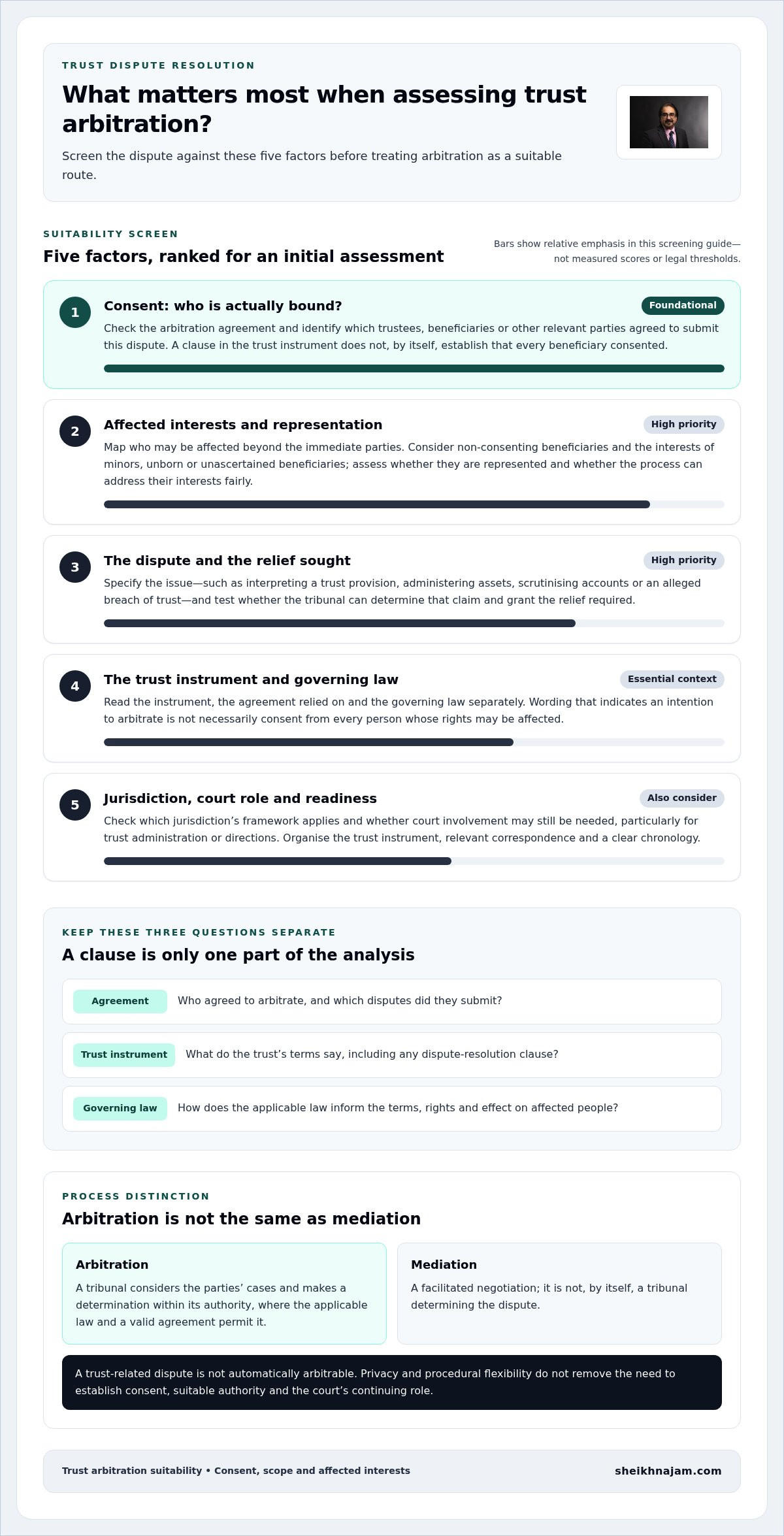
A disciplined preliminary assessment tests legal authority and practical fit before procedural commitments are made. Trust arbitration should not be selected simply because the trust instrument mentions it or because the parties favour a private process. Establish who may participate, what issues can properly be determined and whether the proposed tribunal can address the remedy required.
What should the initial assessment establish?
Start with the trust instrument and any document said to create an arbitration agreement. Identify the trust’s governing law and the legal relationship between the proposed parties. Then organise relevant correspondence, records of trustee decisions and a clear chronology. These materials can help distinguish the original decision in dispute from later events, responses and consequences.
Next, map the parties and interests. This includes trustees, beneficiaries, anyone whose interests may require representation, and potential non-parties whose rights or practical position could be affected. Set out the disputed conduct or interpretation, the remedy sought and any time-sensitive procedural concerns. A disagreement over past accounts, for example, may require a different analysis from a dispute about a proposed administration decision.
An ordered review can keep the assessment focused:
Governing law: identify the relevant jurisdiction and the law governing the trust and any arbitration agreement.
Agreement: establish what the arbitration wording covers and who has agreed to it.
Parties and interests: record the participants, represented interests and potentially affected non-parties.
Issues and remedy: define the matters to be determined and the relief sought.
Process and oversight: consider fairness, representation safeguards and whether court involvement may be needed.
How can the process be structured responsibly?
If arbitration remains a viable option, its design should follow from the assessment rather than precede it. The parties should consider how a tribunal would be appointed, which procedural rules would apply, what issues fall within its remit and how evidence and submissions would be handled. Notice and participation arrangements deserve particular care where beneficiary interests may be affected, especially if those beneficiaries are not direct parties.
Procedural fairness is not achieved merely by setting a timetable. The proposed arrangements should allow relevant parties to understand the case and respond, while addressing representation questions and the relationship between the arbitration and possible court proceedings. A timetable or confidentiality provision should be treated as dependent on the agreement, applicable law and circumstances, not as an automatic feature of arbitration.
Considering trust administration alongside dispute strategy can help test whether the proposed process addresses the real issue. This is the purpose of a structured trust dispute resolution assessment. To discuss the documents, affected interests and available routes, contact Sheikh Najam about your trust dispute.
How can specialist advice support a trust-arbitration decision?
A decision about process should be grounded in the trust’s terms, the fiduciary context and the practical consequences of the dispute. Specialist advice can bring these strands together before the parties commit to a route, testing whether the issues and participants fit arbitration or whether mediation or court proceedings warrant consideration. The objective is a reasoned assessment, not an assumption that trust arbitration is available in every case or that any process will produce a particular result.
What does a joined-up trust dispute assessment consider?
The analysis begins with the trust instrument and relevant administration: what decision or conduct is challenged, which duties and interests may be engaged, and what remedy is sought? The answers can have procedural consequences. A dispute over the interpretation of a trust provision, for instance, may raise different issues from a challenge to trustee conduct or a request for guidance on administration.
Next, assess the available routes against the facts. Arbitration can be considered alongside mediation and litigation, with attention to agreement, party participation, affected beneficiaries, the tribunal’s remit and any potential need for court involvement. Mediation may offer scope for a negotiated resolution; arbitration involves a tribunal’s determination if the necessary legal and procedural conditions are met. Neither should be treated as the default.
Trust and estate issues can also intersect with probate or a wider inheritance dispute. Where the same events raise questions about estate administration or a contested will, contentious probate analysis may help clarify the connected claims and interests. Sheikh Najam’s work includes trust disputes, arbitration, mediation, contentious probate and trust and estate administration, allowing process questions to be considered alongside the underlying fiduciary and administrative context.
What should a first discussion aim to clarify?
A useful first discussion establishes the essential facts and identifies what remains uncertain. Organising the trust instrument, relevant correspondence and a concise chronology can help explain how the disagreement developed. It is also useful to summarise:
the trust’s governing law and any arbitration wording or separate agreement;
the trustees, beneficiaries and other people whose interests may be affected;
the decisions or conduct in dispute and the remedy being sought;
any pending proceedings, stated deadlines or immediate concerns.
This information helps identify whether further analysis is needed on consent, representation, jurisdiction or the relationship between a proposed process and court oversight. It can also clarify whether the immediate priority is to preserve a position, understand the available procedures or explore a negotiated resolution. Advice can assess those options, but cannot guarantee that a particular forum is available or predict the outcome.
For a considered assessment of the circumstances and possible resolution strategy, contact Sheikh Najam to discuss your trust dispute.
Make the next decision with clarity
The next step is not necessarily to select a forum immediately. First establish what a sound resolution must achieve, whose interests need to be represented and whether the proposed process can address the dispute without leaving material questions unresolved. That considered starting point can help trustees and beneficiaries make decisions with greater clarity, even where trust arbitration ultimately proves unsuitable.
Sheikh Najam advises on trust and estate matters and brings dispute-resolution experience to the assessment of trust disputes, including arbitration, mediation and contentious probate. The focus is on examining the circumstances and available routes, rather than presuming a particular process or outcome.
If you are weighing the options in a trust dispute, discuss your circumstances and resolution options. A measured, well-informed next step can provide a firmer basis for deciding how to proceed.
Frequently Asked Questions
Is trust arbitration legally recognised in England and Wales?
Yes. Arbitration is legally recognised in England and Wales, but that does not mean every dispute concerning a trust can be referred to it. The Arbitration Act 1996, as amended by the Arbitration Act 2025, provides the general statutory framework. Whether a particular trust dispute can proceed depends on matters including the arbitration agreement, the parties and the issues to be determined. The 2025 amendments apply to proceedings commenced on or after 1 August 2025.
Can a trust deed require beneficiaries to resolve disputes through arbitration?
A deed may contain an arbitration clause, but its presence alone does not establish that every beneficiary must arbitrate. The clause’s wording, the trust’s governing law and the legal position of each beneficiary require examination. A beneficiary’s status may differ from that of a trustee who has expressly entered into an arbitration agreement. Any proposed process should also address how the interests of beneficiaries who cannot participate personally would be represented.
Can trust arbitration bind beneficiaries who did not agree to arbitrate?
Not automatically. A beneficiary who is not a party to an arbitration agreement should not be assumed to be bound simply because the trust deed refers to arbitration or other parties have proceeded. This issue is particularly sensitive if a decision could affect a minor, an unborn beneficiary or a person whose identity is not yet known. The tribunal’s authority and any representation arrangements require careful analysis under the law applicable to the trust and proceedings.
How does trust arbitration differ from mediation?
In mediation, an independent mediator helps participants explore settlement but does not decide the dispute. Any agreement depends on the parties accepting the proposed terms. In arbitration, an appointed tribunal determines the issues within its authority, subject to the agreement and applicable law. For example, parties who cannot agree how to interpret a trust provision may seek a determination, whereas mediation may help them negotiate a resolution without asking a third party to impose one.
Is trust arbitration confidential?
Arbitration is generally conducted in private, but privacy should not be treated as a guarantee that all information or outcomes will remain confidential. The position may depend on the parties’ agreement, applicable rules and law, and whether a court application or other disclosure becomes necessary. Trust matters can also involve beneficiaries who are not arbitration parties. Before selecting arbitration partly for privacy, consider what information may need to be shared and with whom.
Can an arbitral award in a trust dispute be challenged or enforced?
An award may be enforceable through the applicable legal framework, but enforcement is not automatic in every trust dispute and may depend on the tribunal’s jurisdiction and the parties bound by the arbitration agreement. In England and Wales, the Arbitration Act 1996, as amended, provides limited routes for court challenge, including challenges concerning jurisdiction. It does not ordinarily provide a general rehearing simply because a party disagrees with the tribunal’s conclusion.
When might court proceedings be more appropriate than trust arbitration?
Court proceedings may warrant consideration where the dispute requires directions about ongoing trust administration, involves people who did not agree to arbitrate, or raises difficult questions about representing absent beneficiaries. A court may also be needed for relief beyond the tribunal’s authority or where its supervisory role is engaged. The practical and legal question is whether the proposed process can address every material issue and the interests affected.


Comments