Arbitration for Shareholder Disputes: A UK Case Study

Could arbitration resolve a shareholder dispute more effectively than court proceedings or mediation? The answer depends less on arbitration’s general attractions than on whether the parties’ agreement covers the claims, who is bound by it and what outcome is needed. For that reason, arbitration for shareholder disputes requires careful analysis before a route is chosen, particularly where preserving the company’s stability and limiting exposure of sensitive information are priorities.
Uncertainty over an arbitration clause can have significant consequences. Its wording, the dispute’s legal basis and the available evidence may all affect whether arbitration is appropriate. Privacy or speed should not be assumed to settle the question: arbitration is a formal process, and its practical advantages need to be weighed against litigation and negotiated resolution in the circumstances of the dispute.
This UK case study examines when arbitration may be suitable, how the process works and which strategic decisions influence the path to resolution. It considers the role of the shareholder agreement, the claims and supporting evidence, and the relative functions of arbitration, court proceedings and mediation, providing a structured basis for deciding on an informed next step.
Table of Contents
When is arbitration for shareholder disputes a suitable remedy?
Shareholder arbitration is a private adjudicative process in which an arbitrator, appointed under an applicable arbitration agreement, determines a dispute within that agreement’s scope. Unlike a negotiated settlement, it does not depend on the parties reaching consensus. Unlike mediation, it results in a decision rather than a neutral facilitator helping the parties seek agreement. Negotiation and mediation help parties find common ground; arbitration asks an appointed decision-maker to determine the dispute. An overview of What is arbitration? provides useful general context, but the suitability of arbitration for shareholder disputes turns on the particular documents, parties and legal issues involved.
The commercial stakes can be immediate. A deadlock over budgets, appointments or strategic direction may prevent decisions needed to keep a business operating. An alleged breach of a shareholder agreement, such as failure to comply with a transfer restriction or voting arrangement, may erode trust between owners. Governance disagreements can also put directors, employees, suppliers and ongoing operations under pressure. Serious conflict alone, however, does not establish that arbitration is available or that it will resolve every aspect of the dispute.
Which shareholder conflicts may raise an arbitration question?
Deadlock, alleged breaches of shareholder obligations and governance disputes are common situations in which the parties may need to examine an arbitration clause. For example, shareholders might disagree about whether a decision required unanimous approval or whether one party followed an agreed procedure. These are illustrations, not conclusions: the claim must be characterised accurately and assessed against the relevant agreement and applicable law.
It is also necessary to distinguish disputes between shareholders from claims involving the company, its directors or an outside party. A shareholder’s contractual claim against another signatory may raise different questions from a claim brought on the company’s behalf, a claim against a director or a dispute involving someone who never agreed to arbitrate. The remedies sought matter too. A clause cannot be assumed to cover every corporate or statutory claim simply because the disagreement arose within a company.
What must be true before arbitration can proceed?
The first task is to identify an applicable arbitration agreement and interpret its scope: which disputes does it cover, and which parties have consented to be bound? Shareholder agreements, articles of association and related contracts may all be relevant, but their interaction should not be presumed. Party identity is substantive, not a procedural afterthought. The analysis must establish whether the proposed claimant and respondent are within the agreement and whether the particular claim falls within its wording.
Jurisdiction matters. The governing framework and legal character of the claim can affect whether arbitration is available and what issues a tribunal may determine. A disciplined assessment considers the documents, the parties’ legal relationships, the relief sought and the applicable law before reaching a conclusion. Only then can arbitration be weighed against other routes, with the company’s continuity and the parties’ commercial objectives in view.
How does arbitration for shareholder disputes work in practice?
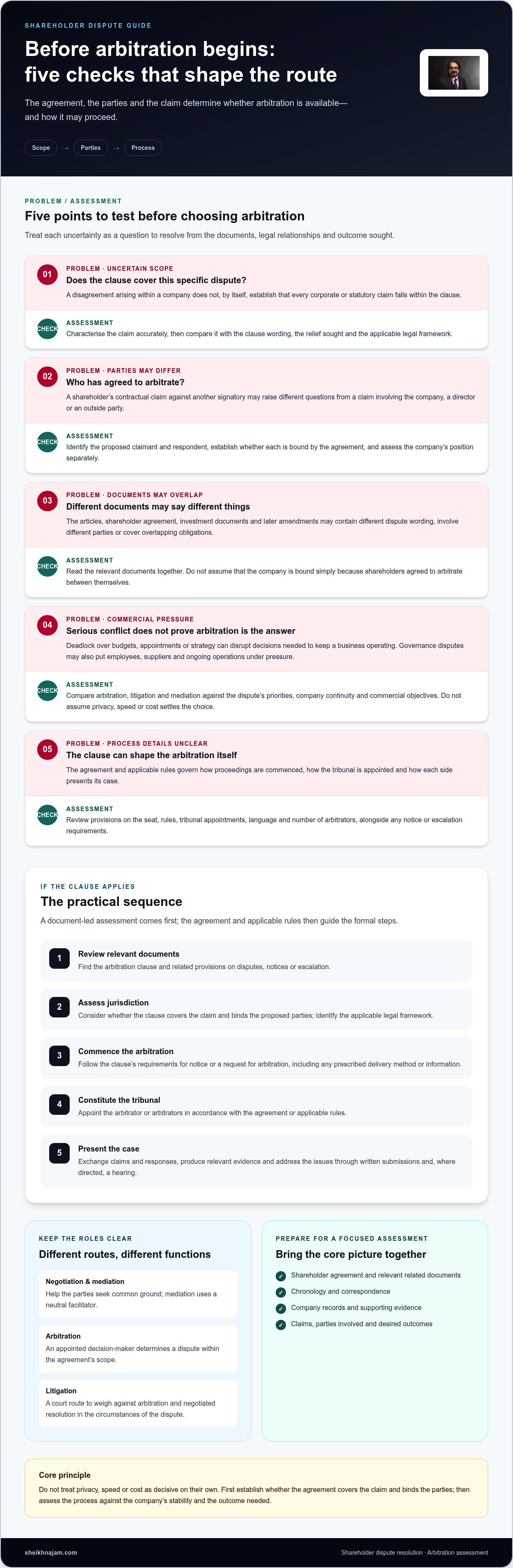
The process is not automatic, and not every dispute follows the same timetable. Arbitration for shareholder disputes generally begins with a document-led assessment, followed, if the clause applies, by formal steps to refer the dispute to a tribunal. The agreement and applicable rules govern the procedure, including how the arbitration is commenced, how the tribunal is appointed and how the parties present their cases.
A practical sequence is:
Review the relevant documents. Identify the arbitration clause and any related provisions on disputes, notices or escalation.
Assess jurisdiction. Consider whether the clause covers the claim and binds the proposed parties, and identify the applicable legal framework.
Commence the arbitration. Follow the clause’s requirements for notice or a request for arbitration, including any prescribed delivery method or information.
Constitute the tribunal. Appoint the arbitrator or arbitrators in accordance with the agreement or applicable rules.
Present the case. The parties exchange their claims and responses, produce relevant evidence and address the issues through written submissions and, where directed, a hearing.
How do the articles and shareholder agreement affect jurisdiction?
Read the articles of association alongside the shareholder agreement, investment documents and later amendments. The documents may contain different dispute-resolution wording, have been signed by different parties or address overlapping obligations. Those differences can affect whether a particular claim falls within an arbitration clause. A company should not be treated as bound merely because its shareholders agreed to arbitrate between themselves; its legal position and the relevant documents require separate analysis.
The clause may specify the seat of arbitration, the procedural rules, the method of appointing the tribunal, the language and whether there will be a sole arbitrator or a panel. Each term has practical consequences. For example, the seat identifies the arbitration’s legal home and the courts with supervisory jurisdiction. It is not necessarily where hearings take place. The law governing the underlying contract is separate from the law governing the arbitration agreement, and the two should not be conflated.
What happens after a tribunal is constituted?
Procedure depends on the arbitration agreement and applicable rules, not on a single universal template. The tribunal will ordinarily set directions for written pleadings, evidence and the conduct of the case. Depending on the issues, parties may exchange relevant company records and correspondence, provide witness evidence or expert material, and make submissions at a hearing. The tribunal then determines matters within its jurisdiction and issues an award. Its form and the available remedies depend on the dispute and governing framework.
In England and Wales, the Arbitration Act 1996, as amended by the Arbitration Act 2025 for arbitrations commenced on or after 1 August 2025, forms part of the statutory framework. The applicable law and territorial position must be assessed in each case. Reviewing the seat, clause and documents can clarify the procedural route and identify jurisdictional risks before positions harden. Shareholders considering that analysis can discuss their dispute-resolution circumstances.
Arbitration, litigation, or mediation: which route fits the dispute?
The appropriate route depends on more than a preference for privacy or formality. Consider the arbitration clause, the parties to the dispute, the evidence required, the remedy sought and the urgency of the commercial problem together. In arbitration for shareholder disputes, a route that appears attractive in principle may prove unsuitable if the claim involves non-parties or requires a court’s authority.
When might arbitration offer a practical advantage?
Where an applicable agreement permits it, arbitration may allow the parties to select a decision-maker with relevant experience and adopt a procedure suited to the dispute. A private hearing may reduce public exposure of commercially sensitive material, though privacy is not a guarantee that no information will become public. If the parties cannot agree on governance or contractual obligations, a tribunal’s determination may provide an outcome where further negotiation has reached an impasse.
These advantages are conditional. Arbitration is not invariably quicker or less expensive than litigation, and a complex dispute may require extensive written evidence, document production and hearings. The clause, the tribunal’s directions and the parties’ conduct all affect the process. Procedural flexibility has limits: it operates within the framework the parties have agreed and the applicable law.
When might litigation or mediation be preferable?
Court proceedings may warrant consideration where the dispute requires court authority, involves people who have not agreed to arbitrate, or raises claims and remedies that need careful assessment in a public forum. Mediation may be better suited where the parties want to retain control over settlement, preserve a working relationship or explore practical arrangements that an adjudicator may not impose. It can also be considered alongside another process, but timing and procedural consequences need careful analysis.
Before selecting or combining routes, assess the agreement, urgency, parties, evidence, available remedies and commercial relationship. Specialist dispute-resolution advice can help test these factors together, rather than treating arbitration, litigation and mediation as interchangeable choices.
A hypothetical shareholder dispute: applying the arbitration framework
Consider a wholly hypothetical closely held company whose two shareholder-directors are deadlocked after disagreeing about governance obligations. One believes that specified decisions required joint approval; the other says the relevant decisions were within their authority. The disagreement has begun to delay operational choices. This fictional scenario has no predetermined outcome. Its purpose is to show how the documents and commercial priorities would shape an assessment.
How should the fictional parties assess the agreement and claims?
In this hypothetical, the first step would be to assemble the shareholder agreement, the company’s articles, any investment documents and later amendments. The parties would identify the clause’s exact scope, who signed each document, how any notice requirements operate and whether the company itself agreed to arbitrate. A clause signed by the two shareholders would not, without further analysis, establish that the company is also bound.
The fictional parties would then define the disputed conduct and the relief each seeks. Is the central issue the interpretation of a contractual voting provision, or does one party also allege conduct by a director or seek a remedy affecting the company? Each claim would need to be tested against the wording of the arbitration clause, the identity of the parties and the applicable law. Different claims arising from the same events may not follow the same route.
That analysis could change the initial assumption. Suppose both fictional shareholders first believe that the clause sends every aspect of their disagreement to arbitration. On closer review, it might cover only disputes between its signatories, whilst a proposed claim involving the company raises separate questions about consent, jurisdiction or the appropriate forum. The correct route could therefore depend on the character of each claim, not merely on the fact that the conflict concerns share ownership.
How can the process account for commercial priorities?
In this hypothetical, the shareholders would also need to assess what matters most to the business: limiting public exposure of sensitive governance discussions, obtaining a decision-maker familiar with the relevant commercial context, or restoring the company’s ability to make decisions. Privacy may favour arbitration in some circumstances, but it would not justify an assumption of absolute confidentiality. Nor should the parties presume that arbitration would necessarily be quicker or less disruptive.
The fictional parties could examine whether their agreement and applicable rules allow them to shape procedural choices, including the tribunal’s constitution. They would also consider the evidence required: board minutes, written approvals, correspondence and company records that may clarify what was decided and by whom. Identifying those materials early could help distinguish a contractual disagreement from broader allegations requiring separate analysis.
Mediation might be considered alongside the hypothetical arbitration question if both shareholders are willing to explore an agreed governance arrangement or another negotiated solution. It would not guarantee settlement, and any proposed sequence would need to account for the agreement, jurisdiction and procedural consequences. The hypothetical dispute therefore remains unresolved: arbitration may be suitable for some issues, but the parties would need to assess scope, consent, evidence and business continuity before choosing a route. To discuss a shareholder dispute and its resolution options, contact Sheikh Najam TEP.
Arbitration for shareholder disputes: specialist support
A sound decision about arbitration begins with an organised account of the dispute, not an assumption that a clause resolves every issue. The wording of the relevant agreements, the identity of the parties, the evidence and the company’s immediate commercial needs must be considered together. Specialist dispute-resolution advice can help assess whether arbitration, mediation or court proceedings best fit those circumstances.
What information should a shareholder assemble?
Before seeking advice, gather the documents that explain both the parties’ obligations and how the disagreement developed. An indexed file, with gaps or disputed points identified rather than concealed, can make the initial analysis more focused. Include:
Signed shareholder agreements, investment documents, amendments and any related dispute-resolution clauses.
The company’s relevant articles of association and records of who signed or adopted each document.
Board minutes, written resolutions, approval records and other company documents connected to the disputed decisions.
Key correspondence, including emails and letters that record requests, responses, warnings or proposed solutions.
A dated chronology distinguishing documented events from recollections, assumptions and allegations that remain contested.
A short statement of business objectives, immediate operational risks and the outcomes sought, without treating a desired remedy as an established legal entitlement.
For example, if shareholders disagree about whether a decision required joint approval, the chronology can identify when that decision was proposed, what was communicated and which records may evidence approval or objection. This does not determine the issue; it helps frame the questions that the agreement and evidence must answer.
How can specialist advice shape the next decision?
Sheikh Najam TEP handles civil and commercial disputes through arbitration and mediation. An assessment can examine the scope of the relevant agreement, whether the proposed parties are bound, how the claims should be characterised and what the available evidence may establish. It can then compare arbitration with mediation and court proceedings, taking account of the remedies sought, operational pressures and the parties’ commercial objectives.
That assessment may identify a clause that covers some contractual issues but not every claim connected with the company, or reveal that a person whose involvement matters did not agree to arbitrate. It can also clarify whether an agreed process might preserve room for negotiation, or whether a binding determination is more consistent with the parties’ position. Neither route should be selected without considering jurisdiction and procedural consequences.
Sheikh Najam TEP’s commercial dispute-resolution services assess the documents, parties and commercial context. If you are weighing a route for your own matter, discuss a shareholder dispute and its resolution options. You can arrange a confidential discussion to consider the circumstances and the appropriate next step.
Shape a resolution that supports the company’s future
The next step is not simply to select a forum, but to consider what a workable resolution must make possible after the immediate conflict has been addressed. For a closely held company, that may mean clarifying how future decisions are made, how disagreements are escalated, or what happens if the shareholders’ commercial relationship cannot continue. These questions can influence whether arbitration for shareholder disputes is the right course, or whether a negotiated outcome offers greater scope to reshape the parties’ arrangements.
A measured assessment can help distinguish the result a party hopes to obtain from the outcome the agreement, evidence and applicable law may support. It can also bring the company’s continuing needs into the decision, rather than allowing the dispute alone to dictate the strategy. Taking that step early can give shareholders a clearer basis for choosing how to proceed.
If you are considering the available routes and their implications for your company, discuss your shareholder dispute. A carefully considered next step can help you move towards a more stable resolution.
Frequently Asked Questions
Can shareholders arbitrate a dispute if their agreement contains no arbitration clause?
Yes, if the relevant parties agree to submit the dispute to arbitration after it has arisen. Without an applicable arbitration agreement, one shareholder generally cannot compel another to arbitrate merely because arbitration seems suitable. Any new agreement should identify the parties and the disputes it covers, and address procedure sufficiently to avoid further uncertainty. The legal requirements and consequences depend on the governing law and jurisdiction.
Is arbitration for shareholder disputes confidential?
Arbitration is generally conducted in private, but that does not mean every aspect of the dispute is necessarily confidential. Confidentiality may depend on the arbitration agreement, applicable rules and law. Disclosure may arise in related court proceedings or where a party has another legal obligation to disclose information. Before choosing arbitration for shareholder disputes, consider what sensitive material may be shared and how it could be handled.
Can a minority shareholder be required to arbitrate?
A minority shareholder may be required to arbitrate if they are bound by an applicable arbitration agreement covering the dispute. Their minority status alone does not establish consent, nor does it automatically exempt them from a clause they agreed to. Review how the shareholder became a party, including any signed agreement, accession document or relevant constitutional provisions, and assess the clause’s reach under the applicable law.
Can a company be included in arbitration between its shareholders?
Not automatically. If only the shareholders agreed to arbitrate, the company’s separate legal identity means it should not simply be assumed to be bound by their agreement. Its status may depend on whether it signed or otherwise became party to an applicable arbitration agreement, and on the claim being advanced. Where the company’s records, conduct or interests are central, establish its legal position before framing the arbitration.
Can a shareholder seek urgent protection before an arbitration hearing?
Potentially. Depending on the arbitration agreement, applicable rules and law, urgent relief may be sought through an emergency arbitrator or from a court with relevant authority. The appropriate route can depend on the seat, the nature of the threatened harm and whether the requested measure affects people who are not parties to the arbitration. Prompt legal advice is important, since the available powers and procedures vary across jurisdictions.
Can an arbitration award resolve every issue in a shareholder dispute?
No. An award determines matters within the tribunal’s jurisdiction and the scope of the parties’ agreement; it cannot necessarily determine claims involving non-parties or grant every remedy a shareholder may seek. A dispute may also combine contractual issues with company, director or statutory claims that require separate analysis. Before proceedings begin, map each claim and requested remedy to the parties and legal authority relevant to it.
Does arbitration prevent shareholders from going to court?
Not in every respect. An applicable arbitration clause may require covered disputes between bound parties to be referred to arbitration, but courts may still have roles connected with the process, subject to the relevant law. A court may also be the necessary forum for issues outside the clause or involving parties who are not bound. The effect of the agreement, the claim and the arbitral seat should be assessed together.


Comments