Lasting Power of Attorney Mental Capacity Assessment: A UK Guide

Could a diagnosis, a difficult conversation or a family member’s concern mean that making an LPA is already out of reach? Not necessarily. A lasting power of attorney mental capacity assessment is not a general judgement of someone’s intelligence or ability to manage every aspect of life. The legal question is whether they can make this particular decision at the relevant time.
It is understandable to worry that a diagnosis automatically prevents someone from appointing attorneys, or that uncertainty could cause delay or lead to a later challenge. In England and Wales, capacity is assessed in relation to the decision to make the LPA, under the Mental Capacity Act 2005. The donor, certificate provider and any clinician have distinct roles. A medical assessment may help where there is genuine uncertainty, but it is not automatically required in every case.
This guide explains the decision-specific test, what the certificate provider must consider and when clinical evidence may be useful. It also covers practical steps to prepare before registration, so the donor’s wishes are clearly recorded and concerns can be addressed without undue pressure.
Table of Contents
What does a mental capacity assessment for a Lasting Power of Attorney establish?
A mental capacity assessment for a Lasting Power of Attorney considers whether the donor can make the specific decision to appoint attorneys and grant them defined authority. It is not a general appraisal of their intelligence, memory or ability to manage daily life. The focus is whether they can understand this LPA decision at the relevant time, taking account of support that helps them communicate or consider their choices.
This section concerns LPAs made in England and Wales. Scotland and Northern Ireland have different legal frameworks and arrangements for appointing someone to make decisions. In England and Wales, the Mental Capacity Act 2005 provides the principal statutory framework for capacity. A medical diagnosis or the donor’s age, by itself, does not establish that they lack legal capacity.
What decision must the donor be able to understand?
The donor must be able to understand, in broad terms, what appointing an attorney means. They are choosing one or more people to make specified decisions on their behalf, within the limits set by the law and the LPA. Because the appointment gives another person authority to act, the nature and possible consequences of that authority are relevant.
The implications depend partly on the type of LPA. A property and financial affairs LPA concerns matters such as managing money or property. A health and welfare LPA concerns decisions about care and treatment. The donor need not understand every situation an attorney might face in the future or anticipate every practical consequence. The question is whether they can grasp the essential nature and effect of the authority they propose to grant, including that attorneys must act within its scope.
Capacity is assessed for this decision, not as a pass-or-fail judgement on the donor’s whole life. A person might be unable to make one complex decision yet retain capacity to make another, including the decision to create an LPA. Equally, being able to discuss familiar matters does not, on its own, show that they understand this appointment.
Which legal framework applies to an LPA capacity assessment?
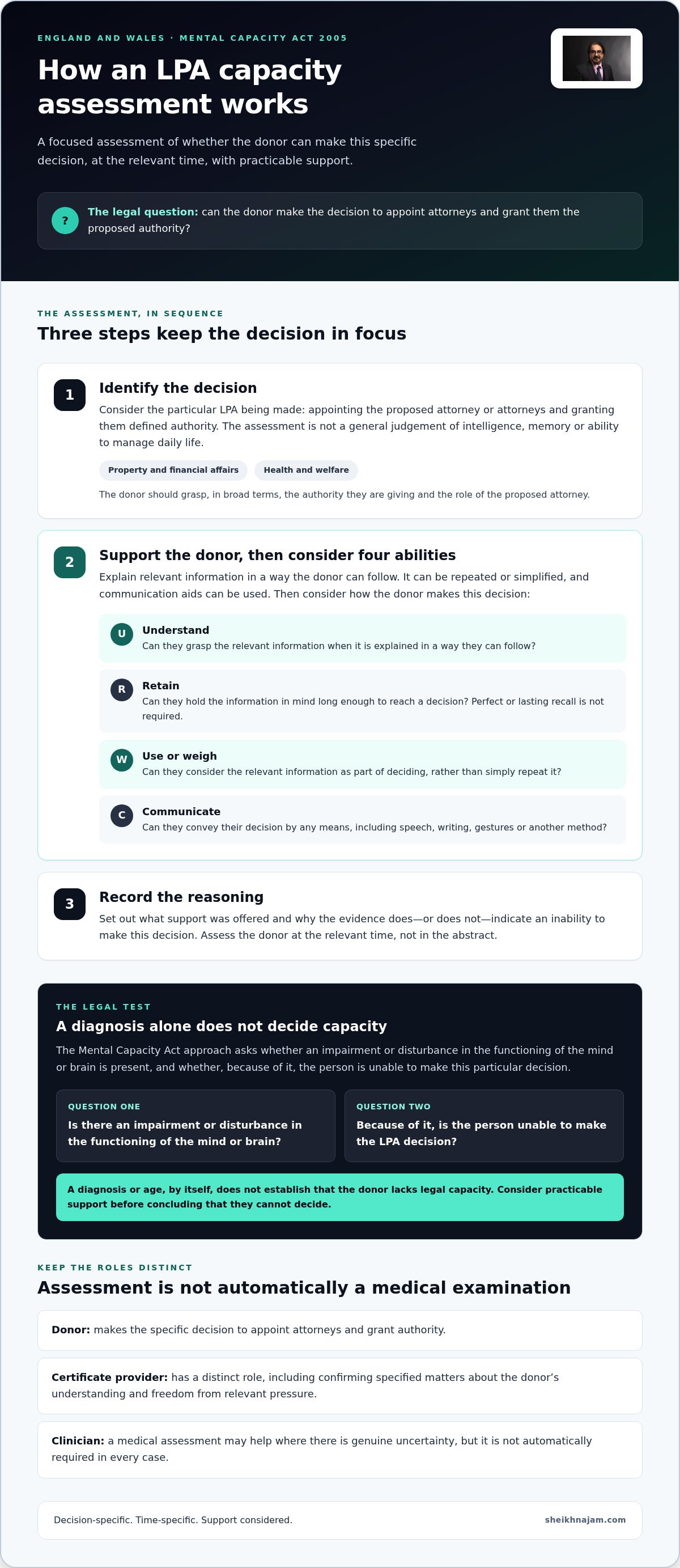
Under the Mental Capacity Act 2005, capacity is decision-specific and time-specific. The question is whether the donor can make the LPA decision when it needs to be made. The statutory approach considers whether they can understand, retain, use or weigh relevant information, and communicate their decision. These abilities are considered in relation to the actual appointment, rather than tested in the abstract.
A diagnosis may help explain why a capacity question has arisen, but it is not the legal finding itself. The assessment focuses on the donor’s decision-making ability at the relevant time, with practicable support considered before concluding that they cannot decide. This is central to a lasting power of attorney mental capacity assessment: it respects the donor’s autonomy while checking that the authority granted reflects an informed decision.
How is capacity to make an LPA assessed under the Mental Capacity Act?
A lasting power of attorney mental capacity assessment addresses the donor’s ability to make this specific decision, rather than applying a general test of competence. Under the Mental Capacity Act 2005, the assessment considers whether an impairment or disturbance in the functioning of the mind or brain is present and whether, because of it, the person is unable to make the decision. A diagnosis may be relevant evidence, but it does not settle either question on its own.
A clear process helps keep the assessment focused. First, identify the decision: making this LPA and granting the proposed authority to the chosen attorney or attorneys. Then take practicable steps to support the donor’s understanding and consider how they engage with the relevant information. Finally, record the reasoning, including what support was offered and why the evidence does or does not indicate an inability to make the decision.
Understand: Can the donor grasp the information relevant to making this LPA when it is explained in a way they can follow?
Retain: Can they hold that information in mind long enough to reach a decision? Perfect or lasting recall is not required.
Use or weigh: Can they consider the relevant information as part of deciding, rather than simply repeat it?
Communicate: Can they convey their decision by any means, including speech, writing, gestures or another method?
These are the functional abilities set out in the Act. A person may be able to repeat an explanation of an LPA yet struggle to weigh what appointing an attorney would mean for them. Conversely, difficulty recalling a detail later does not by itself establish inability if they retained it long enough to decide. The assessment should examine their decision-making, not test memory in isolation.
What abilities are considered in the legal test?
Information relevant to the decision should be proportionate, not an exhaustive account of every possible future event. For example, the donor may need to understand the broad authority they are granting and the role of the proposed attorney. Explanations can be repeated or simplified, and the donor may use communication aids. The central question is whether they can make the decision with practicable support, not whether they can do so unaided.
How should assessment account for fluctuating capacity?
Capacity can vary, so timing and context may affect the evidence. If the donor’s clarity changes, consider whether the decision can be discussed when they are more alert, with suitable breaks and in a setting that supports concentration and communication. One difficult conversation, or a diagnosis considered without context, should not be treated as conclusive. A clear, contemporaneous record helps explain the circumstances and reasoning.
This is general information, not an assessment of any individual’s capacity. Careful LPA preparation can help clarify the decision and the donor’s intentions. Discussing LPA preparation may be useful when legal questions arise alongside any clinical evidence.
Is a formal mental capacity assessment always required before making an LPA?
No. A separate clinical or independent mental capacity assessment is not routinely required before making an LPA. The certificate-provider safeguard is part of the LPA process and is distinct from commissioning a clinician or another professional to produce a separate assessment. A lasting power of attorney mental capacity assessment may be useful where specific concerns arise, but it is not an automatic prerequisite simply because the donor has a diagnosis or family members are worried.
The certificate provider has a defined role under the LPA procedure. They must certify that the donor understands the purpose of the LPA and the authority it gives, is not acting as a result of fraud or undue pressure, and that there is no other reason why the LPA application should not proceed. They must also meet the Office of the Public Guardian’s eligibility requirements. This safeguard is not a medical opinion, and the certificate provider is not automatically required to prepare a clinical report.
What does the LPA certificate provider do?
The certificate provider considers the donor’s understanding and circumstances in relation to the proposed LPA. Their role is not simply to witness a signature. They must be satisfied that the donor understands what they are making and is choosing freely. Current Office of the Public Guardian guidance sets out who may act as a certificate provider and who is excluded. The proposed provider should meet those criteria before completing the certificate.
When might further professional evidence be useful?
Further evidence may help where there is genuine uncertainty about the donor’s ability to make this decision, substantial communication difficulty, or contemporaneous information that appears inconsistent with what the donor says about the LPA. Identify the reason for seeking evidence clearly, rather than relying on a diagnosis alone. For example, a clinician might explain how a condition affects communication or decision-making, while the legal question remains whether the donor can make this particular choice.
Clinical evidence and the legal conclusion are related but not interchangeable. A diagnosis may describe an impairment; it does not automatically establish inability to make an LPA, and requesting an assessment does not predetermine its outcome. Equally, a certificate-provider discussion may identify concerns that need careful clarification before the application proceeds.
Where questions arise during Lasting Power of Attorney preparation, legal advice can help distinguish the document’s requirements from any separate evidential issue and support a process that accurately records the donor’s intentions.
How can a donor prepare for an LPA capacity assessment?
Preparation should make it easier for the donor to express their own decision, not teach them what to say. The purpose of a lasting power of attorney mental capacity assessment is to understand the donor’s ability to make this decision, so rehearsed or scripted answers may obscure rather than clarify their wishes. They should be encouraged to consider whom they want to appoint, what authority they intend to grant and any questions or reservations they wish to raise.
Practical arrangements can help. Choose a time when the donor is usually alert, use a quiet and familiar setting where possible, and allow enough time for explanations and pauses. If the donor benefits from written information, hearing aids, an interpreter or another communication aid, consider how to use these effectively. Breaks may also help if the discussion becomes tiring.
What information should be available beforehand?
Before the discussion, organise information that helps explain the decision and the donor’s circumstances. Keep it relevant and accessible rather than assembling a large file that may distract from the donor’s own account.
A clear explanation of the proposed LPA’s purpose and scope, including the type of decisions the attorney may be authorised to make.
The donor’s questions, preferences and any points they want explained in more detail.
Relevant background about communication needs, support that helps the donor understand information, or circumstances in which their clarity may vary.
A concise note of specific concerns and when they arose, so they can be considered in context rather than treated as assumptions.
Medical or care information can provide useful context, particularly where it explains communication needs or changes in alertness. It does not replace consideration of the legal test for this decision. The donor should have an opportunity to ask for information to be repeated or explained differently, and should not be expected to demonstrate perfect recall of every detail.
How can families support without influencing the decision?
Family members may help by arranging a suitable setting, explaining how the donor communicates best, or making relevant information available. Their support should preserve the donor’s opportunity to express their own wishes. Where appropriate, the donor should have time to speak independently, particularly if someone else’s presence could affect what they feel able to say.
Avoid coaching answers, leading questions or presenting one attorney or outcome as the only acceptable choice. A family member may believe a particular appointment is sensible, but the donor’s preferences must remain central. Possible undue influence is separate from diagnosis: the question is whether pressure or another person’s conduct is affecting the donor’s decision, not whether they have a particular condition.
Careful Lasting Power of Attorney preparation can help clarify the proposed authority and record the donor’s intentions. For guidance on preparing an LPA in light of capacity concerns, discuss your LPA preparation.
Uncertain capacity before an LPA is registered?
Uncertainty should prompt careful clarification, not an automatic refusal to proceed. First identify the precise question: is there doubt about the donor’s understanding of the proposed LPA, their ability to communicate a choice, the information available, or whether another person’s influence is affecting the decision? Separating these issues helps ensure that the next step responds to evidence rather than assumption.
A lasting power of attorney mental capacity assessment may help resolve a genuine concern, but the evidence should be considered in context. Relevant records might include the donor’s own account, observations from discussions, information about communication needs and, where appropriate, clinical evidence. Legal advice can help organise LPA preparation, clarify the document’s scope and identify matters requiring attention. It does not replace a clinical opinion where one is relevant or guarantee a particular capacity finding.
How should concerns be documented and addressed?
A clear, proportionate record can help distinguish what was observed from what others inferred. It should identify the decision under consideration, when and in what circumstances it was discussed, what support was provided, and the material observations that gave rise to concern. Record the donor’s stated wishes separately from a relative’s preferred outcome or interpretation.
Note the LPA decision being considered and the relevant date or circumstances.
Record practical support offered, such as explanations in a different format, additional time or communication aids.
Describe specific observations accurately, avoiding conclusions that go beyond the evidence.
Keep records relevant to the issue and handle personal or medical information confidentially.
If evidence appears inconsistent, clarify what each source relates to before drawing conclusions. A comment made during a period of fatigue, for example, may need to be considered alongside the donor’s communication and decision-making at other relevant times. The aim is neither to dismiss concerns nor to let unsupported assumptions determine the outcome.
When does broader LPA planning become important?
Timely planning gives a person the opportunity to express preferences about who should act for them and what authority those attorneys should receive, provided they can make the decision. This can be particularly significant where a business depends on the owner’s personal involvement. Continuity planning should consider how important decisions might be managed if the owner could no longer make them. A business LPA strategy may therefore form part of wider succession and operational planning.
Where capacity is uncertain, avoid undue pressure or rushed decision-making. Clarify the outstanding issue, consider what evidence is relevant, and approach the LPA’s legal preparation carefully. A discussion about Lasting Power of Attorney planning can help identify the planning questions involved without presuming what any capacity assessment would conclude.
Take the next step with confidence
Questions about capacity need not bring planning to a standstill. Identify what remains uncertain, keep the donor’s intentions central and ensure the LPA is prepared with appropriate care. A lasting power of attorney mental capacity assessment concerns a specific legal decision. It is not a judgement on the person’s overall abilities or a predetermined outcome.
Sheikh Najam TEP’s private wealth and estate-planning work includes preparing Lasting Powers of Attorney, alongside trust, estate and probate matters. This broader perspective can help place the document within the donor’s wider arrangements while keeping its purpose and authority clear.
If you are considering an LPA or have questions about its preparation, discuss your Lasting Power of Attorney plans.
Frequently Asked Questions
Is a mental capacity assessment always required for a Lasting Power of Attorney?
No, a separate clinical assessment is not automatically required. The LPA process includes a certificate provider, whose role is distinct from a doctor’s or other clinician’s report. Additional evidence may be appropriate if a specific concern needs clarification, but a diagnosis or a relative’s general worry does not, by itself, make a formal assessment necessary. If concerns arise, identify what remains uncertain before deciding what evidence could address it.
Can someone with dementia make a Lasting Power of Attorney?
Yes, a person with dementia may make an LPA if they have capacity to make that decision at the relevant time. The diagnosis alone does not determine the answer. For example, a donor may be able to explain whom they wish to appoint and the authority they intend to grant, even if they need information repeated or presented differently. If they lack capacity to make the LPA, another person cannot sign it for them.
What does a mental capacity assessment for an LPA involve?
A lasting power of attorney mental capacity assessment considers whether the donor can make the decision to appoint attorneys, rather than testing their general competence. In practical terms, they may be asked to explain, in their own way, what the proposed attorneys could do and why they have chosen them. The assessment also considers whether they can retain and weigh relevant information and communicate a choice, with appropriate support available.
Who can assess capacity to make a Lasting Power of Attorney?
There is no universal requirement for a doctor to conduct a separate assessment. The certificate provider completes the LPA safeguard, while a clinician’s evidence may be sought if a particular medical or communication issue needs explanation. The person considering capacity should focus on the donor’s ability to make this decision and the evidence available. A clinical opinion can inform that consideration, but a diagnosis alone is not the legal conclusion.
What happens if the donor’s capacity fluctuates?
Fluctuation means the circumstances and timing of a discussion may be relevant. If the donor is clearer at some times than others, arrange important conversations when they are generally more alert, and note relevant factors such as tiredness, medication effects or communication difficulties where these are known. One poor discussion should not automatically settle the issue. Consider the evidence in context and offer practicable support.
Can a family member decide whether someone has capacity to make an LPA?
No. A relative’s concern or belief cannot, on its own, determine whether the donor has capacity to make an LPA. Family members can provide relevant background, describe communication needs or raise specific observations, but should distinguish these from their own preferred outcome. The donor’s wishes must be considered directly. A family member’s involvement should not become coaching or pressure, particularly where there is disagreement about whom the donor should appoint.
Does lack of capacity mean an existing LPA can no longer be used?
No. If an LPA was validly made and registered, a later loss of capacity does not by itself cancel it. The conditions for use depend on its type and terms: a property and financial affairs LPA may be used while the donor has capacity if they permit it, whereas a health and welfare LPA can be used only when the donor lacks capacity for the relevant decision. Attorneys must act within their authority and any restrictions in the document.


Comments