Business LPA: A Strategic Guide for Business Owners

What happens to your business if you lose the capacity to make decisions? Can the person you trust keep essential financial matters moving, or are they authorised only to manage your personal affairs? A business LPA can form part of the answer, but it is not a substitute for the company’s governance arrangements.
Business owners should consider who may need to step in and what authority that person will require. In England and Wales, the relevant instrument is a property and financial affairs LPA planned with business interests in mind. It can authorise an attorney to deal with matters within your personal authority, but it does not automatically confer a directorship or override the company’s articles or shareholder arrangements.
This guide explains what a business LPA may enable an attorney to do, where its authority begins and ends, and why the right arrangements depend on whether you operate as a sole trader, in a partnership or through a company. It also sets out the governance and continuity questions to address in advance, so your LPA, business documents and wider estate planning can be considered together rather than in isolation.
Table of Contents
What is a business LPA, and why does continuity planning matter?
How does a business-related property and financial affairs LPA work?
What a business LPA cannot do: company authority, directorship and ownership
How to prepare a business LPA and test your continuity arrangements
Integrating a business LPA into a wider succession and estate plan
What is a business LPA, and why does continuity planning matter?
An owner’s loss of capacity can affect more than personal financial administration. Decisions about investments, payments, contracts or a business shareholding may need timely attention, but the authority to act depends on the legal arrangements already in place. Planning for this possibility means separating the owner’s personal authority from the business’s own governance and decision-making structure.
Is there a separate legal document called a business LPA?
No separate statutory instrument is called a “business LPA”. The phrase is commonly used to describe a property and financial affairs lasting power of attorney (LPA) prepared with relevant business interests in mind. In England and Wales, this type of LPA allows the person making it, known as the donor, to appoint one or more attorneys to make decisions about the donor’s property and finances, within the authority granted by the document.
The LPA framework in England and Wales is established by the Mental Capacity Act 2005. A Lasting Power of Attorney is a formal legal document, not a general delegation of every responsibility the donor holds. It must be registered with the Office of the Public Guardian before an attorney can use it. The attorney’s powers remain subject to the document’s terms and applicable law. Scotland and Northern Ireland have different legal arrangements, so this discussion concerns England and Wales.
Why can incapacity create a business continuity problem?
If an owner cannot make or communicate a particular decision, routine matters may become harder to manage. These could include paying personal liabilities, dealing with a personally held shareholding or attending to financial administration connected with business interests. Whether an attorney can take a particular step depends on the donor’s authority, the LPA’s scope and any relevant legal or governance requirements. A business LPA should not be treated as authority over every business operation.
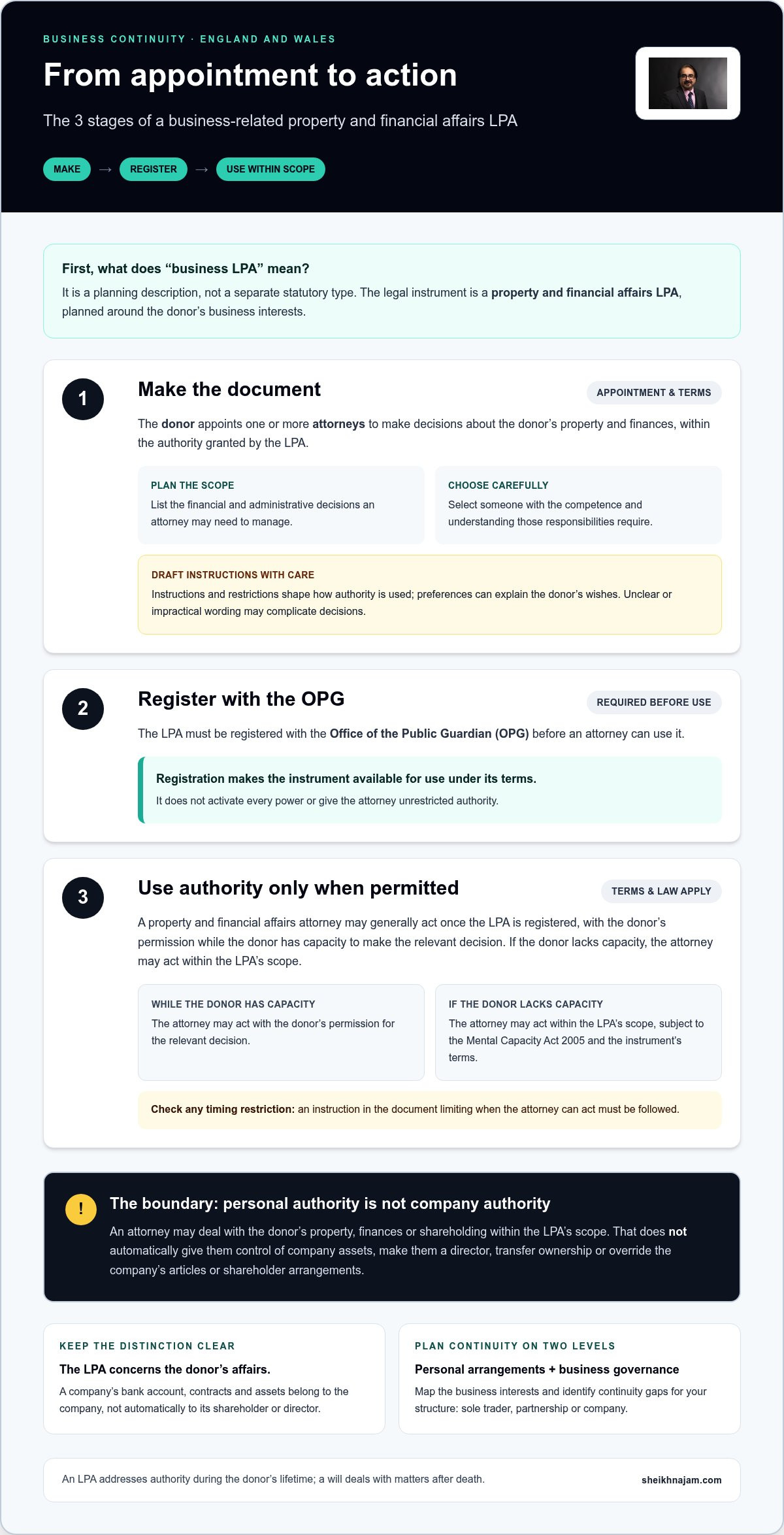
The distinction between individual and company property is fundamental. A company’s bank account, contracts and assets belong to the company, not automatically to its shareholder or director. An LPA concerns the donor’s affairs; it does not, by itself, give an attorney unrestricted control of company assets or confer every power the donor exercised in a business role.
Illustrative example, not legal advice: A sole shareholder who is also a director becomes unable to manage their affairs. An attorney may be able to deal with the donor’s personal financial matters and shareholding within the LPA’s scope. The company’s ability to make decisions and continue operating raises separate questions about its governance arrangements. That distinction is why continuity planning must address both personal authority and the business’s legal structure.
How does a business-related property and financial affairs LPA work?
The process has three distinct stages: making the document, registering it and exercising the authority it grants. Keeping these stages separate helps avoid a common misconception: appointing an attorney does not, by itself, mean that person can immediately act for the donor or take control of a business.
What authority can an attorney exercise under an LPA?
The donor is the person making the LPA; the attorney is the person appointed to act on the donor’s behalf. Under a property and financial affairs LPA, an attorney may make decisions about the donor’s property and finances, but only within the powers permitted by law and the registered instrument. A business LPA is a planning description, not wider authority that overrides company governance.
Instructions and restrictions can shape how authority is exercised, while preferences can explain the donor’s wishes to the attorney. These provisions need careful drafting. Unclear or impractical wording may complicate decisions, and an attorney must act within the document’s scope. Authority over a donor’s shares or personal business-related finances does not automatically extend to company assets or confer the donor’s separate powers as a director.
When can an attorney act, and what does registration change?
Making an LPA records the donor’s appointment and the terms of the authority. It must then be registered with the Office of the Public Guardian (OPG) before an attorney can use it. Registration makes the instrument available for use under its terms; it does not activate every power or give the attorney unrestricted authority.
For a property and financial affairs LPA, an attorney may generally act once it is registered, with the donor’s permission while the donor has mental capacity to make the relevant decision. If the donor lacks capacity, the attorney may act within the LPA’s scope, subject to the Mental Capacity Act 2005 and the instrument’s terms. The document may also contain an instruction restricting when the attorney can act, which must be followed. The OPG’s guidance on making, registering and using an LPA and the Mental Capacity Act 2005 provide the relevant framework.
When planning, list the financial decisions an attorney may need to handle, then distinguish those from decisions that belong to the company. This keeps the LPA’s personal authority clear and brings continuity questions into focus alongside arrangements for capacity. Discussing LPA planning can help you consider how the document fits your personal and business interests.
What a business LPA cannot do: company authority, directorship and ownership
A business LPA does not automatically appoint an attorney as a company director. An LPA gives authority in relation to the donor’s affairs, whereas a directorship derives from the company’s legal and governance arrangements. An attorney may have authority to deal with the donor’s personal financial interests without having authority to make decisions for the company or operate its assets.
Can an attorney take over as director or run the company?
Not by virtue of the LPA alone. A director’s appointment and responsibilities are governed by company law and the company’s constitutional documents. The LPA does not transfer the office of director to the attorney or automatically authorise the attorney to exercise the director’s functions in the donor’s place.
Continuity may depend on the company’s articles of association, any shareholder agreement and its board arrangements. These documents may address appointments, delegated responsibilities or what happens if a director cannot act. The precise position depends on their wording and the circumstances. Board decisions and any delegation remain subject to applicable governance requirements. An attorney should not assume that authority over a donor’s finances permits them to direct staff, approve company transactions or sign on the company’s behalf.
How do shares, company assets and personal finances differ?
Shares held by the donor are the donor’s property. The company’s bank account, equipment and other assets belong to the company as a separate legal person. An attorney’s authority over the donor’s shares is therefore distinct from authority to use a company account, which may depend on the company’s own mandates and governance.
Use the comparison below as a starting point, not as a conclusion about any particular company. The relevant documents and procedures need to be considered together.
For business owners, the practical value of a business LPA lies in planning for the donor’s personal authority and identifying separate governance measures needed for the company. Reviewing these boundaries together can show where the LPA supports continuity and where company arrangements must provide the authority.
How to prepare a business LPA and test your continuity arrangements
Preparation is most effective when the LPA is considered alongside the legal and practical arrangements that support the business. A structured review can identify what an attorney may need to manage, which matters depend on company authority and where existing documents may leave uncertainty. The aim is not to make the LPA perform every continuity function, but to align personal authority with the wider plan.
Preparation is most effective when the LPA is considered alongside the legal and practical arrangements that support the business. Alongside legal decision-making structures, robust risk management involves safeguarding physical premises and operations; for enterprise owners and commercial property holders in Ireland, you can learn more about Britton Insurance to review tailored commercial and landlord policies. A structured review can identify what an attorney may need to manage, which matters depend on company authority and where existing documents may leave uncertainty. The aim is not to make the LPA perform every continuity function, but to align personal authority with the wider plan.
Start with a clear record of the interests and financial responsibilities connected to the owner. Depending on the business structure, this may include:
shares or other ownership interests held personally;
personal guarantees, business-related personal assets and recurring financial commitments;
payments, investments or other financial decisions that may need attention if the owner cannot act; and
the company’s articles of association, any shareholder agreement, existing delegations and relevant banking arrangements.
Next, identify essential decisions and note which document governs each one. An LPA may address the donor’s property and financial affairs, whilst company documents and banking arrangements may govern separate powers and processes. Their effect depends on the wording, the business structure and the circumstances, so do not assume that one document resolves every potential gap. A tailored review can clarify how the arrangements interact.
How should an owner approach attorney selection and instructions?
Choose an attorney based on more than personal closeness alone. Consider integrity, financial competence, practical availability and whether the person understands your priorities and the context of the relevant business interests. Where responsibilities are extensive, consider whether more than one attorney is appropriate and how the document should define their decision-making authority.
Instructions and restrictions can express the intended scope of authority, but they should be clear and workable. For example, you may want the attorney to understand which financial commitments require attention first, whilst recognising that company decisions remain subject to their own governance arrangements. The LPA should reflect your wishes without purporting to confer powers it cannot grant.
Finally, test the plan against a practical scenario. Who would address the donor’s personal financial commitments? Which matters would require action under company arrangements? Where might a delay arise? This exercise can expose gaps between the LPA, banking mandates, shareholder arrangements and succession planning. Considering how these issues fit within wider private-client planning can help bring the arrangements together.
Sheikh Najam TEP provides lasting power of attorney services as part of its private-client practice. Discuss how LPA planning can align with your personal and business interests.
Integrating a business LPA into a wider succession and estate plan
A business LPA addresses a particular period: the donor’s lifetime, when they may need another person to make decisions within the authority granted by the registered document. It is one element of continuity planning, not a complete succession arrangement. Its effectiveness depends on how it fits alongside ownership arrangements, company governance and the owner’s wider estate plan.
How is an LPA different from a will or succession plan?
An LPA and a will serve different purposes. A property and financial affairs LPA enables an attorney to make authorised decisions for the donor during their lifetime, subject to the instrument’s terms and applicable law. A will sets out how the estate is to be administered and distributed after death. A will does not appoint an attorney to manage the donor’s affairs if they lose capacity, and an LPA does not determine how the estate passes on death.
For a business owner, coordination may involve considering the LPA alongside a will, succession intentions and the arrangements governing ownership. A plan should distinguish decisions an attorney may make for the donor during their lifetime from matters determined by the company’s constitutional documents or by the estate after death. Each document has its own legal function. Reviewing them together can help identify inconsistencies or gaps without treating one as a replacement for another.
What should an owner do next?
Begin by defining the authority the attorney may need and the limits or preferences that should be recorded. Then consider the proposed attorney’s suitability, review relevant governance and ownership documents, and identify how the arrangements interact with your succession wishes. Company articles, shareholder agreements and other arrangements need to be assessed in light of their wording and circumstances. The objective is a coherent plan that respects the donor’s intentions, the company’s governance and relevant legal duties.
This work may intersect with estate planning, inheritance tax planning and other private-client matters. Reviewing the relevant specialist private-client areas can help frame the wider considerations, whilst keeping clear that a business LPA addresses lifetime authority rather than post-death succession.
To consider how these arrangements relate to your circumstances, arrange a discussion about your LPA planning.
Put a considered continuity plan in place
A business LPA can support continuity by giving a trusted attorney authority over relevant aspects of your personal property and financial affairs. Its scope has limits: it does not automatically confer directorship or replace company governance arrangements. Consider the LPA alongside the documents governing ownership and decision-making, as well as your succession and estate plans.
An LPA addresses authority during your lifetime; a will addresses the administration and distribution of your estate after death. Reviewing these arrangements together can help clarify how your wishes, business interests and personal affairs fit within a coherent plan.
Lasting powers of attorney are part of Sheikh Najam’s practice, which also advises on trust and estate planning and probate matters. This broader private-client perspective can help owners consider capacity planning in the context of their wider affairs.
To discuss your arrangements, contact Sheikh Najam about lasting power of attorney planning. Careful planning can clarify who may act, and within what authority, if circumstances change.
Frequently Asked Questions
What is a business LPA?
A business LPA is a practical description, not a separate statutory document. It usually means a property and financial affairs lasting power of attorney intended to cover the donor’s financial affairs where they relate to business interests. Its effect depends on the instrument’s terms and applicable law. It does not automatically appoint the attorney as a company director, transfer company ownership or give them general control of the company.
Can an attorney run my company under a business LPA?
Not automatically. An LPA authorises an attorney to act in relation to the donor’s affairs within the instrument’s scope; company management and directorship involve separate legal and governance questions. The company’s articles, any shareholder agreement, the donor’s role and applicable law may all be relevant. Whether an attorney can take a particular step must be assessed against the facts and documents, rather than assumed from the LPA alone.
Is a business LPA different from a normal LPA?
No separate statutory “business LPA” category exists in the usual England and Wales framework. The phrase generally describes a property and financial affairs LPA considered in light of the donor’s business interests. Its practical relevance depends on the donor’s role, the document’s instructions and restrictions, and the company’s governance arrangements. It remains an LPA, not a separate instrument conferring additional company powers.
When can an attorney use a property and financial affairs LPA?
The LPA must be registered with the Office of the Public Guardian before an attorney can use it. Registration alone does not permit unrestricted action: the attorney must follow the instrument’s terms and applicable duties. While the donor has capacity to make the relevant decision, the attorney generally needs the donor’s permission to act, unless the document restricts when authority may be exercised. If the donor lacks capacity, the attorney may act within the LPA’s scope.
Does an LPA give an attorney control of company assets?
No. Company property, such as funds in a company bank account or business equipment, is legally distinct from the donor’s personal property. An LPA may authorise an attorney to deal with the donor’s finances or shareholding within its terms, but it does not itself transfer ownership of company assets. Authority to access accounts or participate in company decisions depends on relevant roles, arrangements and documents.
Can I make a business LPA for a company director?
A director can make a property and financial affairs LPA as part of planning for personal finances and business interests, but it does not itself appoint a replacement director. If the director becomes unable to act, the company’s response may depend on its articles, other governance arrangements and applicable rules. Review the director’s personal authority separately from corporate decision-making, and assess the relevant documents before relying on them for continuity.
Do business LPAs apply throughout the UK?
The LPA framework discussed here applies to England and Wales. Scotland and Northern Ireland have different arrangements and terminology for powers of attorney, so an LPA should not be assumed to have the same effect across the UK. If your personal affairs or business interests span jurisdictions, consider where the relevant assets and responsibilities are situated and assess the applicable rules before making or relying on an instrument.


Comments