Digital Asset Inheritance: A UK Planning Guide

What happens to a cryptocurrency wallet, business account or family archive if your executors don’t know it exists, or cannot access it? Understanding how to structure digital assets for inheritance means more than keeping a list of passwords: ownership, legal authority and secure access arrangements all need to work together. The Property (Digital Assets etc) Act 2025 recognises digital assets as a category of personal property, but legal recognition alone cannot ensure an asset is identified or transferred in line with your wishes.
It’s understandable to want heirs to have the information they need without creating a record that could expose valuable holdings to theft or misuse. A sound plan addresses both concerns and distinguishes assets with financial value from accounts and records that may be principally sentimental or practical.
This guide explains how to build and maintain an inventory, coordinate your will and succession arrangements with secure access instructions, and account for platform terms. It also considers how digital holdings may intersect with probate, trusts, inheritance tax and international planning, and when valuable, business-linked, jointly owned or cross-border assets may call for tailored legal advice.
Table of Contents
How to structure digital assets for inheritance: begin with a complete inventory
A reliable inheritance plan starts with knowing what exists. For this purpose, a digital asset is an electronically held or accessed item, right or account that may have financial, personal or practical significance after its holder’s death. Whether it forms part of an estate, can be transferred or can be accessed by another person depends on its legal character, ownership arrangements, applicable law and, in some cases, the platform’s terms. This overview of digital inheritance illustrates why planning needs to consider both the assets and the obstacles to succession.
Digital holdings are not all the same. A cryptoasset held in a wallet may have economic value; a family photo archive may matter for personal reasons; and an email or social media account may be controlled by a provider under contractual terms. Distinguishing these categories helps avoid assuming that every account can simply be transferred to a beneficiary.
Which digital assets should an inheritance inventory include?
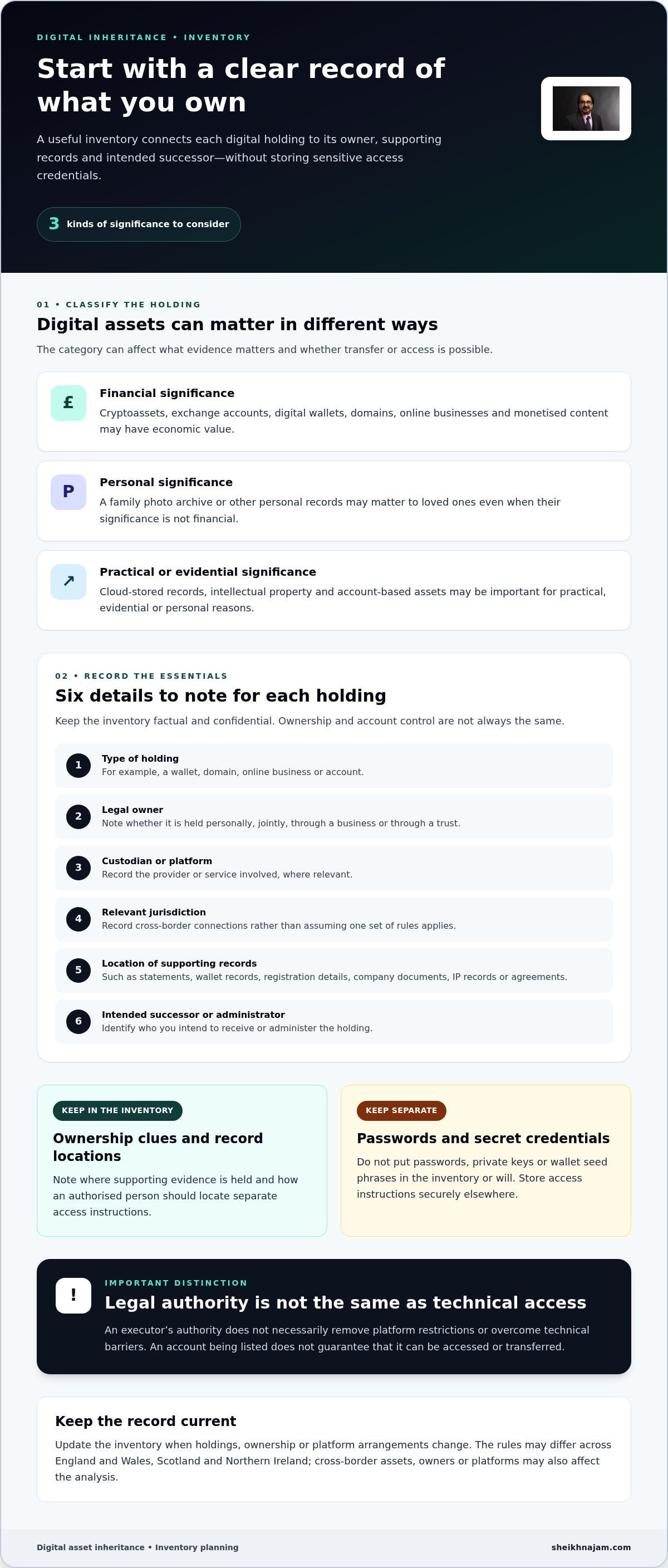
Include cryptoassets, exchange accounts and digital wallets, as well as domains, online businesses and monetised content. Consider cloud-stored records, intellectual property and other account-based assets if they have financial, evidential or personal significance. Separate items with potentially transferable economic value from personal accounts whose treatment may be governed by platform terms. Do not assume that access or transfer will be available just because an account is listed.
What details belong in the inventory, and what should remain separate?
For each holding, record its type, legal owner, custodian or platform, relevant jurisdiction, location of supporting records and intended successor or administrator. Useful evidence may include account statements, wallet records, domain registration details, company documents, intellectual property records and relevant agreements. Note whether an asset is held personally, jointly or through a business or trust. Control of an account does not, by itself, establish legal ownership.
Treat the inventory as a confidential planning record, not a place to store passwords, private keys or wallet seed phrases. It can say where access instructions are securely held and explain how an authorised person should locate them, while keeping the credentials separate from the will. A will may need to be disclosed during estate administration, so including sensitive access information could create avoidable exposure.
Organise the inventory so you can update it as holdings, ownership and platform arrangements change. It provides the factual foundation for aligning legal ownership, succession documents and practical access. For more on the wider ownership and succession framework, see the digital asset structuring guide.
This guide takes a UK perspective, but succession and administration rules differ across England and Wales, Scotland and Northern Ireland. Where assets, owners or platforms have cross-border connections, the relevant jurisdiction may also affect the analysis. Record those connections in the inventory rather than assuming one set of rules applies to every holding.
Match digital asset ownership to the right inheritance structure
Once you have identified an asset, consider whether its legal ownership and intended succession arrangements align. A will, trust or business succession document may each be relevant, but none is a universal solution. The right structure depends on who owns the asset, who holds any beneficial interest, how it is controlled and what the governing documents permit.
These elements can differ. A company may own a wallet or domain while an individual manages the account; a platform may control account access without owning the underlying intellectual property. An executor’s authority to administer an estate does not necessarily remove platform restrictions or overcome technical barriers. Effective planning considers legal authority alongside practical control.
When may a will, trust or business document be relevant?
A valid will may direct how assets forming part of the estate are distributed, subject to ownership, applicable law and relevant platform terms. A trust involves distinct choices about control, beneficiaries, administration and tax. It should be considered as a deliberate legal structure, not simply as a way to provide access. Where wallets, domains or intellectual property belong to a business, succession documents should be coordinated with the company’s ownership and governance arrangements.
How do cross-border holdings complicate digital inheritance?
An asset, its custodian, the platform and its intended beneficiary may each be connected to a different jurisdiction. Residence, domicile, asset location and tax treatment can require current, jurisdiction-specific review. Do not assume that one will or choice of governing law resolves every foreign succession issue. Where several countries are involved, specialist advice on coordinating digital asset and succession arrangements can help bring ownership, documents and administration into a coherent framework.
Protect access without putting digital assets at risk
A plan should give successors usable instructions without exposing valuable credentials during your lifetime. The challenge is to make instructions available in the right circumstances while limiting who can see sensitive information and when. Legal authority to administer an estate and the technical ability to unlock a device, wallet or account are separate. An executor may have authority to deal with estate assets but lack a password, recovery method or the information needed to satisfy a provider’s process.
Platforms may apply their own terms, identity checks and procedures after a user’s death. Depending on the service, an account might be eligible for transfer, memorialisation or deletion, or access may be restricted. A wallet’s recovery process can differ. Review the current terms and procedures for each relevant platform, and choose security arrangements suited to the specific storage method rather than assuming one approach will work for every asset.
Why should private keys and passwords stay out of a will?
A will may be handled by executors, professional advisers and others involved in estate administration, and may be copied or disclosed in relevant circumstances. Including a seed phrase, private key or password could create a confidentiality and security risk, particularly if the credential allows immediate control of an asset. A reference to where secure instructions are held is different: it points an authorised person to a separate process without reproducing the secret itself.
A will should direct the succession of an asset, not disclose the secret credentials that control it.
How can access instructions be organised securely?
Possible arrangements include encrypted records, controlled emergency access and carefully defined arrangements involving a trusted person. The right design depends on the asset, security risks and provider terms. No single method suits every holding. Where the chosen approach allows, keep authentication devices, recovery codes and asset records separate so that one compromised item does not automatically expose the whole arrangement.
Test the process with practical questions: can the intended person locate the instructions, understand the steps and use them lawfully when required? Review access arrangements whenever credentials, devices, ownership or platform procedures change. An obsolete recovery code or inaccessible encrypted record can frustrate succession as effectively as having no instructions. The aim in considering how to structure digital assets for inheritance is not simply to preserve access, but to make it secure, current and consistent with the estate documents.
Build a practical digital inheritance plan in five steps
A workable plan turns the inventory into coordinated decisions about ownership, succession and access. Use the steps below to distinguish actions you can document yourself from questions that may need legal, tax or technical analysis.
Step 1: Identify the assets. List relevant financial, business, practical and sentimental holdings, including where each is recorded and who currently manages it.
Step 2: Confirm ownership. Check account statements, wallet records, company documents and relevant agreements. Establish whether each asset is personally owned, jointly held, held by a business or subject to a trust. Account access alone may not prove legal ownership.
Step 3: Select the succession structure. Consider how each asset should pass or be administered, and whether the will, trust arrangements or business documents reflect that intention. Material value, complex beneficial interests or cross-border connections warrant tailored legal and tax review.
Step 4: Secure access arrangements. Record where instructions are held and how an authorised successor can locate them, without putting passwords or private keys in the will. Check that the security method is usable, confidential and consistent with relevant provider terms.
Step 5: Schedule a review. Revisit the plan after acquiring assets, changing platforms, restructuring ownership or experiencing a major life event. Set a review interval suited to how quickly your holdings and the relevant technology change.
What documents and decisions should be coordinated?
Review the will alongside trust instruments, shareholder arrangements, powers of attorney and business continuity documents. Check that the people named as executors, trustees or authorised representatives can carry out their respective roles, and that operational access arrangements support rather than contradict those documents. Record the intended treatment of sentimental accounts separately from assets with transferable financial value, as their practical and legal considerations may differ.
Actions you can take now:
Prepare and date an asset inventory, then gather records that support ownership and value.
Note where secure access instructions are stored, without including the credentials themselves.
Record which documents and named people relate to each asset.
Matters for tailored analysis:
Whether a will, trust or business arrangement fits the ownership and intended succession.
Tax, domicile, residence or jurisdiction questions, particularly where assets or beneficiaries are cross-border.
Whether technical access arrangements remain secure and workable for the specific holdings.
Where these issues intersect, specialist private-client services can help coordinate legal structure, tax considerations and estate administration. To discuss aligning your digital holdings with your succession documents, contact Sheikh Najam.
When specialist advice can bring the inheritance plan together
A straightforward inventory may be enough to organise modest, personally held accounts. Tailored advice becomes more relevant where digital holdings have material value, are owned through a business or trust, involve complex beneficiary arrangements, or connect with more than one jurisdiction. In those circumstances, succession documents, ownership and practical administration need to be considered together rather than as separate tasks.
There is no uniform outcome. Legal structuring, tax analysis and estate administration may each affect how an asset is treated, but advice cannot guarantee tax savings, access to a platform or avoidance of probate. A review assesses the particular facts, identifies inconsistencies and clarifies which decisions need coordinated action.
What should a digital asset inheritance review examine?
A focused review can examine who owns each asset, what the relevant governing documents say, and whether the intended beneficiaries and administrators can carry out the plan in practice. It should also consider platform restrictions and available recovery routes. Where appropriate, trust arrangements, international wills or business documents may need to be reviewed together, with tax and succession assumptions considered against current law and the individual’s circumstances.
For example, a wallet used in a business may raise different ownership and continuity questions from a personally held account. A cross-border holding may require consideration of the asset, custodian and relevant jurisdictions, rather than reliance on a single succession document—such as partnering with dedicated financial planning services Australia if overseas assets or wealth structures need to be integrated into the wider estate.
How can readers prepare for an initial discussion?
You do not need to share sensitive credentials to prepare. Bring a high-level inventory and supporting information that explains ownership and context, then identify the questions that remain unresolved.
Summarise the assets and how each is held, including any business or trust connection.
Note intended beneficiaries, executors or trustees, and relevant documents such as wills, trust instruments or company agreements.
List any cross-border connections, platform restrictions or uncertainties about access and administration.
Do not transmit private keys, passwords or recovery phrases as part of the initial enquiry. The inventory and questions provide a sound basis for considering how to structure digital assets for inheritance, while keeping operational secrets separate.
Sheikh Najam TEP advises on digital asset structuring alongside private wealth, trusts, inheritance tax planning and estate administration. To discuss how these considerations apply to your circumstances, use the contact form to arrange a confidential discussion.
Put your digital inheritance plan into action
A dependable digital inheritance plan begins with a complete, confidential inventory, then aligns asset ownership, succession documents and secure access arrangements. The central lesson in how to structure digital assets for inheritance is that legal authority and the practical ability to access an account are distinct, and both need careful consideration.
Where holdings are valuable, business-linked, held through trusts or connected with other jurisdictions, the decisions may extend beyond a will. Sheikh Najam TEP advises on digital asset structuring, trusts and estate planning, as well as inheritance tax planning, international wills and probate matters. This breadth supports coordinated consideration of legal structure, tax and estate administration, tailored to the circumstances.
Begin by preparing a high-level inventory and noting questions about ownership, intended beneficiaries, relevant documents and cross-border connections. Keep passwords, private keys and recovery phrases separate. To discuss your circumstances, arrange a confidential discussion about digital asset structuring. Considered planning can give your successors a clearer framework for managing your digital legacy.
Frequently Asked Questions
What counts as a digital asset for inheritance?
A digital asset is an electronically held or accessed item, right or account that may have financial, personal or practical significance after its holder’s death. Examples include cryptoassets, exchange accounts, digital wallets, domains, online businesses, monetised content, intellectual property and cloud-stored records. Personal accounts, such as email or social media, may also matter, although their treatment can depend on platform terms. Whether an item forms part of an estate depends on its legal character, ownership and applicable law.
Should I put my crypto wallet recovery phrase in my will?
No. A recovery phrase or private key can give direct control over a wallet, so including it in a will could expose the asset if the document is copied, disclosed or handled during estate administration. Keep credentials in a secure, separate arrangement, and use the will or another appropriate document to explain succession intentions. Your records can indicate where authorised people may find access instructions without reproducing the secret phrase itself.
Can an executor access my online accounts after I die?
Not necessarily. An executor’s legal authority to administer an estate does not automatically provide the technical ability to unlock a device or satisfy an online platform’s access process. Providers may require particular evidence and may restrict transfer, memorialisation or deletion under their terms. Wallet recovery arrangements can differ from account procedures. An inheritance plan should therefore consider both who has authority to act and how relevant assets or records can practically be located.
Do I need a trust to pass digital assets to my beneficiaries?
No, a trust is not automatically required. Personally owned assets may be addressed through a will, subject to ownership, validity and applicable law. A trust may be relevant where deliberate arrangements for control, administration or beneficiaries are needed, but it brings its own legal and tax considerations. Planning how to structure digital assets for inheritance means matching the arrangement to the asset and wider estate, rather than adopting one structure for every holding.
Can digital assets be included in a UK will?
Yes, a will can address digital assets that belong to the person making it, subject to the will’s validity, ownership and applicable law. The Property (Digital Assets etc) Act 2025 recognises digital assets as a category of personal property in the UK, but this does not itself resolve access or transfer for every asset. Platform terms, technical controls and cross-border connections may still affect administration, so consider the wording and wider plan together.
What happens to cryptoassets if beneficiaries cannot access the wallet?
If the people administering the estate cannot locate or use the necessary recovery method, they may be unable to control or transfer the cryptoassets, even where the holding is identified. The practical outcome depends on the wallet and its recovery arrangements; there is no single process for every provider or technology. Maintain records of wallet ownership and location, and arrange secure instructions that an authorised successor can find without placing recovery phrases in a will.
How often should I update my digital asset inheritance plan?
Review it whenever you acquire relevant holdings, change platforms, restructure ownership or experience a major life event, such as a change in family or business circumstances. Also set a review interval suited to how quickly your assets and the technology supporting them change. At each review, check that the inventory, succession documents and access instructions remain consistent, current and usable by the people expected to act.


Comments