Digital Asset Structuring: A UK Guide to Ownership, Control and Succession

What happens when an asset forms part of your wealth but nobody can access or administer it? Digital asset structuring addresses more than the name on an account or wallet. Legal ownership, practical control and authority to act are separate questions, each affecting how an asset is managed during your lifetime and dealt with after death.
Recording passwords or naming a beneficiary may seem like a complete solution, but it may not be. Digital assets can include cryptoassets, tokens and rights held through online platforms. The arrangements that establish ownership may not provide the technical access needed to manage them. Equally, having secure custody does not, by itself, establish who owns an asset or who may make decisions about it.
This guide explains how to build a coherent framework for ownership, access and future administration under UK law. Legal and tax treatment can depend on the asset and the circumstances. We look at how legal structures relate to wallets, keys and platform accounts, and how tax planning, incapacity and succession fit together. We also cover when specialist advice may be useful, particularly where trusts, international connections or fiduciary responsibilities are involved.
Table of Contents
What does digital asset structuring mean for private clients?
Digital asset structuring is the deliberate alignment of legal ownership, practical control, administration and future transfer. It asks not only where an asset is held, but who has rights in it, how it can be managed, who may make decisions if the owner cannot, and how it may be dealt with through an estate or other arrangement. The process goes beyond choosing a wallet, online platform or technical custody method. Those choices can affect access, but do not, by themselves, settle ownership or succession.
The term digital asset is used broadly for items or rights represented and managed in digital form. For private clients, the key question is not simply whether something has economic value, but what rights attach to it and how those rights are documented. A password or private key is a means of reaching or controlling an asset. It is not necessarily the asset itself or proof of its legal ownership.
Which assets may require a structuring decision?
Potential examples include cryptoassets, tokenised interests, digital accounts, online content and associated intellectual property. A token may represent or relate to an interest, while an online account may provide access to content or services governed by contractual terms. A creator’s digital work may carry separate intellectual property rights, even when stored on a platform. These examples are illustrative, not a definitive inventory or legal classification.
Economic value and legal character may differ. The rights associated with a digital account, a token and copyright in an online work are not necessarily equivalent, even if each contributes to a person’s wealth. A useful first step is to distinguish what you own from what you can access under a licence or contract, and from what merely provides access to something else.
Why ownership and control are not always the same
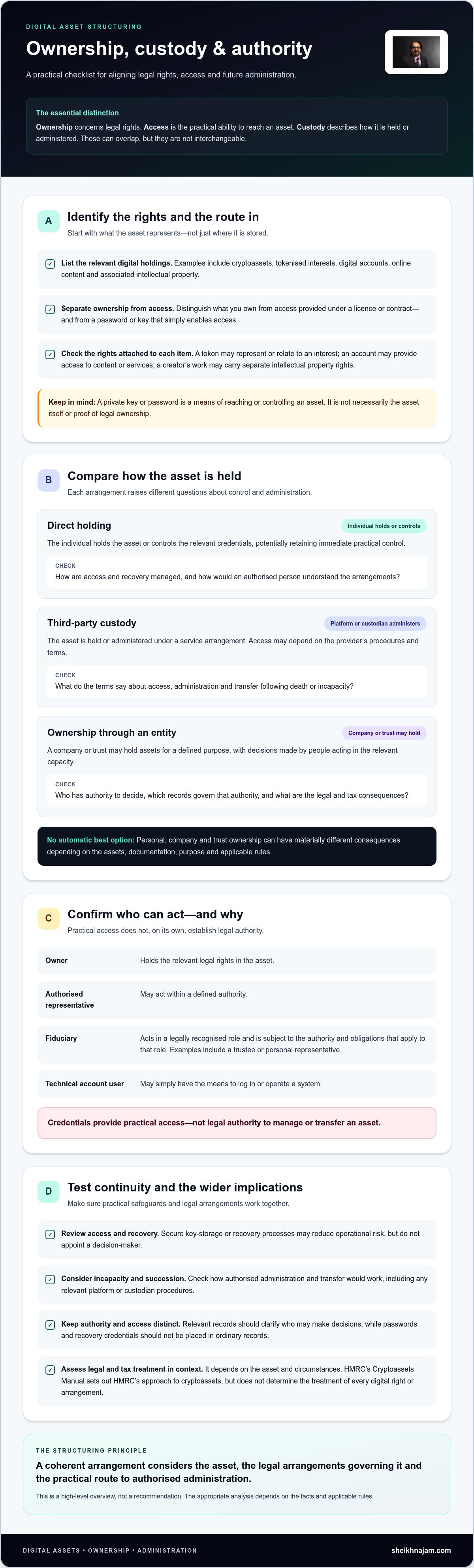
Ownership concerns the legal rights in an asset; access concerns the practical ability to reach it; custody describes how it is held or administered. These concepts can overlap, but they are not interchangeable. Someone may hold rights in an asset but lack the credentials to access it. Conversely, a person with login details may be able to operate an account without being its legal owner.
Third-party platforms and custodians add another layer. Their systems and contractual terms may affect how an account or asset can be accessed, administered or transferred. Possession of a password alone does not ensure continuity. Effective structuring considers the asset, the legal arrangements governing it and the practical route to authorised administration. The appropriate analysis depends on the facts and applicable rules; this overview is educational and is not individual legal advice.
How do ownership, custody and decision-making fit together?
How an asset is held affects more than its day-to-day security. Direct holding, third-party custody and ownership through an entity can lead to different arrangements for control and administration. None is automatically preferable. Sound digital asset structuring considers legal rights alongside technical safeguards, relevant contracts and the authority of anyone expected to act.
Direct holding, custody and entity ownership compared
This is a high-level comparison, not a recommendation. Personal, company and trust ownership can have materially different consequences depending on the assets, documentation, purpose and applicable rules. UK tax analysis is also fact-sensitive. HMRC's Cryptoassets Manual sets out HMRC’s approach to cryptoassets, but it does not determine the treatment of every digital right or arrangement.
Who can act, and under what authority?
An owner holds the relevant legal rights. An authorised representative may act within a defined authority. A fiduciary, such as a trustee or personal representative, acts in a legally recognised role and is subject to the authority and obligations that apply to that role. A technical account user, by contrast, may simply have the means to log in or operate a system. These capacities should not be confused.
Credentials alone provide practical access, not legal authority to manage or transfer an asset. A secure process for storing or recovering keys may reduce operational risk, but cannot appoint a decision-maker or establish their powers. Equally, legal authority may not provide a workable route through a platform’s procedures. Planning needs to account for both the relevant legal documents and the terms and processes governing custody.
Where ownership, custody and decision-making span an individual, an entity or several jurisdictions, coordinated legal and tax analysis can help clarify the arrangement. Discuss digital asset arrangements where those responsibilities intersect.
Which digital asset structure may suit your circumstances?
The appropriate arrangement depends on what you want it to achieve. Priorities might include retaining personal control, providing continuity if you lose capacity, establishing governance for assets connected with a business, or assessing tax and risk implications. These aims can point in different directions. Start with the purpose and your wider estate, rather than assuming one form of ownership is inherently superior.
Personal, corporate and trust arrangements
The matrix below is a starting point for discussion, not a recommendation. An arrangement’s effects depend on the asset, its documentation and applicable law.
Companies and trusts involve distinct legal responsibilities, governance and record-keeping. Neither is a simple substitute for personal ownership. A structure does not automatically reduce tax, protect assets or ensure that someone can access them. Assess how it would operate in light of your circumstances and the relevant legal and tax rules.
Questions that change the appropriate analysis
Several connecting factors may materially affect the analysis. These include the owner’s residence, domicile where relevant under current law, the location or governing arrangements of an asset, and any business or family interests. The asset’s character matters too: an online account, a tokenised interest and intellectual property may raise different questions about ownership, contracts and succession.
Consider family circumstances, intended beneficiaries, existing wills and trusts, and the authority of the people expected to administer the estate together. If international wills or assets connected with more than one jurisdiction are involved, local rules and cross-border consequences may require coordinated advice. Sheikh Najam TEP advises on trust and estate planning, international tax planning and digital asset structuring as part of this multidisciplinary assessment. Further information is available on international wills and estate planning.
How can you review digital asset arrangements in a practical way?
A structured review can expose gaps between what you own, how you access it and who may administer it. Treat the review as part of digital asset structuring, not simply as an inventory of accounts. For each asset, connect the ownership information to its governing arrangements and continuity plan.
Create an asset and authority map
For each relevant holding, record its category, the person or entity that owns it, any custodian or platform involved, the relevant account and the documents that govern it. Note who is expected to act and the basis of their authority. Distinguish a formally appointed representative or fiduciary from someone who simply knows how to use an account.
Keep the inventory secure and proportionate. It should help an authorised person locate the right information without exposing passwords, private keys or recovery phrases in ordinary estate documents or broadly shared records.
Identify assets: list relevant cryptoassets, tokenised interests, digital accounts, online content and associated rights.
Establish ownership: review records, account details, contracts or entity documents that indicate who holds the relevant rights.
Map access: record the custodian, platform and secure location of access instructions, without copying confidential credentials into the inventory.
Review authority: identify who may make decisions and the legal or organisational documents supporting that role.
Record decisions: note the intended approach to administration and transfer, and where the current supporting documents are held.
Test continuity and review arrangements
Consider different disruptions separately. Death raises questions about estate administration and transfer. Incapacity may mean someone needs to manage affairs during the owner’s lifetime. Changed platform terms may alter available processes, while lost access can create a practical obstacle even when ownership is clear. These scenarios require different responses, so do not assume that one instruction or document will address them all.
Review platform terms and account procedures alongside company or trust records, relevant estate documents and applicable compliance considerations. Update the map when holdings, ownership, decision-makers or service arrangements change. Where assets or fiduciary roles span jurisdictions, coordinated legal, tax and compliance advice can help identify inconsistencies before they obstruct administration.
For more on how inheritance arrangements can be planned around digital holdings, consult digital asset and estate planning guidance. If your review identifies uncertainty about ownership, authority or continuity, discuss your digital asset arrangements.
When should digital asset structuring involve specialist legal advice?
A coordinated legal review is particularly valuable when arrangements extend beyond a straightforward personal holding. Cross-border assets, different forms of digital property, company or trust ownership, family succession plans and business interests can all raise questions that need to be considered together. A decision intended to simplify administration, for example, may also affect governance, tax analysis or a fiduciary’s authority.
Digital asset structuring may therefore involve related areas of advice. Legal analysis can clarify ownership, decision-making powers and how arrangements interact with estate documents. Tax considerations depend on the asset, owner and structure, where specialist support from crypto accounting practices such as Block3 Finance can help clarify complex reporting obligations. Financial crime and compliance issues may also arise in connection with relevant transactions, entities or relationships. Do not assume that a particular arrangement will produce a specific tax outcome, safeguard or access right.
Situations that merit a coordinated review
Consider specialist advice where digital holdings are owned through an entity, connected to a business, part of a wider trust or estate plan, or linked to more than one jurisdiction. A review can also help where several people may have administration roles, or where intended succession arrangements need to align with existing documents. Sheikh Najam TEP advises private clients on digital asset structuring alongside trust and estate planning, international tax planning, and financial crime and compliance matters. Further information is available on the specialist advisory areas.
Turning a review into a considered plan
A useful review should establish a clear position on five connected matters:
Ownership: who holds the relevant legal rights, and what records evidence them?
Authority: who may make decisions during the owner’s lifetime, on incapacity or after death, and under what authority?
Access: what practical arrangements support authorised access without exposing confidential credentials?
Administration: how do platform terms, entity records and fiduciary responsibilities affect the intended process?
Future transfer: how should the arrangements connect with estate planning and any relevant tax analysis?
The answers depend on individual circumstances, the nature of the assets and the rules that apply. This section provides general information, not advice on a particular structure. For broader context, consider how these decisions fit within digital succession planning. A considered discussion can help identify where ownership, authority and future administration need closer alignment. Discuss your digital asset structuring requirements.
Put a considered plan in place
Effective digital asset structuring aligns legal ownership, practical access and decision-making authority so arrangements can be understood and administered when circumstances change. The right approach depends on the assets, the owner’s wider estate and family position, and any relevant entities or jurisdictions. A secure record of holdings is useful, but it needs to sit alongside clear legal authority and considered succession planning.
Sheikh Najam TEP advises private clients on digital asset structuring, drawing on related experience in trust and estate planning, international tax planning, and financial crime and compliance matters. Where these considerations intersect, a coordinated review can help identify questions that need specialist analysis. The outcome depends on the individual facts and applicable rules.
Taking steps now can give you a clearer basis for future decisions and continuity. Discuss your digital asset structuring requirements and consider how your arrangements can support confident administration over time.
Frequently Asked Questions
What is digital asset structuring?
Digital asset structuring aligns the legal ownership, practical control, administration and future transfer of digital assets. It may involve reviewing the assets, related accounts or custodians, governing documents and the owner’s wider estate arrangements. It does not mean adopting one standard structure or simply choosing a wallet. The appropriate analysis depends on the asset, the owner’s circumstances and the rules that apply.
Which assets should be considered in digital asset structuring?
A review may include cryptoassets, tokenised interests, digital accounts, online content, intellectual property and contractual rights connected with digital platforms. Not every online account is an owned asset, and different rights may attach to the same digital item. An assessment should establish what exists, who holds the relevant rights, how it is accessed and which agreements or other documents govern it.
Is a digital wallet the same as legal ownership?
No. A wallet or account may provide a means of accessing or controlling an asset, but that alone does not determine who legally owns it or has authority to act. Custody arrangements, platform terms and supporting documents may also be relevant. Keep practical access distinct from ownership and legal authority. If any of these matters is unclear or disputed, seek advice based on the specific circumstances.
Can digital assets be held in a trust or company?
Trusts and companies may be considered in some circumstances, but neither is automatically suitable for every asset or owner. Each involves different legal responsibilities and administration, and may have tax consequences that depend on the facts and applicable rules. The purpose of the arrangement, the asset and the wider estate all matter. A structure alone does not guarantee access, asset protection or a particular tax outcome.
What happens to digital assets if the owner dies or loses capacity?
The outcome depends on factors including legal ownership, custody arrangements, available authority and relevant estate documents. Practical access and legal authority are separate. Having credentials may not be enough to establish a right to administer or transfer an asset. A considered plan should address both, protect confidential credentials and take account of relevant rules. Review the arrangements when assets, platforms or personal circumstances change.
Does digital asset structuring reduce tax?
No particular structure should be assumed to reduce tax. Treatment may depend on the asset, its ownership, transactions, the owner’s residence and other relevant facts, as well as current law. Consider digital asset structuring alongside appropriate tax analysis, not as a guaranteed tax-saving method. General examples cannot establish an individual outcome, so decisions should be based on the specific circumstances.
How often should digital asset arrangements be reviewed?
Review arrangements after a material change, such as acquiring a new asset type, changing custody, creating or altering an entity, moving across jurisdictions or revising estate plans. Periodic checks can also reveal outdated records or access procedures. Consider whether the inventory, authority documents and succession arrangements remain consistent. The appropriate review interval depends on the owner’s circumstances and how frequently the assets and related arrangements change.


Comments