Estate Administration in the UK: A Practical Checklist for 2026

What if the grant of probate is not the start of estate administration, but one milestone in a series of decisions for which personal representatives remain accountable? Applying for a grant may be a prominent step, but identifying and protecting assets, establishing liabilities and understanding the tax position all require attention. Some institutions will release funds without a grant; others will not.
It can be difficult to know where to begin when banks, beneficiaries, property and tax matters all need attention. Distributing assets too soon can expose personal representatives to risk if debts, tax liabilities or competing claims remain unresolved. The order of tasks matters, and the process can vary across the UK.
This practical 2026 checklist explains the principal stages of estate administration, the personal representative’s responsibilities and the tasks that may depend on probate or equivalent authority. It also highlights when trusts, overseas assets, tax complexity or disputes may warrant specialist advice before distribution.
Table of Contents
Estate administration explained: what a personal representative is responsible for
The estate administration process: establish authority, assets, liabilities and tax
Estate administration complications: trusts, international assets and disputes
Estate administration checklist: actions to take before distributing assets
When specialist estate administration advice can bring clarity
Estate administration explained: what a personal representative is responsible for
Estate administration is the process of identifying, safeguarding and accounting for a deceased person’s assets, addressing liabilities and tax obligations, and transferring what remains to those entitled to it. The person legally responsible for this work is the personal representative: an executor appointed by a valid will or an administrator authorised under the applicable procedure where there is no effective appointment.
Estate administration is the accountable process by which a personal representative establishes authority, protects and values the estate, settles its liabilities and distributes the balance in accordance with the will or the law. Where required, a grant of probate provides formal authority to deal with an estate. It is not the administration itself, and obtaining it does not complete the representative’s responsibilities.
Who administers an estate when there is a will or no will?
Where a valid will appoints executors, they are responsible for carrying out its provisions, subject to the duties imposed on personal representatives. Their work may include securing assets, keeping proper records, dealing with claims and making distributions only when the estate’s position is sufficiently clear. An executor should consider the complexity of the estate and whether professional support would help with particular tasks.
If there is no valid will, or no executor able or willing to act, an administrator must obtain the appropriate authority under the applicable intestacy procedure. The term administration of an estate is also used more broadly in common-law contexts; this overview of estate administration describes the general distinction between administration where a will exists and where it does not. Appointment and distribution rules depend on the jurisdiction and circumstances.
When is probate or equivalent authority needed?
A grant may be required before certain institutions will release assets or before particular estate property can be dealt with. The requirement depends on the assets, how they are owned and the relevant jurisdiction. Some assets may pass outside the estate or be dealt with without a grant, while others require formal authority. In England and Wales, probate applications are handled by HM Courts & Tribunals Service.
Terminology and procedure differ across the UK. England and Wales and Northern Ireland use grants of probate or letters of administration in relevant cases; in Scotland, the corresponding court authority is generally called confirmation. Establish which rules apply before relying on procedures used elsewhere in the UK. Where a grant is required, it provides authority, but the representative’s wider obligations to administer the estate remain.
The estate administration process: establish authority, assets, liabilities and tax
A sound administration follows connected stages, but the order and amount of work depend on the estate, its assets and the jurisdiction. Use the following as a practical framework rather than a fixed timetable. A property sale, overseas account or trust interest may introduce steps that a simpler estate does not require.
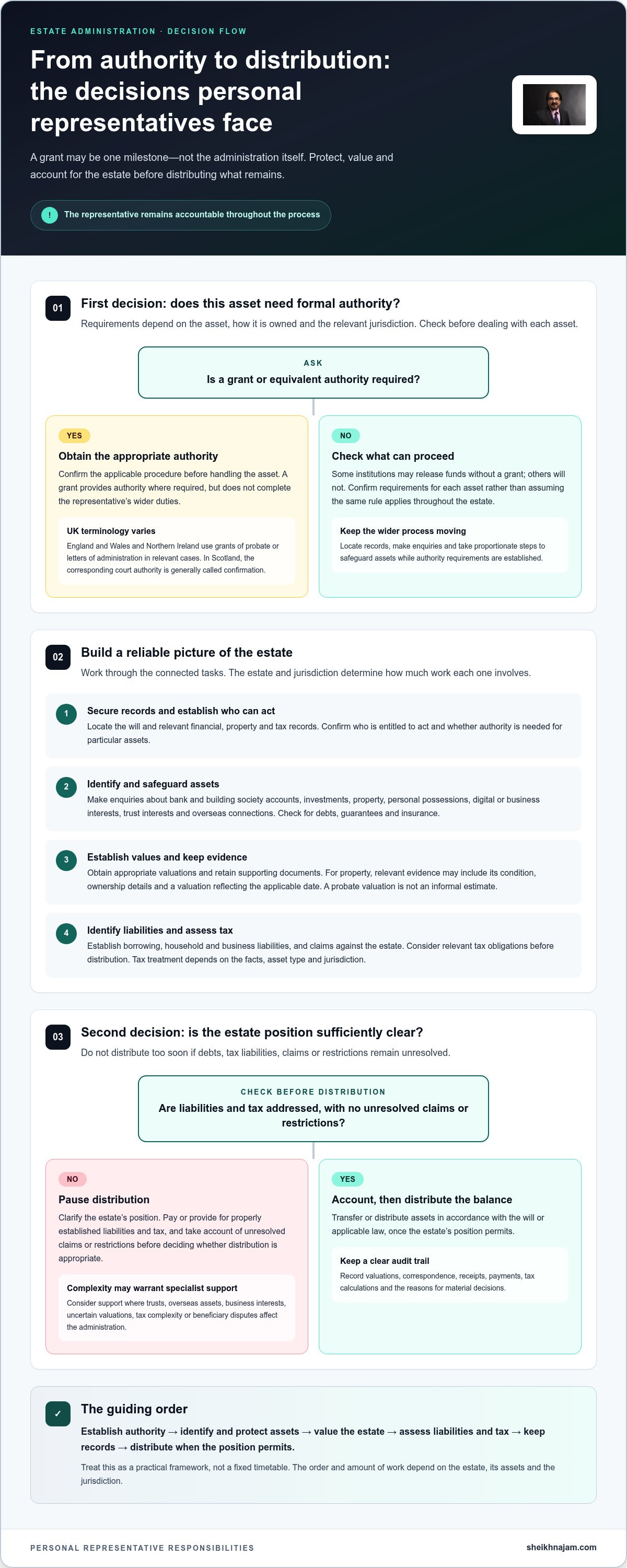
In broad terms, the representative establishes authority, identifies and protects assets, assesses liabilities and tax, keeps a full account of decisions and transactions, then distributes the estate when the position permits.
1. Secure records and establish authority. Locate the will and relevant financial, property and tax records. Confirm who is entitled to act and whether a grant or equivalent authority is needed before dealing with particular assets. For England and Wales, GOV.UK sets out the official probate guidance.
2. Identify and safeguard the estate. Make enquiries about bank and building society accounts, investments, property, personal possessions, and digital or business interests. Check for debts, guarantees, insurance, trust interests and overseas connections. Take proportionate steps to protect property and records.
3. Establish values and supporting evidence. Obtain appropriate valuations and keep the documents that support them. For a property, relevant evidence may include its condition, ownership details and a valuation reflecting the applicable date. A probate valuation should not be treated as an informal estimate.
4. Identify liabilities and assess tax. Establish outstanding borrowing, household and business liabilities, and any claims against the estate. Consider relevant tax obligations before making distributions. Tax treatment depends on the facts, the type of asset and the jurisdiction, so verify the applicable requirements rather than assuming one set of rules applies to every estate.
5. Settle, account and distribute. Pay or provide for properly established liabilities and tax, then transfer or distribute assets in accordance with the will or applicable law, taking account of unresolved claims or restrictions.
Records, tax and estate accounts
Keep a record throughout the administration of asset valuations, correspondence with institutions and beneficiaries, receipts, payments, tax calculations and the reasons for material decisions. This creates an audit trail and helps show how the representative has discharged their responsibilities.
Tax on the deceased’s estate is not the only tax question. Income or gains arising from estate assets during administration may need separate consideration from tax arising on death or from a beneficiary’s later ownership. Check the applicable treatment against current, jurisdiction-aware guidance. Estate accounts should reconcile opening assets and liabilities with receipts, payments, asset realisations and distributions, so beneficiaries can see how the final balance was reached.
Where valuations, tax exposure or competing interests are difficult to resolve, discussing the estate’s administration can help clarify the issues before consequential decisions are made.
Estate administration complications: trusts, international assets and disputes
Some estates involve more than collecting assets and paying liabilities. A trust interest, overseas property or disagreement between beneficiaries can affect what the personal representative may deal with, what evidence is needed and whether distribution should proceed. Review the relevant documents, ownership arrangements and claims rather than assuming one rule resolves every issue.
Trusts and international connections
Ownership structure matters. An asset held by trustees, for example, should not automatically be treated as an asset personally owned by the deceased. Examine the trust instrument and supporting records to establish the nature of any interest. An overseas asset may also engage more than one legal or tax system. Assess the applicable succession rules, reporting obligations and tax treatment together, rather than inferring them from the asset’s location alone. For a general introduction to Inheritance Tax planning, consumer guidance can provide context, but the estate’s actual position depends on its circumstances.
Valuation questions and contested claims
A disagreement about an asset’s value is not necessarily a challenge to the will or a fiduciary decision. It may call for better evidence or an independent valuation. By contrast, an allegation that a will is invalid, or that a representative has acted improperly, may move the matter beyond ordinary administration into contentious probate. Where a claim remains unresolved, distributing assets prematurely may expose the estate and its representative to avoidable risk. Depending on the dispute and the parties’ positions, mediation or another dispute-resolution process may provide a structured way to address it. Further detail appears in this guide to contentious probate and dispute resolution.
Estate administration checklist: actions to take before distributing assets
A working checklist helps personal representatives distinguish enquiries they can begin from decisions that should wait for formal authority, tax review or resolution of a claim. Record the outcome of each task, including any enquiry that remains open. This creates a controlled process instead of relying on memory or informal updates.
Record each enquiry and decision
Maintain a central digital or paper file and update it throughout the administration. For each item, note the action taken, its date, the evidence received and any next step. If more than one representative is acting, record discussions and agreed decisions so responsibilities and reasons for action remain clear.
Will and authority: locate the will or establish which succession rules apply; record who is entitled to act and whether a grant or equivalent authority is required.
Assets and ownership: list accounts, investments, property, personal possessions, business interests and any trust or overseas connection; record enquiries, responses and ownership evidence.
Valuations and protection: keep valuation reports and supporting documents, and record steps taken to safeguard assets. Flag estimates or disputed figures for further review.
Liabilities and tax: log creditor enquiries, invoices, tax correspondence, calculations and payments, marking unresolved amounts for attention.
Communications and decisions: retain correspondence with institutions and beneficiaries, along with receipts, payment records and notes explaining material decisions.
Transparent records support accurate estate accounts and help representatives provide beneficiaries with clear, consistent updates. They also make it easier to identify issues requiring particular expertise, such as trust interests, international connections, uncertain tax positions or competing claims. These are reasons to assess the issues carefully. Advice on private client matters can help clarify where coordinated support is relevant.
Separate preliminary work from steps that must wait
Information gathering, record preservation and asset-protection enquiries can often begin early. Transferring or selling assets, paying claims and making distributions may depend on authority, the nature of the asset and a sufficiently clear understanding of liabilities, tax and any unresolved dispute. A checklist is not permission to take a legally consequential step: establish the position for the particular estate first.
Before considering distribution: confirm that assets and ownership have been identified, valuations are adequately supported, liabilities and relevant tax have been considered, and any necessary asset realisation is properly documented.
Check entitlement: establish what the will directs or, if there is no valid will, which intestacy rules govern succession. An interim distribution may be appropriate in some circumstances, but consider possible liabilities, claims and the estate’s remaining needs before proceeding.
If trusts, cross-border matters, tax complexity or a dispute make the next step uncertain, discuss the estate administration position before committing estate assets to distribution.
When specialist estate administration advice can bring clarity
Not every estate needs the same level of support. A personal representative may be able to manage a relatively straightforward estate where ownership is clear, records are accessible and there are no material disputes. The decision to seek assistance is better guided by the issues than by the estate’s apparent size alone. Even a limited number of assets can raise complex questions if they are held through a trust, connected with another country or subject to competing claims.
Which situations may warrant specialist input?
Consider advice where legal, tax and practical questions overlap, or where uncertainty could affect a consequential decision. Indicators may include:
Trust arrangements or complex ownership: the deceased’s rights may depend on trust documents, company records or agreements that need careful interpretation.
International connections: overseas property, accounts or beneficiaries may raise questions involving more than one legal or tax system.
Tax complexity: asset values, business interests, trusts or cross-border circumstances may require coordinated consideration of inheritance tax and other relevant tax matters.
Contested claims: disagreement about a will, entitlement or a representative’s actions may call for contentious probate or dispute-resolution expertise.
Uncertain evidence or valuation: incomplete records or a material difference of opinion about an asset’s value may make it difficult to account confidently for the estate.
Specialist input need not mean transferring every task to an adviser. It may help clarify a particular legal or tax issue, identify the evidence required, or coordinate advice where trust, international and administration questions intersect. Sheikh Najam TEP advises on probate and estate administration alongside related private-client matters, including trusts, inheritance tax planning, international tax and contentious probate. The appropriate scope of support depends on the representative’s circumstances and the issues to resolve.
How can a personal representative take the next step?
Before seeking advice, assemble the will or available succession documents, a preliminary list of assets and liabilities, relevant valuations, correspondence with financial institutions and beneficiaries, and a concise note of outstanding questions. Identify the immediate concern, such as authority to deal with an asset, its ownership or valuation, the tax position, or a potential claim. This preparation gives the discussion a clear focus without requiring every issue to be resolved in advance.
For guidance tailored to the estate’s circumstances, Discuss estate administration matters.
The central principle is measured administration: establish the relevant authority, keep a reliable record and avoid distribution until material liabilities, tax questions and claims have been considered. The precise process depends on the estate’s facts and the UK jurisdiction involved, so a method appropriate in one case may not suit another.
Take the next step with a clear administration plan
Effective estate administration involves more than obtaining probate. Personal representatives must establish their authority, identify and protect assets, account for liabilities and tax, and keep a clear record of decisions before distributing the estate. The order and extent of those steps depend on the assets involved, any trusts or international connections, potential claims and the applicable jurisdiction.
A structured checklist helps distinguish enquiries that can begin now from decisions requiring further authority or review. It also makes emerging complexities easier to recognise, without assuming that every estate needs the same level of support.
Sheikh Najam TEP advises on probate and estate administration, with related expertise in trusts, inheritance tax planning and international tax. Where these issues intersect, considered advice can help personal representatives understand the questions involved and determine an appropriate course of action.
Discuss estate administration matters and bring the relevant documents and questions into focus. A methodical approach can help you proceed with greater clarity at each stage.
Frequently Asked Questions
What does estate administration involve?
Estate administration involves identifying and safeguarding a deceased person’s assets, establishing their value, addressing liabilities and relevant tax obligations, and transferring the remaining estate to those entitled to it. The personal representative should also keep clear records of enquiries, decisions, receipts and payments. The tasks depend on the estate: a trust interest, overseas asset, business holding or unresolved claim may require further investigation before distribution can be considered.
Is estate administration the same as probate?
No. Probate is a grant of authority issued in relevant cases, while estate administration is the wider process of dealing with the deceased’s affairs. A grant may enable a personal representative to access or transfer particular assets, but obtaining it does not settle liabilities, address tax obligations or distribute the estate. Whether a grant is required depends on factors such as asset ownership, the institutions involved and the applicable UK jurisdiction.
Who is responsible for administering an estate?
The personal representative is responsible for administering the estate. If a valid will appoints executors, they may act in that capacity, subject to the applicable procedures and duties. Where there is no valid will, or no executor able or willing to act, an appropriate person may apply for authority to act as administrator. Terminology and appointment procedures differ across England and Wales, Scotland and Northern Ireland, so establish the relevant jurisdiction.
How long does estate administration take in the UK?
There is no fixed duration for every estate. A straightforward estate may take around six to nine months, an estate involving property around nine to fifteen months, and a complex estate eighteen to thirty-six months. These are indicative ranges, not guaranteed timeframes. Delays may arise from asset valuations, tax matters, overseas procedures or disputes. The time taken to obtain a grant is only one part of the overall administration period.
Can an executor distribute money before probate is granted?
Sometimes an executor can deal with assets that do not require a grant, but this depends on how each asset is held and the requirements of the institution or authority involved. A grant may be necessary to access or transfer other assets. Before making any distribution, the executor should consider outstanding liabilities, tax, possible claims and the estate’s continuing costs. A premature payment may leave the representative responsible for a shortfall, so assess the circumstances first.
What happens if someone dies without a will?
If someone dies without a valid will, their estate is generally distributed under the intestacy rules that apply in the relevant jurisdiction. In England and Wales, those rules determine which relatives inherit and in what proportions; an unmarried partner does not automatically inherit under intestacy. An administrator must obtain the appropriate authority where required and identify those entitled to apply or benefit. The rules differ across the UK, so the deceased’s circumstances and jurisdiction matter.
When should I seek professional help with estate administration?
Professional advice may be useful where an estate includes trusts, international assets, complex tax questions, business interests, uncertain valuations or competing claims. Coordinated advice can help clarify how these issues interact, with the appropriate support depending on the estate and the representative’s needs. Sheikh Najam TEP advises on probate and estate administration, with related expertise in trusts, inheritance tax planning, international tax and contentious probate. A clear record of the estate’s assets and outstanding questions can help focus the discussion.


Comments