Intestacy Laws in the UK: Who Inherits When There Is No Will?

What if the person a family considers closest is not recognised as an heir under the applicable intestacy laws? When someone dies without a valid will, statutory rules determine who may inherit. Those rules do not necessarily reflect the deceased’s relationships or wishes.
It’s understandable to expect a long-term partner or stepchild to receive a share, especially if they were central to family life. Yet unmarried partners and stepchildren who were not legally adopted may not inherit automatically. The outcome can also depend on which UK legal system applies and how particular assets were owned.
This article explains how intestacy rules establish the broad order of inheritance, why the position differs between England and Wales, Scotland, and Northern Ireland, and which relationships or assets may be treated differently. It also covers practical steps families may need to take when administering an estate, including checking cross-border assets and clarifying a disputed entitlement. The applicable rules depend on the circumstances, so this overview is general information rather than advice on an individual case.
Table of Contents
What do intestacy laws mean, and which UK rules apply?
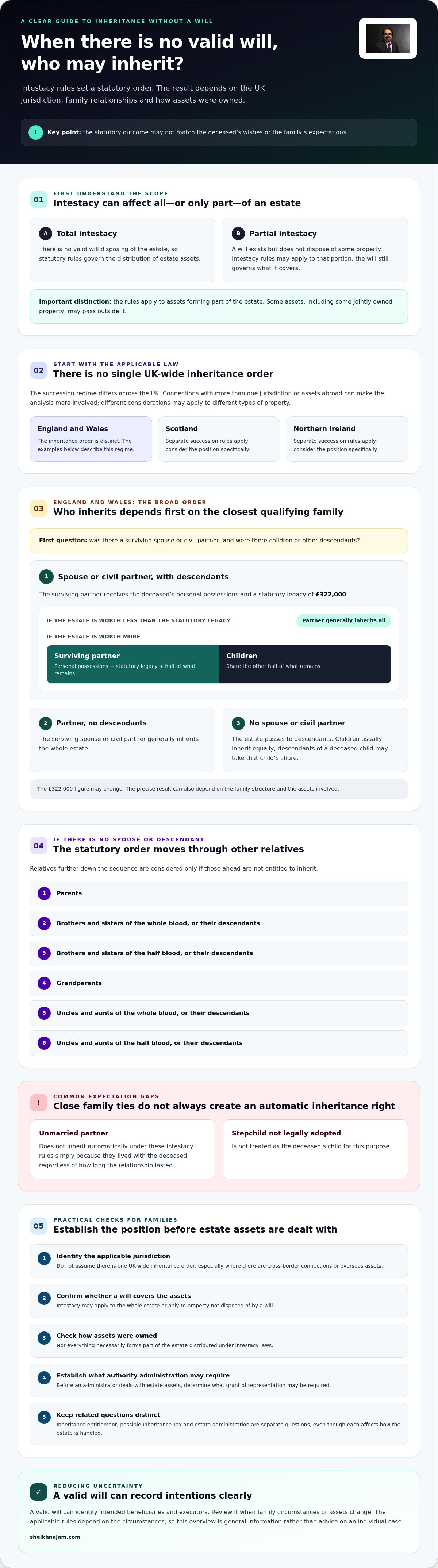
Intestacy arises when someone dies without a valid will disposing of their estate. Statutory succession rules then determine who may inherit property forming part of the estate. The result may not reflect the deceased’s wishes or the family’s expectations. A high-level introduction to the rules of intestacy can provide context, but it cannot establish which rules apply to a particular estate.
There is no single UK-wide formula. England and Wales, Scotland, and Northern Ireland have distinct succession regimes, so identifying the applicable jurisdiction is an essential first step. The next section uses England and Wales as its main example. The Scottish and Northern Irish positions need separate, jurisdiction-specific consideration.
When does a person die intestate?
Total intestacy means there is no valid will disposing of the estate, so statutory rules govern the distribution of estate assets. Partial intestacy can arise even when a will exists. If it does not dispose of some property, intestacy rules may apply to that portion, while the will continues to govern the property it covers.
This section does not assess whether a particular document is valid. If there is concern that a will may be invalid or its terms are disputed, that is a separate issue from identifying beneficiaries under intestacy. Read our information on contentious probate matters for an overview of relevant dispute considerations.
Why does the UK jurisdiction matter?
The relevant succession rules depend on the law governing the assets and estate, rather than on one UK-wide inheritance order. The analysis may be more involved if the deceased had connections with more than one jurisdiction or owned assets abroad. Different considerations can apply to different types of property. Establishing the applicable law is therefore part of working out who may inherit.
Inheritance entitlement is also separate from two related questions. Inheritance Tax concerns whether tax may be payable on an estate and how it is calculated; it does not, by itself, identify who inherits. Estate administration is the process of dealing with the deceased’s assets and liabilities, including establishing what authority an administrator may need. Families may need to consider entitlement, tax and administration separately, even though each affects how the estate is handled.
Who inherits under intestacy laws in England and Wales?
In England and Wales, the distribution depends first on whether the deceased left a surviving spouse or civil partner and descendants. The statutory order applies to the estate governed by these rules. It does not necessarily cover assets that pass outside the estate, such as some jointly owned property.
How do a spouse, civil partner and children inherit?
If a spouse or civil partner survives alongside the deceased’s children or other descendants, the surviving partner receives the deceased’s personal possessions and a statutory legacy, currently £322,000. If the estate is worth less than that amount, the spouse or civil partner generally inherits the whole estate. If it is worth more, the surviving partner also receives half of what remains after the statutory legacy, and the children share the other half. The figure may change, so check an authoritative source before publication or relying on it in a particular estate.
If there are no surviving descendants, the spouse or civil partner generally inherits the whole estate under the England and Wales rules. If there is no surviving spouse or civil partner, the estate passes to the deceased’s descendants. Children usually inherit equally, with a deceased child’s own descendants potentially taking that child’s share. The precise result can depend on the family structure and the assets involved.
Unmarried partners do not inherit automatically under these intestacy rules simply because they lived with the deceased, regardless of how long the relationship lasted. Stepchildren who were not legally adopted are also not treated as the deceased’s children for this purpose. The statutory outcome can therefore differ sharply from what the family expects.
What happens if there is no spouse or direct descendant?
If there is no surviving spouse or civil partner and no descendant entitled to inherit, the statutory order moves through other relatives. Broadly, this is:
parents;
brothers and sisters of the whole blood, or their descendants;
brothers and sisters of the half blood, or their descendants;
grandparents;
uncles and aunts of the whole blood, or their descendants; then
uncles and aunts of the half blood, or their descendants.
Relatives further down this sequence are considered only if no qualifying person in the preceding category is entitled to inherit. If no qualifying relatives can be identified, the estate may pass to the Crown or, in certain circumstances, the relevant Duchy. A complex family tree, disagreement about entitlement or uncertainty about the estate’s value calls for careful review. Discussing the estate’s circumstances may help clarify the relevant legal and administration questions.
How do intestacy laws differ across the UK, and which assets are covered?
The UK has three distinct succession regimes, not one uniform set of intestacy laws. The table below is a high-level summary only. Check the governing rules, terminology and procedures against current jurisdiction-specific sources before applying them to an estate.
These descriptions are not a substitute for checking applicable legislation and official guidance. The family categories, shares and administrative procedures differ, so Scotland and Northern Ireland should not be treated as extensions of the England and Wales framework.
Does every asset pass under intestacy?
No. Intestacy generally governs property that forms part of the deceased’s estate and is available for distribution under the applicable rules. An asset owned solely by the deceased may be treated differently from property held jointly. For example, property held as joint tenants may pass automatically to the surviving owner by survivorship, depending on the ownership arrangement, rather than being distributed under intestacy. The legal form of ownership matters.
Other assets need separate examination. Trust-held property may not belong to the deceased personally, while a nomination or similar arrangement may affect who receives particular benefits. Overseas property can raise additional questions because the law governing succession may not be the same for every asset or country. Review title documents, trust instruments and relevant nominations rather than assuming all assets follow one inheritance order.
If an estate includes assets or family connections across borders, specialist advice may help clarify which law applies and how administration should proceed. Information on international wills and cross-border succession can be a useful starting point, although the right analysis depends on the circumstances and documents of the particular estate.
What should families do after a death without a will?
A careful sequence can help establish who may inherit and what authority is needed to administer the estate. Avoid distributing assets informally before checking the applicable rules and obligations.
Identify the applicable jurisdiction. The deceased’s connections, and the location and ownership of assets, may affect which succession rules apply, particularly where property is held overseas.
Look for a will. Check the deceased’s papers and make reasonable enquiries before assuming there is no valid will. A will may dispose of only part of the estate.
Build an asset and liability picture. Record assets, debts, jointly owned property, trust interests and relevant nominations. Establishing what belongs to the estate is separate from deciding who inherits.
Clarify authority to administer. An eligible person may need to apply for the appropriate grant under the procedure in the relevant jurisdiction.
Who administers an intestate estate?
An administrator deals with the estate, including identifying assets and liabilities and distributing what remains in accordance with the applicable rules. In England and Wales, the relevant authority is generally called a grant of letters of administration. In Northern Ireland, check the local terminology and procedure. Scotland has its own process and terminology, including confirmation. The application and who may apply depend on the jurisdiction and circumstances. Further information on probate and estate administration can explain the broader responsibilities involved.
Administration is not the same as immediate distribution. Estate debts and any applicable tax obligations must be addressed, and the administrator must establish the net estate before distributing it to beneficiaries. Inheritance Tax is separate from the question of who is entitled under intestacy laws.
When might the family need specialist advice?
Tailored advice may be appropriate if ownership is unclear, a trust is involved, beneficiaries cannot be traced, relatives disagree about entitlement, or assets are located in more than one country. These issues can affect the governing law, the administration process or which assets are available for distribution.
An administrative question is not automatically a legal challenge. A concern about whether a will is valid, or a genuine dispute over entitlement, may need a separate assessment as a contentious probate matter. If the estate’s jurisdiction, assets or beneficiaries are uncertain, contact Sheikh Najam TEP to discuss the estate’s circumstances. This general information cannot determine the right steps for an individual estate.
How can families reduce uncertainty about intestacy?
A valid will is the principal way to record who someone intends to benefit and who should administer their estate. Without one, intestacy laws determine entitlement according to statutory categories, which may not reflect personal relationships, financial dependence or the deceased’s wishes. A will can provide direction, but it must be valid and its effect depends on the applicable law and the assets it covers.
What can a valid will clarify?
A will can set out intended gifts and appoint executors to administer the estate. It can also help distinguish assets intended for particular beneficiaries from the residue of the estate. However, it cannot necessarily determine the destination of every asset. Jointly owned property, trust-held assets and benefits subject to separate arrangements may need their own analysis.
Review arrangements after material changes, such as marriage or civil partnership, separation, a birth or adoption, a substantial change in assets, or a move involving another country. These events may affect the assumptions behind an existing plan. If trusts, inheritance tax or overseas property are involved, separate advice may be needed to understand how the will, asset ownership and relevant laws interact. No single planning document resolves every family, tax or succession question.
When should an intestacy matter receive tailored advice?
Individual advice may be particularly valuable where an estate involves:
assets or family connections in more than one country;
substantial, complex or uncertainly owned assets;
trusts or beneficiaries who may need particular consideration; or
disagreement about entitlement, family relationships or the administration of the estate.
These circumstances can raise separate questions about which law applies, what belongs to the estate and how administration should proceed. A disagreement about handling an estate is not necessarily the same as challenging a will; identifying the nature of the issue is an important first step. The practice’s specialist estate and probate services include probate and estate administration, international wills and contentious probate, where relevant to the circumstances.
This overview is general information, not advice on an individual estate. If you’re dealing with a complex inheritance or considering how to document your wishes, you may contact the practice to discuss your circumstances.
Take the next step with clarity
Intestacy laws do not follow one uniform UK-wide formula. The rules differ between England and Wales, Scotland, and Northern Ireland, and the outcome depends on the family relationships recognised by the applicable regime. Unmarried partners should not assume that cohabitation alone gives them an automatic inheritance entitlement.
It is also essential to establish which assets form part of the estate. Joint ownership, trusts and overseas property can affect how assets pass, while administration, tax and beneficiary entitlement remain distinct questions. If someone has died without a will, identifying the relevant jurisdiction and the administrator’s authority provides a sound basis for taking the next steps.
Sheikh Najam TEP advises on probate and estate administration, and handles contentious probate and will or trust disputes where entitlement or validity is contested. If you’re facing an intestacy or estate-administration issue, contact the practice to discuss your circumstances.
Frequently Asked Questions
What are intestacy laws?
Intestacy laws determine how estate assets are distributed when someone dies without a valid will disposing of them. They may also govern property left undisposed by a will, a situation known as partial intestacy. The outcome depends on the jurisdiction governing succession, surviving relatives and asset ownership. England and Wales, Scotland, and Northern Ireland have different rules, so identifying the relevant legal regime is an essential first step.
Does a spouse inherit everything under intestacy laws?
Not necessarily. In England and Wales, a surviving spouse or civil partner’s entitlement depends in part on whether the deceased left descendants, and statutory rules may divide the estate between them. Scotland and Northern Ireland have different frameworks, so the same result cannot be assumed across the UK. Before estimating anyone’s entitlement, establish which jurisdiction applies and whether the assets form part of the estate.
Does an unmarried partner inherit under intestacy laws?
In England and Wales, an unmarried partner does not inherit automatically simply because they lived with the deceased, even after a long relationship. Other legal routes may be relevant in some circumstances, but they are separate from automatic entitlement under intestacy. The applicable rules may differ elsewhere in the UK. Establish the governing jurisdiction and seek advice before drawing conclusions about an individual estate or any potential claim.
Do intestacy laws apply if there is a will?
Yes. Intestacy rules can apply to part of an estate if a will does not effectively dispose of all relevant property. This is called partial intestacy: the will may govern the assets it covers, while statutory rules apply to the undisposed portion. Whether a will is valid is a separate question. If its validity is disputed, avoid distributing assets based on assumptions and obtain advice specific to the estate and jurisdiction.
What happens to jointly owned property when someone dies intestate?
The result depends on the form of ownership and the applicable law. In England and Wales, property held as joint tenants will generally pass to the surviving owner by survivorship, while a deceased owner’s share in a tenancy in common may form part of their estate. Check the title documents and any trust arrangements. Not every asset connected with the deceased is necessarily distributed under intestacy rules.
Who can administer an estate when there is no will?
An eligible person may apply for authority to administer the estate, following the procedure that applies in the relevant jurisdiction. In England and Wales, this commonly involves applying for a grant of letters of administration; Scotland and Northern Ireland have distinct procedures and terminology. An administrator may need the relevant grant before dealing with some assets. First establish the applicable jurisdiction, identify the estate’s assets and note any complications.
Can someone claim against an estate if intestacy leaves them out?
Possibly, but being excluded or receiving less than expected does not establish that a claim is available or that it will succeed. Eligibility, legal tests and time limits depend on the applicable law and the person’s circumstances. In England and Wales, statutory claims may be open to certain applicants, but current requirements should be checked promptly with a qualified adviser. Scotland and Northern Ireland may have different legal routes and rules. Contact Sheikh Najam TEP to discuss the circumstances of the estate.


Comments