What Is the Role of a Professional Executor? A UK Guide

The person best placed to administer an estate may not be the person closest to the deceased. If you’re asking “what is the role of a professional executor”, the answer extends well beyond paperwork: an executor must deal with the estate carefully, impartially and in accordance with the will and applicable law. That responsibility can feel substantial for a family member already coping with bereavement, particularly when finances are complex or relatives disagree.
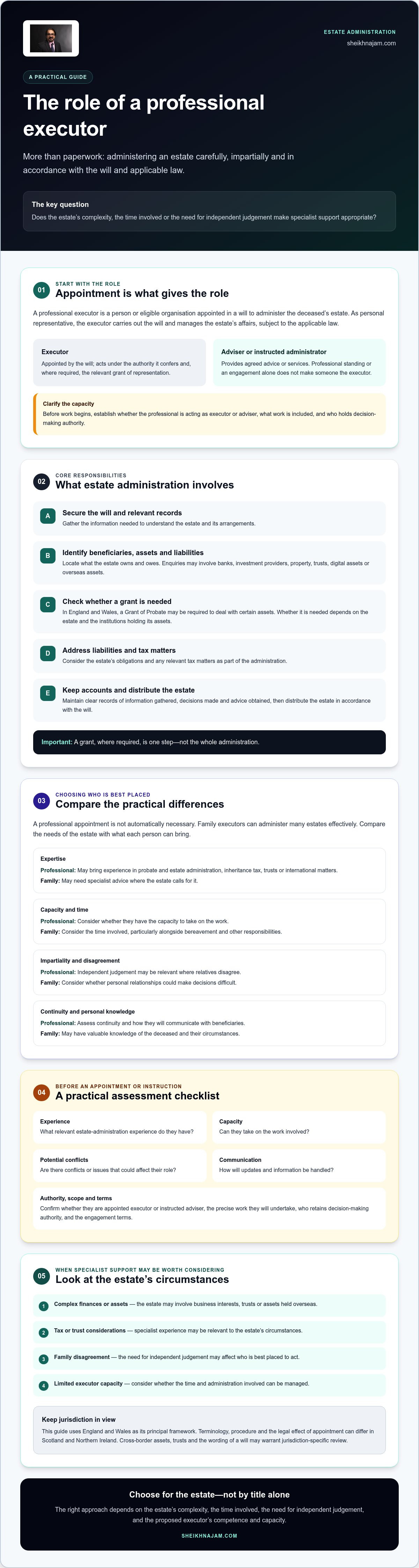
A professional appointment isn’t automatically necessary. Family executors can administer many estates effectively. The key question is whether the estate’s complexity, the time involved or the need for independent judgement makes specialist support appropriate. This guide explains an executor’s principal responsibilities and limits, then compares professional and family appointments so you can assess the practical differences.
You’ll also learn when experience in probate and estate administration, inheritance tax, trusts or international matters may be relevant, and what to clarify about authority, scope and engagement terms before appointing or instructing a professional. The aim is to help you make a considered decision, rather than assume one type of executor suits every estate.
Table of Contents
What Is the Role of a Professional Executor in Estate Administration?
A professional executor is a person or eligible organisation appointed in a will to administer the deceased’s estate. As personal representative, the executor carries out the will and manages the estate’s affairs, subject to the applicable law. In practice, the executor acts under the authority conferred by the will and, where required, the relevant grant of representation. A general explanation of the Role of an executor can provide useful background, but it does not replace advice on the law governing a particular estate.
Professional expertise alone does not make someone an executor. A practitioner may advise on estate matters or provide post-death administration services without being appointed in the will. Those instructions do not, by themselves, confer the legal role of executor or the authority attached to it. In turn, an appointed executor may instruct specialists to advise or assist with particular aspects of the administration.
This section uses the law of England and Wales as its principal framework. Terminology, procedure and the legal effect of appointment can differ in Scotland and Northern Ireland. The will and relevant arrangements should be reviewed in the appropriate jurisdiction.
How does a professional executor differ from an estate adviser?
The will establishes who is appointed as executor; an engagement or retainer sets out the work an adviser has agreed to undertake. An adviser’s authority depends on those instructions and any other applicable authority, not simply on their professional standing. The same practitioner might act as executor under the will in one matter, but serve only as an adviser or instructed administrator in another. Before work begins, clarify the capacity in which they are acting, the scope of their responsibilities and who retains decision-making authority.
Who might be appointed as a professional executor?
A will-maker may consider appointing a suitable professional, such as a solicitor, or an organisation legally able to act in that capacity. No single profession is universally required. The right choice depends on the estate, the proposed appointee’s competence and capacity, and the legal requirements that apply. The will should identify the intended appointee clearly. Wording and legal effect warrant jurisdiction-specific review, particularly if the estate has cross-border elements or involves trusts.
In short, asking “what is the role of a professional executor” requires more than checking whether someone has relevant expertise. The decisive questions are whether they have been appointed in the will, what responsibilities follow from that appointment, and whether any separate advisory or administration work has been properly defined.
What Duties Does a Professional Executor Have After a Death?
After a death, the executor must establish what the estate contains, what it owes and what steps are needed before distribution. The work begins with securing the will and relevant records, identifying beneficiaries, and locating assets and liabilities. This may involve contacting banks and investment providers, reviewing property and trust records, and identifying digital or overseas assets. The responsibilities of an executor can span several connected stages, and the estate’s circumstances determine the appropriate course.
The scope of the work matters. An estate with a single bank account and straightforward assets may need different enquiries from one involving business interests, trusts, foreign assets or disputed claims. The executor should keep a clear record of information gathered, decisions made and advice obtained, so the administration can be accounted for to beneficiaries and relevant authorities.
How does probate fit into an executor’s role?
In England and Wales, a Grant of Probate may be required to establish authority to deal with certain assets. The executor applies through the Probate Registry where a grant is needed. Whether one is required depends on the estate and the institutions holding its assets. Obtaining the grant is one step, not the whole administration. The executor must still identify and collect assets, address liabilities and tax matters, maintain accounts and distribute the estate in accordance with the will.
How are estate assets, liabilities, and tax matters handled?
The executor should gather appropriate valuations and supporting records for assets and debts, then establish which reporting and payment obligations apply. Inheritance Tax information may need to be reported to HMRC, depending on the estate’s circumstances and current requirements. Creditor claims also need careful consideration. Distributing assets without properly accounting for liabilities can expose an executor to personal risk.
Accurate estate accounts should show assets collected, income received, expenses and liabilities paid, and distributions made. Where the estate raises complex tax, trust or international questions, the executor may need relevant professional input. Record decisions and the reasoning behind them rather than relying on informal family records or assumptions.
The executor is responsible for administering the estate; a beneficiary has the right to receive only what the will and applicable law provide, once the administration permits distribution. If the scope of the work or the authority required is unclear, a discussion about probate and estate administration may help clarify the issues before decisions are taken.
Professional Executor vs Family Executor: What Should You Compare?
The choice is not simply between expertise and personal knowledge. The estate’s complexity, the time available and the relationships between those involved should all inform the decision. Asking “what is the role of a professional executor” is useful, but a professional title alone does not establish that an appointment is necessary or suitable.
Appointing a professional does not remove beneficiaries’ rights or prevent appropriate family involvement. The executor remains responsible for administration, while beneficiaries retain the interests provided for by the will and applicable law. Agree practical arrangements for updates, information-sharing and decision-making, without assuming that beneficiaries direct the executor’s work.
When might a professional executor be useful?
A professional appointment may be worth considering where an estate includes complex assets, trust interests, international connections or demanding tax and administrative questions. Independence may also be valuable where family disagreement or potential conflicts could complicate decisions. These factors do not guarantee faster administration or a particular outcome. They are considerations to weigh against the proposed appointee’s scope and capacity.
When might a family executor be the practical choice?
For a more straightforward estate, a willing family member with sufficient time and organisational capacity may be a suitable choice. The role can still involve sustained record-keeping, correspondence and consequential decisions. Before accepting, a prospective executor should understand the likely demands and consider whether they can carry them out impartially and carefully.
Remuneration should never be assumed. Check the basis for any payment against the will, applicable law and engagement terms, as the position may depend on the circumstances and jurisdiction. Make the decision based on the estate’s actual needs, not professional status alone.
How Should You Assess and Appoint a Professional Executor?
Choosing an executor calls for more than checking professional credentials. The proposed appointment should fit the estate’s assets, obligations and potential complications, and the person or organisation concerned should understand the capacity in which they are being asked to act. If you’re considering specialist estate and probate services, establish whether the intended role is executor, adviser, administrator or a combination defined by separate arrangements.
Use this sequence to assess the appointment:
1. Map the estate’s complexity. List known assets, liabilities, trust interests, business holdings and international connections. Note where information is incomplete.
2. Identify the needs. Decide what expertise and practical capacity the administration may require, including whether tax, trust or cross-border issues could arise.
3. Assess the proposed executor. Ask about relevant experience, current capacity, potential conflicts, continuity arrangements and who would undertake the work in practice.
4. Clarify the terms. Establish the precise scope of the role, how any remuneration is authorised and calculated, which expenses may be claimed, and how additional work would be agreed.
5. Review the will. Check that it identifies the intended executor and reflects the testator’s wishes. Obtain qualified advice on drafting and formalities in the relevant jurisdiction.
What questions should you ask before making an appointment?
Ask which tasks the proposed executor expects to undertake personally, what may be delegated, and how responsibility for delegated work will be overseen. Clarify how beneficiaries will receive updates, what information they can expect, and how material decisions will be recorded. Discuss how conflicts of interest, unexpected complexity or a change in capacity would be addressed. These questions help distinguish a defined, workable role from a general assurance of expertise.
What should the will and engagement terms make clear?
The will should identify the intended executor accurately and express the testator’s wishes in legally effective terms. Separate written engagement terms should define any advisory or administration work, its scope, remuneration basis and expenses, so those arrangements are not confused with the authority arising from appointment. Check the legal basis for remuneration and the effect of the wording in the relevant jurisdiction. Neither payment nor authority should be assumed.
Because what is the role of a professional executor depends on both the will and any separate engagement, review the documents together before proceeding. To discuss the proposed scope, authority and terms, contact Sheikh Najam TEP about your estate administration requirements.
When Should You Seek Professional Executor and Estate Administration Advice?
Specialist advice may be useful where an estate includes assets in more than one country, trust interests, material tax considerations, disagreement among family members or an executor with limited time or capacity. These circumstances can raise questions about the will, the applicable jurisdiction, the scope of administration and the decisions to take before assets are distributed.
Seeking advice does not mean the adviser must become the executor. A professional can help clarify the available options, explain the responsibilities attached to an existing appointment or identify where further expertise may be needed. If a dispute is emerging, advice concerning contentious probate and will disputes may also be relevant. Specialist input should be tailored to the facts, rather than assumed to form part of every executor appointment.
How can specialist estate experience support a complex matter?
Probate administration may intersect with trust arrangements, inheritance tax questions, international wills or disagreement about the estate. Considering ways to prevent and resolve disputes can help frame issues constructively, but the appropriate approach depends on the circumstances. Any assessment should take account of the will, known assets, relevant jurisdictions and the client’s instructions, with the professional’s precise role and authority clearly established.
What is a useful next step for a prospective client?
For an initial discussion, prepare a high-level outline of the estate and the questions that need answering. This can help focus the conversation without requiring you to send sensitive records prematurely.
A copy or summary of the will, if available.
A broad outline of known assets, including any trust or overseas interests.
Known liabilities, tax questions or concerns about existing administration.
Key issues such as family disagreement, executor capacity or uncertainty about the proposed role.
Do not send sensitive personal or financial documents through an unsecured channel. First clarify what information is needed and how it should be provided. Asking what is the role of a professional executor in a particular estate is a useful starting point, but the answer depends on the appointment, the documents and the circumstances. To discuss the estate and clarify the appropriate scope of advice, contact Sheikh Najam.
Make an informed decision about estate administration
Understanding what is the role of a professional executor begins with recognising that appointment in the will, not professional expertise alone, establishes the role. An executor administers the estate and must act in accordance with the will and applicable law. The appropriate choice depends on the estate’s complexity, the proposed executor’s capacity and the family circumstances, rather than a professional title in isolation.
Before proceeding, clarify the intended role, authority, scope of work, communication arrangements and basis for any remuneration. Where trusts, inheritance tax considerations, international wills or potential disputes arise, specialist experience may help identify the issues requiring attention. Procedures can differ between UK jurisdictions, so advice should reflect the law governing the estate.
Sheikh Najam provides probate and estate administration, alongside trust and estate planning, inheritance tax planning, international wills and contentious probate services. These connected areas may be relevant where an estate presents additional complexity, although they do not make a professional executor necessary in every case. Discuss your estate administration requirements to clarify the questions and options relevant to your circumstances. With the right information and clearly defined responsibilities, you can approach the next steps with greater confidence.
Frequently Asked Questions
What is the role of a professional executor?
A professional executor is appointed in a will to administer the estate and carry out its provisions in accordance with applicable law. In England and Wales, this can include identifying assets and liabilities, applying for a Grant of Probate where required, addressing tax and creditor matters, keeping proper records and distributing the estate. The executor’s appointment is distinct from simply instructing a professional to provide advice or administration services.
Is a professional executor the same as a probate solicitor?
No. A probate solicitor may advise an executor or undertake agreed estate administration work, but that does not automatically make the solicitor the executor. The executor is appointed under the will, whereas an adviser’s role and authority depend on the instructions and engagement terms. A solicitor can be appointed as executor, but it is important to clarify which capacity they are acting in and what work they have agreed to perform.
Can a professional executor be appointed alongside a family member?
Yes, a will may appoint more than one executor, which can include both a professional and a family member, subject to the applicable law and appropriate drafting. They would share the responsibilities of the appointment, so it is sensible to clarify how decisions, communication and practical tasks will be managed. The will-maker should obtain jurisdiction-specific advice, particularly if the estate includes assets or arrangements connected with more than one legal system.
What responsibilities does an executor have before distributing an estate?
Before distributing the estate, an executor should establish the assets and liabilities, obtain relevant valuations, secure records and determine what probate and tax steps are required. They must consider creditor claims and keep accurate accounts of receipts, payments and decisions. Distributing assets before liabilities and obligations have been properly addressed can create personal risk for an executor. The appropriate process depends on the estate’s circumstances and the law that applies.
Does a professional executor automatically charge for administering an estate?
No. Appointment as a professional executor does not, by itself, establish what remuneration is payable. Check the basis for payment against the will, applicable law and any relevant engagement terms, and confirm the position before appointment or work begins. Clarify separately how expenses are treated and whether additional services fall within the agreed scope. Legal requirements may differ by jurisdiction, so avoid relying on a general assumption.
When should you appoint a professional executor instead of a family member?
Consider a professional where the estate involves complex assets, trust interests, international connections or demanding tax matters, or where family disagreement or limited executor capacity could complicate administration. A capable family member may be a practical choice for a more straightforward estate if they understand the time and record-keeping involved. The decision should reflect the estate’s needs and the proposed executor’s suitability, not professional status alone.
Can beneficiaries challenge the actions of a professional executor?
Beneficiaries can raise concerns if they believe an executor has failed to administer the estate properly, acted outside their authority or managed a conflict inappropriately. A proportionate first step may be to request an explanation or relevant estate information, keeping correspondence clear and documented. The appropriate remedy depends on the facts and jurisdiction; court action may be possible in some circumstances. Obtain independent legal advice before taking formal steps.


Comments