Probate Valuation of Property: A Practical UK Guide

Would a property’s value today tell you what it was worth when its owner died? Not necessarily. A probate valuation of property is based on its open-market value at the date of death, rather than its current asking price or a later sale figure. That distinction can affect the estate’s Inheritance Tax reporting and the evidence executors should retain.
An estate agent’s appraisal can be a useful starting point—for example, executors seeking initial market insights can visit Taylors Estate Agency or speak with a local residential specialist—but it may not provide enough detail to support a figure in a complex or high-value estate. The evidence needed depends on the property, its condition and ownership, and the reason the valuation is being prepared.
This guide explains the valuation basis, the evidence that can support a reported figure and when a more detailed property valuation may be appropriate. It also covers unusual, jointly owned and overseas property, and how valuation evidence fits into probate and estate administration. Where ownership, cross-border assets or a disputed figure raise legal or tax questions, tailored advice can help address those issues alongside the property valuation.
Table of Contents
What does probate valuation of property mean, and which date matters?
How is a property’s probate value established from evidence?
Probate valuation versus market appraisal: which evidence fits the estate?
How should executors document and report a probate property valuation?
When does probate property valuation call for wider estate advice?
What does probate valuation of property mean, and which date matters?
A probate valuation of property concerns its value at the date the owner died, not the date an executor obtains a report or later puts it on the market. The figure contributes to the estate’s valuation and reporting, and may affect the Inheritance Tax calculation. It should be based on a reasoned assessment of the property at the relevant date, not selected simply because it matches a later asking price or sale proceeds.
For Inheritance Tax purposes, the valuation framework uses an open-market basis: broadly, the price the property might reasonably have been expected to fetch if sold on the open market at the date of death. Check the applicable statutory wording and procedure for the relevant jurisdiction. Probate terminology and application processes differ across England and Wales, Scotland, and Northern Ireland, so do not assume that terms used in one jurisdiction apply in another.
What does date-of-death value mean in practice?
The date fixes the point in time at which the property’s characteristics and market context are assessed. A report prepared months later can still address that earlier date, but it should not simply substitute the property’s present value. A later sale may provide relevant context, but does not automatically establish the date-of-death figure. Market conditions, the property’s condition and any changes since the death may all differ.
Ownership matters too. The deceased may have owned the property outright, held a share jointly or had an interest affected by a trust, lease or other rights. The estate’s valuation should reflect the interest the deceased held, rather than assume the whole property forms part of the estate. This can affect both the evidence needed and how the asset is recorded.
Why does the valuation matter to an executor?
The figure feeds into estate accounts and Inheritance Tax reporting, and can inform administration decisions, including whether and when to sell the property. A clear supporting record helps explain the executor’s reasoning to beneficiaries and HMRC, particularly if the property is later sold for a materially different amount. A probate sale is a later stage in administering an estate. Its eventual proceeds should not be confused with the value reported at death.
Probate property value is the deceased’s property interest valued at the date of death on the applicable open-market basis, for estate administration and tax reporting. Recording the valuation basis and supporting evidence creates a clearer audit trail and distinguishes the reported figure from a later sale price.
How is a property’s probate value established from evidence?
A defensible probate value is a reasoned opinion, not a figure chosen by instinct or taken from a single asking price. The evidence should relate to the property and market conditions at the relevant valuation date, and explain how those factors support the conclusion. HMRC’s guidance on how to value the estate for Inheritance Tax sets out the wider reporting context. Property-specific evidence supports the figure reported for the asset.
Which property details and market evidence should be assembled?
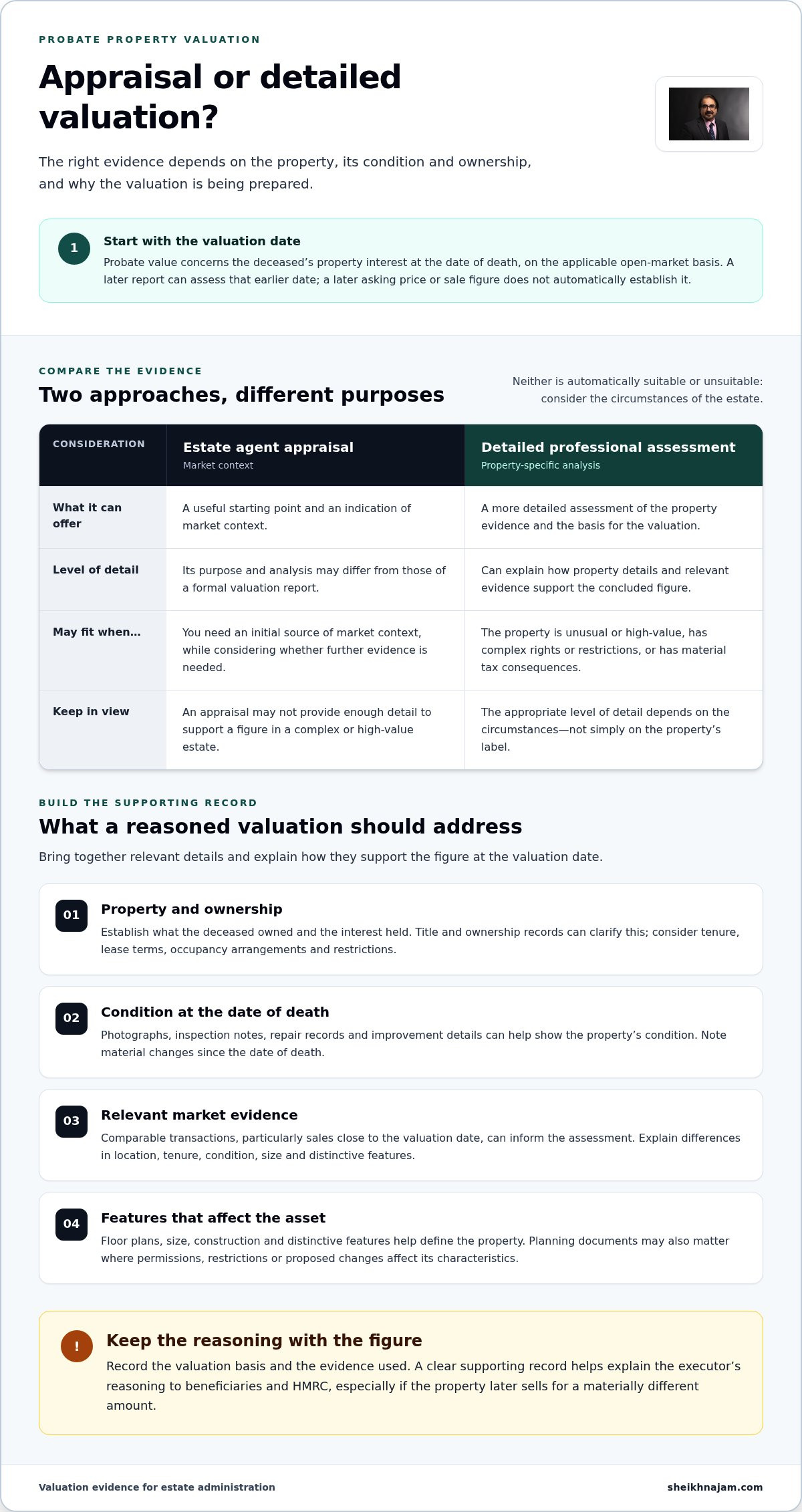
Start by establishing what the deceased owned and what a buyer could acquire. Title documents and ownership records can clarify the interest held. Tenure, lease terms, occupancy arrangements and restrictions may affect marketability or value. Floor plans and details of the property’s size, construction and distinctive features help define the asset being assessed.
Assess the property’s condition as at the valuation date. Photographs, inspection notes, repair records and evidence of improvements can help show whether it needed substantial work or was in good order. Planning documents may also be relevant where permissions, restrictions or proposed changes affect its characteristics. The aim is to document material facts, not to collect paperwork without a clear purpose.
Comparable transactions can inform the assessment where suitable evidence exists, particularly sales close to the valuation date. Comparisons should be similar enough to be useful. Consider differences in location, tenure, condition, size and distinctive features rather than treating the properties as identical. A comparison without an explanation of its relevance can create an appearance of precision without supporting the conclusion.
A well-supported valuation identifies the property interest, valuation date, condition, tenure and material restrictions, then explains how relevant comparable market evidence supports the concluded figure.
When may a formal valuation be more appropriate?
An estate agent’s appraisal can provide useful market context, but its purpose and analysis may differ from those of a formal valuation report. Neither is automatically suitable or unsuitable. A detailed professional assessment may be proportionate where the property is unusual or high-value, has complex rights or restrictions, or has material tax consequences. The appropriate level of detail depends on the circumstances, not simply on the property’s label.
Property valuation expertise addresses the property evidence and the basis for the valuation. Legal advice addresses separate questions, including ownership, estate administration and the treatment of the figure in tax reporting. Where these issues intersect, advice on estate administration can help executors consider the wider legal and reporting context alongside the valuation evidence.
Probate valuation versus market appraisal: which evidence fits the estate?
A market appraisal and a probate valuation may both give an opinion about a property’s worth, but they may have different purposes and use different bases. The right evidence depends on the estate, the property and how much explanation is needed to support the reported figure.
How does probate value differ from a later sale or current market value?
The probate valuation is historical: it addresses the property’s value at the date of death. A current appraisal may inform present-day marketing, while the eventual sale price records what a buyer paid later. The property may have changed in condition, the market may have moved, or the circumstances of the sale may differ. A later transaction can prompt a review of the earlier valuation, but does not automatically replace it. The property does not have to sell for the probate figure.
Which valuation approach is proportionate to the circumstances?
For a straightforward property, an appraisal or desktop estimate may provide useful initial context. Choosing the least detailed estimate solely for convenience may not be appropriate for a complex estate, particularly where ownership arrangements, distinctive features or potential tax scrutiny call for fuller reasoning. An agent’s appraisal can offer market insight, while a detailed report may explain more fully how the evidence supports a retrospective figure. Neither format is invariably sufficient or necessary.
The probate valuation of property should be supported by evidence proportionate to the risks and complexity involved. Property valuation expertise concerns the property and its market evidence; legal advice addresses how ownership, estate administration and reporting questions fit together. Executors dealing with these intersecting issues can Discuss a complex probate matter.
How should executors document and report a probate property valuation?
A well-documented valuation gives executors a traceable basis for the figure recorded in estate accounts and any relevant tax submission. The probate valuation of property is one part of the wider estate assessment. It does not, by itself, determine whether Inheritance Tax is payable or settle the requirements for a grant. Forms, reporting thresholds and deadlines can change, so check current HMRC guidance and the applicable procedure in the relevant UK jurisdiction before filing.
A practical sequence is:
Establish ownership. Identify the deceased’s interest in the property and record relevant title, co-ownership, tenure or trust information.
Assemble the evidence. Gather records that describe the property and its condition at the valuation date, alongside relevant market evidence.
Obtain a reasoned figure. Make sure the valuation basis, date, assumptions and supporting analysis are clear.
Retain the working record. Keep instructions, reports, appraisals, comparable evidence and related correspondence with the estate papers.
Report consistently. Use the supported figure and relevant ownership details consistently across estate accounts and applicable submissions, explaining any necessary distinction.
What records should an executor retain?
Keep the valuation report or appraisal, inspection notes, photographs and market evidence relied upon. Store title and ownership documents, lease or occupancy details, condition records, and material repair or improvement information with the valuation date and stated assumptions. Retain HMRC submissions and correspondence alongside the estate’s accounting records, so the figure can be understood in context rather than in isolation.
What if the evidence or a later sale raises questions?
A material difference between the reported date-of-death value and a later sale price may justify reviewing the original evidence and assumptions. It does not, by itself, prove that the earlier valuation was wrong. Intervening market movements, changes to the property or the circumstances of the sale may explain the difference. Record the reasons for any review and keep relevant supporting documents with the estate file.
Accurate records support orderly administration, but they do not resolve every legal or tax issue. Executors managing complex responsibilities may also find it useful to read a guide to the role of a professional executor. For advice on the legal and estate-administration questions raised by a valuation, discuss your probate matter.
When does probate property valuation call for wider estate advice?
A property valuation can raise questions beyond its physical features and market evidence. Wider legal advice may be appropriate where the deceased held only a share, a beneficial interest or an interest subject to a trust, lease or occupancy arrangement. The estate needs to distinguish the property’s overall value from the nature and extent of the interest that forms part of the estate.
Which circumstances can complicate a property valuation?
Unusual characteristics, restrictions on use, complex ownership and overseas location can all affect how a property interest is understood and reported. A cross-border estate may also raise questions about how assets are administered across jurisdictions and how relevant tax matters are considered. A valuation specialist assesses property evidence; legal advice can address ownership, trust arrangements and the estate’s reporting obligations.
Where a trust or contested ownership is involved, the central issue may be who held which rights at death, not simply what the building might have fetched on the open market. A dispute between beneficiaries about the asset or its treatment may also require advice on contentious probate, separate from the technical assessment of market value. If there is no will, the rules governing who administers and inherits the estate may affect the administration. The applicable procedure depends on the relevant UK jurisdiction.
How can legal advice support the wider probate process?
Legal advice can connect the valuation evidence with the executor’s wider responsibilities: identifying the deceased’s interest, organising estate administration, considering Inheritance Tax reporting and addressing questions raised by beneficiaries. It does not replace a property valuation or determine the market figure. It helps ensure the figure is considered alongside the legal rights and reporting context to which it relates.
Sheikh Najam TEP advises on probate and estate administration, Inheritance Tax planning, trusts and international estate matters, including situations where ownership or cross-border issues make an estate more complex. Advice can be tailored to the legal and administrative questions involved, alongside the relevant property valuation evidence.
If a property interest, trust arrangement or international element is complicating the administration, Arrange a confidential discussion about probate and estate administration.
Bring the valuation and estate administration into focus
A sound probate valuation of property is anchored to the date of death and supported by evidence that explains how the figure was reached. The right level of detail depends on the property, the deceased’s ownership interest and the estate’s circumstances. Consider an appraisal, desktop estimate or detailed report in that context rather than treating them as interchangeable by default.
Executors can strengthen the administration record by retaining the valuation basis, supporting documents and relevant correspondence, then using the figure consistently in estate accounts and reporting. Where trusts, shared ownership, overseas assets or a dispute are involved, valuation evidence may sit alongside wider questions of estate administration, Inheritance Tax planning and beneficiary rights.
Sheikh Najam TEP advises on probate and estate administration, with related expertise in Inheritance Tax planning, trusts and international estate matters. If the issues extend beyond the property evidence, discuss your probate and estate administration requirements.
Frequently Asked Questions
What is the probate value of a property?
The probate value is the property’s open-market value at the date of the deceased’s death, assessed for estate administration and relevant tax reporting. It is not automatically the value shown in a current appraisal or the amount later received on sale. The assessment should also reflect the deceased’s actual interest, such as a share in jointly owned property, rather than assume they owned the whole asset.
How is a property valued for probate in the UK?
A property is valued by forming a reasoned opinion of its open-market value at the date of death, using evidence relevant to that date. This may include comparable transactions, location, condition, tenure, restrictions and property-specific features. The probate valuation of property should identify the interest being valued and explain the evidence and assumptions behind the figure. Probate terminology and procedures differ across UK jurisdictions, so check the applicable process.
Can an estate agent provide a probate valuation?
An estate agent can provide a market appraisal or opinion of value, which may be useful evidence, particularly for a straightforward property. Its purpose, valuation date and level of supporting analysis may differ from those of a formal report prepared for estate or tax reporting. An appraisal is not automatically sufficient or unsuitable. Its adequacy depends on the property, ownership circumstances and evidence needed to support the figure.
Do I need a RICS valuation for probate?
A RICS valuation is not automatically required in every estate, but a detailed professional report may be proportionate for high-value, unusual or complex property. HMRC guidance recognises the relevance of professional valuation standards, including RICS Red Book standards, particularly where Inheritance Tax may be payable. The appropriate evidence depends on the circumstances and current guidance. Consider whether the report clearly addresses the date of death, the deceased’s interest and the valuation basis.
What happens if the probate valuation is wrong?
If you believe a reported figure is materially wrong, review the valuation date, ownership interest, evidence and assumptions before deciding what action is needed. A later sale at a different price does not, by itself, prove the original figure was incorrect. If the review indicates an error in information already submitted, check the relevant current HMRC correction process and consider legal or tax advice where the potential consequences are material or disputed.
Is probate value the same as the property’s sale price?
No. Probate value refers to the property’s value at the date of death, whereas the sale price is the amount achieved in a later transaction. The figures may differ because of changes in market conditions, the property’s condition or the circumstances of the sale. Sale evidence can be relevant when reviewing the original assessment, but it does not automatically replace the date-of-death figure used in estate reporting.
Can a property be sold for more than its probate value?
Yes. A property may sell for more than its probate value, particularly if the market rises or its condition changes after the valuation date. A higher sale price does not automatically mean the original assessment was wrong; executors should consider the evidence and circumstances at both dates. The date-of-death figure may also be relevant to a beneficiary’s acquisition cost for Capital Gains Tax purposes, so retain the valuation and sale records.


Comments