What Is a Caveat in Probate? A Clear Guide to Its Purpose and Effect

Could a notice pause an estate’s progress without proving that a will is invalid? If you’re asking what is a caveat in probate, the key point is that it can prevent a grant from being issued whilst it remains in force. It does not determine whether a will is valid or resolve a dispute about the estate. That pause can cause concern for executors and beneficiaries, particularly when administration or access to estate assets is delayed.
A caveat may be appropriate when there is a specific concern to investigate, but it is not a substitute for a substantive challenge to a will. This guide explains its procedural effect and duration in England and Wales, how it may be renewed or challenged, and what may follow if the dispute continues. It also sets out practical steps for someone considering a caveat and for an executor responding to one. The rules differ across the UK, so this article focuses on England and Wales.
Table of Contents
What Is a Caveat in Probate, and What Does It Prevent?
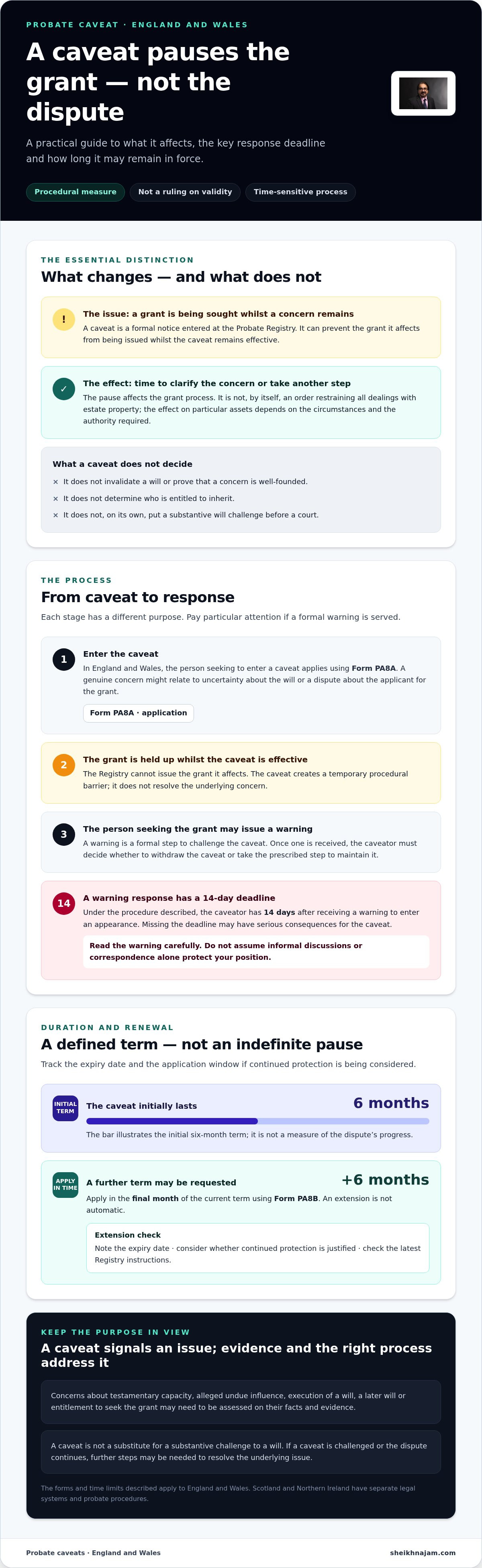
If you’re asking what is a caveat in probate, it is a formal notice entered at the Probate Registry that affects whether a grant of representation can be issued. In England and Wales, a caveat can pause the grant while a relevant concern is examined, such as uncertainty about the will or the person applying to administer the estate. It is a procedural measure, not a ruling. Entering one does not invalidate a will or establish who is entitled to inherit.
A grant is the formal authority that enables an executor or administrator to deal with an estate when a grant is required. It forms part of the wider probate process, which involves establishing authority to administer a deceased person’s affairs and then dealing with the estate. A caveat affects the issue of the grant; it does not decide the underlying dispute.
What does a probate caveat do to a grant?
Whilst an effective caveat is in place, the Probate Registry cannot issue the grant it affects. This can delay someone seeking authority to administer the estate and gives the parties time to clarify the concern or take an appropriate next step. The pause is limited to the grant process. It is not an automatic freeze on every estate activity or transaction: whether particular assets can be dealt with depends on the circumstances and the authority required.
This distinction matters in practice. A bank or other institution may require a grant before releasing or transferring certain assets, so a delay in obtaining one can have practical consequences. But a caveat is not, by itself, an order restraining all dealings with estate property, nor does it determine how the estate will eventually be distributed.
Who might consider entering a caveat?
A person with a genuine concern about the will or the applicant for a grant may consider whether a caveat is an appropriate procedural step. The concern might be that a later will exists, that the document being relied on may not be valid, or that the applicant’s entitlement to seek the grant is disputed. Be clear about the reason: a caveat signals that an issue needs attention, but it does not prove the concern is well-founded.
This guide covers the law and procedure in England and Wales. Scotland and Northern Ireland have separate legal systems and probate arrangements, so the terminology and process described here should not be assumed to apply there.
How Does a Probate Caveat Work, and How Long Can It Last?
The procedure is time-sensitive. A caveat creates a temporary barrier to the grant, but it also starts a period in which the concern must be assessed and any response handled. For anyone researching what is a caveat in probate, the practical point is that it is not an indefinite holding position. Check the current forms, deadlines and Registry instructions before applying or responding to a warning.
What are the usual stages after a caveat is entered?
In England and Wales, a person seeking to enter a caveat applies using Form PA8A. Once registered, the caveat prevents the grant from being issued whilst it remains effective. The person seeking the grant may then take formal steps to challenge it by issuing a warning. The caveator must decide whether to withdraw the caveat or take the prescribed step to maintain it.
Under the current procedure, a caveator who receives a warning has 14 days to enter an appearance. Missing that deadline may have serious consequences for the caveat, so read the warning carefully and act promptly. Service requirements and the response process matter. Do not rely on informal discussions or assume that correspondence alone protects your position. The legal definition of a caveat offers general terminology, but it does not explain the procedure in England and Wales.
Can a probate caveat be extended or removed?
A caveat initially lasts for six months. It may be extended for a further six months by applying in the final month of its current term, using Form PA8B. An extension is not automatic, so note the expiry date and consider whether continued protection remains justified. A caveat should not be used to postpone a grant indefinitely without addressing the underlying issue.
Withdrawing a caveat is different from responding to an applicant’s challenge through a warning. If the caveator enters an appearance in response to a warning, the matter may move beyond a temporary Registry restriction and require further steps to resolve the dispute. The appropriate route depends on the facts, evidence and positions of the parties.
These forms and time limits apply to England and Wales; Scotland and Northern Ireland have separate procedures. Before acting, consult the latest Probate Registry instructions, particularly if a warning has been served or the caveat is nearing expiry. Where the dispute concerns a will or entitlement to a grant, advice on a probate dispute can help clarify a proportionate next step.
Does a Caveat Invalidate a Will or Stop the Whole Estate?
No. A caveat does not invalidate a will, determine who inherits or establish that the person who entered it is right. It is a procedural notice that affects the issue of a grant. If you’re asking what is a caveat in probate, this distinction is central: a caveat may hold up the grant while a concern is addressed, but resolving the underlying issue requires its own appropriate route.
Caveat versus will challenge: what is the difference?
A will challenge is a substantive dispute about whether a will, or a particular provision in it, is valid. It requires evidence and a legal basis. Entering a caveat alone does not put a case before a court or prove an allegation. Concerns about testamentary capacity, undue influence or the will’s execution may be relevant, but each must be assessed against the available evidence and the circumstances in which the document was made.
The distinction helps you identify the real objective. Someone concerned that a later will exists may need to investigate that document and the circumstances in which it was made. A dispute about who should apply for the grant raises a different question. A caveat may provide time to clarify matters, but it does not replace an investigation or resolve competing claims.
Does a caveat freeze estate assets or distributions?
A restriction on issuing a grant is not the same as a general order freezing estate property. Some institutions may require a grant before releasing or transferring particular assets, which can cause practical delays. Other steps depend on the assets, any authority already available and the specific circumstances. It is inaccurate to assume that every transaction, administrative act or distribution automatically stops.
A caveat should address a properly considered concern about the grant, not simply be used to exert pressure or postpone administration. An unsupported or unjustified caveat can prolong uncertainty and may expose the person who entered it to legal costs if the matter is contested. Assessing the concern and evidence carefully helps keep this procedural measure proportionate to the dispute.
What to Do If You Need to Enter or Respond to a Caveat?
Whether you're considering a caveat or dealing with one as an applicant, start by defining the decision you need to protect. A precise concern, supported by relevant documents, helps distinguish a genuine dispute about the grant from a broader disagreement that needs a different approach. The question what is a caveat in probate is only the starting point. Next, identify what the notice is intended to achieve in your circumstances.
If you are considering entering a caveat
Identify the issue. Explain how your concern relates to the will, the grant application or the applicant’s entitlement to seek a grant. For example, are you aware of a possible later will, or do you dispute the proposed applicant’s right to act?
Assemble the relevant material. Gather copies of the will or wills, correspondence and other documents that directly relate to the concern. A clear chronology can help separate documented facts from assumptions.
Consider the intended outcome. A caveat can provide time to address a concern, but it does not resolve the underlying dispute. Consider what evidence or further action may be needed, and whether a proportionate discussion could clarify matters before positions harden.
Use a caveat to protect a legitimate procedural concern, not as a substitute for progressing a will or entitlement dispute. Where constructive engagement is appropriate, probate dispute prevention and resolution can help the parties consider a measured way forward.
If a caveat is affecting your probate application
Check the current status. Establish whether the caveat remains effective and review any formal warning or other notice received. Do not assume an informal conversation changes the Registry position.
Identify the response deadline immediately. In England and Wales, a warning requires the caveator to enter an appearance within 14 days if they wish to maintain the caveat. Check the notice and current Probate Registry instructions promptly, as the required response and timing are procedural matters.
Organise the evidence. Bring together the will relied on, grant application records and relevant communications. Arrange them chronologically, noting what is known, what is disputed and which decision is affected.
If the issue concerns capacity, alleged undue influence, competing wills or entitlement to apply, the caveat may be only one part of a wider contentious probate matter. A careful assessment can help determine whether discussion, mediation or formal proceedings are proportionate. For help assessing the dispute and appropriate next steps, contact Sheikh Najam TEP about a probate dispute.
When Does a Probate Caveat Require Specialist Dispute Advice?
A caveat may be an initial procedural safeguard, but specialist dispute advice becomes particularly relevant when the concern involves contested evidence, competing legal rights or significant consequences for the estate. The question what is a caveat in probate concerns the caveat’s limited effect. Deciding what should happen next requires a separate assessment of the dispute, the available evidence and the interests the parties seek to protect. Not every caveat leads to litigation, but an unresolved issue should not be left to drift simply because the grant is paused.
Which disputes may extend beyond a caveat?
Further advice may be appropriate where someone disputes the deceased’s capacity, alleges undue influence, identifies a potentially competing will or challenges the proposed executor’s or applicant’s entitlement. Disagreement may also concern how the estate is being administered, rather than the validity of the will itself. These issues are distinct, and the evidence needed to address one may not resolve another.
Additional complexity can arise where the estate includes trusts, assets or beneficiaries in more than one country, or arrangements made under different legal systems. Those features may affect the evidence to gather, the parties whose interests are involved and the appropriate sequence of steps. Sheikh Najam advises on contentious probate, trusts and wills, alongside international tax planning and estate administration.
How can a caveat dispute be approached proportionately?
A measured assessment should clarify three matters: the precise issue in dispute, the documents and other evidence supporting each position, and the current procedural status of the caveat. This helps distinguish a concern that may be resolved through further information or discussion from one requiring a formal challenge. It also allows the parties to consider the estate’s structure and the practical consequences of delay, rather than treating the caveat as the final outcome.
Depending on the facts and the parties’ objectives, a dispute may progress through direct negotiation, mediation or litigation. Mediation can provide a structured setting to explore resolution where the parties are willing to engage. Court proceedings may be necessary where issues cannot otherwise be determined. The caveat’s role remains procedural throughout: it does not decide the will’s validity or settle entitlement to the estate.
Where capacity, undue influence, competing wills, trust interests or cross-border assets are involved, focused advice can help establish a proportionate route forward. To discuss a caveat or a wider estate dispute, arrange a confidential probate discussion.
Take the Right Next Step in a Probate Dispute
Understanding what is a caveat in probate starts with its limited role: it can pause the issue of a grant while a concern is addressed, but it does not decide whether a will is valid or who inherits. The appropriate response depends on the precise issue, the supporting evidence and the procedural position. Treat a caveat as one step in a wider estate matter, not as a resolution in itself.
Whether you’re considering entering a caveat or responding to one, clarify the decision you need to protect and act promptly on any formal notice or deadline. Where the matter involves contested capacity, competing wills, executor entitlement or trust interests, careful advice can help identify a proportionate route forward.
Sheikh Najam advises on probate and estate administration, as well as contentious probate, will disputes and trust disputes. Discuss a probate caveat or estate dispute to consider the issues and potential next steps.
Frequently Asked Questions
What is a caveat in probate in England and Wales?
A probate caveat is a formal notice entered at the Probate Registry that can prevent a grant of representation from being issued whilst it remains effective. It may be used where someone has a genuine concern about the will or the applicant’s entitlement to the grant. It is a procedural safeguard, not evidence that the concern is established, and it does not decide who inherits.
How long does a caveat last in probate?
In England and Wales, a caveat initially lasts for six months. It can be extended for a further six months by applying during the final month of its term, using the current Registry procedure. Extension is not automatic, so note the expiry date and assess whether continued protection is justified. Check the latest Probate Registry instructions before applying, as forms and requirements may change.
Can a caveat stop probate from being granted?
Yes. Whilst an effective caveat is in place, the grant of representation it affects cannot be issued. This may delay an executor or administrator seeking formal authority to deal with the estate. A caveat does not necessarily stop every estate activity or transaction, however. Practical effects depend on the assets, any authority already available and the requirements of institutions holding estate property.
Does a caveat invalidate a will?
No. A caveat does not invalidate a will, determine its validity or establish who is entitled to inherit. It temporarily affects whether a grant can be issued, leaving time for the concern to be considered. A substantive challenge, such as an allegation concerning capacity, undue influence or execution, requires an appropriate legal route and evidence. Entering a caveat alone does not prove that any such allegation is correct.
Can an executor challenge or remove a probate caveat?
An applicant for a grant, including an executor, may challenge a caveat by issuing a formal warning under the applicable procedure. The caveator must then decide whether to withdraw the caveat or take the prescribed step to maintain it. In England and Wales, a caveator who receives a warning has 14 days to enter an appearance. Review the warning and current Registry instructions promptly, as deadlines are important.
What happens if someone enters a caveat against a probate application?
The Registry will not issue the affected grant whilst the caveat remains effective. The applicant may challenge it through a warning, prompting the caveator to withdraw it or formally maintain their position. The underlying concern still needs to be addressed; the caveat does not decide the dispute. The delay may affect access to assets or estate administration where a grant is required, but it does not automatically freeze all estate dealings.
Can I enter a probate caveat without a solicitor?
Yes. In England and Wales, an individual can apply to enter a caveat without instructing a solicitor, using the current application process, which includes Form PA8A. Before acting, identify the specific concern about the will, grant or applicant’s entitlement and gather relevant documents. A caveat can have procedural consequences and may be challenged, so consider advice if the issue is complex or a formal warning is received.
Do probate caveat rules differ in Scotland and Northern Ireland?
Yes. Scotland and Northern Ireland have separate legal systems and probate procedures, so the England and Wales process described here should not be assumed to apply. Terminology, the relevant authority and the steps available may differ by jurisdiction. If the deceased, assets or parties have connections across more than one part of the UK, establish which jurisdiction’s procedure applies before lodging a notice or responding to one.


Comments