Estate Planning for Social Media Influencers: A UK Guide

What happens to a creator’s income, content and online identity if they die or lose capacity to manage their affairs? For social media influencers, estate planning must address more than who inherits their assets. Estate planning for social media influencers also requires careful thought about platform access and the economic rights connected to digital content.
A will can set out wishes for an estate, but it doesn’t automatically give personal representatives access to social media accounts. Platform terms and policies may govern what can be accessed, memorialised or removed. Copyright, outstanding brand agreements, monetised content and business interests may each have separate rules for succession.
This guide explains how to identify relevant digital and non-digital assets, organise secure information for those who may need to administer them, and plan for both death and incapacity. It also considers how creator income, intellectual property, business structures, inheritance tax and international connections can affect a UK estate plan, and when specialist advice may help.
Table of Contents
Why estate planning for social media influencers now requires a digital dimension
How to distinguish influencer accounts, content rights and creator income
Why a will alone may not resolve influencer digital-succession questions
How influencers can organise a practical digital estate plan
When specialist estate planning can help influencers protect continuity
Why estate planning for social media influencers now requires a digital dimension
For a creator, estate planning must coordinate personal wealth, business interests and digital affairs in the event of death or incapacity. The objective is not just to decide who should inherit. It is also to identify what exists, who owns or controls it, and what can lawfully be accessed, administered or transferred. A digital estate is the identifiable digital assets, rights and associated instructions that a person leaves behind.
This distinction matters because audience reach does not, by itself, establish ownership, transferable value or a right of inheritance. A large following may support commercial activity, but the account is governed by platform terms. The creator’s rights in content, contractual income and business interests may be held or restricted in different ways. Estate planning for social media influencers therefore involves assessing the underlying rights and arrangements, not simply listing profile names.
What counts as an influencer’s digital estate?
The term digital assets can include digital information and media, but estate planning calls for more precise categories. Social media accounts and the data stored within them are not the same as original videos, photographs or written work. Those works may involve intellectual property rights, permissions or contractual restrictions. A creator may also have a website, domain names, mailing lists, digital files and business records that matter to the continuity or administration of their affairs.
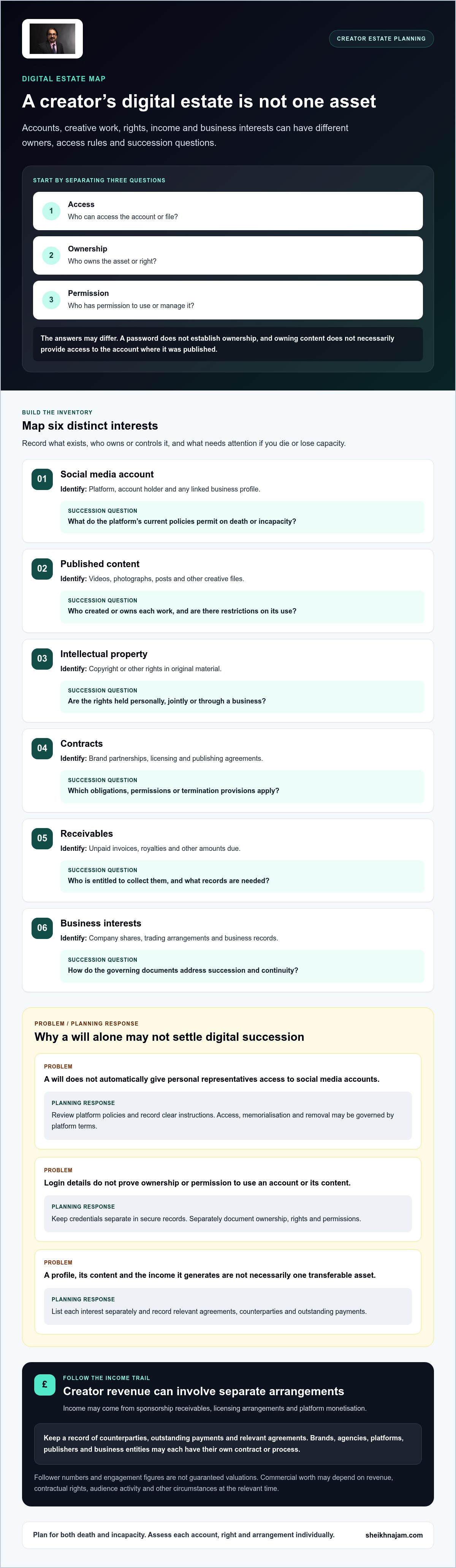
Keep three questions separate: who can access an account or file, who owns the relevant asset or right, and who has permission to use or manage it. The answers may differ. A stored password does not establish ownership, and ownership of content does not necessarily provide access to the account where it was published. Assess each item individually.
Why creator businesses make succession planning distinctive
Creator income may come from several channels, including sponsorship receivables, licensing arrangements and platform monetisation. These streams can involve separate brands, agencies, platforms, publishers or business entities, each with its own contract or process. Keep a record of counterparties, outstanding payments and relevant agreements so those responsible can identify what needs attention.
Platform terms and commercial arrangements may change independently of a will. A will can record testamentary intentions, but it cannot guarantee that an account can be transferred or that a platform will permit a particular form of access. Follower numbers and engagement figures are not guaranteed valuations either. Commercial worth may depend on revenue, contractual rights, audience activity and other circumstances at the relevant time.
Effective planning starts with an accurate picture of these connected interests. Digital-asset structuring can then be considered alongside wider estate arrangements, so that instructions, ownership records and succession plans address both personal affairs and the business activity built around the creator’s work.
How to distinguish influencer accounts, content rights and creator income
An online presence can combine several legally distinct interests. For estate planning for social media influencers, identify each interest separately rather than treating a profile, its content and the revenue it generates as one asset. The Law Commission’s work provides useful context on the legal treatment of digital assets and property, but the status and succession of a particular account or right still depend on its terms and circumstances.
Are social media accounts and content the same kind of asset?
No. A platform account is subject to the relevant platform’s terms and policies. Original content and contractual entitlements may involve separate ownership and use rights. Account transfer, memorialisation and access to stored data are distinct questions, and outcomes depend on the platform’s current rules. An executor or beneficiary should not assume they can inherit or operate an account simply because the creator left login details.
Access credentials and transferable economic rights are separate planning considerations. A password may help someone locate or secure an account, but it doesn’t establish ownership or permission to use the account or its content. This digital asset structuring guide highlights why those interests need to be considered separately.
Where do royalties, sponsorships and business interests fit?
Record unpaid invoices, licensing income, expected royalties and continuing contractual obligations, alongside the relevant counterparties and agreements. Review whether content rights are held by the creator personally, jointly with another person, or through a company. The answer can affect administration and continuity. Valuation and tax treatment are fact-specific, particularly where revenue depends on contracts, platform activity or rights that may be restricted.
Where ownership, creator income or business arrangements intersect, tailored estate and digital-asset structuring advice can help clarify how the interests fit together. A review of a creator’s estate-planning circumstances can focus on the underlying rights and arrangements.
Why a will alone may not resolve influencer digital-succession questions
A will is central to succession planning, but it doesn’t determine every practical question about a creator’s online affairs. It can record wishes concerning assets and beneficiaries. It cannot, by itself, guarantee access to an account, require a platform to transfer it, or override the platform’s applicable terms and procedures. A personal representative’s authority under an estate document and a platform’s decision about account access are not automatically the same thing.
The Law Society’s explanation of the new law recognising digital assets as property provides relevant UK context. Recognition of property rights does not mean every social media account can be inherited or operated by a beneficiary. The legal character of the relevant asset, the platform’s current rules, privacy obligations and security procedures may all need consideration. Rules can also differ across UK jurisdictions, so advice should reflect the circumstances and applicable law.
Can a personal representative access a creator’s accounts?
Not automatically. A will may appoint personal representatives and set out the creator’s intentions, but the platform may require specific documentation or apply its own process for memorialisation, deletion or data requests. Policies vary and can change, so review them when preparing and updating the plan. For incapacity, arrangements such as a lasting power of attorney may be relevant to the person’s affairs, but shouldn’t be assumed to confer account access contrary to platform rules.
Do not rely on sharing passwords or bypassing authentication controls as a succession strategy. Instead, record the platform, account identifier, relevant business purpose and intended action, whilst keeping credentials in a separate, secure system. This gives those administering the estate useful information without creating unnecessary security or privacy risks.
What can go wrong when instructions are incomplete?
Missing records can make it harder for personal representatives to identify where creator income is due, which contracts require attention, or who owns particular content rights. Business activity may also be more difficult to continue or wind down in an orderly way. These are risks to plan for, not inevitable outcomes. A clear inventory and coordinated instructions can help reduce uncertainty.
Access can raise sensitive questions, too. Private messages and personal data may contain information unrelated to the business or estate, and their disclosure may affect other people’s privacy. Instructions should distinguish between records needed to administer affairs and material that should remain private, whilst recognising that platform procedures and applicable law govern what can be accessed.
Effective estate planning for social media influencers connects the will with practical digital instructions, platform-specific processes and wider business arrangements. A tailored review of digital succession planning circumstances can help identify where those elements need to work together.
How influencers can organise a practical digital estate plan
A useful plan is more than a list of usernames. For estate planning for social media influencers, it should help the people responsible identify relevant assets, understand the creator’s intentions and locate the records needed to administer them. It should also keep sensitive credentials out of a will or general estate file.
A structured planning sequence
1. Create an inventory. Record social platforms, websites and domain names, mailing lists, content libraries, digital files, licences, business entities and sources of creator income. Include relevant brand partners, publishers, agencies and other counterparties.
2. Review ownership. For each item, note whether it is held personally, jointly or through a business. Identify any contract or permission that may affect its use or transfer, and record where supporting agreements and business records are kept.
3. Set out instructions. State whether content should be retained, licensed, removed or used in a particular way, and note preferences for public communications. Treat these as instructions to guide administration, not guarantees that a platform or third party must comply.
4. Organise secure records. Give personal representatives an executor-facing inventory, contact details and directions for locating relevant documents. Keep passwords, recovery codes and other authentication data separate, in an appropriately secure arrangement with a carefully considered access process.
5. Review and update. Revisit the inventory after creating a business entity, entering a significant contract, changing ownership of rights, moving to a different platform or experiencing a material family change. Confirm that named contacts and storage arrangements remain accurate.
What should the inventory and instructions cover?
For each account or asset, identify its purpose, associated business, relevant owner or rights-holder, and where records can be found. Note key administrative contacts and time-sensitive obligations, such as a licensing agreement or an outstanding payment. This gives those handling the estate a practical route to the information without disclosing credentials in the document itself.
Instructions should distinguish business continuity from personal preferences. A creator might identify which content may continue to be licensed, which should be reviewed before publication, and who should prepare a public statement. The outcome will still depend on applicable agreements, platform procedures and legal rights, so avoid drafting instructions as though every request is automatically enforceable.
How can the plan remain secure and current?
A will may be seen by people involved in its administration and, in some circumstances, may become publicly available through probate. Sensitive authentication details therefore belong in a separate, secure record, with clear directions about who may access it and how it should be maintained. Avoid sending passwords through ordinary correspondence or relying on a single person’s memory.
Where rights are held across several companies, beneficiaries or jurisdictions, professional review can help align digital-asset structuring with the wider estate plan. The practical considerations involved in a digital estate plan include its records, instructions and succession arrangements.
When specialist estate planning can help influencers protect continuity
Tailored advice is particularly relevant where a creator’s personal affairs are closely connected to commercial activity, intellectual property, or assets and beneficiaries in more than one country. Multiple income streams, an incorporated business, shared ownership of content rights or international beneficiaries can raise questions that a standard set of estate documents may not address in isolation.
These circumstances don’t lead automatically to a particular tax or succession outcome. The treatment of an asset, its legal owner and the terms governing its use all require individual analysis, including where inheritance tax may be relevant. A coherent plan considers the creator’s intentions alongside the rights, contracts and jurisdictions involved.
Connecting digital assets with the wider estate plan
Digital-asset structuring can form part of a broader arrangement rather than sit apart from it. Depending on the creator’s circumstances, this may involve coordinating digital instructions with a will, considering whether trusts are appropriate, reviewing inheritance tax planning and anticipating the practical requirements of estate administration. Each element has a distinct function. The aim is to ensure they work together without assuming every account, contract or right can be transferred in the same way.
For example, a creator may hold some rights personally, conduct other activity through a company and have beneficiaries living overseas. The plan should establish what is owned, which documents govern it and which jurisdictions may be relevant, then address continuity and administration accordingly. Sheikh Najam TEP advises on private-client estate planning, including arrangements relevant to complex personal and digital affairs.
What should a first planning discussion establish?
A useful starting point is a clear account of the creator’s objectives and circumstances. This includes family arrangements, existing estate documents, business structures, shared rights, principal digital holdings and the location of relevant records. It also helps distinguish questions concerning a will or trust from those concerning ownership, tax planning, incapacity or eventual estate administration.
The assessment should reflect the individual, not an assumed template. Appropriate arrangements depend on the assets involved, the creator’s intentions and the legal jurisdictions engaged. A review may identify connected issues that need to be addressed together, or clarify which questions require further consideration.
For creators whose income, rights or family circumstances span several arrangements, estate-planning objectives and related issues can be considered as part of a coordinated review.
Put a coherent succession plan in place
For creators, estate planning for social media influencers means looking beyond account access to the rights, contracts, income and business interests connected to an online presence. A clear inventory and secure, regularly reviewed instructions can help personal representatives understand what exists and what the creator intended, whilst recognising that platform policies and legal rights may affect what can be carried out.
The plan should fit within the creator’s wider estate arrangements. Wills, trusts, tax considerations and practical administration may need to be considered together, particularly where business ownership, intellectual property or international connections are involved. No single template can account for every creator’s circumstances.
Sheikh Najam TEP advises on private-client estate planning and digital-asset structuring, bringing these considerations into a considered succession framework. A discussion can help establish which issues are most relevant to your assets, family and business arrangements.
Arrange a confidential discussion about your estate-planning priorities and take a clear, measured step towards protecting the continuity of your affairs.
Frequently Asked Questions
Can social media accounts be inherited in the UK?
Sometimes, but a beneficiary shouldn’t assume that a social media account can be transferred or operated after its owner’s death. A will can deal with property and rights that form part of an estate, but an account remains subject to the platform’s current terms and procedures. Estate planning for social media influencers should distinguish potentially inheritable content or economic rights from account access, which may be treated differently.
Does a will give an executor access to social media accounts?
No, a will does not automatically give an executor access to a social media account. It appoints personal representatives and can express the creator’s wishes, but a platform may apply its own identity checks, documentation requirements and privacy rules. The executor’s legal authority and the platform’s access process are separate considerations. Review relevant platform policies and provide secure directions for locating records, rather than relying on a will to override account procedures.
What happens to an influencer’s content and royalties after death?
It depends on who owns the content and the terms of any relevant agreement. Copyright in original work may pass under a will or intestacy rules, whilst rights held by a company, shared with collaborators or licensed under contract may be dealt with differently. Royalties and unpaid sponsorship invoices should be identified as part of estate administration. Review agreements for provisions affecting ongoing use, payment, termination or permissions after the creator’s death.
Should influencers include passwords in their will?
No. A will may be seen by people involved in its administration and can become accessible through probate, so including passwords or recovery codes risks exposing sensitive information. Instead, document the accounts and explain where authorised representatives can find the relevant records, keeping authentication details separate in a secure arrangement. Give careful thought to access and maintenance, and don’t encourage anyone to bypass a platform’s security controls or authentication procedures.
How often should a social media influencer review an estate plan?
A practical approach is to review it at least annually and after a material change, such as forming a company, entering a significant licensing agreement, changing ownership of content rights or moving to a new platform. Family circumstances may also affect intended beneficiaries or decision-making arrangements. Check that the inventory, contacts, instructions and secure-record access remain accurate. This is a planning recommendation, not a fixed legal review interval.
Are digital assets subject to inheritance tax in the UK?
Yes, digital assets with value are treated as property for UK inheritance tax purposes and may form part of the taxable estate. Their value is generally assessed at market value on the date of death, although valuation can be complex. The nil-rate band is £325,000, with inheritance tax generally charged at 40% on the taxable amount above it, subject to applicable reliefs, exemptions and individual circumstances.
Do influencers with international followers or contracts need international estate planning?
International followers alone don’t necessarily require international estate planning. However, overseas beneficiaries, business entities, contracts, intellectual property or assets connected with other jurisdictions may raise questions about which laws and tax rules apply. The relevant analysis depends on the creator’s circumstances and the jurisdictions involved. A review can establish whether existing wills and succession arrangements work coherently across those connections, or whether international wills or tax planning should be considered.


Comments