Lasting Power of Attorney for Sole Traders: UK Guide

What happens to your sole-trader business if illness or injury leaves you unable to make decisions? A lasting power of attorney for sole traders may allow someone you trust to manage specified property and financial affairs, including relevant business matters. The authority depends on how the LPA is drafted and the decisions it covers.
It is understandable to expect one document to keep everything running. An LPA provides a legal framework for decision-making, but it does not automatically ensure uninterrupted trading or replace practical continuity arrangements, contractual provisions or other succession planning. The position also differs across England and Wales, Scotland and Northern Ireland, so the applicable rules matter.
This guide explains what an attorney may be authorised to do, how personal finances and sole-trader assets can intersect, and where an LPA’s limits lie. It also covers decisions that merit careful planning, from choosing an attorney to preparing instructions for clients, suppliers and staff. The aim is to help you plan for both personal affairs and business continuity.
Table of Contents
Why a sole trader should consider a lasting power of attorney
If illness or an accident left you unable to make decisions, who could deal with essential financial matters connected with your business? For a sole trader, unanswered questions about payments, banking or contractual commitments can affect both business activity and personal finances. A lasting power of attorney for sole traders is one way to plan in advance for decision-making if you lose mental capacity.
An LPA is a legal instrument through which you appoint one or more attorneys to make decisions on your behalf, within the authority and conditions set out in the document and applicable law. In England and Wales, LPAs cover property and financial affairs, and health and welfare. The Lasting Power of Attorney is a useful term to understand when considering this legal framework. Scotland and Northern Ireland have distinct arrangements, so the relevant jurisdiction matters.
What makes a sole trader’s position different?
A sole trader does not conduct business through a separate limited company. The individual and the business are not divided by a company’s separate legal personality, so business and personal financial affairs may be closely connected. Business banking, invoices due for payment, tax records and ongoing contractual commitments can all require timely decisions if the trader cannot manage them personally.
A sole trader is an individual carrying on business personally; a company director acts for a separate legal entity. This distinction matters. An LPA for an individual is not the same as appointing someone to act for a company, and a sole trader’s arrangements should not be assumed to work like a company’s governance procedures.
What problem is an LPA intended to address?
An LPA provides for decisions if the donor loses mental capacity, rather than simply being unavailable. A temporary illness, time away or inability to attend to a task does not, by itself, mean that the legal test for loss of capacity has been met. How the document operates depends on its terms and applicable law.
Appointing a trusted attorney in advance can establish who may make authorised decisions when you cannot make them yourself. That authority may be relevant to financial matters affecting a sole-trader business, but it does not automatically transfer ownership, resolve every practical difficulty or ensure trading continues without interruption. Consider the attorney’s role, the scope of the authority and the business’s operational needs together.
An LPA is therefore a planning measure, not a complete continuity strategy. It prepares for a defined decision-making risk. Practical instructions, accessible records and other arrangements may still be needed to show how essential work should be managed.
How a property and financial affairs LPA may relate to business decisions
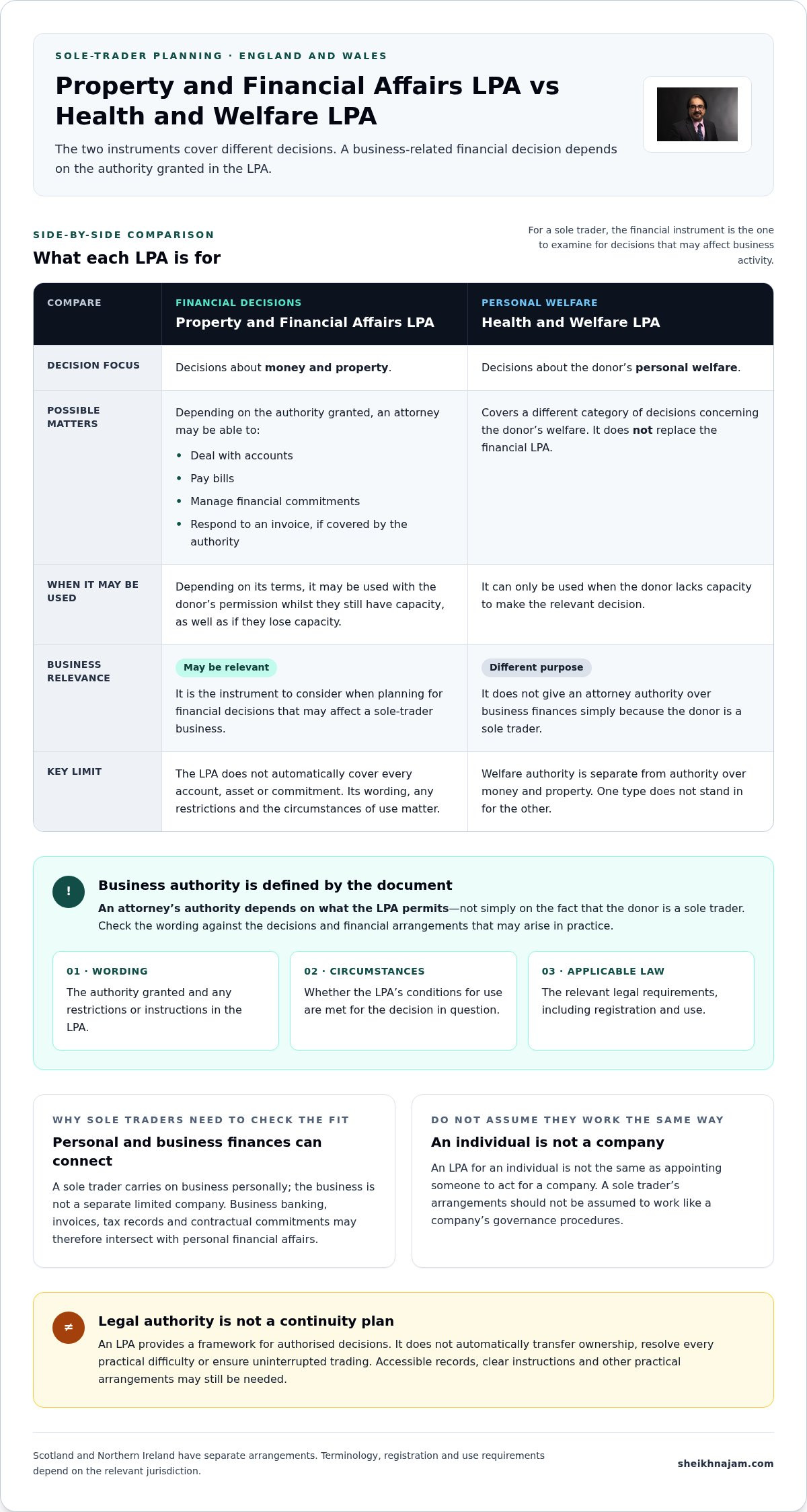
For a sole trader in England and Wales, a Property and Financial Affairs LPA is the instrument to consider when planning for financial decisions that may affect business activity. It can give an appointed attorney authority over relevant financial matters, but that authority is not unlimited. The document’s terms, any restrictions and the circumstances in which it is used all matter.
Which LPA type should a sole trader examine?
A Property and Financial Affairs LPA concerns decisions about money and property. Depending on the authority granted, these may include dealing with accounts, paying bills or managing financial commitments. A Health and Welfare LPA covers a different category of decisions concerning the donor’s personal welfare. It does not replace a Property and Financial Affairs LPA, and the financial instrument does not grant authority over welfare decisions.
The GOV.UK guidance on Lasting Power of Attorney sets out the LPA framework and the processes for making and registering an LPA in England and Wales. The legal instruments differ across the UK: Scotland and Northern Ireland have separate arrangements, so terminology, registration and use requirements depend on the relevant jurisdiction.
What authority does an attorney actually receive?
The LPA’s wording is consequential. For business-related decisions, an attorney’s authority depends on what the LPA permits, not simply on the fact that the donor is a sole trader. Restrictions or instructions may define or limit the attorney’s role, and the relevant law and circumstances must also be considered.
For example, an attorney might need to manage payments or respond to an invoice if that falls within the authority granted. Do not assume that a particular account, asset or commitment is covered in every case. Consider the document alongside your actual financial arrangements and the decisions that may arise in practice.
Registration and the conditions for using the instrument also matter. In England and Wales, a Property and Financial Affairs LPA may, depending on its terms, be used with the donor’s permission while they still have capacity, as well as if they lose capacity. This differs from a Health and Welfare LPA, which can only be used when the donor lacks capacity to make the relevant decision. The linked official guidance covers current requirements.
Careful drafting can help align the intended authority with a sole trader’s circumstances. Discuss your LPA circumstances as part of planning for your personal and business affairs.
LPA or business-continuity plan: what does a sole trader need?
An LPA and a business-continuity plan address different risks. A Property and Financial Affairs LPA may give an attorney legal authority to make decisions within its terms. A continuity plan records practical information that can help someone understand what needs attention and how the business operates. A lasting power of attorney for sole traders can form part of a considered plan, but it is not a substitute for operational preparation.
What can an LPA address, and what may need separate planning?
An LPA concerns decision-making authority, not a detailed operating manual. Separate planning can identify essential records, payment schedules, deadlines, contractual commitments and professional contacts, and explain where to find this information. For sole traders managing staff or sector-specific operations, professional HR and employment support from providers like altumhr.co.uk can help keep workforce processes compliant during unexpected leadership absences. These arrangements may assist continuity, but they do not themselves confer legal authority. Do not assume that a bank, client, supplier or other third party must accept a particular arrangement without considering the relevant terms and law.
No single document necessarily resolves every dependency. Access to information, the terms of an agreement and the steps required to keep work moving may each need separate consideration. Business LPA: A Strategic Guide for Business Owners offers a broader perspective on business-related LPA planning.
How does the sole-trader structure affect the comparison?
A sole trader operates personally rather than through a separate limited company. Business assets and liabilities may therefore be closely connected with the individual’s affairs, although ownership and responsibility depend on the particular facts. A company director, by contrast, acts in relation to a separate legal entity, so company arrangements should not be assumed to apply to a sole trader.
Where business assets or obligations cross borders, or the owner’s estate is complex, the interaction between the LPA, personal affairs and business dependencies may require tailored analysis. The aim is to align legal authority with practical preparations, rather than to treat either as a guarantee that trading will continue uninterrupted.
How to prepare before making a sole-trader LPA
Preparation helps ensure that a lasting power of attorney for sole traders reflects the decisions you may need an attorney to make, rather than relying on broad assumptions about what the document covers. Work through these steps before finalising your arrangements.
Define your priorities. Identify which personal and business-related financial decisions could require attention if you lost capacity. Separate these from practical operating tasks that need their own instructions.
Consider who could act. Assess a proposed attorney’s trustworthiness, judgement, availability and ability to manage financial responsibilities. Consider a replacement arrangement in case your first choice cannot act.
Map the business’s dependencies. Organise a record of relevant accounts, assets, liabilities, invoices, recurring payments, contractual obligations, deadlines and key professional contacts. Note where records are kept and how essential information can be found.
Discuss expectations. Speak with your prospective attorney about business priorities, preferences and record-keeping. A written note of your discussion can clarify expectations, but it does not replace the legal authority or terms of the LPA.
Review, execute and register. Check that the document reflects the authority you intend to grant and that any restrictions or instructions are clear and workable. Consider the wording and proposed arrangements in their legal context, then confirm the signing, witnessing and registration requirements for the relevant UK jurisdiction.
Set review points. Reconsider the arrangements after material changes, such as a change in business structure, assets or family circumstances. Keep related continuity records up to date.
Assessing a proposed attorney
Practical understanding matters alongside personal trust. Consider whether the person can exercise sound judgement, has time to act and understands the business’s commitments, such as payment cycles and work already promised. Discuss how they should record decisions and where important information will be kept. Clear expectations can reduce uncertainty without extending the attorney’s legal authority.
Reviewing the document and formalities
Requirements vary across England and Wales, Scotland and Northern Ireland. In England and Wales, the Office of the Public Guardian’s current guidance covers signing and registering an LPA. For Scotland or Northern Ireland, follow the applicable jurisdiction’s requirements. Avoid informal or ambiguous restrictions: wording that seems clear in principle may be difficult to apply in practice.
Sheikh Najam TEP’s specialist legal areas include lasting powers of attorney within wider private wealth and estate-planning work. The practice advises on how proposed authority may fit your affairs and wider planning.
Discuss a lasting power of attorney for your sole-trader circumstances
The central question is not simply whether to make an LPA, but which legal instrument fits your circumstances, what decisions you intend an attorney to make, and what practical arrangements need to sit alongside that authority. For financial decisions connected with a sole-trader business, a Property and Financial Affairs LPA may be relevant in England and Wales. Consider it in light of its wording and your actual affairs. A continuity plan, accessible records and clear contact arrangements address separate operational needs.
Individual advice can bring these strands together. The aim is to consider your personal financial affairs alongside business dependencies, so that the proposed authority and practical preparations are coherent. An LPA can form part of wider estate, tax and succession planning, but it does not guarantee that trading will continue uninterrupted or resolve every issue arising when you cannot act.
What information can make an initial discussion more productive?
A concise outline of your circumstances can help focus the discussion. Include the nature of your business, its essential financial commitments and any continuity arrangements already in place. You may also wish to identify:
the person or people you are considering as attorneys, and any possible replacements;
the decisions you believe an attorney may need to make, and any boundaries or concerns about that authority;
important recurring obligations, business records and key professional contacts; and
any assets or commitments held across borders, or complex estate considerations that may affect the wider plan.
You do not need to prepare a complete business file for an initial discussion. The purpose is to clarify priorities, identify questions and show how personal and business affairs intersect, so legal advice can focus on the matters that need careful analysis.
Jurisdiction is also material. Legal instruments and formal requirements differ across England and Wales, Scotland and Northern Ireland. The appropriate position depends on the applicable law and your circumstances. Any proposed LPA should be considered in its proper legal context, including how it relates to wider private wealth and succession arrangements.
Sheikh Najam advises on lasting powers of attorney as part of private wealth and estate planning. Discuss your lasting power of attorney requirements.
Put a considered plan in place
A lasting power of attorney for sole traders should reflect the decisions an attorney may need to make, while recognising that practical continuity arrangements address different needs. A Property and Financial Affairs LPA may be relevant to financial decisions, but its scope depends on its terms and applicable law. Consider your attorney, business commitments and personal affairs as parts of one carefully structured plan.
Legal requirements vary across the UK, and individual circumstances affect how an LPA fits alongside wider estate and succession planning. Sheikh Najam’s specialist practice covers lasting powers of attorney and private wealth planning, bringing these considerations together with attention to your affairs.
Discuss your lasting power of attorney requirements with Sheikh Najam.
Frequently Asked Questions
Can a sole trader use a lasting power of attorney to manage business affairs?
Yes. An attorney may be able to make financial decisions relevant to a sole-trader business if the LPA grants the necessary authority. The document’s wording, any restrictions, applicable law and the circumstances all matter. An attorney might, for example, need to deal with a financial commitment, but do not assume the LPA covers every account, asset or operational task. Practical continuity arrangements may still be needed.
Which type of lasting power of attorney is relevant to a sole trader?
A Property and Financial Affairs LPA is generally the relevant type to consider for financial decisions, including those connected with business affairs, subject to its terms. A Health and Welfare LPA concerns personal welfare decisions and does not replace the financial instrument. In England and Wales, these are separate LPA types. Scotland and Northern Ireland have different legal arrangements, so the appropriate instrument depends on the jurisdiction.
Does a sole trader need a business lasting power of attorney?
Not necessarily. In England and Wales, “business LPA” is commonly used to describe an LPA planned around business-related decisions, rather than a separate statutory LPA type. A sole trader may consider how a Property and Financial Affairs LPA should address relevant financial matters, including appropriate limitations. The need and suitable scope depend on the trader’s affairs. A separate continuity plan may also be needed for practical instructions.
When can an attorney act under a Property and Financial Affairs LPA?
In England and Wales, a Property and Financial Affairs LPA must be registered before it can be used. Depending on its terms, the attorney may act with the donor’s permission while the donor still has capacity, or when the donor lacks capacity to make the relevant decision. The attorney must stay within the authority granted. Registration and use rules differ elsewhere in the UK, so follow current guidance for the relevant jurisdiction.
Does a lasting power of attorney guarantee that a sole-trader business can continue?
No. An LPA can provide a framework for authorised decision-making, but it cannot guarantee uninterrupted trading or resolve every operational dependency. Continuity may also depend on accessible records, clear instructions, outstanding contractual commitments and how essential tasks are handled. A business-continuity plan complements an LPA; it does not itself grant an attorney legal authority. Consider both legal decision-making and practical arrangements when planning for possible incapacity.
Can a sole trader make an LPA after losing mental capacity?
Generally, no. The person making an LPA must have the required mental capacity to understand and make that decision at the time. If a sole trader has already lost the relevant capacity, someone cannot simply create an LPA on their behalf. The appropriate legal process depends on the UK jurisdiction and circumstances. Planning in advance allows the individual, whilst able to do so, to choose who may act and define their authority.
Are lasting powers of attorney the same across the UK?
No. Legal arrangements differ between England and Wales, Scotland, and Northern Ireland, including the instruments used and relevant processes. An LPA made under one jurisdiction’s rules should not be assumed to have identical requirements or effect elsewhere. This matters if you live in one part of the UK but have business interests or assets in another. Advice should reflect the applicable jurisdiction and your individual circumstances.


Comments