Revoking a Lasting Power of Attorney: 2026 Guide

What if an attorney no longer reflects the donor’s wishes? Can the authority simply be cancelled? The lasting power of attorney revocation process is more than a change of preference. In England and Wales, the donor’s capacity to make that decision is central. If they lack capacity, an application to the Court of Protection may be necessary. That distinction determines which legal route may be available and who can make decisions in the meantime.
It is also important to distinguish between revoking an entire LPA and removing one attorney while allowing the rest of the arrangement to continue. The appropriate route depends on the circumstances, the LPA’s terms and its registration status. Planning the change carefully can help avoid uncertainty about who has authority to act.
This guide explains when an LPA may be revoked, the documentation and notification stages, and the considerations involved in arranging a replacement. It also explains why attorneys and relevant institutions, such as banks or healthcare providers, should be informed so they understand who has authority after a change. Where capacity, attorney conduct or continuity of decision-making is in question, the details may need careful legal consideration.
Table of Contents
Lasting power of attorney revocation process: what can be ended or changed?
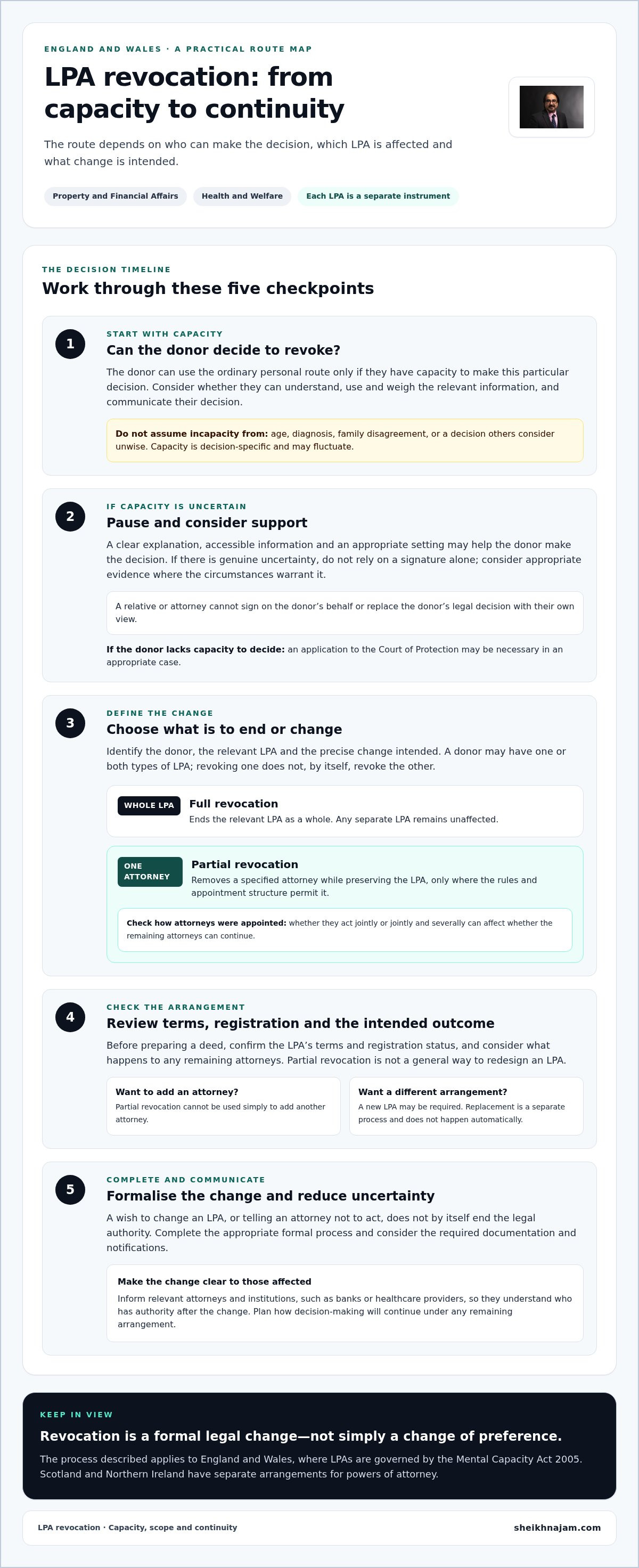
Revocation is the legal act of ending the authority a donor has given an attorney under a lasting power of attorney (LPA). It is not the same as changing one’s mind, telling an attorney not to act or drafting a replacement document. Until the appropriate legal steps are completed, the existing LPA may continue to govern the attorney’s authority. The lasting power of attorney revocation process described here applies to England and Wales, where LPAs are governed by the Mental Capacity Act 2005. Scotland and Northern Ireland have separate arrangements for powers of attorney, so the process described should not be assumed to apply there.
A donor may have a Property and Financial Affairs LPA, a Health and Welfare LPA, or both. Each is a separate instrument, so revoking one does not, by itself, revoke the other. The general background in Revoking a Power of Attorney distinguishes powers of attorney by legal form and jurisdiction. The applicable rules depend on where the arrangement was made.
Full revocation and partial revocation: how do they differ?
Full revocation ends the relevant LPA as a whole. It may suit a donor who no longer wants that arrangement to operate, although any separate LPA remains unaffected. Partial revocation removes a specified attorney while preserving the LPA, but it is available only where the rules and the appointment structure permit it. The result can depend on whether the other attorneys were appointed jointly or jointly and severally, and whether they can continue to act after the removal.
Partial revocation is not a general way to amend an LPA. It cannot be used simply to add another attorney or redesign the appointment. If the donor wants a different arrangement, such as appointing an additional attorney or changing how attorneys act together, a new LPA may be required. Making that replacement is a separate process. It does not happen automatically when the existing LPA is revoked.
Why might a donor consider revocation?
A donor’s circumstances and preferences can change over time. Their relationship with an attorney may have altered, an attorney may no longer be willing or able to act, or the donor may want different people to manage financial or welfare decisions. These are reasons to review the arrangement, not actions that end it. Even a clear wish to remove an attorney does not, on its own, change the LPA’s legal effect.
Deciding to change an LPA is only the first step. Legally ending or altering it requires the correct formal process. This distinction matters when deciding whether the aim is to terminate one instrument, remove a particular attorney or establish a new arrangement. In complex cases, consider the LPA’s terms and the effect on any remaining attorneys before choosing a route.
Can you revoke an LPA if capacity is in doubt?
In England and Wales, a donor can use the ordinary personal route to revoke an LPA only if they have mental capacity to make that particular decision. Capacity is decision-specific, not a permanent label. A person may be able to decide whether to end an LPA even if they need support with other matters, or may be unable to make that decision at a particular time. A diagnosis, advanced age or disagreement within the family does not, by itself, prove incapacity.
This distinction determines who may initiate the relevant route. A donor with capacity may revoke the LPA personally. If the donor lacks capacity to decide to revoke, an application to the Court of Protection may be necessary in an appropriate case. The lasting power of attorney revocation process should not proceed on the assumption that a signature alone resolves genuine uncertainty about the donor’s ability to make the decision.
What does the donor need to understand when deciding to revoke?
The question is whether the donor can understand, use and weigh relevant information about ending the authority, and communicate their decision. In practical terms, they should be able to grasp which LPA is affected, what authority will end and the foreseeable implications for decisions made under it. The assessment concerns the decision at the time it is made. Capacity may fluctuate, so evidence from another date may not settle the question.
Consider what support could help before concluding that the donor cannot decide. A clear explanation, accessible information and an appropriate setting may help the person understand the choice. A decision others regard as imprudent, or one that creates family tension, does not alone establish incapacity. For further context on the decision-specific nature of this issue, see this guide to lasting power of attorney capacity assessment.
What if the donor may no longer have capacity?
If there is a genuine question about capacity, pause before relying on a revocation signed by the donor. A relative or attorney cannot sign in the donor’s place or substitute their own view of the donor’s wishes for the donor’s legal decision. Set out the practical concerns, consider whether the donor can decide with suitable support, and obtain appropriate evidence where the circumstances warrant it. The relevant question is the donor’s capacity to decide about revocation, not their general ability to manage every aspect of life.
Where the donor lacks that capacity, the Court of Protection may have jurisdiction to consider ending an LPA, including in circumstances involving concerns about an attorney’s conduct. Court involvement is not automatic, and the route and outcome depend on the facts and legal grounds. If capacity, attorney conduct or the consequences of revocation are contested, individual legal guidance can help clarify the issues before you take steps.
How to complete the lasting power of attorney revocation process
In England and Wales, the paperwork must reflect the change the donor intends to make. Ending the whole LPA and removing one attorney are not interchangeable. Using wording for the wrong route may fail to achieve the intended result or create uncertainty about who remains authorised to act. Use the following sequence as a practical framework, and check the current Office of the Public Guardian (OPG) instructions before signing or sending documents.
Confirm the intended change. Establish whether the donor wants to revoke the entire LPA or remove a particular attorney while preserving the rest. Identify whether the instrument is a Property and Financial Affairs LPA or a Health and Welfare LPA, and whether it has been registered.
Identify the document precisely. Find the LPA and confirm the donor’s name, the relevant LPA type, its date and the attorney or attorneys named in it. Accurate details help ensure the deed addresses the right instrument and, for partial revocation, the correct appointment.
Prepare the appropriate deed. Use the current government wording for a deed of revocation or partial deed of revocation, as appropriate. The statement should identify the donor and the relevant LPA, and make clear whether the whole LPA is being revoked or a specified attorney’s authority is being removed.
Complete the execution formalities. Follow current official guidance on signing, dating and witnessing. Do not infer the requirements or wording from another deed or an older template. Resolve any uncertainty before signing.
Submit and retain a record. For a registered LPA, follow the OPG’s current submission instructions. Government guidance requires the relevant deed and original LPA to be sent to the OPG. Check the latest requirements, including accepted formats and document-handling directions, before dispatch.
Preparing and signing the deed of revocation
Check every identifying detail against the LPA itself, rather than relying on memory or correspondence. For a partial revocation, name the attorney whose appointment is to end and state clearly that the rest of the LPA is intended to continue, subject to the instrument’s terms and the applicable rules. A replacement LPA is a separate document and process. Do not treat it as part of the deed that ends or alters the existing appointment.
Notifying the Office of the Public Guardian and relevant people
The OPG administers LPA registration and handles revocation documentation in England and Wales. Once the relevant steps have been taken, inform the attorneys and, where appropriate, institutions that have relied on the LPA, such as a bank or healthcare provider. Keep a complete copy of the deed and LPA, evidence of delivery, and a record of notifications and responses. This creates a clear audit trail if authority is later questioned. Where capacity, attorney conduct or replacement arrangements make the sequence complex, discussing the LPA circumstances can help clarify the issues before documents are executed.
What happens after revocation, and what if circumstances are complicated?
The effect depends on what has been revoked and how the LPA appoints its attorneys. Full revocation ends the relevant LPA, so no attorney can continue to rely on it for authority. Partial revocation removes a specified attorney, but the remaining appointment may continue only if the instrument and applicable rules allow it. A new LPA is different: it creates a separate arrangement, with its own execution and registration process, rather than amending the old document.
Before acting, consider who can make decisions under the existing LPA, whether anyone will remain authorised after a partial revocation, and how decisions will be managed if the whole instrument ends. A replacement LPA does not take effect merely because the donor has decided to revoke the current one. It must be made and registered in its own right. This continuity question matters where financial or welfare decisions cannot simply be put on hold.
Donor-led revocation should also be distinguished from other events that may affect an LPA. The death or loss of capacity of an attorney can alter whether, or how, that person may act, depending on the appointment and any replacement attorneys. This is not the same as the donor choosing to revoke the LPA. A Court of Protection decision may also affect an LPA, but that is a separate legal route. Consider the LPA’s terms alongside the event prompting review.
Planning replacement arrangements without a gap in authority
Before ending an existing LPA, consider who is suitable to act, whether attorneys should act jointly or jointly and severally, and whether the donor wants separate arrangements for financial and welfare matters. If business interests depend on an attorney’s authority, consider how a change could affect decision-making and continuity. A new LPA must meet its own formal requirements and be registered. Planning its terms does not preserve or extend authority under the earlier instrument.
When attorney conduct or disagreement is the concern
Concern about an attorney’s conduct and the donor’s capacity to revoke are separate issues. Reporting concerns to the Office of the Public Guardian, where appropriate, is not the same as revoking an LPA. One step does not automatically accomplish the other. If relatives disagree about the donor’s wishes, the attorney’s conduct or the right course of action, identify the specific issue and relevant evidence before deciding how to respond. A dispute involving trusts or estates may call for a broader dispute-resolution perspective, but not every concern about an attorney amounts to such a dispute.
Where replacement planning, business continuity or disagreement makes the consequences difficult to assess, get advice tailored to the facts before changing authority. Discuss your LPA and continuity concerns to consider the legal implications of the proposed next step.
Choosing your next step in an LPA revocation matter
Before taking action, establish what the donor intends to achieve and whether the proposed route is legally available. A sound decision considers more than the wording of a deed. The donor’s capacity, the LPA’s terms and registration status, and the effect on anyone who currently relies on the authority all matter. This checklist can help organise the key questions, but it cannot determine the right outcome where the facts are disputed or complex.
A practical checklist before taking action
Locate the signed LPA. Confirm whether it is a Property and Financial Affairs LPA, a Health and Welfare LPA, or both, and establish whether the relevant instrument is registered.
Clarify the intended change. Is the donor seeking to end the whole LPA, or remove one attorney while retaining the rest of the arrangement? The legal route and effect differ.
Consider capacity. The donor must have capacity to make the particular decision to revoke or remove an attorney. If there is genuine uncertainty, address it before relying on a document signed by the donor.
Plan for what follows. Consider whether a replacement LPA is needed, who may act in the interim, and how affected financial or welfare decisions will be managed.
Registration status is a practical point, not a substitute for identifying the correct legal route. It may affect the documents and notifications required, so establish it before submitting anything. Keep the original instrument and relevant correspondence together, and record the change the donor intends. This preparation can help distinguish the donor’s settled decision from a family member’s preferred solution.
When individual advice may assist
Careful legal analysis can be useful where capacity is contested, deed formalities are uncertain or the donor’s intended outcome is unclear. The terms governing how attorneys act can also determine whether removing one person leaves a workable arrangement. Personal LPAs and LPAs connected with business responsibilities may raise different continuity questions, particularly where decisions about assets, operations or welfare cannot be deferred without consequence.
Consider the wider private-client context too. A proposed change may interact with trust and estate planning, existing decision-making arrangements or a disagreement about an attorney’s conduct. Reporting a concern and revoking an LPA are separate responses. If the matter has developed into a substantive trust or estate dispute, trust and estate dispute resolution may be relevant to the broader issues.
The lasting power of attorney revocation process should reflect the donor’s capacity, the document and the practical consequences of the change. Sheikh Najam advises on lasting powers of attorney and related private-client matters. If these issues are difficult to resolve, you can discuss your LPA circumstances and the options that may be available.
Put your next decision on a considered footing
A change to an LPA can prompt a wider review of how decisions will be made and how those arrangements fit within the donor’s private affairs. The appropriate next step depends on the donor’s circumstances, the intended outcome and, where relevant, the relationship between the LPA and wider trust and estate planning. A carefully assessed lasting power of attorney revocation process can help ensure the legal steps reflect the donor’s position and avoid uncertainty for those who may need to act.
Sheikh Najam’s specialist private-client practice includes lasting powers of attorney and trust and estate planning. Sheikh Najam TEP advises on these matters, including where capacity, replacement arrangements or wider estate considerations intersect. General guidance can clarify the issues, but it cannot determine the right course in every individual case.
If you are considering a change, discuss your lasting power of attorney circumstances with Sheikh Najam. Advice tailored to the facts can help you understand the available options and plan your next step.
Frequently Asked Questions
Can I revoke a lasting power of attorney after it has been registered?
Yes. In England and Wales, a donor with capacity to make the decision can revoke a registered LPA, provided the required formal steps are followed. The lasting power of attorney revocation process includes notifying the Office of the Public Guardian as required. Check current submission instructions before sending documents. If the donor wants to remove one attorney but retain the rest of the arrangement, that is different from ending the entire LPA.
Do I need a deed of revocation to cancel an LPA?
Yes. A deed of revocation is the formal document a donor with capacity uses to end an LPA in England and Wales. It should identify the donor and the particular LPA, and clearly state the donor’s intention to revoke it. A letter expressing dissatisfaction or an informal message to an attorney is not a substitute. Check the current Office of the Public Guardian guidance for the required wording, execution formalities and submission procedure.
Can I remove one attorney without cancelling the whole LPA?
Possibly. A donor may be able to remove an attorney from a registered LPA by making a partial deed of revocation, if the applicable conditions are met. The effect on other attorneys depends on the appointment and how they are authorised to act. Removing someone does not add a new attorney. A new LPA may be needed for that. Check the current official procedure before preparing or submitting the deed.
Can someone revoke an LPA on behalf of a donor who lacks capacity?
Not through the donor’s ordinary personal revocation process. A relative or attorney cannot cancel the LPA simply by notifying the Office of the Public Guardian or signing for the donor. Depending on the circumstances, an application to the Court of Protection may be available, but court involvement is not automatic and does not guarantee a particular result. Where capacity is uncertain, get advice on the evidence and lawful options before taking action.
Does an LPA end automatically when the donor dies?
An LPA no longer provides authority to make decisions for the donor after their death. Administration then concerns the donor’s estate and proceeds under the applicable will, intestacy and probate rules, rather than under the LPA. This is distinct from revocation during the donor’s lifetime. People and institutions relying on the LPA should be informed of the death through appropriate procedures, and the person responsible for the estate should establish the authority required for the next steps.
Can I change the instructions in an existing LPA instead of revoking it?
Generally, an executed LPA cannot be altered by simply editing its instructions. If the donor has capacity and wants materially different terms, making a new LPA may be appropriate, with revocation of the existing instrument considered as part of that plan. For example, changing how attorneys are appointed to act may require a replacement rather than an informal amendment. The suitable course depends on the requested change, capacity and the LPA’s status.
What happens if an attorney objects to the revocation?
An attorney’s objection does not, by itself, determine whether a donor with capacity can revoke an LPA. It may, however, raise practical or legal questions about notice, the validity of the decision or whether the donor is acting freely. Keep a clear record of communications and follow the applicable formal process. If coercion, capacity, validity or the attorney’s conduct is disputed, individual legal analysis may be needed. Court involvement may be relevant in some cases.


Comments