Trust Variation in the UK: Principles and Risks in 2026

What if a proposed trust variation could benefit one generation whilst changing another’s rights? A trust variation is not an informal amendment. Whether a change is possible, and whose approval is required, depends on the trust instrument, the interests affected and the applicable legal framework. For trustees and families, the first question is not simply what should change, but whether there is a valid route to change it.
Beneficiaries may disagree, lack capacity to consent or be affected in ways that are not immediately apparent. A change intended to improve administration or respond to changed family circumstances may also have inheritance tax, capital gains tax or other legal consequences. The position can differ across UK jurisdictions, so the relevant framework must be considered carefully.
This article explains what a trust variation can achieve, how to identify the appropriate route, and which beneficiaries, trustees or courts may need to be involved. It also sets out why the trust terms, capacity and consent, and potential tax treatment should be reviewed together before a variation is documented.
Table of Contents
Trust variation explained: what can change and why does it matter?
A trust variation is a proposed change to the terms of a trust or the way its arrangements operate. It might concern trustee powers, the duration of the trust, when a beneficiary becomes entitled to an asset, or how benefits are allocated. These are possible subjects for review, not changes that every trust permits. The governing instrument and applicable law determine what can change and which route must be followed.
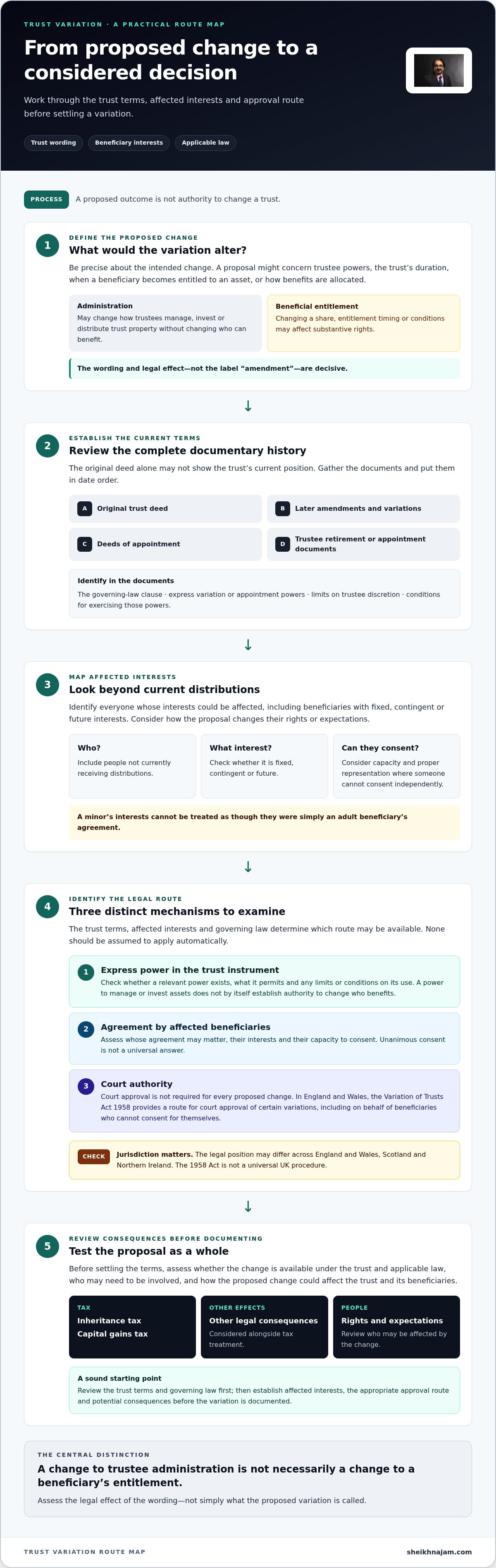
The distinction between administration and beneficial entitlement is fundamental. Changing administrative powers may affect how trustees manage, invest or distribute trust property without changing who can benefit. By contrast, changing a beneficiary’s share, postponing the age at which they become entitled, or altering the conditions attached to a benefit may affect substantive rights. The legal and practical implications can differ significantly, even if both proposals are described as amendments to the same deed.
What does varying a trust mean in practice?
Assess a proposed change against the trust’s complete documentary history. The original deed may give trustees express powers over investment, appointments of assets, distributions or the trust’s duration, while also setting limits on how those powers may be used. Later deeds or other amendments may have changed the original position. Reviewing the original deed alone can therefore give an incomplete picture.
For example, a trust may give trustees discretion over when a beneficiary receives capital. Changing the powers trustees use to manage that capital is not necessarily the same as giving the beneficiary an immediate entitlement. The first proposal may concern administration; the second may alter beneficial rights. The wording and legal effect, rather than the label given to the proposal, are decisive.
Why might trustees or beneficiaries consider a variation?
Family circumstances and asset arrangements can change after a trust is created. A family structure may develop in a way the original terms did not anticipate, a beneficiary’s needs may differ from what was expected, or administrative provisions may become impractical as the trust’s assets or responsibilities evolve. Trustees or beneficiaries may then explore whether the trust can be adapted, for example by revisiting trustee powers, the trust’s duration or the timing of an entitlement.
A desired outcome does not, by itself, give anyone authority to change the trust. In England and Wales, the Variation of Trusts Act 1958 provides a route for court approval of certain variations on behalf of beneficiaries who cannot consent for themselves. Its relevance depends on the applicable legal framework. A UK-wide overview should not obscure the need to identify which jurisdiction’s law governs the trust.
Assess a proposed variation against the trust terms and governing law before deciding whether it is valid, which approval route applies or what effect it may have. This establishes the starting point for identifying affected people and the steps that may be required.
Which legal route can a trust variation take?
Start with the trust instrument, not the outcome a family hopes to achieve. The deed may contain an express power to amend particular provisions, set conditions on its use or restrict trustee discretion. If no relevant power exists, other routes may need consideration, including agreement by beneficiaries whose interests are affected or an application for court authority. These are distinct mechanisms, and none should be assumed to apply automatically.
Jurisdiction matters. Trusts connected with England and Wales, Scotland or Northern Ireland may be governed by different legal rules. A governing-law clause is an important starting point, but may not provide the whole answer. The Variation of Trusts Act 1958 is relevant to certain court-approved variations in England and Wales, including arrangements involving beneficiaries who cannot consent for themselves. It is not a universal UK procedure: the applicable law, trust terms and proposed change all need careful analysis.
What should the trust deed review establish?
A focused review should identify the governing-law clause, any express variation or appointment powers, limits on trustee discretion and conditions for exercising those powers. Gather the original deed and later documents, such as deeds of appointment, trustee retirement or appointment, and previous variations. Putting these documents in date order helps establish the trust’s current terms and the authority on which a proposed step would rely.
A power to manage or invest trust assets does not, simply by existing, establish a power to change who benefits or the nature of their entitlement. This distinction matters: an administrative change may fall within one authority, while a change to beneficial interests may require a different legal basis.
When might consent or court approval matter?
Begin a consent analysis by identifying everyone whose interests could be affected, not just those currently receiving distributions. Beneficiaries may have fixed, contingent or future interests. Their capacity to consent and the proper representation of anyone unable to consent independently may also need consideration. A minor’s interests, for example, cannot be treated as though they were simply an adult beneficiary’s agreement.
Unanimous consent is not a universal answer, and court approval is not required for every proposed change. The correct route depends on the instrument, the affected beneficiaries’ legal positions and the governing law. If a court application is being considered, establish the relevant statutory power and the court’s jurisdiction for that trust. HMRC’s guidance on trust variations also illustrates why the route and tax treatment should be examined together.
Where the instrument, beneficiary interests or jurisdictional position is complex, a coordinated review can clarify the available authority before documents are prepared. Discuss trust variation considerations in the context of the trust terms, affected interests and wider estate planning.
Trust variation consequences: how to assess beneficiaries, tax and disputes
Once a potential route has been identified, compare the proposed terms with the current position. A side-by-side assessment can show who may gain or lose and how the nature of an interest might change. Record each affected person’s current and proposed entitlement, including its timing, conditions and any trustee discretion. A beneficiary may appear to retain the same share but face a later entitlement date, different conditions or less influence over how trust property is managed.
How could a variation affect beneficiaries?
Consider current beneficiaries alongside those with contingent or future interests. For example, distributing capital earlier may benefit one person now while reducing the assets available to others later. Identify any relevant absent, untraceable, unborn or legally incapable beneficiaries. Their interests may not be represented by the people taking part in discussions.
Competing interests do not mean a challenge will necessarily follow. They do make clear analysis and careful documentation especially important. Uncertainty about who benefits, how discretion may be exercised or whether a person’s interests have been properly considered can strain family relationships and complicate trust administration. Evaluate the practical effect on each interest, not just the intended advantage of the proposal.
Which tax and dispute risks need separate analysis?
Tax treatment depends on the transaction, the trust, the parties and the rules applicable to the circumstances. A change to beneficial interests may raise different questions from an administrative amendment, while transferring or appointing assets may require separate analysis. Consider inheritance tax, capital gains tax and any relevant income-tax consequences under current rules. Do not infer the tax treatment from the document’s legal form or stated purpose. Legal permission to vary a trust does not, by itself, establish that the variation is tax-neutral.
For matters governed by English and Welsh law, Practical Law on varying trusts outlines routes and procedural considerations. The analysis must still be applied to the particular instrument and facts. Cross-border assets, parties or governing-law provisions may add further tax and legal dimensions, so conclusions should not be generalised across UK jurisdictions.
Distinguish a proposed change from an allegation that trustees have breached their duties. The first concerns whether and how the trust may be changed; the second concerns alleged conduct in administering it. They can arise together, but require separate analysis of the relevant decisions, evidence and remedies. If the concern is alleged misconduct, a focused review of trust dispute resolution can help frame the issues without treating an unresolved allegation as established fact.
How to prepare for a proposed trust variation
A structured preparation process helps separate the desired outcome from the legal authority and practical steps needed to pursue it. Before assessing options, assemble the relevant records, define the proposal precisely and identify the people and assets it may affect. This gives the legal, tax and administrative review a reliable factual foundation without presuming that the proposed change is available or appropriate.
What information should trustees assemble first?
Start with the original trust instrument and gather every later deed or record that may have changed its terms, including appointments, trustee changes and previous variations. Add a current summary of the trust’s assets and administration, relevant correspondence, and a concise description of the proposed change. State its purpose, intended effect and proposed timing. Separate established facts from assumptions that still need investigation.
Then organise the review in a clear sequence:
Define the objective. Describe the practical issue the proposal is intended to address and the outcome sought. Avoid drafting around a preferred legal solution before analysing the available authority.
Set out the current position. Summarise the trust’s terms, assets, current administration and existing beneficiary interests, using the complete documentary record.
Describe the proposed effect. Record what would change, for whom and when. Identify any change to conditions, discretion, entitlement or administrative responsibility.
Identify affected people. List current, contingent and future beneficiaries who may be affected. Note any known absence, uncertainty about location, capacity concerns or need for representation.
Separate the questions for review. Record legal authority and approval issues, potential tax treatment, asset valuation matters and practical administration separately. Note where one issue may affect another.
How can the process reduce avoidable uncertainty?
Keep a written record of the interests considered, the documents and information relied on, and the reasons for exploring the proposed course. Mark unresolved issues instead of treating estimates, assumptions or incomplete records as settled facts. For example, if an asset’s value could materially affect the analysis, record the valuation question and the relevant date for consideration.
Before implementation, identify outstanding legal, tax and administrative questions and determine how they will be resolved. The required form, approvals and execution steps depend on the available route and governing law. A draft document alone does not establish that those requirements have been met. Careful preparation also helps distinguish a planned change from a dispute about past administration.
A coordinated review can bring the trust terms, affected interests and tax considerations into one decision-making framework. To discuss preparing a proposed trust variation, contact Sheikh Najam.
Trust variation advice: turning a proposed change into a considered decision
A sound decision about changing a trust requires more than identifying a desirable outcome. Test the proposal against the trust instrument and the correct governing law, then consider the people affected, the available approval route and the legal, tax and administrative consequences. These strands are connected, but each raises distinct questions. Examining them separately before drawing them together helps prevent an assumption in one area from being mistaken for a conclusion in another.
What should a considered trust-variation decision address?
The analysis should establish what the proposed change is intended to achieve and whether the trust terms and governing law provide a valid route. It should account for present and future interests, including any change to entitlement, timing, conditions or trustee discretion. It should also address required approvals, potential tax treatment, documentation and practical steps for implementation.
A useful decision framework asks:
Objective: What practical issue is the proposal intended to resolve, and is the change proportionate to that purpose?
Authority: Which terms and legal rules support the proposed route, and what limits or conditions apply?
Interests and approvals: Who may be affected now or in future, and whose consent, representation or court approval may be relevant?
Consequences: What legal, tax and administrative effects need separate assessment before the change proceeds?
Implementation: What formal documents, execution steps and records will be required under the applicable route?
This framework can expose gaps in the evidence or reasoning. A proposed change to distributions may appear straightforward, for example, but its effect could depend on how the deed defines discretion, which beneficiaries hold future interests and whether assets need separate valuation or tax analysis.
How can specialist advice support the next step?
A focused review can bring the trust instrument, proposed objective and material circumstances into one coherent assessment. Trust and estate planning expertise can consider the proposal alongside wider family and asset arrangements. A dispute-resolution perspective can help identify where interests diverge and where clear explanation and a careful process may reduce avoidable misunderstanding. Divergent interests do not make conflict inevitable, but they should be recognised rather than left implicit.
Sheikh Najam’s trust and estate planning work sits alongside expertise in inheritance tax planning, international tax and trust disputes. This breadth is relevant when a proposed change requires the instrument, beneficiary interests and potential consequences to be assessed together rather than in isolation. Any recommendation must be tailored to the trust’s terms, governing law and circumstances; no general approach can determine the right outcome for every arrangement.
If you are considering a change to an existing trust, arrange a discussion about the proposed objective, affected interests and issues requiring review.
Make your next decision with clarity
Consider a proposed trust variation in light of the trust’s continuing purpose, not as an isolated amendment. Establish what decision must be made, which facts remain uncertain and what evidence would help address those questions. This creates a more deliberate basis for action, whether the proposal is pursued, refined or set aside.
Sheikh Najam’s work brings trust and estate planning, international tax and contentious trust perspectives to the assessment of private-client arrangements, including circumstances where beneficiaries’ interests may not align. A tailored discussion can place the proposed change in its wider context and identify the matters requiring focused review.
Arrange a discussion about your trust variation and take the next step towards a carefully considered decision.
Frequently Asked Questions
What is a variation of trust?
A variation of trust is a legally effective change to an existing trust arrangement, rather than a new trust or an informal family agreement. Depending on the available authority, it might change provisions about trustee administration or alter the nature, timing or conditions of a beneficiary’s entitlement. The distinction matters: a written proposal or trustee resolution alone does not necessarily amend the trust or bind those whose interests are affected.
Can trustees change the terms of a trust without going to court?
Yes, in some circumstances. Trustees may be able to act under an express power in the trust instrument, subject to its conditions and limits. A change may also be possible through the agreement of all adult beneficiaries who are legally able to consent and together hold the relevant interests. If neither route is available, court authority may be considered. The deed and governing law determine whether a non-court route is effective.
Do all beneficiaries have to agree to a trust variation?
Not invariably. Whether consent is necessary depends on the proposed change, the trust terms, the interests affected and the legal route being used. Agreement from current income beneficiaries, for example, may not resolve the position of someone with a future or contingent interest. Where a beneficiary cannot consent personally, other mechanisms may be relevant. Identify whose interests are engaged before treating any agreement as sufficient.
Can a trust variation affect inheritance tax or capital gains tax?
Yes. A trust variation may have inheritance tax or capital gains tax consequences, although the outcome depends on the transaction, the trust, the parties and the applicable tax rules. Changing beneficial interests or transferring trust assets may raise different tax questions from an administrative amendment. Consider the proposed legal documents alongside the relevant tax facts, including asset ownership and values, before implementing the change.
Can a trust be varied if a beneficiary is a minor or lacks capacity?
Possibly, but that beneficiary cannot simply be treated as having given valid consent. The legal route may require appropriate representation or court approval, depending on the trust, the beneficiary’s interest and the governing law. In England and Wales, the Variation of Trusts Act 1958 gives the court power to approve certain arrangements on behalf of specified beneficiaries who cannot consent themselves. Its application should not be assumed for every UK trust.
Does the same trust-variation law apply throughout the UK?
No single procedure should be assumed to apply throughout the UK. Trusts connected with England and Wales, Scotland and Northern Ireland may engage different legal rules, and the trust’s governing-law provisions and circumstances matter. The Variation of Trusts Act 1958 is relevant to certain cases in England and Wales; it is not a universal UK route. Cross-border connections may require further analysis of which law governs the trust and proposed change.
Can a trust variation be challenged by a beneficiary?
A beneficiary may raise a challenge where there is a genuine issue about the authority for the change, the validity of consent, compliance with the trust’s terms or the effect on their interest. Whether a challenge can succeed depends on the evidence, legal route and governing law; disagreement alone does not establish that a variation is invalid. Keeping the relevant instruments, approvals and decision records can help clarify how the change was authorised and implemented.


Comments