International Will Validity: How Cross-Border Rules Affect Your Estate

Could a will that was properly signed in one country still fail to produce the intended result elsewhere? International will validity is not determined by a single worldwide test. Formal requirements, the law governing succession and the location of particular assets may each raise separate questions. A will’s execution may be recognised, but that alone does not establish that every gift will take effect as intended.
For anyone with property, family or residence connections across borders, this distinction can cause understandable uncertainty. This article explains the principal issues that shape cross-border recognition, including the difference between a will’s formal validity and the rules governing who inherits. It also considers why foreign property may need separate analysis and why the applicable law can depend on the jurisdictions involved.
You will learn where separate planning or advice may be needed and what information can make a professional review more focused. As a starting point, gather copies of all existing wills, details of the testator’s nationality and residence history, and a schedule showing the location, ownership and nature of each asset. For UK readers, the relevant domestic framework may also differ between England and Wales, Scotland and Northern Ireland.
Table of Contents
International will validity: the questions a cross-border estate raises
Formal validity of an international will: execution, form and applicable law
Foreign assets and international will validity: whose succession law applies?
How to assess international will validity: a practical review checklist
Professional advice on international will validity and estate planning
International will validity: the questions a cross-border estate raises
There is no single worldwide test for whether a will “works” wherever an estate has connections. International will validity is better understood as a sequence of related enquiries: whether the document meets relevant rules on its form, which law governs succession to particular assets, and whether its provisions can take effect under that law. The answers depend on the jurisdictions and facts involved, including the distinct legal frameworks within the UK.
In brief: A cross-border will may need to be assessed under more than one legal system. Recognition depends on the applicable rules and the circumstances of the testator, the document, the beneficiaries and the assets.
This section concerns estates connected with the UK through, for example, a testator, a will made or held abroad, a beneficiary living in another country, or property situated overseas. A foreign connection raises a question for legal analysis. It does not, by itself, make a will invalid.
What makes a will international in legal terms?
Relevant connections can include where and how the will was executed, the testator’s nationality, habitual residence and domicile, and the location of assets. These factors are not interchangeable. One may matter to formal requirements, while another may help identify the law governing succession. A UK resident with property overseas, for instance, may have a cross-border issue even if the will was signed in the UK and all beneficiaries live here.
“International will” can also refer to a particular legal instrument created under an international framework. That is different from using the phrase descriptively for any will involving foreign people, documents or property. The label alone does not establish which rules apply or determine whether every gift will be effective.
Why validity is not the same as the law governing inheritance
Keep two enquiries distinct. Formal validity concerns whether the will was made in a form that the relevant legal rules recognise, including requirements concerning execution. Material validity concerns the legal effect of its provisions: which law governs succession, and whether the gifts or other dispositions can operate under that law. The applicable rules may vary according to the UK jurisdiction and the foreign connection.
A will may satisfy the rules for how it was signed, yet the law governing succession may still affect whether particular gifts take effect. This distinction matters where an estate includes different asset types or property in more than one country. Neither a signature witnessed in accordance with one jurisdiction’s requirements nor a document’s acceptance for an administrative purpose resolves every succession question.
Start by identifying the testator’s relevant personal connections, the circumstances of execution and the location of each asset. These facts provide a framework for examining formal recognition separately from the law that determines inheritance, before reaching a conclusion about the estate as a whole.
Formal validity of an international will: execution, form and applicable law
When a will has a foreign connection, the place where it was signed is only one possible reference point. A jurisdiction’s conflict-of-laws rules may recognise several connections when deciding whether the document met the required formalities. The relevant framework can take account of where the will was executed and, depending on the rule in question, the testator’s nationality, domicile or habitual residence at a specified time. Which connections matter, and when, must be established under the law applied by the court or authority considering the will.
For UK-connected estates, the Wills Act 1963 forms part of the statutory framework for formal validity. Its application should be considered in the context of the relevant UK jurisdiction and the facts, rather than treated as a universal rule. England and Wales, Scotland and Northern Ireland do not necessarily share identical succession frameworks. A sound assessment identifies the applicable domestic rules before drawing conclusions about execution.
Which law may determine whether the will was properly made?
The question is not simply whether the will followed the signing procedure familiar to the testator. The analysis may involve more than one potentially relevant law, with the applicable conflict rules determining which routes are available. For example, a will executed abroad by a UK national may require consideration of both the circumstances of execution and the testator’s personal connections. Neither fact alone dictates the outcome.
Timing also matters. A rule may refer to a connection at execution or at death, and those dates must not be conflated. A change of residence or domicile after the will was made could be relevant, but only if the governing rule gives it significance. The conclusion depends on the applicable legislation, the evidence and the jurisdiction addressing validity.
What the International Will Convention does, and does not, do
The Washington Convention provides an additional form of will for jurisdictions in which its framework has been implemented. It is not a universal code for all cross-border estates, and using that form does not decide which law governs the distribution of assets. Its function concerns form. Succession, the effect of gifts and any restrictions imposed by the applicable law remain separate questions.
For a UK estate, establish whether the Convention’s rules have effect in the relevant territory and how they apply to the circumstances. Treaty participation, domestic implementation and territorial application are distinct matters. They should not be inferred from the Convention’s existence or from a reference to an “international will”.
Keep the original document, any execution certificate or supporting record, and information about where and when the will was signed. These materials can help a focused review distinguish a formal defect from a question about the law governing the estate. Where execution abroad or a special will form is involved, cross-border will advice can help bring those issues together with relevant estate-planning and administration considerations.
Foreign assets and international will validity: whose succession law applies?
The location and legal character of an asset can affect which succession rules need to be considered. A home situated abroad may raise different questions from a bank account or investment portfolio, even where the same will refers to them all. The rules are jurisdiction-specific: principles applied in England and Wales should not be assumed to govern Scotland, Northern Ireland or a foreign court.
In broad terms, immovable property commonly means land and buildings, whilst movable property may include personal possessions and financial assets. Classification can be more complex for particular interests, so an asset’s description in a financial statement does not, by itself, establish its legal treatment.
Movable and immovable property may raise different questions
For immovable property, the law of the place where the asset is situated, known as the lex situs, may be relevant to succession or related questions. A holiday home overseas, for example, may require consideration of local rules as well as the will and succession framework relevant to the rest of the estate. The precise effect depends on the applicable law and the issue being examined.
For movable succession, domicile is a significant connecting factor under the traditional approach in England and Wales. Domicile is a legal concept, not simply a synonym for nationality or current residence. That principle must be applied in its proper context and should not be treated as a single UK-wide rule. The governing approach and any relevant conflict-of-laws rules require jurisdiction-specific analysis.
This comparison is a starting point, not a determination of applicable law. A cross-border review should identify each asset’s legal owner, location and nature, then consider the relevant UK jurisdiction and any foreign law that may affect succession or administration.
How multiple wills and governing laws can interact
Some estates use separate wills for assets in different jurisdictions; others rely on one instrument. Either structure requires coordination. A new will with a broad revocation clause could unintentionally revoke an earlier foreign will, whilst overlapping descriptions of assets may leave uncertainty about which document governs a particular holding. Read the documents together, including their definitions, territorial scope and revocation provisions.
A strategic guide to cross-border estate planning can provide broader context, but each estate still requires attention to its own documents and assets. International will validity must be assessed alongside asset location, ownership and the succession rules relevant to each part of the estate.
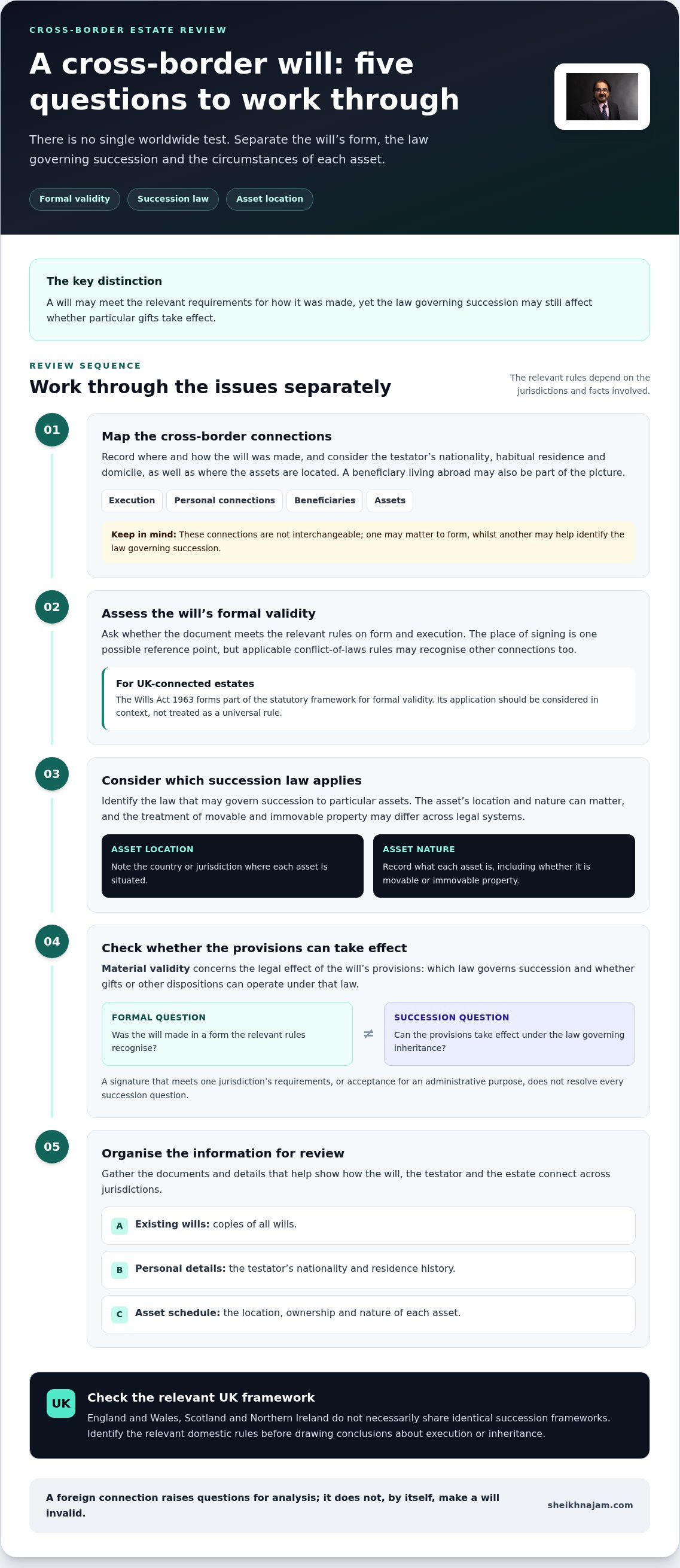
How to assess international will validity: a practical review checklist
A structured review begins with evidence, not an assumption that a will is either valid or invalid everywhere. Organise the documents and relevant connections so that the applicable rules can be considered separately for each issue and, where necessary, each asset.
Execution evidence shows how a will was made; asset details help identify which succession rules may apply. Both are needed before a reliable view can be formed.
Documents and facts to assemble before a review
Gather the material in a consistent order. Copies are useful for initial analysis, but record where original documents are held, since they may be needed during estate administration.
Collect every testamentary document. Include signed wills, codicils, amendments, revocation documents and earlier versions. Record where each was made, signed and stored, and whether execution records or certificates are available.
Build a dated personal history. Note the testator’s nationality or nationalities, residences over time and relevant dates, including when each will was executed and when any move occurred. Record evidence that may bear on domicile separately from residence. The terms are not interchangeable.
Prepare an asset schedule. For each asset, note its type, country and precise location where relevant, legal owner, and any co-ownership or other ownership arrangement. Distinguish land from a bank account rather than grouping both under “overseas property”.
Map the documents to the estate. Identify which will appears to address each asset or jurisdiction, and note broad revocation wording, overlapping descriptions or apparent gaps. Treat this initial map as a guide, not a conclusion about legal effect.
Preserve supporting records. Keep correspondence about execution, translations, evidence of witnesses or the signing process, and records clarifying an asset’s ownership and location. These can help resolve factual uncertainties during the legal review.
Questions the legal analysis should answer
Once the information is organised, test each issue in sequence. Which jurisdiction’s conflict rules are relevant, and do they recognise the will’s form? Can the document be admitted to probate in the relevant forum? Which law governs succession to each material category of asset? The applicable framework may differ across England and Wales, Scotland and Northern Ireland, so identify the UK jurisdiction precisely.
The review should also consider whether a later document revoked an earlier will, whether separate wills can operate together without contradiction, and whether a particular gift may fail under the law governing succession. A will accepted in one jurisdiction does not, by that fact alone, settle its effect for every asset in another country. Nor does notarisation, by itself, determine testamentary validity or guarantee recognition abroad.
For a focused assessment of the documents, personal history and asset schedule, discuss your cross-border estate questions.
Professional advice on international will validity and estate planning
A cross-border review should connect the will’s execution history with the law potentially governing succession, the location and ownership of assets, and the practical requirements of estate administration. Considering only the signature or only the foreign property can leave important issues unresolved. A coordinated assessment can identify where separate jurisdictional analysis is needed and how the documents are intended to operate together, without assuming in advance that a particular will or gift will be recognised.
When a cross-border review is particularly important
Tailored advice is especially relevant where a person has property, residence or substantial personal connections in more than one country. Several wills, earlier revocation documents or incomplete records of how a will was signed may add complexity. The UK connection also needs precision: the applicable framework may differ between England and Wales, Scotland and Northern Ireland. Identify the relevant jurisdiction rather than treating the UK as a single succession system.
Coordinating will planning with administration
Planning should account not only for the intended distribution of an estate, but also for the steps required to administer assets in different places. A foreign institution or authority may require supporting documents before an asset can be dealt with; the necessary evidence and process depend on the circumstances and local requirements. Consider succession analysis alongside likely probate and estate administration needs.
Sheikh Najam TEP advises on international wills and complex probate matters, and provides notarial services for international legal documentation and authentication. Notarial work may address the authentication or formal presentation of documents, but it does not determine the succession law or establish that a will or gift is substantively valid. Documentation can support an administrative process without resolving the legal effect of testamentary provisions.
A considered approach to international estate planning can bring together:
the execution and intended scope of each will;
the law potentially governing succession to assets in each jurisdiction;
the relationship between multiple wills, including their revocation provisions; and
the documentation and administration issues that may arise when the estate is dealt with.
This coordinated review is particularly valuable before a new will is signed or an existing arrangement is changed, since even limited amendments may affect other documents or assets. Advice can be tailored to the individual’s circumstances and the relevant jurisdictions, while recognising that the final treatment of an estate depends on the applicable law and facts.
For a considered review of your circumstances, arrange a discussion about your international will.
Put a considered cross-border plan in place
Where an estate touches more than one legal system, careful preparation can give executors and beneficiaries a clearer framework. Treat international will validity as a planning question to revisit when circumstances change, such as acquiring property abroad, moving country or making a new will. A focused review can identify which documents and asset details need attention without assuming that one document settles every issue.
Sheikh Najam TEP’s specialist work across international wills and complex probate matters supports a joined-up consideration of planning and administration, including notarial services for international legal documentation. The next step is a review shaped around your circumstances and the jurisdictions involved.
Discuss your international will and cross-border estate requirements and take a measured step towards a more clearly organised estate plan. With the relevant documents and asset information to hand, you can approach that discussion with greater confidence.
Frequently Asked Questions
Is a will made abroad valid in the UK?
A will made abroad may be recognised in a UK jurisdiction, but the answer depends on the applicable formal-validity rules and the circumstances of its execution. Relevant facts can include where it was signed and the testator’s personal connections. For example, a will signed during a period of residence overseas should be assessed alongside the dates and evidence of that residence, rather than rejected solely because it was made outside the UK.
Can a will be formally valid but still have gifts that are ineffective?
Yes. A document may meet the relevant requirements for its execution while a gift raises a separate question under the law governing succession. For instance, a clause giving a particular asset to a named person may be affected by ownership arrangements, the asset’s legal character or applicable inheritance rules. Consider the wording of the will and the nature of the asset, not just the signing process.
Does the country where a property is situated affect which law governs its inheritance?
It can. The law of the place where land is situated may be relevant to succession questions concerning that property, but the outcome depends on the applicable conflict rules and the jurisdiction dealing with the estate. Property held through a company, shared ownership or another legal arrangement may raise additional issues. Establishing the registered owner and the nature of the interest is a useful first step.
Can someone have separate wills for assets in different countries?
Separate wills can address assets in different jurisdictions, provided their drafting and intended scope are coordinated. Review each document alongside the others, including its definitions of covered assets and any revocation wording. A will intended for overseas property could create uncertainty if it appears to revoke all earlier wills without limiting that revocation. The appropriate structure depends on the estate and relevant legal systems.
Does an apostille make a foreign will valid for use in the UK?
No. An apostille authenticates the origin of a public document, such as the signature or seal of the official who issued it. It does not certify that the will’s contents are legally effective or that it satisfies relevant succession rules. Whether an apostille is required for a particular document depends on the process and authority involved. Authentication may assist with documentary formalities, but it does not determine international will validity.
What happens if a later will revokes an earlier international will?
The effect depends on the later will’s wording, the earlier document’s terms and the law applicable to revocation. A broad clause may be intended to revoke earlier wills, but its reach can be disputed if the documents were designed for different countries or asset groups. Preserve every version, codicil and revocation document, and note when each was signed. Reviewing them together can help establish whether the later instrument was meant to replace or supplement the earlier one.
Do the rules differ between England and Wales, Scotland, and Northern Ireland?
Yes. The UK does not have one uniform succession system, and relevant rules may differ between England and Wales, Scotland and Northern Ireland. Identify the jurisdiction connected with the estate before applying a legal rule or drawing conclusions from guidance written for another part of the UK. If a person lived in one jurisdiction but held assets in another, both the domestic framework and any foreign connection may need consideration.


Comments