Cross-Border Probate: A Strategic Guide to International Estates

For families managing international estates, the key question is often how to administer an estate when the country holding an asset applies succession rules or procedures that differ from those connected to the deceased’s will. The answer is rarely just a matter of securing one grant and distributing everything: authority, succession and tax questions may need to be addressed separately in each relevant jurisdiction.
A valid will and a UK probate grant may provide a starting point, but overseas property, movable assets, forced-heirship rules and foreign documentation can complicate administration. UK inheritance tax exposure may also need to be considered alongside tax obligations abroad.
This guide explains how to identify the jurisdictions and legal questions that matter, organise the steps for obtaining authority and dealing with assets, and coordinate tax and international documentation. It also considers how residence and domicile can affect different parts of the analysis, and how planning for probate, inheritance tax and notarial requirements can help avoid preventable delays.
Table of Contents
What Is Cross-Border Probate, and When Does an Estate Need It?
Cross-border probate is the administration of an estate with assets, personal circumstances or testamentary arrangements connected to more than one country. The executor or personal representative may need to consider each jurisdiction’s laws and procedures. This can mean separate enquiries into who inherits, what authority is needed to deal with particular assets, and whether tax or document requirements arise abroad.
No single international connection determines the whole outcome. The deceased’s nationality, residence and will may be relevant, as may the location and legal character of each asset. Map these connections before assuming that one will, one set of succession rules or one grant governs the entire estate.
For example, a person might have lived in England, held an overseas bank account and owned a property abroad. The will may have been made in England, but the property’s location could raise questions about local succession rules or the authority needed to transfer it. The account may involve different procedures, while residence and nationality may form part of the wider legal analysis. One estate can therefore raise several connected but distinct enquiries.
Which international connections can make probate cross-border?
Relevant connections may include overseas land or buildings, foreign bank or investment accounts, business interests held through an overseas entity, and personal ties such as nationality or residence. An asset’s location can matter independently of where the deceased lived or which passport they held. Personal connections may also affect the legal analysis without changing the asset’s location. A will, or the absence of one, can raise further questions. Where no valid will governs the estate, intestacy laws and cross-border inheritance provide useful background, although the applicable rules must be assessed for the particular estate. These factors indicate what to investigate; they do not determine the answer on their own.
What is the difference between probate, succession and estate administration?
Probate is authority to administer an estate where the applicable procedure requires a grant or equivalent document. Succession concerns who is entitled to inherit, whether under a will or the relevant law. Estate administration is the broader practical work: identifying assets and liabilities, obtaining necessary authority, collecting or transferring assets, addressing relevant tax matters and distributing the estate to those entitled.
These concepts are related but not interchangeable. Authority under one jurisdiction’s procedure may not resolve entitlement or meet another jurisdiction’s requirements. The position depends on the assets and countries involved.
This is general information, not a determination of any individual estate. The relevant legal questions and procedural steps depend on the estate’s facts and the jurisdictions involved.
Which Laws Apply to a Cross-Border Probate Estate?
There is not necessarily one “law of the estate” that answers every question. The rules governing entitlement may differ from the procedure for obtaining authority, the law relevant to an asset because of its location, and the rules determining tax exposure. Separate these enquiries before considering how they interact.
One estate can raise several legal questions, each governed by a different connecting factor. This distinction is central to cross-border probate London searches: the deceased’s personal circumstances, the nature and location of each asset, and the relevant tax rules must each be considered for their particular purpose.
The UK does not have a single probate procedure for every part of the country. England and Wales, Scotland, and Northern Ireland have distinct processes and terminology. GOV.UK’s guidance on applying for probate sets out initial steps for England and Wales, not a universal procedure for all UK jurisdictions.
How do domicile, residence and asset location affect the analysis?
Domicile is a legal connecting factor concerning a person’s enduring home in the eyes of the law. It is not simply their nationality or current address. Tax residence is assessed under applicable tax rules and may determine the scope of tax obligations. Since April 2025, UK Inheritance Tax has used a residence-based framework, including a test based on UK tax residence in at least 10 of the previous 20 tax years for worldwide assets. Asset situs means the asset’s legal location. These concepts are not interchangeable: domicile may remain relevant to succession questions concerning movable assets, while residence and situs can be material to tax analysis. Review current statutory tests, thresholds and their application against the law in force.
How can inheritance tax and overseas tax overlap?
Tax exposure must be examined separately from who inherits. An estate may raise UK Inheritance Tax considerations and potential tax liabilities in another jurisdiction. Domestic rules or a double taxation treaty may provide relief or determine how tax paid elsewhere is treated, but the outcome depends on the assets, taxpayer and jurisdictions. Do not assume relief applies. Coordinated planning can consider how international wills, estate administration and tax interact. See this international wills and estate planning guide for further information.
For an estate spanning legal and tax systems, advice on cross-border estate matters can help bring the separate questions into a coherent analysis.
Why Does a Grant in One Country Not Automatically Resolve Every Overseas Asset?
A grant of probate or equivalent authority issued in one country does not guarantee that an executor can access every asset held elsewhere. Its effect depends on the law and procedures where the asset is situated, and on the institution or authority responsible for releasing or transferring it. Recognition, resealing or a separate local application may be required in some cases, but none is universal.
A grant confirms authority under a particular legal process; it does not provide automatic access to every foreign asset. The authority needed to deal with an asset is a procedural question. Who is entitled to inherit is determined separately under the succession rules applicable to that asset or estate. Establishing one does not necessarily settle the other.
For example, an executor with a UK grant might need to deal with both an overseas bank account and foreign land. The bank and the authority responsible for recording a change in ownership may have different requirements. A grant accepted for one purpose may not provide the authority required for the other. Mapping the steps asset by asset helps prevent assumptions about recognition from delaying administration.
When might a foreign authority require a separate probate step?
The destination jurisdiction determines whether an existing grant can be recognised, whether resealing is available, or whether a local application or other process is required. Resealing is not available or necessary everywhere. Start by recording each asset’s location and legal character, then establish the relevant authority’s procedure rather than treating a grant obtained elsewhere as universally effective.
Property and financial assets can involve different routes. Land may require steps with the authority responsible for local ownership records. A bank may have its own process for verifying the representative’s authority and the deceased’s account. These enquiries are not interchangeable. An administration record can track each asset, the institution or authority holding it, the evidence requested and any outstanding local application.
Which documents may need translation or authentication?
Depending on local requirements, an executor may need to provide a certified copy of the grant, a death certificate, the will, proof of identity or other supporting evidence. A document issued in one language may need translation. A foreign authority may also require authentication to establish that a document is genuine. These requirements must be checked for the relevant jurisdiction; they do not apply automatically to every estate.
Where formal authentication is required, notarial services can assist with international legal documentation. Match the documents to the receiving authority’s requirements, including any specified certification, translation or form of authentication. Ordering documents before confirming the required format can lead to avoidable expense and delay.
Keep the workstreams distinct: determine who inherits, establish what authority is needed in each place, and prepare documents in the form the relevant institution will accept. See this guide to international document authentication for further information.
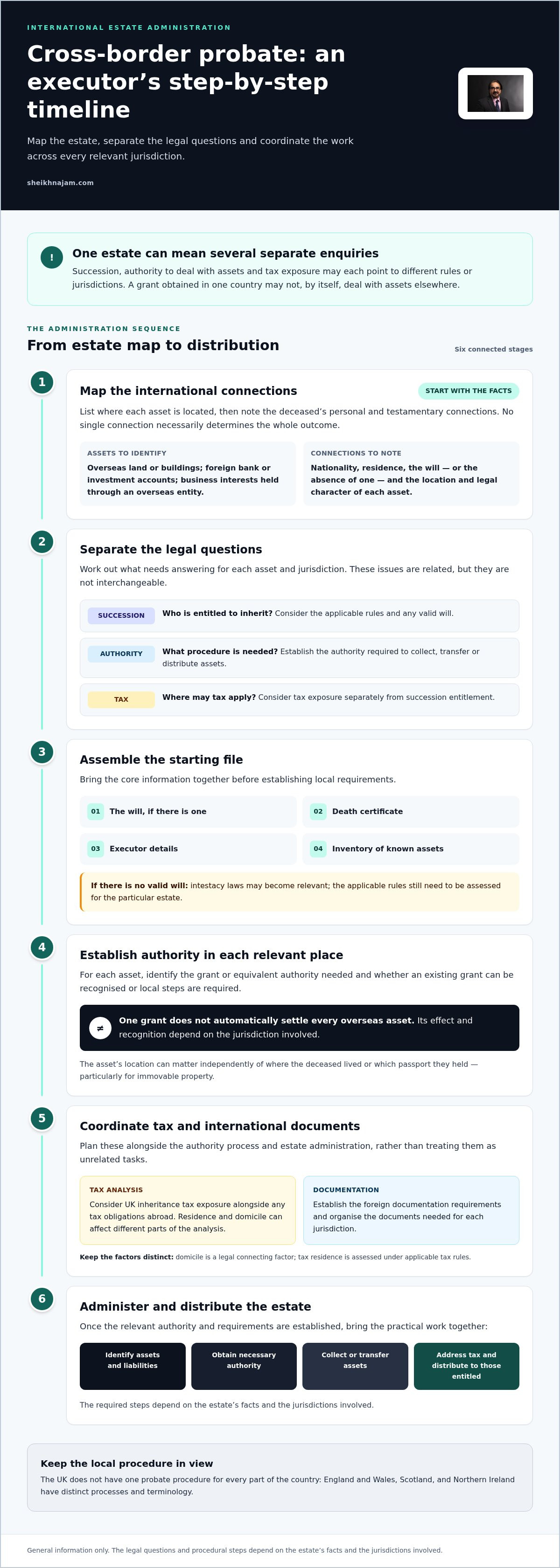
How Should an Executor Organise Cross-Border Probate Step by Step?
Cross-border administration is easier to manage when the executor builds a reliable record before choosing a procedural route. The sequence below is a working framework, not a universal timetable. The order of applications, evidence and tax steps depends on the jurisdictions, assets and authorities involved. Early coordination can expose separate workstreams before they become obstacles.
Assemble the core records. Locate the death certificate, every known will and codicil, the executor’s identity documents, and papers showing who owns each asset. Record where originals are held and whether copies are available.
Build an asset and liability inventory. List property, accounts, investments, business interests, debts and other known obligations. For each, note the country, legal owner and associated institution or authority. Keep uncertain ownership visible rather than treating it as settled.
Map personal and testamentary connections. Record the deceased’s nationality, residence history and relevant family connections, alongside where and when each will was made. These facts may inform different legal enquiries. Keep supporting records and avoid drawing conclusions from one fact alone.
Identify the required authority for each asset. For every item, note which institution or local authority controls its transfer, what grant or recognition procedure may be relevant, and whether a separate application appears necessary. Establish requirements for the specific jurisdiction.
Coordinate tax and documentation work. Establish which valuations, dates and supporting evidence are needed for tax reporting, and identify any translation, certification or authentication requirements. Coordinate these tasks with applications where appropriate, without assuming every jurisdiction follows the same sequence.
Track decisions, dependencies and distribution. Maintain a schedule of applications, outstanding evidence, correspondence and approvals. Distribute assets only once the representative has established the necessary authority and addressed relevant liabilities and entitlement questions.
What information should the executor assemble first?
Start with a document register covering all known wills, death records, asset locations, ownership documents, liabilities and relevant personal connections. Record values and valuation dates with the available evidence, noting the basis and source for each figure. Mark missing records, conflicting versions of a will and uncertain ownership as open enquiries. This focuses further investigation and avoids unsupported assumptions.
How can the executor coordinate applications and administration?
A working schedule should link each asset to its holder, the authority that may be required, and any associated filing, translation, authentication or tax advice. Some tasks may proceed in parallel; others may depend on a grant or document from another jurisdiction. Verify the sequence locally and track progress without assuming a standard completion date.
If disagreement over a will, entitlement or an executor’s proposed action obstructs administration, a separate resolution process may be needed. The estate dispute resolution framework addresses this distinct issue. For support organising probate, tax and international-document questions, see cross-border estate administration.
How Can Specialist Advice Bring Cross-Border Probate Under Control?
International estate administration is not simply a matter of repeating one probate application in several countries. The executor must bring together questions of entitlement, authority, tax treatment and document acceptance, while recognising that each asset and jurisdiction may require a distinct analysis. Specialist advice can organise these workstreams into a coherent strategy tailored to the estate’s assets and legal questions.
For families researching cross-border probate London, the practical value lies in joining the separate enquiries early. A clear picture of the estate can help identify where a grant or local procedure may be needed, which assets raise succession questions, what tax exposure requires assessment, and what evidence foreign institutions may request. This supports informed decisions without assuming that one procedure or answer applies throughout.
What does coordinated advice contribute to an international estate?
Sheikh Najam TEP advises on probate and estate administration, international wills, inheritance tax planning and international tax, alongside notarial services for international legal documentation. Considered together, these services can inform a practical review of the asset map. The executor’s authority and succession questions can be assessed alongside tax issues and document formalities, rather than in isolation.
Identifying issues early can also clarify dependencies. An asset-holder’s evidence requirements may affect which documents should be obtained or authenticated, while tax analysis may depend on reliable valuations and ownership records. A coordinated approach can establish priorities, distinguish settled facts from open questions and organise necessary steps across jurisdictions. It cannot guarantee a particular tax result, recognition decision or timetable; these depend on the estate’s circumstances and applicable rules.
When should beneficiaries or executors seek advice?
Advice may be useful where it is unclear which law governs an asset or entitlement, where property or accounts are held abroad, or where the deceased made wills in more than one jurisdiction. Potential tax exposure in the UK and overseas, difficulty accessing assets, or uncertainty about documents and local authority requirements are also reasons to assess the issues before taking consequential steps.
Where beneficiaries advance competing claims, a will’s validity is disputed, or disagreement about the executor’s actions is holding up administration, the matter may require consideration of contentious probate or dispute-resolution options alongside the estate process. Early assessment can help distinguish a procedural delay from a substantive disagreement, so each can be addressed on its own terms.
Probate, international tax planning, international wills and notarial services can all be considered where relevant, with attention to both legal substance and practical documentation. Discuss your cross-border probate matter.
Give the Estate a Clear Strategic Direction
Turn the information gathered about the estate into a considered plan. Identify unresolved questions, connect each asset to the relevant legal and tax analysis, and sequence the work required to administer it. This early structure can help executors make decisions with a clearer view of dependencies, responsibilities and documentation.
Sheikh Najam TEP brings together probate and estate administration, inheritance tax advice and international tax planning, with notarial services for international legal documentation. These services are relevant where legal authority, tax considerations and foreign document formalities intersect. The appropriate approach depends on the estate and jurisdictions involved.
If you are an executor or beneficiary facing uncertainty over an international estate, contact Sheikh Najam TEP to discuss your estate and plan the next steps.
Frequently Asked Questions
Can an English grant of probate be used to access assets abroad?
Not necessarily. A grant issued in England and Wales may not be accepted by an overseas institution or authority without further steps. A bank may request evidence in a particular format, while a property authority may require a separate local procedure. These requirements concern the executor’s authority to deal with the asset; they do not, by themselves, determine who inherits. Establish the destination jurisdiction’s current requirements before relying on the grant.
Do I need probate for every overseas asset?
No, not in every case. The process may depend on how an asset is owned, its value and structure, and the requirements of the institution holding it. An asset held jointly or subject to a separate contractual arrangement may need a different analysis from an account held solely in the deceased’s name. Record each asset separately, including its location and ownership evidence, rather than assuming one probate requirement applies to the whole estate.
What happens if the deceased left wills in more than one country?
Multiple wills may address different assets or jurisdictions, but their wording and interaction need careful review. Gather all original or available copies, note when and where each was made, and pay particular attention to clauses about revoking earlier wills. A later document does not necessarily revoke every earlier one. Review execution, scope and applicable succession rules before deciding which will governs particular assets.
Can a foreign will be recognised in the UK?
It may be, but recognition depends on the relevant legal rules and the circumstances in which the will was made. The analysis can involve its formal validity, the law applicable to the relevant asset and the UK jurisdiction where it is being relied upon. Preserve the original will and any evidence relating to its signing. An institution or authority handling the estate may also request certified copies or translations.
Does an overseas property automatically fall under the law of the country where it is located?
Not automatically as a complete answer. The property’s location is important, but the analysis may also depend on its ownership, the applicable succession rules and that jurisdiction’s conflict-of-law principles. Tax treatment is a separate question and may not follow the same analysis as inheritance entitlement. Before taking steps to transfer a property, clarify both who may inherit it and what local process applies to the transfer.
Can inheritance tax be due in more than one country on the same estate?
Potentially. An international estate may raise tax questions in the UK and elsewhere, but the outcome depends on the deceased’s circumstances, the assets and the applicable domestic rules. A treaty or unilateral relief may affect how overlapping liabilities are addressed; do not assume it is available. Executors should identify relevant reporting duties and deadlines before distributing assets, so tax questions are considered alongside administration rather than left until the final stage.
Do probate documents need to be translated or apostilled for overseas use?
It depends on the authority or institution receiving them. It may request a certified translation, an apostille, another form of authentication or a certified copy, but these requirements are not universal. Confirm the required format before commissioning translations or certifications, since a document prepared in the wrong form may need to be redone. Where formal authentication is required, notarial services can form part of preparing documents for an international legal matter.



Comments