The Taxation of Offshore Trusts in London: A Strategic Analysis of the Foreign Income and Gains Regime (2026)
- S Najam
- 17 hours ago
- 13 min read

The historical reliance on domicile as the primary arbiter of UK fiscal liability has been decisively superseded by a residence-based paradigm, marking the most profound shift in private client law for a generation. You likely recognise that the transition from the remittance basis to the Foreign Income and Gains (FIG) regime has transformed the taxation of offshore trusts London, creating an environment where traditional structures may now inadvertently invite significant exposure. It's a period of unprecedented transition.
This analysis offers a comprehensive examination of the modernised fiscal landscape, providing the strategic clarity necessary to manage the reclassification of excluded property for Inheritance Tax and the complexities of the Transfer of Assets Abroad code. We'll explore how to align your trust structures with 2026 legislation, utilising the Temporary Repatriation Facility and the four-year FIG relief to safeguard global assets. By the conclusion of this study, you'll possess a precise understanding of your current liabilities and the multi-disciplinary expertise required to maintain absolute UK compliance whilst ensuring robust asset protection.
Table of Contents
The Evolution of the Taxation of Offshore Trusts in London
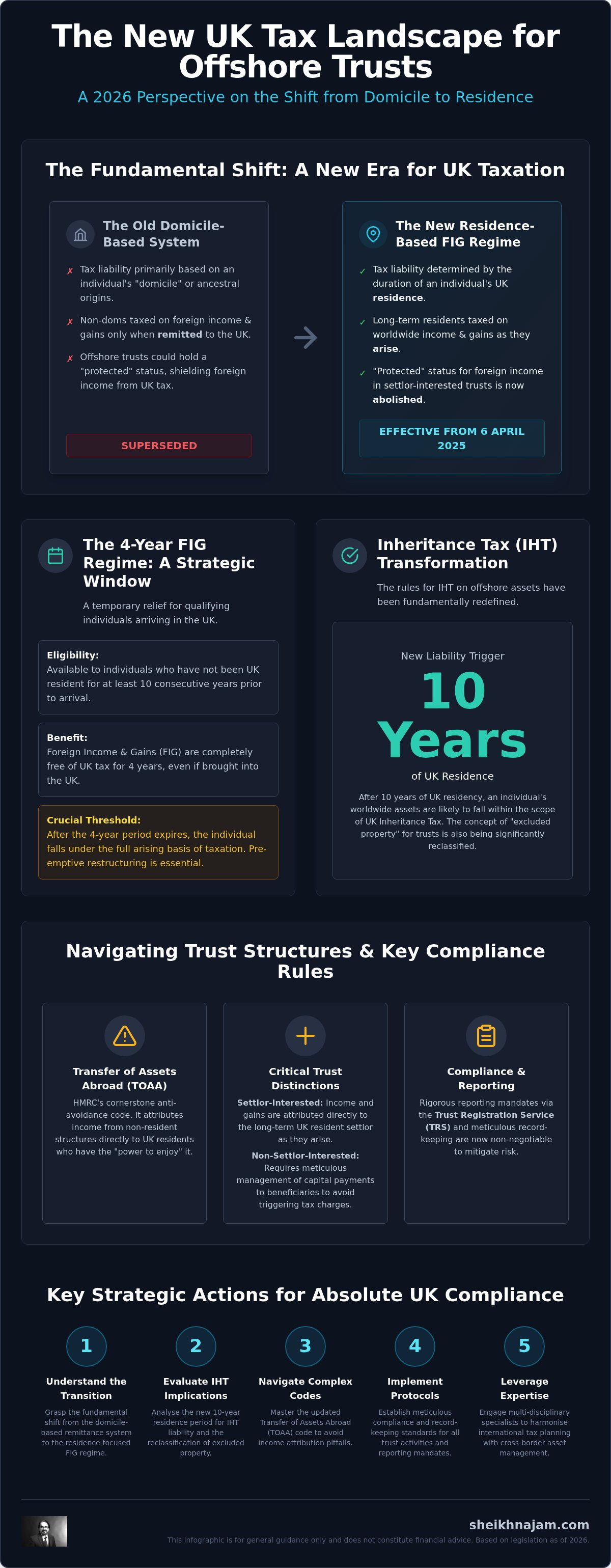
The legislative architecture surrounding the taxation of offshore trusts London has undergone a fundamental metamorphosis, moving from the historically established remittance basis to the modernised Foreign Income and Gains (FIG) regime. This transition, which commenced on 6 April 2025, has reached a new "steady state" in the 2026 fiscal year, where the previous ambiguities of the changeover have been replaced by a residence-based certainty. For high-net-worth individuals, the reliance on domicile as a shield against UK fiscal reach is no longer a viable strategy, as the UK taxation system now prioritises the duration of an individual's residence over their ancestral origins. It's a profound shift that demands a total recalibration of how international wealth is structured and maintained within the City.
A critical distinction in this new era lies between settlor-interested and non-settlor-interested trusts, a divide that dictates the immediate taxability of income at the settlor level. Under the 2026 rules, if a settlor is a long-term UK resident and retains an interest in the trust, the previous "protected" status for foreign income has been entirely abolished. This means that income and gains arising within the trust are often attributed directly to the settlor as they arise, regardless of whether the funds are brought into the UK. Conversely, non-settlor-interested trusts require meticulous management of capital payments to beneficiaries to avoid the matching of accumulated income, which can trigger significant tax charges and interest supplements.
The FIG Regime: A 2026 Perspective
The FIG regime provides a specific four-year window of relief for qualifying individuals who haven't been UK resident for at least ten consecutive years prior to their arrival. During this period, foreign income and gains arising within an offshore trust can be received entirely free of UK tax, even if those funds are enjoyed within the UK. This relief is a strategic tool for internationally mobile individuals who choose London as their centre of interests, but it's a temporary haven. Once the four-year threshold is crossed, the individual typically falls into the full arising basis of taxation, necessitating a pre-emptive restructure of assets before this exemption expires.
London as a Global Trust Nexus
Despite the tightening of fiscal rules, London remains the definitive nexus for international trust administration due to the stability of English law and the concentration of elite advisory expertise. The strategic integration of double taxation treaties London into trust frameworks is essential for mitigating the risk of dual liability across multiple jurisdictions. Trustees must now operate with a higher degree of transparency and precision, ensuring that every notarial act and fiduciary decision is documented to withstand the scrutiny of a residence-based tax authority. The City's infrastructure provides the necessary security for these complex compliance requirements, provided they're handled with multidisciplinary foresight.
The Mechanics of Income and Capital Gains Taxation
The technical architecture governing the taxation of offshore trusts London has evolved into a sophisticated web of attribution rules designed to ensure that fiscal liability remains tethered to the UK resident individual. Whilst the four-year FIG relief offers a temporary reprieve for new arrivals, the long-term management of trust assets necessitates a profound understanding of how income and gains are matched and taxed. It's no longer sufficient to rely on the mere separation of legal and beneficial ownership; the modern practitioner must instead dissect the underlying mechanics of the settlement to identify latent exposures before they crystallise into significant liabilities.
The Transfer of Assets Abroad (TOAA) Code
The TOAA provisions remain the cornerstone of HMRC’s anti-avoidance strategy, functioning to attribute the income of non-resident structures directly to UK resident individuals who have the "power to enjoy" such income. The rigour of these anti-avoidance rules for offshore trusts ensures that any transfer designed to circumvent UK liability is scrutinised through the lens of the commercial purpose test, requiring taxpayers to prove that the avoidance of taxation was not a primary objective. The TOAA code effectively nullifies the fiscal distance between a London settlor and their offshore vehicle by treating the underlying income as having arisen directly to the individual, absent a robust commercial defence. In 2026, this attribution extends with renewed precision to underlying corporate layers, where the income of non-UK companies held within the trust is often deemed trust income, stripping away the historical benefits of corporate "wrappers."
Capital Gains and the Matching Principle
For non-settlor-interested trusts, the matching principle dictates the fiscal consequences of capital distributions. Capital payments or benefits received by a UK resident beneficiary are matched against the trust’s accumulated foreign income and sections 1(2) and 2(2) gains in a strict chronological order. If a distribution is matched against historic gains, the beneficiary faces a capital gains tax charge, which may be increased by a supplementary charge of 10% for each year the gain was retained within the trust, capped at a maximum of 60%. It's a punitive mechanism designed to discourage the long-term deferral of tax.
The Temporary Repatriation Facility (TRF) provides a strategic window for former remittance basis users to address these historic pools. During the 2026-27 tax year, qualifying individuals can bring previously unremitted foreign income and gains into the UK at a reduced rate of 12%, offering a final opportunity to rationalise offshore holdings before the higher 15% rate takes effect in 2027. A meticulous review of existing deeds is often the first step in sophisticated International Tax Planning to prevent the "settlor-interested" trap, where a settlor’s potential to benefit from the trust triggers immediate taxation on all arising income, regardless of actual distribution.
Inheritance Tax and the Reclassification of Excluded Property
The jurisprudential shift from domicile to residence as the primary nexus for Inheritance Tax (IHT) liability represents a watershed moment for the taxation of offshore trusts London. Under the 2026 protocols, the historical "excluded property" status of non-UK situs assets is no longer a perpetual shield; instead, it's contingent upon the settlor’s status as a long-term resident. An individual who has been UK resident for at least 10 of the preceding 20 tax years now brings the entirety of their worldwide trust assets within the scope of the UK IHT regime. This exposure persists even after departure, as the legislation imposes a 10-year "tail," ensuring that individuals remain within the UK's fiscal reach for a decade after they've ceased to be resident. These 2025 offshore trust tax changes necessitate a rigorous audit of trust deeds to identify potential Gift with Reservation of Benefit (GWROB) exposures, where a settlor’s continued access to trust capital can lead to the entire fund being treated as part of their death estate.
The 10-Year Anniversary and Exit Charges
Offshore trusts settled by long-term residents are now integrated into the relevant property regime, subjecting them to periodic charges every ten years and exit charges when capital is distributed. The periodic charge, calculated at a maximum rate of 6% of the trust's value above the £325,000 nil-rate band, requires trustees to maintain high levels of liquidity to meet these liabilities without forced asset liquidations. Meticulous valuation of non-UK assets, including private company shares and international real estate, is paramount to ensure compliance and avoid punitive underpayment penalties. Trustees must implement disciplined fiscal forecasting to account for these decennial outlays, which can significantly erode the trust’s capital base if not managed with strategic foresight.
Protected Settlements vs. Modern Realities
The concept of "protected settlements" has been fundamentally undermined in the 2026 fiscal environment. While trusts established prior to April 2025 initially benefited from certain grandfathering provisions, the risk of "tainting" these structures is an ever-present danger. Adding property to a pre-2025 trust, or even providing certain types of non-commercial loans to it, can strip away its protected status, immediately exposing the structure to the modern residence-based rules. One must consult the residence and domicile rules London to determine the precise moment a settlor transitions into the long-term resident category. Forfeiting protected status often triggers an immediate entry charge of 20% on the value of assets exceeding the nil-rate band, making the preservation of a trust's original character a high-stakes administrative priority.
Strategic Management and Compliance Protocols
The administrative burden associated with the taxation of offshore trusts London has escalated to a level where meticulous record-keeping is no longer merely a best practice but a fundamental requirement for legal survival. In the 2026 fiscal environment, trustees must maintain an exhaustive audit trail that distinguishes between historic capital, accumulated income, and current gains to ensure accurate reporting under the FIG regime. Failure to provide such granularity during a self-assessment or an HMRC enquiry can lead to the presumptive matching of distributions against the most tax-heavy pools, significantly eroding trust capital. Central to this compliance framework is the Trust Registration Service (TRS), which mandates that almost all offshore trusts with UK connections provide detailed beneficial ownership information, ensuring a level of transparency that was previously non-existent.
Managing the transition for individuals moving from the non-dom income tax London framework requires a multi-disciplinary approach that integrates tax advisory with robust financial crime and compliance protocols. As the UK aligns more closely with global Anti-Money Laundering (AML) standards, the intersection of fiduciary duty and regulatory oversight becomes increasingly complex. High-net-worth individuals require a Master Advisor capable of overseeing these layered requirements, ensuring that every asset restructure is compliant with both domestic legislation and international transparency mandates. To ensure your structures withstand such rigorous scrutiny, it's prudent to engage in professional Financial Crime & Compliance Advisory to safeguard against inadvertent non-compliance.
Fiduciary Duty and Liability Management
The responsibilities of trustees have expanded significantly under the FIG regime, as they now bear the burden of navigating residence-based liabilities that can shift based on a settlor’s or beneficiary’s movements. Mitigating personal liability in this volatile landscape necessitates the acquisition of professional indemnity insurance and the constant procurement of specialist legal advice to justify fiduciary decisions. We're seeing an increase in trust disputes where beneficiaries challenge trustees over perceived mismanagement of tax liabilities, particularly when the loss of protected status results in unforeseen entry or periodic charges. Rigorous documentation of the rationale behind every distribution and investment choice is the only effective defence against such contentious probate or trust litigation.
International Information Exchange (CRS and FATCA)
The Common Reporting Standard (CRS) and FATCA have effectively ended the era of offshore opacity, creating a global environment of automatic information exchange that HMRC utilises with increasing sophistication. Whilst legitimate asset protection remains a cornerstone of international wealth management, it must now coexist with absolute transparency regarding the tax residence of all reportable persons. The integration of international notarial authentication into these compliance protocols is vital, as it provides the necessary legal weight to documents moving across borders. Ensuring that trust instruments are not only tax-efficient but also notarially sound is essential for maintaining the integrity of the structure in the eyes of both UK and foreign authorities.
Sheikh Najam TEP: Integrated Advisory for Offshore Trusts
The complexities inherent in the taxation of offshore trusts London necessitate a level of strategic oversight that transcends mere fiscal calculation; it requires the intersection of academic rigor and practical notarial authority. Sheikh Najam, as a Public Officer appointed by The Court of Faculties, provides the Scrivener-level precision required to manage the City’s elite legal landscape. This multidisciplinary expertise is vital for high-net-worth individuals whose affairs span multiple jurisdictions, where the failure to harmonise notarial acts with tax strategy can lead to catastrophic administrative failures. By operating at the nexus of International Tax Planning and Trust and Estate Planning, the Master Advisor ensures that every structural recalibration for the 2026 FIG regime is underpinned by absolute legal validity.
In the event of Trust Disputes or Contentious Probate, the deployment of Mediation and Arbitration offers a sophisticated alternative to public litigation, preserving the confidentiality of the settlement whilst resolving intricate cross-border conflicts with surgical precision. These disputes often arise from the subtle misinterpretation of modern residence rules or the "tainting" of protected settlements discussed earlier. Addressing these conflicts requires a practitioner who understands the historical weight of trust law as well as the sharp, strategic focus required for high-stakes negotiation. Furthermore, the crafting of International Wills is essential to complement offshore structures, ensuring that the devolution of assets is harmonised across jurisdictions to prevent conflicting probate requirements that could otherwise trigger unforeseen tax charges.
Notarial Services for International Trusts
The authentication of international trust documents is a critical component of cross-border transactions, where the Notary Public must verify the integrity of complex global investment structures for international regulatory bodies. This includes the authentication of powers of attorney and trust deeds destined for foreign jurisdictions, ensuring that these instruments meet the "fit and proper" compliance standards of global financial centres. In an era of heightened transparency, the role of the Notary in verifying the identity and authority of trustees is a fundamental safeguard against financial crime. Meticulous documentation serves as the primary defence in international trust management, providing a layer of security that simple legal advice cannot match.
Wealth Preservation through Meticulous Structuring
Tailoring trust instruments to the specific needs of HNWIs in the City of London requires a commitment to strategic precision that accounts for the 10-year IHT tail and the nuances of the FIG exemption window. Every trust deed must be a bespoke instrument, reflecting the unique centre of interests of the settlor whilst maintaining flexibility for future legislative shifts. This level of estate planning is rooted in institutional weight and a deep understanding of how digital asset structuring and traditional wealth preservation intersect. For those seeking a bespoke analysis of their current holdings, it's advisable to consult with a private client solicitor London to ensure that your global assets remain protected within a compliant, tax-efficient framework.
Securing Wealth in the Residence-Based Era
The transition to the FIG regime necessitates a decisive departure from historical domicile-based strategies. The fiscal landscape of 2026 demands a precise alignment of offshore structures with the updated TOAA code and residence-based IHT rules. Success in this environment depends on the meticulous documentation of trust assets and the strategic use of the Temporary Repatriation Facility to rationalise historic gains. Navigating the taxation of offshore trusts London requires a multi-disciplinary perspective that harmonises complex tax law with authoritative notarial acts.
As a Member of the Society of Trust and Estate Practitioners (TEP) and a Public Officer appointed by The Court of Faculties, Sheikh Najam provides the institutional weight required to manage high-value contentious probate and international wills. You're invited to instruct Sheikh Najam TEP for specialised offshore trust advisory and international tax planning to ensure your global interests remain both compliant and secure. With the right command over these intricate legal landscapes, your legacy remains protected. It's time to move forward with absolute precision.
Frequently Asked Questions
Is an offshore trust still tax-efficient for a UK resident in 2026?
Tax efficiency in 2026 has shifted from the historical deferral of liabilities to a focus on asset protection and the strategic utilisation of specific relief windows. For individuals within their first four years of UK residence, the FIG regime offers a highly potent exemption on foreign income and gains. However, for long-term residents, the abolition of protected status means that efficiency now depends on meticulous compliance and the precise alignment of trust structures with the new residence-based paradigms.
How does the FIG regime affect income arising within an offshore trust?
The FIG regime imposes an arising basis of taxation on foreign income and gains for individuals who don't qualify for the initial four-year exemption. Historically, "protected" settlements shielded such income from UK tax until it was distributed or remitted to the UK. In the current fiscal year, this income is typically attributed directly to the settlor if they're a long-term UK resident. This fundamental shift necessitates a comprehensive review of the taxation of offshore trusts London to identify latent liabilities.
What is the Temporary Repatriation Facility (TRF) and can I still use it?
The TRF is a transitional mechanism allowing former remittance basis users to bring historic foreign income and gains into the UK at a reduced tax rate. For the 2026-27 tax year, the applicable rate remains at 12%, which is scheduled to increase to 15% for the 2027-28 period. It remains a vital tool for rationalising offshore structures and addressing accumulated pools of income that would otherwise face significantly higher arising-basis charges or matched distribution taxes.
Will my offshore trust be subject to UK Inheritance Tax (IHT)?
Liability for UK IHT now depends on the settlor's residence status rather than their ancestral domicile. If the settlor has been a UK resident for at least 10 of the last 20 tax years, the trust’s worldwide assets fall within the scope of the UK relevant property regime. This includes decennial periodic charges of up to 6% and exit charges upon distribution, alongside a 10-year "tail" of liability that persists even after the settlor departs from the UK.
Do I need to register my offshore trust with the UK Trust Registration Service (TRS)?
Registration is mandatory for most offshore trusts that maintain a UK connection, such as UK resident trustees, the acquisition of UK situs assets, or an ongoing business relationship with a UK professional. Compliance with the TRS is a critical regulatory requirement that ensures transparency regarding beneficial ownership. Failure to register or maintain accurate records can result in significant financial penalties and heightened scrutiny from HMRC’s specialised compliance divisions, potentially jeopardising the trust's standing.
What happens if I receive a distribution from an offshore trust whilst resident in London?
Distributions are matched against the trust's accumulated income and gains in a specific chronological order, often triggering immediate UK tax charges for the recipient. For capital gains, a supplementary charge of up to 60% may apply if the gains have been retained within the trust over several years. Meticulous record-keeping is essential to ensure that distributions are matched against the most tax-efficient pools available under the current taxation of offshore trusts London protocols.
How does the 10-year residency rule affect my trust’s excluded property status?
The 10-year residency rule serves as the definitive threshold for transitioning from "excluded property" status to full IHT exposure for non-UK assets. Once a settlor meets the "long-term resident" criteria, which is defined as being resident for 10 out of the 20 preceding years, the trust's global assets are no longer excluded from the UK IHT net. This shift represents a permanent change in the trust’s fiscal character, requiring trustees to implement robust liquidity management strategies.
Can Sheikh Najam TEP assist with the notarial authentication of offshore trust deeds?
Sheikh Najam provides specialised notarial services and integrated legal advisory for the authentication of trust instruments destined for international jurisdictions. As a Public Officer and TEP member, he ensures that trust deeds, powers of attorney, and corporate resolutions meet the rigorous standards required by foreign regulatory bodies and financial institutions. This multidisciplinary approach harmonises notarial precision with strategic tax planning, ensuring that complex global structures remain both legally valid and fiscally compliant in the 2026 landscape.


Comments