Statutory Residence and Domicile Rules in London: A Strategic Fiscal Checklist for 2026

Updated: Aug 26
By April 2026, the historical concept of domicile will effectively cease to be the primary arbiter of UK tax liability, rendering decades of established wealth structuring obsolete for the international elite. You’ve likely recognised that the transition from the remittance basis to the Foreign Income and Gains (FIG) regime represents the most significant upheaval in private client taxation for a generation, creating profound uncertainty for those with complex global footprints. This authoritative guide provides the strategic framework required to master the residence and domicile rules London now demands, ensuring your global assets remain protected whilst maintaining absolute regulatory compliance. We shall examine the intricate mechanics of the Statutory Residence Test, the critical four-year FIG transition period, and the precise evidentiary standards required to document your fiscal position with the meticulousness that the current regulatory environment necessitates.
Table of Contents
The Evolution of UK Fiscal Jurisdiction: Domicile vs Residence in 2026
The Statutory Residence Test: A Technical Framework for London HNWIs
Navigating the FIG Regime: Strategic Departure from the Remittance Basis
The HNWI Residence Audit: A Comprehensive Checklist for Compliance
Wealth Preservation Strategies under the New Residency-Based Framework
The Evolution of UK Fiscal Jurisdiction: Domicile vs Residence in 2026
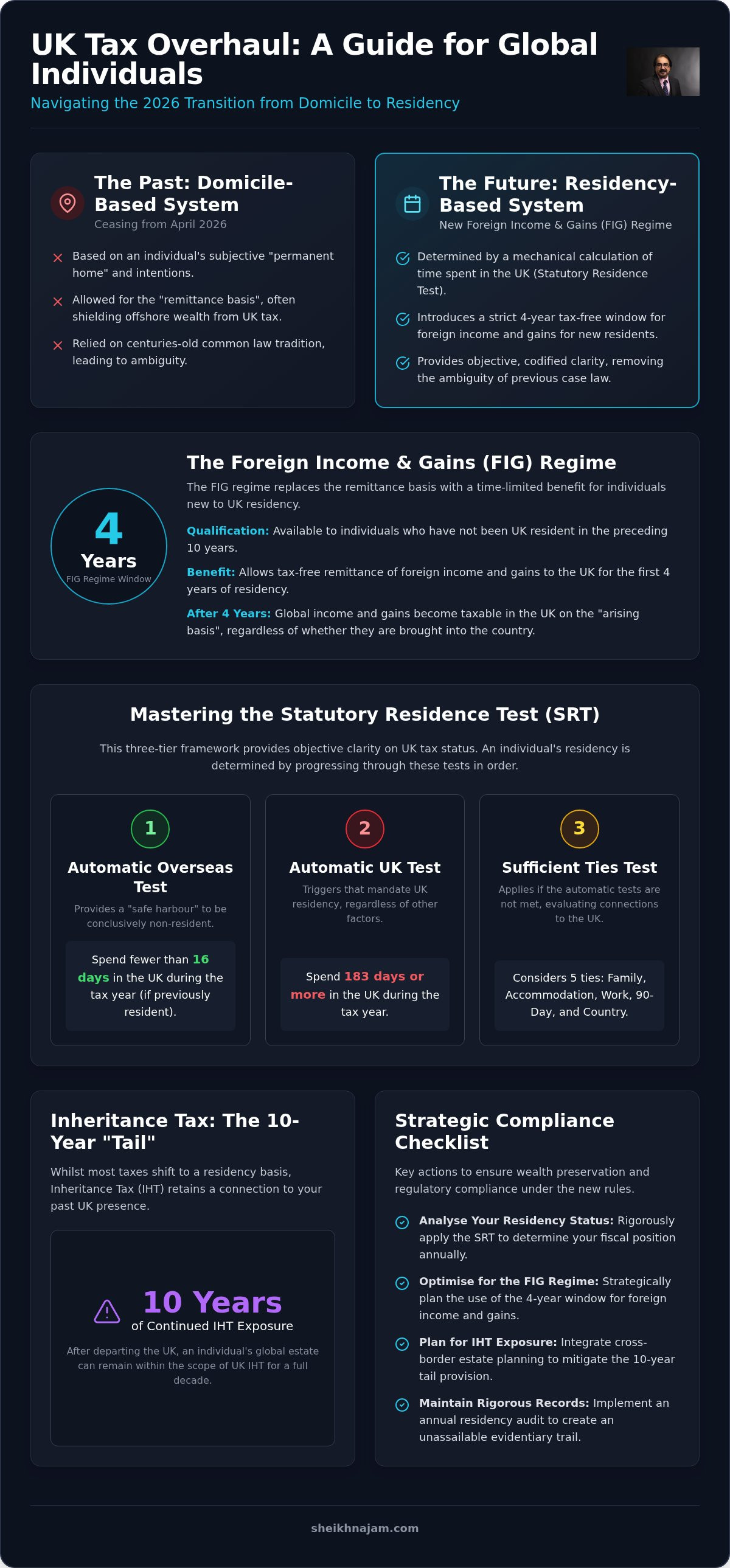
The 6 April 2025 transition marked a terminal point for the historical non-domiciled regime, replacing a centuries-old common law tradition with a codified, duration-centric model that demands a new level of strategic foresight. Under the updated residence and domicile rules London now applies, the focus has shifted from an individual’s subjective intention to a mechanical calculation of time spent within the jurisdiction, necessitating a rigorous re-evaluation of global wealth structures. Domicile once functioned as a permanent jurisdictional anchor, often shielding offshore wealth from the UK tax net; however, residency now acts as the primary fiscal metric, whilst the new FIG (Foreign Income and Gains) regime has effectively retired the "non-dom" label in professional and regulatory discourse.
The Residual Impact of Domicile on Inheritance Tax
Whilst income and capital gains tax have transitioned to a residency basis, inheritance tax (IHT) maintains a lingering connection to the concept of domicile through a ten-year "tail" provision that affects those departing the jurisdiction. Individuals who exit the UK may find their global estates remain within the scope of IHT for a decade, a reality that necessitates a sophisticated approach to international wills London practitioners must carefully structure to mitigate multi-jurisdictional exposure. The evolution from "deemed domicile" to a residency-duration test means that estate planning is no longer a static exercise but a dynamic process that accounts for a rolling ten-year window of liability. It’s essential to recognise that even after physical departure, the shadow of UK fiscal jurisdiction remains a factor for the better part of a decade.
The Rise of the Residency-Based FIG Regime
The FIG regime introduces a precise four-year window of tax-free foreign income and gains for qualifying individuals, provided they haven't been UK resident in the preceding ten years. This represents a significant departure for those who previously relied on the remittance basis, as all foreign income falls under the arising basis of taxation once this initial period expires. For many, this shift demands the robust international tax planning for business owners London advisers facilitate, particularly when managing complex revenue streams that were formerly shielded. The transition requires a meticulous audit of offshore holding structures to ensure they remain compliant under the new duration-based criteria, as the luxury of the remittance election is no longer an available shield for long-term residents.
The Statutory Residence Test: A Technical Framework for London HNWIs
The Statutory Residence Test is the definitive legislative mechanism introduced in 2013 to provide objective clarity on UK tax status. For those navigating the residence and domicile rules London enforces, this three-tier framework removes the ambiguity of previous case law, replacing it with a rigorous mathematical and qualitative assessment. The first tier, the Automatic Overseas Test, provides a safe harbour for those seeking to maintain non-resident status, provided they spend fewer than 16 days in the UK if they were resident in any of the three preceding years. Conversely, the Automatic UK Test identifies non-negotiable triggers, such as spending 183 days or more in the country during a single tax year, which mandate residency regardless of the individual’s long-term intentions or global connections. This binary approach ensures that residency is no longer a matter of interpretation but a matter of documented fact.
Navigating the Sufficient Ties Test
When an individual doesn't meet the criteria of the automatic tests, the Sufficient Ties Test becomes the decisive factor in determining fiscal liability. This tier evaluates five specific connections: family ties, accommodation ties, work ties, the 90-day tie, and, for departing residents, the country tie. The number of ties required to trigger residency fluctuates based on the individual’s previous three years of UK residency, creating a sliding scale of risk that demands constant monitoring. For high-net-worth individuals maintaining substantial property portfolios, managing an "accommodation tie" in Central London requires meticulous planning, as even a secondary residence available for 91 days or more can inadvertently strengthen the jurisdictional link. It’s vital to understand that "availability" doesn't require actual occupation; the mere right to occupy a property for a continuous period of 16 days or more can trigger this specific tie, making expert international tax planning a prerequisite for global mobility.
The 183-Day Rule and Mid-Year Arrivals
The calculation of residency days relies on the "midnight presence" rule, where any day in which an individual is in the UK at the end of the day is counted, subject to specific split-year treatment for those relocating mid-tax year. Exceptional circumstances, such as unforeseen transit delays or urgent medical emergencies, may permit up to 60 days to be excluded from the count, though these claims require robust evidentiary support to satisfy HMRC. Engaging a private client solicitor London is often essential to ensure that such nuances are documented contemporaneously to withstand future scrutiny. For those with multi-jurisdictional assets, every day spent in the capital must be strategically accounted for within the broader fiscal framework to avoid the inadvertent triggering of a worldwide tax liability.
Navigating the FIG Regime: Strategic Departure from the Remittance Basis
The implementation of the Foreign Income and Gains (FIG) regime on 6 April 2025 represents a seismic shift in how the residence and domicile rules London enforces are applied to global wealth. For the first four years of UK residency, qualifying individuals may enjoy a tax-free window on foreign income and gains, provided they've not been resident in the UK for the preceding ten tax years. This duration-based incentive replaces the complex remittance basis, effectively removing the annual remittance charge—previously set at £30,000 or £60,000—and simplifying the fiscal landscape for new arrivals. However, once this four-year period expires, the transition to the arising basis is absolute, requiring a sophisticated analysis of double taxation treaties London practitioners utilise to prevent the erosion of international capital. The strategic cost-benefit analysis has changed; the focus is no longer on managing the movement of funds into the UK, but on the structural optimisation of the assets themselves before the four-year threshold is crossed.
Protecting Offshore Trust Income
The new framework fundamentally alters the protections previously afforded to excluded property trusts, particularly where the settlor becomes a long-term UK resident. As the 2025/26 rules take effect, assets held within these structures may no longer enjoy the same IHT exemptions if the settlor meets the residency-duration criteria, necessitating the strategic decanting or variation of trust deeds to align with the new residency-based IHT framework. Failure to proactively manage this transition can lead to significant fiscal leakage and potential breach of trust litigation London courts may oversee if fiduciaries fail to adapt to the changing legislative environment. Precise legal intervention is required to ensure that trust administration remains compliant whilst protecting the underlying interests of the beneficiaries.
Capital Gains Tax and Rebasing
For individuals who were previously non-domiciled, the 2025 rebasing rules provide a vital opportunity to reset the base cost of certain foreign assets to their market value as of 5 April 2025. This rebasing isn't automatic; it requires meticulous professional valuation and, frequently, notarial authentication to satisfy HMRC's evidentiary requirements for international asset holdings. One must also remain vigilant regarding "Temporary Non-Residency" traps, where individuals departing the UK for fewer than five full tax years may find themselves liable for capital gains realised during their absence upon their return to London. The intersection of these rules demands a methodical approach to documentation, ensuring that every valuation and jurisdictional shift is recorded with absolute precision.
The HNWI Residence Audit: A Comprehensive Checklist for Compliance
Establishing a robust evidentiary trail through contemporaneous documentation is the cornerstone of a successful residency defence in the current climate of heightened HMRC scrutiny. The burden of proof for non-residency rests entirely with the taxpayer, necessitating meticulous record-keeping that transcends mere anecdotal accounts of travel. For the sophisticated global citizen, a proactive annual residency audit isn't merely a compliance exercise but a strategic necessity to ensure that the residence and domicile rules London enforces are navigated with absolute precision. This process often involves coordinating with a notary public central London practitioners rely upon to authenticate cross-border presence and formalise jurisdictional declarations that may be required by foreign tax authorities.
Step 1: The Quantitative Audit (Days and Dates)
The foundation of any audit is the maintenance of a "Day Count Diary" that is rigorously cross-referenced with flight manifests, hotel receipts, and digital location data. It's imperative to audit "midnight presence" against both the 183-day threshold and the specific criteria of the Automatic Overseas Tests to avoid inadvertent residency. You must also review travel patterns to ensure there's no breach of the "Country Tie," which occurs if you spend more days in the UK than in any other single country during the tax year. Precision here is paramount; a single day's discrepancy can shift your entire fiscal status and trigger worldwide reporting requirements.
Step 2: The Qualitative Audit (Ties and Intent)
Beyond the calendar, the Sufficient Ties Test requires a qualitative assessment of your physical and social connections to the capital. You must determine if any London residential property is considered a "home" available for 91 days or more, regardless of whether you actually occupy it. Employment contracts should be audited to ensure they don't constitute "substantive work in the UK," which is defined as three hours or more of work per day. Additionally, family ties must be assessed, particularly if minor children or a spouse are resident in the UK for educational or business purposes, as these connections significantly reduce the number of permitted days before residency is triggered.
Step 3: Asset and Trust Review
The final pillar involves examining the source of funds used for UK expenditures to ensure compliance with the London non-dom tax transition rules. This includes verifying the "Excluded Property" status of offshore assets under the updated residency-duration tests for inheritance tax. It's also essential to document the "motive test" for any offshore corporate structures to mitigate the impact of Anti-Avoidance legislation. To secure your global interests against these evolving complexities, we recommend engaging in expert international tax planning to formalise your compliance protocol and ensure your wealth remains protected.
Wealth Preservation Strategies under the New Residency-Based Framework
The transition toward a residency-based fiscal jurisdiction necessitates a synthesis of the Statutory Residence Test with broader, long-term estate preservation objectives. Moving beyond reactive compliance requires a sophisticated understanding of how physical presence dictates the exposure of global capital, particularly as the residence and domicile rules London enforces continue to evolve in complexity. The role of the Strategic Polymath is essential in this environment, as managing the multi-jurisdictional intersection of tax, trust, and notarial law demands a level of precision that transcends traditional legal advisory. It’s no longer sufficient to merely track days; one must proactively manage the jurisdictional narrative to prevent future conflicts, particularly regarding contentious probate London courts may adjudicate when residency-related estate disputes arise amongst international heirs.
Digital Assets and Residency
Determining the "situs" of cryptocurrency and digital assets remains a critical challenge under the 2026 residency-based taxation framework. HMRC’s protocols increasingly lean toward the residency of the beneficial owner as the primary determinant for capital gains and inheritance tax liability, making the structuring of digital wealth within international trusts a vital defensive measure. To align with London residency rules, high-value digital asset portfolios must be documented with the same academic rigour as traditional holdings, ensuring that fiduciary control and private key management don't inadvertently trigger a UK tax nexus. Proactive jurisdictional management of these assets is required to ensure that the decentralised nature of the holdings isn't misconstrued as a UK-based interest during a residency audit.
Engaging Professional Notarial and Legal Oversight
Establishing a "permanent home" status in a foreign jurisdiction often requires the issuance of notarial certificates that provide unassailable proof of non-residency to UK authorities. These authenticated documents serve as a primary shield during a residency investigation, formalising your status with a level of authority that simple travel logs cannot provide. A TEP-qualified advisor brings the necessary expertise to oversee complex estate administration London mandates, ensuring that every strategic decision is supported by both deep academic theory and practical, high-stakes experience. The goal is to move from a position of uncertainty to one of absolute command over your global fiscal footprint. To secure your financial legacy and ensure your wealth structures remain resilient against legislative shifts, you should consult with Sheikh Najam TEP for a bespoke residency and domicile strategy audit tailored to your unique international profile.
Command Your Global Fiscal Position for 2026 and Beyond
The shift toward a residency-based tax regime demands a fundamental recalibration of how international wealth is structured. The transition to the residence and domicile rules London now enforces requires a movement from subjective intention to objective, duration-centric compliance. Success in this new era hinges on the meticulous application of the Statutory Residence Test and the proactive management of the FIG transition period. By implementing a rigorous annual audit and securing notarial authentication for cross-border declarations, you'll ensure your estate remains resilient against jurisdictional challenges. The burden of proof is yours. As a TEP Qualified Private Client Solicitor specialising in cross-border wealth and contentious probate, Sheikh Najam provides the London-based expertise and global jurisdictional reach necessary to govern these intricate legal landscapes with absolute precision. Secure your global estate with a strategic residency audit by Sheikh Najam TEP to move from reactive compliance to a position of strategic command. Your legacy deserves the security that only multi-disciplinary academic rigour and seasoned practitioner experience can provide.
Frequently Asked Questions
How is UK tax residency determined under the Statutory Residence Test?
It is determined through a sequential three-tier hierarchical assessment comprising the Automatic Overseas Tests, the Automatic UK Tests, and the Sufficient Ties Test. If an individual meets any of the Automatic Overseas Tests, they're non-resident; if they meet any Automatic UK Tests, they're resident. Should neither apply, the Sufficient Ties Test evaluates the strength of their connection to the jurisdiction relative to the duration of their physical presence during the tax year.
What are the sufficient ties for UK tax residency in London?
The five identified connections are the family tie, the accommodation tie, the work tie, the 90-day tie, and the country tie. For high-net-worth individuals, the accommodation tie is particularly sensitive, as having a property available for at least 91 days can trigger residency when combined with other factors. These ties are weighted against the number of days spent in the UK, with the threshold for residency decreasing as the number of ties increases.
Does the 183-day rule apply to all international residents in London?
Yes, the 183-day threshold remains the primary "Automatic UK Test" that mandates residency for any individual, regardless of their global status or intentions. However, it's a common misconception that staying below this limit guarantees non-residency. The limit isn't a guarantee. Many individuals fall within the UK tax net well before reaching 183 days if they possess multiple connections under the Sufficient Ties Test, making the rule a ceiling rather than a safe harbour.
What happens to my non-dom status after the April 2025 changes?
The historical non-domiciled regime will effectively cease to exist, replaced by a duration-based framework that prioritises residency over common law domicile. From 6 April 2025, the residence and domicile rules London historically utilised have transitioned to the Foreign Income and Gains (FIG) regime. This means that after four years of UK residency, your worldwide income and gains will be subject to UK taxation on the arising basis, regardless of your long-term jurisdictional intentions.
Can I be a UK resident for tax purposes but domiciled elsewhere?
Whilst you can still maintain a common law domicile of origin outside the UK, its relevance for income and capital gains tax has been largely superseded by residency status. Under the 2026 framework, your fiscal liability is determined by the duration of your UK presence rather than your subjective domicile. However, domicile remains a critical factor for inheritance tax during the ten-year "tail" period following departure, necessitating continued strategic oversight of your global estate.
How does the 4-year FIG regime differ from the old remittance basis?
The FIG regime provides a total exemption from UK tax on foreign income and gains for the first four years of residency, provided you haven't been resident in the previous ten years. Unlike the remittance basis, there's no requirement to keep funds offshore; you may bring these assets into the UK without triggering a tax charge. It removes the annual remittance basis charge but imposes a strict four-year limit before worldwide taxation applies automatically.
What is the "tail" rule for UK Inheritance Tax after leaving London?
The "tail" rule is a ten-year provision that keeps an individual’s worldwide estate within the scope of UK inheritance tax (IHT) for a decade after they cease to be resident. This residency-based IHT test replaces the old "deemed domicile" rules, creating a lingering fiscal obligation that requires long-term planning. It ensures that departing residents cannot immediately escape the UK IHT net, making the timing of asset disposals and trust variations a matter of high strategic importance.
How should I document my days spent outside the UK for HMRC compliance?
You must maintain a contemporaneous evidentiary trail that includes flight manifests, boarding passes, and hotel invoices to substantiate your physical location at midnight each day. Under the residence and domicile rules London enforces, the burden of proof rests entirely with the taxpayer. It's your responsibility. Utilising digital logs cross-referenced with notarial certificates for significant jurisdictional declarations provides the academic rigour required to satisfy HMRC's evidentiary standards and protect your global wealth.


Comments