Trust Dispute Resolution: Comparing the Routes to a Practical Outcome

The route that appears most decisive is not always the one most likely to produce a workable outcome. In trust dispute resolution, the right next step depends on the evidence, governing documents, parties’ willingness to engage and the urgency of the issue. Privacy concerns and the practical consequences of any proposed outcome also matter.
It is understandable to question whether dialogue can work when confidence has broken down, or whether delay and publicity could deepen a dispute. Negotiation, mediation, arbitration and litigation each serve different purposes. None is automatically suitable: they differ in the control parties retain, the process involved and how an outcome is reached.
This article compares those routes and explains what to examine before choosing one. It covers the nature of the dispute, available evidence, potential fiduciary issues, the conduct of other parties, privacy and the need for a formal determination. The aim is to help you identify a proportionate next step, not prescribe a universal answer. The governing law and particular facts must inform any decision about how to proceed.
Table of Contents
Trust dispute resolution: identify the issue before choosing a route
Compare negotiation, mediation, arbitration and litigation for trust disputes
Choose a trust dispute resolution route using the facts, not assumptions
Prepare for trust dispute resolution with a clear, documented position
Obtain tailored advice on trust dispute resolution and next steps
Trust dispute resolution: identify the issue before choosing a route
Trust dispute resolution covers the processes parties may use to address a disagreement about a trust, from direct discussion to a formal decision by an arbitrator or court. Start by defining what is actually in dispute. A question about interpreting a provision is not necessarily the same as a challenge to a trustee’s decision, the administration of trust assets, a proposed distribution or the treatment of a beneficiary’s interests.
The trust deed and amendments, available evidence, relevant parties and law governing the trust all inform which options may be available. As a foundational overview, Dispute resolution distinguishes consensual approaches from processes that determine an outcome. Not every disagreement requires court proceedings, but discussion alone may not resolve an issue that requires a binding or authoritative determination.
What kinds of disagreement can arise around a trust?
A beneficiary might question a decision to make, defer or refuse a distribution. Parties may also disagree about the meaning of a clause or the handling of trust accounts. A concern that a trustee has failed to meet a duty is an allegation until assessed against the evidence and applicable legal obligations. It should not be presented as an established breach without proper basis.
Defining the issue precisely helps identify relevant decisions, documents and people, and can prevent a focused disagreement from becoming an unfocused dispute. It also clarifies whether the parties want an explanation, a change in administration, a distribution or a formal ruling.
Who may be involved in resolving a trust dispute?
Trustees and beneficiaries are common participants, but who should take part depends on the trust’s terms, the nature of the disagreement and applicable law. In some structures, a settlor, protector or professional adviser may also be relevant. Consider their involvement carefully: someone with useful information may not have authority to determine the issue or agree an outcome for others.
If the dispute also raises questions about an estate, the relationship between the trust issues and contentious probate may need separate consideration. The practice’s overview of dispute prevention and resolution provides further context on assessing options. Establish the governing law and trust structure before selecting a process, particularly where parties, assets or documents connect to more than one jurisdiction.
Compare negotiation, mediation, arbitration and litigation for trust disputes
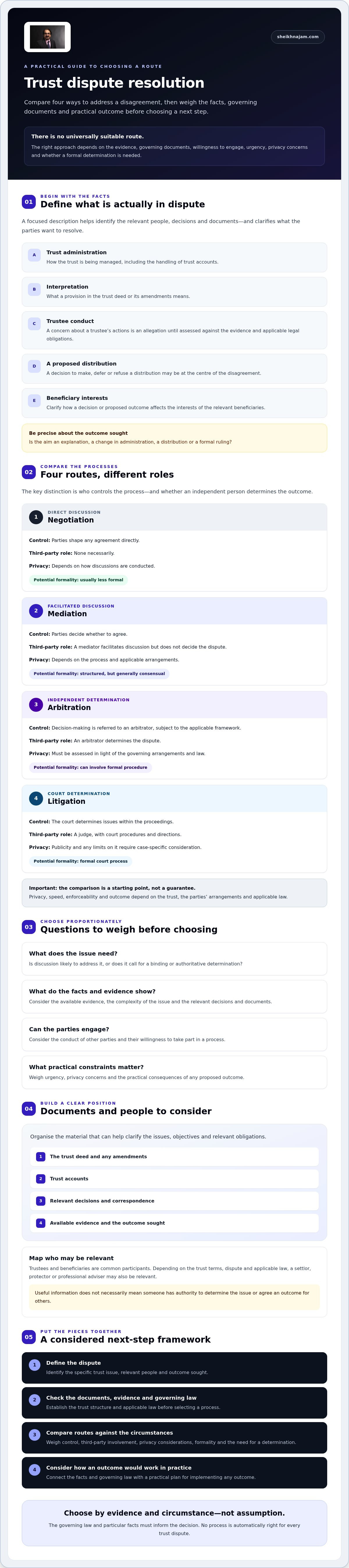
These routes differ in who controls the process and whether an independent person determines the outcome. The distinction matters: a process suited to clarifying accounts or exploring a distribution may not address a contested legal interpretation or the need for formal relief.
The table is a starting point, not a guarantee of privacy, speed, enforceability or outcome. Those features depend on the trust, the parties’ arrangements and applicable law.
When might negotiation or mediation be worth considering?
Direct negotiation can give trustees and beneficiaries the opportunity to explore practical proposals, such as supplying further information or reconsidering the timing of a decision. It depends on meaningful engagement and an adequate exchange of relevant information. If communication has stalled, a mediator may help structure discussion, identify areas of agreement and test possible settlements. A mediator does not impose a decision, and mediation cannot guarantee agreement or replace independent advice.
These consensual routes may be worth considering where parties can participate constructively and preserving family, professional or fiduciary relationships is important. If a party will not engage, or the central issue requires an authoritative determination, recognise those limitations early.
When might arbitration or court proceedings be considered?
Arbitration and litigation are adjudicative routes: an independent decision-maker determines the issues rather than facilitating a negotiated agreement. Before considering arbitration, review the trust documents and applicable law to establish whether it is available, who may be bound and what legal effect an award may have. Court proceedings may warrant consideration where agreement appears unlikely or formal relief is sought, but procedure, privacy and consequences require advice tailored to the circumstances.
For an initial assessment of which process may fit the trust and issues in dispute, consider seeking advice on trust dispute options.
Choose a trust dispute resolution route using the facts, not assumptions
No single process is best for every trust disagreement. Mediation may be constructive where parties can engage, but it cannot resolve every evidential or legal question. Litigation is not inevitable simply because positions have hardened. A proportionate decision turns on the issue, available evidence, urgency and outcome sought.
Consider these four questions before choosing a route:
Urgency: Is there an immediate risk to trust assets, administration or a party’s interests that requires prompt professional assessment?
Evidence: Are the relevant events and decisions documented, or are material facts disputed?
Cooperation: Will the parties share relevant information and participate meaningfully in discussions?
Relief sought: Is the objective an explanation, a practical agreement or a formal determination of rights and obligations?
Weigh these considerations together. A cooperative group may still need formal guidance on complex trust terms; a serious disagreement does not automatically rule out a negotiated outcome.
How do evidence and urgency affect the decision?
Identify material such as the trust deed and amendments, accounts, records of trustee decisions and relevant correspondence. A disagreement about why a distribution was deferred might be clarified by contemporaneous records. Conflicting accounts of a decision, or uncertainty over a detailed provision, may need closer analysis before informal discussion can usefully proceed.
If there is a pressing concern about assets, administration or a party’s position, seek prompt advice on the facts and available options. The appropriate response depends on the trust, governing law and circumstances. Do not assume delay is harmless or that a particular remedy is suitable without assessment.
How should privacy, control and enforceability be weighed?
A negotiated or mediated settlement is shaped by the parties who agree to it. Arbitration or court proceedings involve an independent decision-maker determining the issues. This affects the control parties retain, but does not by itself establish which process is preferable. Consider who must participate and whether the proposed outcome can address the whole dispute.
Privacy is not the same as legal confidentiality. The handling of information depends on the process, participants, any applicable agreements and the legal context. Court proceedings may raise different publicity considerations. Do not select a route on the assumption that all discussions or documents will remain private.
A settlement’s practical effect also depends on clear terms, the authority of those agreeing and the applicable law. Appropriate drafting and jurisdiction-specific advice can help establish what has been agreed and how it may be implemented. Complexity, procedural requirements and the number of participating parties can affect duration and expense, so general estimates may offer little guidance for an individual trust dispute.
Prepare for trust dispute resolution with a clear, documented position
Preparation can focus an initial discussion and separate the central issue from its surrounding history. Before choosing a process, define the disputed decision or conduct, review available records, identify what you want to achieve and obtain appropriate advice. The aim is not to assemble every document that exists, but to create a proportionate and reliable account of the matter.
What information should parties organise before a first discussion?
Start with the governing documents and records relevant to the issue. Depending on the dispute, these may include:
the trust deed and any amendments;
accounts and records of relevant trustee decisions;
correspondence or other material relating to the decision or conduct in question; and
a list of trustees, beneficiaries and any other potentially relevant participants.
Prepare a concise chronology, marking which events are supported by documents, which are disputed and which are assumptions or need clarification. Separately list agreed points, contested issues and unanswered questions. This helps avoid presenting an allegation as established fact and gives advisers or participants a clearer basis for discussion.
Trust records may contain sensitive personal or financial information. Avoid circulating them more widely than necessary, and seek advice on appropriate handling before sharing documents with other parties or prospective participants in a resolution process.
How can parties define a realistic resolution objective?
Separate essential outcomes from preferences. A trustee may need a clear basis for administering the trust, while a beneficiary may seek an explanation, reconsideration of a decision or clarity about their interests. Identify which points could be negotiated and which may require determination. Do not assume every preferred outcome is legally or practically available.
Consider implementation as well as agreement. Would the proposed terms allow the trust to be administered coherently afterwards? Do they account for continuing trustee responsibilities or the interests of people not directly involved in the discussions? Where interests differ, or a participant’s fiduciary duties may be engaged, independent advice can help clarify the position and appropriate next steps.
For further context on available approaches, see the dispute prevention and resolution service. A structured review of documents, objectives and unanswered questions can support an informed assessment of trust dispute resolution, although the governing law and particular circumstances remain decisive. To discuss a trust matter and possible next steps, contact Sheikh Najam TEP.
Obtain tailored advice on trust dispute resolution and next steps
A sound decision follows a clear sequence: define the disagreement, assess the evidence, compare the available processes and consider how any outcome could be implemented. This helps connect the choice to the substance of the dispute, rather than relying on assumptions that mediation must succeed or court proceedings must follow.
The appropriate support depends on the trust’s structure, governing law, parties involved and outcome sought. Mediation may help parties explore an agreed solution. Arbitration may be relevant only where the trust documents and applicable law permit it. Contentious trust work may be needed where the issues require formal analysis or determination. These are distinct options to assess, not predetermined recommendations.
What should an initial professional assessment establish?
An initial review should clarify the trust structure and governing documents, identify relevant trustees, beneficiaries and other participants, and define the precise decision, conduct or interpretation in dispute. It should also consider available records and whether any immediate concern, procedural constraint or jurisdiction question needs prompt verification.
With that information, the parties can assess whether consensual discussion is worth considering or whether a formal process may be more appropriate. The answer may depend on the quality of the evidence, the extent of disagreement about facts and the outcome required. General information cannot determine the right route for an individual matter: the relevant documents and law must be considered.
How can you take the next step?
For an initial enquiry, prepare a concise account of the issue: what happened, which decisions or trust provisions are involved, who is affected and what remains unresolved. Identify key documents, such as the trust deed, amendments, accounts or material correspondence. You need not send a full record at the outset. Use an appropriate channel and avoid sharing sensitive information more widely than necessary.
Sheikh Najam TEP provides services involving trust disputes, mediation and arbitration. Whether any of these options is suitable depends on the circumstances. Do not assume a particular result, timetable, cost or degree of confidentiality before the relevant facts and law are assessed. To outline a live matter and enquire about possible next steps, Discuss your trust dispute.
Take a considered next step towards resolution
A practical outcome begins with a precise understanding of the disagreement, the trust documents and the evidence, followed by a careful comparison of available routes. Negotiation and mediation may support agreement where parties can engage; arbitration or court proceedings may warrant consideration where a formal determination is needed. None is automatically right for every trust dispute. The governing law and desired outcome remain central.
Sheikh Najam TEP’s services include mediation and arbitration, as well as work involving trust disputes and contentious probate. These are distinct areas of support, and their relevance depends on the trust structure, the parties and the issues requiring resolution. A tailored assessment can help clarify what to consider next without assuming a particular result or process.
If you are dealing with a live matter, discuss your trust dispute and outline the key issue and documents available. This is a clear first step towards assessing the choices ahead.
Frequently Asked Questions
Is mediation suitable for every trust dispute?
No. Mediation may be useful where parties are willing to exchange relevant information and explore an agreed outcome, but it will not suit every dispute. Materially disputed evidence, complex questions about trust terms or the need for a formal determination may call for other steps. A mediator facilitates discussion rather than deciding the case. Assess the trust documents, issues, participants and desired outcome before deciding whether mediation is appropriate.
Can a trust dispute be resolved without going to court?
Yes. Some trust disputes can be resolved through direct negotiation or mediation if the relevant parties can reach agreement and the proposed terms are workable. Suitability depends on the trust, the parties’ authority and interests, and the nature of the disagreement. Some matters may require formal determination. Assess trust dispute resolution against the evidence, governing documents and applicable law, rather than assuming court proceedings are either inevitable or avoidable.
What is the difference between trust mediation and arbitration?
In mediation, an independent mediator helps the parties communicate and consider settlement proposals but does not decide the dispute. In arbitration, an arbitrator acts as a decision-maker, subject to the applicable framework and the parties’ arrangements. Whether arbitration is available, who may be bound and what effect an award may have require case-specific review of the trust documents and governing law. The two processes are not interchangeable.
How long does trust dispute resolution take?
There is no reliable standard timescale for trust dispute resolution. Duration may depend on the number of parties, complexity of the trust terms, amount of evidence to review, parties’ willingness to participate and process selected. Negotiation may progress differently from arbitration or court proceedings, but no route guarantees a particular timetable. An initial assessment of the documents, issues and urgent concerns can help identify relevant procedural considerations.
Are trust dispute discussions confidential?
Confidentiality should not be assumed. The treatment of discussions and documents depends on the process, participants, any applicable agreements and the legal context. Mediation may be conducted under agreed arrangements, but that does not justify a blanket assurance about confidentiality in every circumstance. Court proceedings raise different considerations, including potential publicity. Before sharing sensitive trust, financial or personal information, establish how it will be handled and seek advice relevant to the proposed process.
What documents are useful when seeking advice about a trust dispute?
Useful documents commonly include the trust deed and amendments, relevant accounts, records of trustee decisions and material correspondence. The precise selection depends on the disagreement, so start with documents connected to the decision, conduct or trust provision in question. A brief chronology can separate recorded events from disputed assertions, while a list of parties and unresolved questions helps frame the enquiry. Share sensitive material through an appropriate channel and only as advised.


Comments