Challenging a Will for Lack of Capacity: Evidence, Procedure and Options

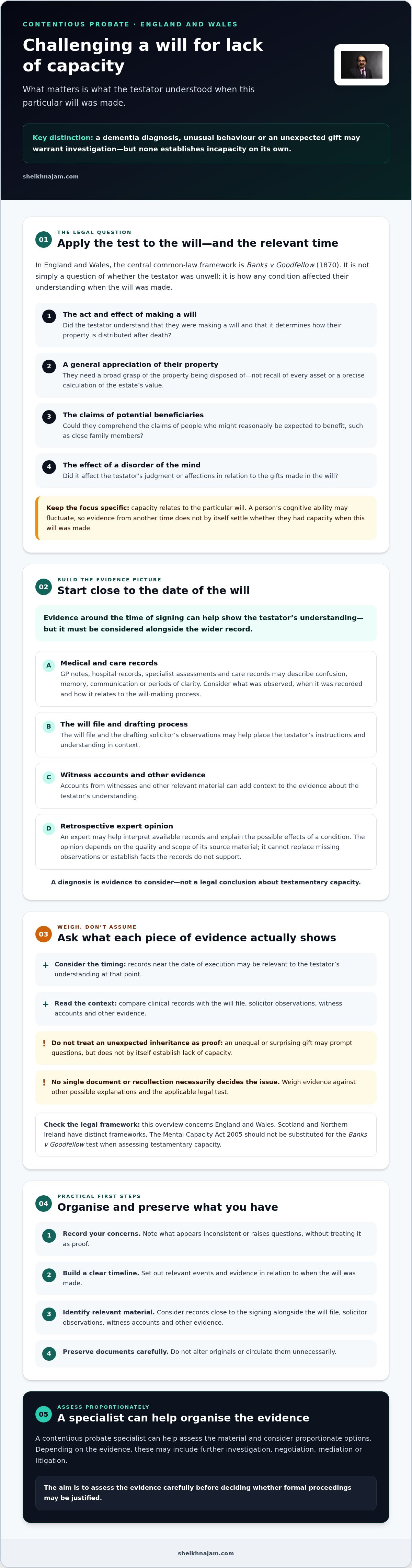
A dementia diagnosis does not, by itself, establish that a person lacked capacity to make a will. When challenging a will for lack of capacity, the central question is what the testator understood when the will was made, not simply their diagnosis or later decline.
It is understandable to look for a clear answer in medical records, particularly where a will appears inconsistent with the person’s earlier intentions. However, capacity is assessed against the legal test in Banks v Goodfellow, and the evidence must be considered in context. Clinical records from around the time may matter, alongside the will file, the drafting solicitor’s observations, witness accounts and other evidence of the testator’s understanding.
This article explains the legal test, the types of evidence that may support or weaken a claim, and why no single document or diagnosis necessarily determines the outcome. It also covers practical first steps, including how to create a timeline, identify relevant material and preserve documents. The aim is to help you assess the evidence carefully before deciding whether formal proceedings may be justified.
Table of Contents
What does lack of testamentary capacity mean when challenging a will?
What evidence can support a challenge to a will for lack of capacity?
How is capacity evidence assessed against other explanations?
What should you do if you suspect the testator lacked capacity?
How can a contentious probate specialist help assess a capacity challenge?
What does lack of testamentary capacity mean when challenging a will?
Concern about a relative’s memory, diagnosis or vulnerability can feel especially acute when their will differs from family expectations. But testamentary capacity has a specific legal meaning. It concerns whether the person making the will, the testator, had the necessary understanding to make that particular will when it was executed. A diagnosis, advanced age, unusual behaviour or surprising gift may warrant investigation, but none establishes incapacity on its own.
In England and Wales, the principal common-law test comes from Banks v Goodfellow (1870). It remains the central framework for testamentary capacity. The test asks whether the testator understood the act and effect of making a will, had a general appreciation of the property being disposed of, and could comprehend the claims of people who might reasonably be expected to benefit. It also considers whether a disorder of the mind affected the testator’s judgment or affections in relation to the gifts made in the will. So the question when challenging a will for lack of capacity is not simply whether the person was unwell, but how their condition affected their understanding at the relevant time.
What must the testator have understood?
The testator need not have recalled every asset or calculated the precise value of the estate. In broad terms, they must understand that they are making a will and that it determines how their property is distributed after death. They must also have a general grasp of the property they are disposing of and be able to consider the claims of people who might expect provision, such as close family members. This does not require them to leave anyone a particular share or agree with relatives about what would be fair.
The assessment relates to the specific will in question. A person’s health or cognitive ability may fluctuate. Evidence about their condition at another time can be relevant, but does not, by itself, resolve whether they had capacity when this will was made.
Which legal jurisdiction applies to the will?
This section addresses the law of England and Wales. Scotland and Northern Ireland have distinct legal frameworks, so check the relevant rules where the will, testator or estate has connections to those jurisdictions. Likewise, where estates or related family property involve assets in Canada, seeking guidance from a multi-disciplinary practice such as Shaikh Law Firm can clarify applicable local requirements. The Mental Capacity Act 2005 provides a statutory framework for decision-making capacity in its own context. It should not be substituted for the Banks v Goodfellow test when assessing testamentary capacity. Establishing the relevant jurisdiction and legal test is essential before drawing conclusions from a diagnosis or an apparently unusual gift.
What evidence can support a challenge to a will for lack of capacity?
When challenging a will for lack of capacity, look for evidence of the testator’s condition and understanding around the time that particular will was made. A diagnosis recorded months or years earlier may provide context, but the central issue is what the person could understand and communicate when giving instructions and executing the document.
Evidence close to the signing may offer a useful picture of the testator’s understanding, but it needs to be weighed alongside the wider medical and will-making record. No single note, opinion or recollection necessarily determines the issue. The Cornell Law School Legal Information Institute provides a general explanation of the mental capacity requirement. For a dispute in England and Wales, however, the evidence must be assessed under the applicable domestic legal test.
Medical and professional records around the signing
Potentially relevant material may include GP notes, hospital records, specialist assessments and care records, where they can be accessed lawfully. Entries made near the date of execution may record confusion, memory, communication or periods of clarity. Their significance depends on what was observed, when it was recorded and how it relates to the will-making process. A clinical diagnosis is not itself a legal conclusion about testamentary capacity.
A retrospective expert opinion may help interpret available records and explain the possible effects of a condition at the relevant time. Its value depends on the quality and scope of the underlying material. It cannot replace missing contemporaneous observations or establish facts that the records do not support.
The will-making process and witness evidence
The will file may show how instructions were obtained and whether the testator appeared to understand the proposed gifts. Relevant documents can include initial instructions, drafts, attendance notes and communications between the testator and the will drafter. Notes that record the testator’s own explanations may be particularly informative. Unexplained changes or limited documentation may call for closer consideration, but do not automatically prove incapacity.
People present when the will was signed may describe the testator’s appearance, conversation and behaviour. Their observations may, however, cover only a short encounter. The so-called Golden Rule is professional guidance that encourages a medical assessment, and a record of it, where a will is made by an elderly or seriously ill person. It is neither a separate legal test nor a guarantee that the will is valid. Failure to follow it does not, by itself, prove incapacity.
Preserve original documents and note where potentially relevant records may be held. If evidence is incomplete or points in different directions, an individual assessment of the contentious probate issues may help identify what further material to seek. You can contact Sheikh Najam TEP about a will dispute to discuss the available evidence and possible options.
How is capacity evidence assessed against other explanations?
A will that seems unfair or differs sharply from an earlier one may raise questions, but it does not establish why the testator made that choice. When challenging a will for lack of capacity, the analysis returns to the testator’s understanding of the will, their property and the claims of potential beneficiaries. That understanding must be considered alongside the evidence about how the will was prepared and executed.
A diagnosis alone does not determine legal capacity. The question is whether the testator met the applicable legal test when making the will. The comparison below helps distinguish different concerns, but all relevant evidence needs to be considered as a whole.
Capacity concerns versus an unpopular or unexpected will
A testator may knowingly favour one person, exclude another or change their plans for reasons relatives consider unreasonable. The law does not require a will to provide equal treatment or reflect the family’s view of fairness. Under Banks v Goodfellow, the focus is whether the testator understood the nature and effect of making a will, had a general grasp of the property being disposed of, and could appreciate relevant potential claims. A change in beneficiaries may prompt scrutiny of those matters, but it does not prove that the testator failed to understand them.
Capacity versus other grounds for disputing a will
Knowledge and approval concern whether the testator knew and approved the contents of the particular will. Testamentary capacity concerns their ability to understand the relevant matters. Undue influence alleges pressure that overbore the testator’s independent decision, not merely persuasion or an unexpected outcome. Forgery is a separate allegation about the document’s authenticity. Each ground requires its own evidence and analysis. For a broader overview, see contentious probate and will disputes.
For general practical considerations when assessing a potential dispute, read this overview of contesting a will. It should not replace advice on the law and evidence applicable to a specific case.
What should you do if you suspect the testator lacked capacity?
Start by recording what has prompted your concern. A clear chronology and preserved documents are more useful than assumptions based on a diagnosis, family disagreement or unexpected gift. If you are considering challenging a will for lack of capacity, establish what is known, what remains uncertain and whether probate has already been granted before deciding what steps may be appropriate.
Organising information before seeking advice
Prepare a dated chronology that separates what you witnessed personally from information reported by others. Include known changes in the testator’s health, when instructions for the will may have been given, the execution date and relevant events around those times. Record family relationships and why particular individuals may have expected consideration, without treating that expectation as proof of incapacity.
Make a separate list of potential sources, such as clinicians and care providers, people present when the will was signed, the will drafter, earlier drafts and relevant letters, emails or messages. Note where documents are held and how you know about them. Do not coach potential witnesses or ask them to align their recollections. Each account should remain their own.
Preserve originals carefully. Do not annotate, mark or alter a will or other original record, and avoid circulating it unnecessarily. Keep copies and note where the originals are held. Access to medical or professional records may require appropriate authority or a legal process, so do not assume that a family relationship alone entitles you to obtain them.
Assessing options and procedural urgency
The proportionate next step depends on the available evidence, your connection to the estate and its probate status. A suitably qualified adviser can consider whether further information should be sought and whether a probate procedure may be relevant. A caveat is a separate procedural measure that can prevent a grant being issued for a period, but it does not determine whether a will is valid. Check the current requirements, eligibility, timing and effect of any step before acting.
In England and Wales, there is no statutory time limit for challenging a will’s validity on grounds such as lack of testamentary capacity. However, delay can make evidence harder to obtain, and the estate may be distributed. This is not a reason to take an ill-considered step. Prompt advice can help clarify urgency and preserve options. The procedure may differ elsewhere in the UK.
For an individual assessment of the evidence and possible contentious probate options, discuss your contentious probate concern with Sheikh Najam TEP.
How can a contentious probate specialist help assess a capacity challenge?
A specialist assessment can turn medical records, correspondence and family accounts into an organised analysis of the legal issues. When challenging a will for lack of capacity, the evidence can be mapped against each element of the applicable test. This can help identify which points are supported, where the record is incomplete and what further enquiries may be proportionate. Sheikh Najam TEP advises on contentious probate and disputes concerning wills. Further information about the practice’s specialist areas of work is available online.
What a case assessment should clarify
An initial review should distinguish evidence that directly relates to the testator’s understanding at the relevant time from material that provides background only. It can identify strengths, evidential gaps, procedural uncertainties and issues that may need further investigation. If medical or other expert evidence may assist, its potential relevance and limitations can be considered. Neither its availability nor its effect on the outcome should be assumed.
Before instructing a professional, clarify the proposed scope of work, who is responsible for each step and how funding arrangements will operate. The appropriate advice may depend on your role in the estate, the probate position and the documents currently available. Make these matters clear before deciding on correspondence, negotiation or proceedings.
Choosing a proportionate route to resolution
Private discussions or correspondence may help establish whether a dispute can be narrowed without formal proceedings. Negotiation and mediation can provide a structured opportunity to explore resolution where appropriate, particularly when preserving family relationships is a concern. These routes are not suitable in every case. Litigation may need to be considered where important issues remain unresolved or a formal determination is required.
Mediation does not itself determine whether a will is legally valid. Any agreement depends on the parties’ participation and the terms they reach, and the suitability of this route must be assessed in context. A specialist can help weigh these options against the evidence and procedural position. Approaches to dispute prevention and resolution may also inform how the parties communicate and consider next steps. Litigation can intensify family conflict, so its necessity, risks and alternatives warrant careful consideration.
For an individual discussion of your circumstances and possible contentious probate options, request a discussion about your will dispute.
Take a measured next step on a will capacity concern
Any decision about challenging a will for lack of capacity should turn on the testator’s understanding when that particular will was made. A diagnosis or unexpected distribution may raise questions, but neither settles the legal issue. A potential claim depends on how the relevant evidence, including records and material about the will-making process, fits the applicable test.
Organising the timeline, preserving documents and identifying what remains unknown can make an initial assessment more focused. The appropriate route may involve further investigation, correspondence, negotiation, mediation or, where necessary, litigation. Each option needs to be considered in light of the evidence, procedural position and family circumstances.
Sheikh Najam TEP advises on contentious probate and will disputes, and offers mediation and arbitration as dispute-resolution services where appropriate. For an individual assessment of your circumstances and potential options, request a discussion about a will capacity dispute.
Frequently Asked Questions
Can you challenge a will if the person had dementia?
Potentially, but a dementia diagnosis does not automatically establish that the person lacked testamentary capacity. The question is whether they could meet the applicable legal test when making that particular will. Relevant material may include medical records and professional observations from around the time, as well as evidence about their instructions and the signing process. The evidence must be assessed as a whole by an appropriately qualified adviser. A diagnosis alone cannot settle the issue.
What is the legal test for lack of testamentary capacity?
In England and Wales, the principal common-law test is associated with Banks v Goodfellow. Broadly, it asks whether the testator understood the nature and effect of making a will, had a general understanding of the property being disposed of, and could appreciate the claims of people who might expect provision. It also considers whether a disorder of the mind affected the testator’s judgment or affections in making the gifts. The assessment concerns the particular will and circumstances. Other UK jurisdictions have distinct frameworks.
Can an unusual or unfair will be challenged for lack of capacity?
An unusual, unequal or disappointing distribution does not, by itself, prove lack of testamentary capacity. A person may make a decision relatives consider unwise while still meeting the legal test. The distribution may be relevant context, but a capacity challenge needs evidence about the testator’s understanding when the will was made. Other grounds for disputing a will, such as undue influence or lack of knowledge and approval, are legally distinct and require separate analysis.
What evidence is needed to challenge a will for lack of capacity?
There is no single document that automatically proves a capacity claim. Potentially relevant evidence includes medical records around the signing date, the will file, instructions, drafts, attendance notes and witnesses’ observations. Expert opinion may help interpret available records, but its value depends on the material it considers. Assess the evidence in context, preserve original documents and seek advice about lawful access before requesting or sharing confidential records.
Does a doctor have to assess capacity when someone makes a will?
No, a medical assessment is not invariably required whenever a will is made. Professional guidance may recommend medical input where there is a genuine concern about capacity, but the absence of an assessment does not alone establish that the will is invalid. The testator’s understanding and the circumstances at execution remain central. The Golden Rule is professional guidance for will-making, not a separate legal test or a guarantee against a later challenge.
How long do you have to challenge a will for lack of capacity?
In England and Wales, there is no statutory time limit specifically for challenging a will’s validity on grounds such as lack of testamentary capacity. However, delay may make evidence harder to obtain, and the estate may be distributed. Procedural steps and the claimant’s circumstances also need consideration. Obtain advice promptly, preserve relevant material and ask whether any deadline or probate procedure applies to your situation. Check the current rules before acting, particularly where another jurisdiction is involved.
Can a will challenge be resolved without going to court?
Some will disputes may be explored through correspondence, negotiation or mediation, depending on the parties, evidence and procedural position. These routes provide an opportunity to seek agreement, but none guarantees resolution. Mediation does not itself determine whether a will is legally valid. Any agreement depends on the parties reaching acceptable terms. A contentious probate specialist can help assess whether a non-court process is suitable or whether court proceedings may need consideration.


Comments