Document Notarisation Cost UK: The Definitive Commercial and Legal Guide

The true expense of cross-border execution rarely stems from professional authentication; it arises from the severe commercial disruption incurred when a foreign registry rejects an improperly certified instrument. When determining the actual document notarisation cost UK corporate entities and private individuals routinely confront an opaque market, confounded by disparate fee structures and unanticipated statutory disbursements. You likely recognise the acute frustration of budgeting for international transactions whilst navigating the critical evidential distinctions between standard solicitor certification and formal notarial acts.
This definitive legal and commercial analysis demystifies the underlying architecture of notarial remuneration, demonstrating how evidential verification rigour, jurisdictional risk, and public office liability govern overall expenditure. By examining these systemic determinants, you will acquire the strategic foresight required to structure foreign authentication cost-effectively, forecast consular and apostille requirements accurately, and secure unquestioned legal validity across every recipient jurisdiction.
Table of Contents
Understanding UK Document Notarisation Costs: The Regulatory and Evidential Framework
Core Determinants That Govern Document Notarisation Expenditure
Evaluating Fee Structures: Fixed Fees, Hourly Rates, and Third-Party Disbursements
Strategic Procurement: How to Optimise Notarisation Costs Without Compromising Legal Validity
Selecting Specialist Notarial Counsel: Ensuring International Enforceability Across Jurisdictions
Understanding UK Document Notarisation Costs: The Regulatory and Evidential Framework
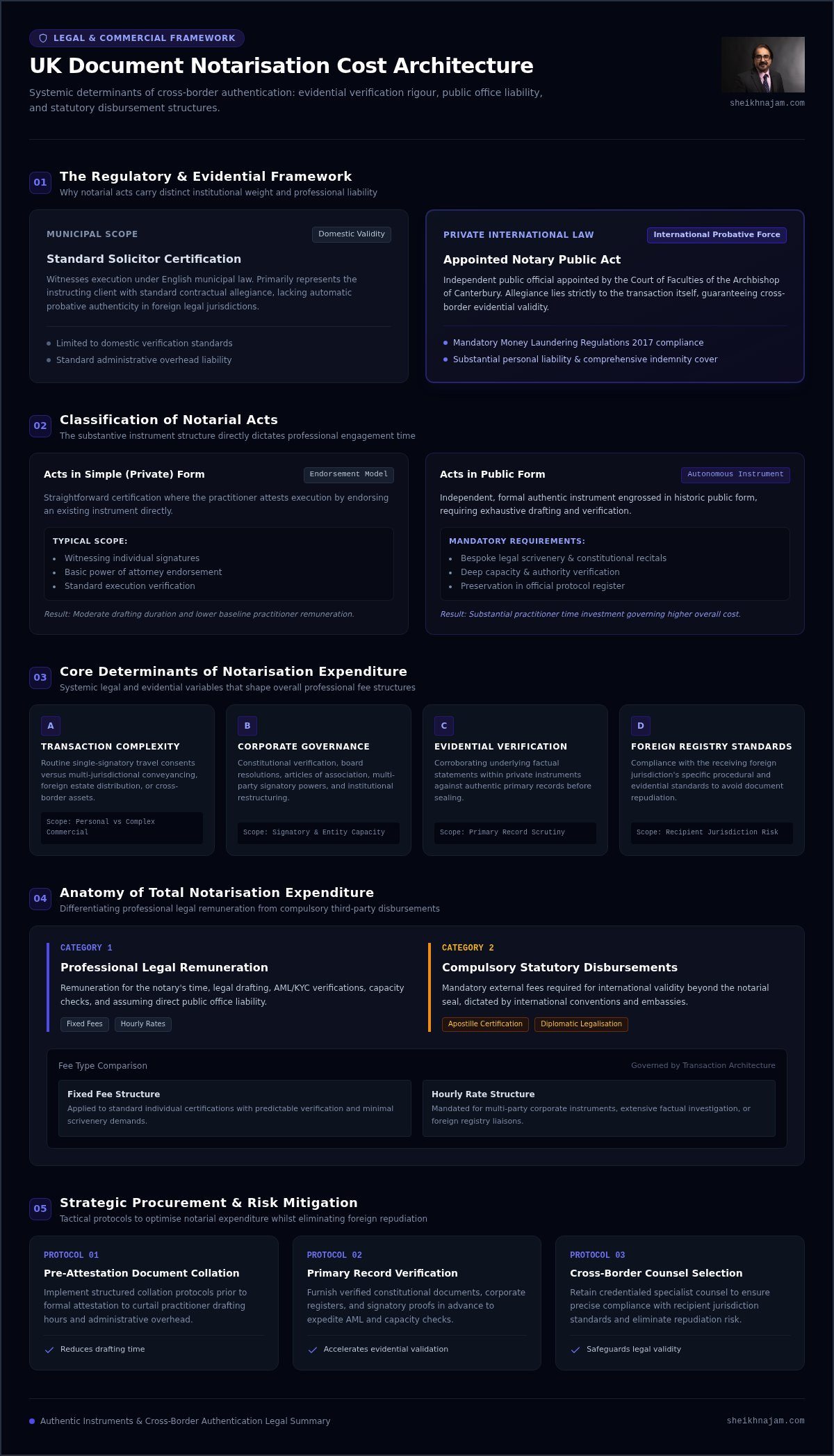
A notarial act is not a procedural rubber stamp; it is an internationally recognised instrument of public authenticity endowed with probative force under private international law. Appointed by the Court of Faculties of the Archbishop of Canterbury, an English notary public serves as an independent public official whose primary allegiance lies to the transaction itself, rather than to an individual instructing party. This vital institutional posture establishes why calculating a baseline document notarisation cost UK clients encounter involves far more than administrative overhead. While domestic solicitor certification confirms simple witnessing under English municipal law, foreign receiving authorities, registries, and judiciaries require the heightened evidential scrutiny of a formal notarial act to establish conclusive validity across jurisdictions, as explored within our definitive legal reference material.
Every professional fee charged by an authenticating practitioner reflects the deep personal liability assumed when issuing an act. Practitioners must establish legal capacity, verify identity beyond doubt, and guarantee genuine volition before affixing their seal of office.
The Statutory Role and Regulatory Governance of an English Notary Public
Notaries operate under rigorous regulatory obligations enforced by the Faculty Office. Each instruction requires stringent anti-money laundering and know-your-customer verifications mandated by the Money Laundering Regulations 2017. Because notarial instruments authenticate substantial cross-border capital transfers, foreign property transactions, and institutional restructuring, practitioners maintain comprehensive professional indemnity insurance commensurate with severe financial exposure.
Baseline Attestation Versus Complex Notarial Acts in Public Form
The substantive architecture of the instrument directly determines professional remuneration. Notarial acts divide into two distinct legal forms:
Acts in Simple (Private) Form: Straightforward certifications where the notary attests execution by endorsing an existing document, such as verifying a power of attorney or witnessing a signature.
Acts in Public Form: Independent, formal authentic instruments engrossed in historic public form by the notary. These require bespoke drafting, constitutional recital of facts, capacity verification, and preservation within the practitioner’s official protocol register.
Drafting an act in public form demands exhaustive legal analysis, translating into higher practitioner time investment and governing the ultimate document notarisation cost UK parties incur.
Core Determinants That Govern Document Notarisation Expenditure
Calculating the true document notarisation cost UK parties must budget for is governed by distinct legal, evidential, and procedural variables rather than an arbitrary tariff. Because an authentic act establishes public faith across international borders, the practitioner must systematically evaluate the transaction's inherent risk profile, the required scrivenery, and the recipient jurisdiction's procedural compliance standards.
Document Classification and Transactional Complexity
The substantive classification of an instrument establishes the initial threshold of required professional engagement. Routine personal matters, such as single-signatory travel consents or standard affidavits, require comparatively straightforward execution verification. Conversely, multi-jurisdictional conveyancing, foreign distribution of estate assets, and complex statutory declarations demand rigorous evidential corroboration. When an authenticating officer attests to underlying factual statements within private instruments, the necessity of verifying primary records increases drafting and consultation duration accordingly.
Corporate Governance and Signatory Verification Demands
Commercial transactions introduce substantial institutional complexity that directly affects overall expenditure. When authenticating international commercial powers of attorney, board resolutions, or cross-border facility agreements, the notary cannot simply witness execution. The authenticating officer must independently inspect the company's constitutional documents, review current filings at Companies House, and confirm the specific signing powers delegated to appointed officers. As highlighted in professional practice standards maintained by The Notaries Society, practitioners must also complete rigorous beneficial ownership verifications under statutory anti-money laundering legislation before certifying that an entity possesses the requisite capacity to bind itself internationally.
Destination Jurisdiction Requirements and Hague Apostille Protocols
The geographic destination of an instrument dictates the downstream procedural trail necessary to achieve legal enforceability. Under the 1961 Hague Legalisation Convention, member states accept an Apostille issued by the Foreign, Commonwealth & Development Office as sufficient verification of the notarial signature and official seal. For destination countries that remain non-signatories to the Convention, documents must undergo bilateral consular legalisation at foreign embassies, introducing statutory consular fees and specialised handling requirements.
Recipient civil law judiciaries frequently demand bespoke notarial certificates engrossed in specific bilingual formats. When documents require certified translation or specialised ribbon binding to prevent tampering, these technical requirements expand the total document notarisation cost UK corporate entities and private individuals experience. To structure complex multi-jurisdictional matters efficiently, instructing parties can contact our practice directly to establish precise evidential requirements prior to formal execution.
Evaluating Fee Structures: Fixed Fees, Hourly Rates, and Third-Party Disbursements
A rigorous appraisal of legal expenditure requires distinguishing between professional remuneration for notarial scrivenery and non-negotiable statutory disbursements. Transparent analysis of any document notarisation cost UK clients face separates practitioner fees, reflecting procedural risk and bespoke drafting, from external fiscal charges levied by sovereign authorities. Establishing this delineation early prevents transactional friction and guarantees total cost certainty across international matters.
Professional Notarial Time Versus Fixed Transactional Quotas
Practices typically deploy two primary remuneration structures based on transactional complexity:
Fixed Transactional Fees: Applied to standardised acts where evidential parameters remain circumscribed, such as verifying duplicate personal identification documents or witnessing pre-drafted standard declarations.
Time-Recorded Hourly Rates: Reserved for complex multi-jurisdictional arrangements involving extensive bespoke drafting, liaison with foreign retaining counsel, corporate governance interrogation, or multi-party execution attendances.
When instruments require substantial revision to satisfy foreign registry standards, time-recorded structures ensure necessary evidential depth without compromising legal enforceability.
Essential Disbursements: FCDO Legalisation and Consular Charges
Disbursements represent mandatory third-party levies paid directly to official bodies. When instruments require formal legalisation, the Foreign, Commonwealth & Development Office imposes statutory apostille fees, varying between postal submissions and priority expedited services. For destinations outside the Hague Convention, bilateral legalisation requires attending sovereign embassies, each applying disparate consular tariffs, verification procedures, and bespoke payment mandates.
Courier Logistics, Insurance, and Secure Transmission Safeguards
The transmission of authenticated legal instruments introduces critical logistics overhead. Because cross-border transactions involve irreplaceable original deeds, powers of attorney, and share transfer covenants, relying on standard postal conveyance presents unacceptable operational exposure. It's standard practice to deploy secure, tracked international couriers backed by heightened transit insurance. While digital notarial platforms increasingly facilitate electronic acts, secure physical transit protocols remain compulsory for jurisdictions demanding wet-ink parchment execution and wax seals. Accounting for these essential security outlays ensures an accurate projection of the comprehensive document notarisation cost UK entities must anticipate.
Strategic Procurement: How to Optimise Notarisation Costs Without Compromising Legal Validity
Achieving expenditure efficiency in cross-border execution does not mean seeking discounted administrative shortcuts; it demands systematic procedural preparation. In commercial transactions, legal defects cause immediate rejection by foreign ministries, invalidating closing dates and triggering severe contractual penalties. Understanding how to manage your total document notarisation cost UK engagements require involves proactive risk mitigation rather than false economies.
Pre-Execution Preparation and Comprehensive Identification Readiness
Incomplete documentation remains the primary driver of inflated practitioner billable hours. Instructing parties must compile all requisite evidential materials prior to formal attendance:
Government Identification: Provide current, unexpired photo identification (a valid passport or photo card driving licence) alongside compliant proof of address dated within the statutory three-month window.
Pre-Execution Drafts: Transmit unexecuted drafts to the notary well ahead of attendance. This enables early review of foreign execution clauses without generating emergency consultation time.
Foreign Counsel Confirmation: Secure explicit written approval of the execution format directly from the receiving overseas legal counsel before attending the appointment.
Bundling Multi-Jurisdictional Documents for Collective Attestation
Commercial enterprises frequently execute suites of inter-related corporate instruments simultaneously. Where permissible under the receiving jurisdiction's civil procedure rules, multiple filings (such as certificates of incorporation, articles of association, and board minutes) can be annexed under a single omnibus notarial certificate. This consolidation reduces individual attestation protocols and optimises downstream Foreign, Commonwealth & Development Office submission processing. However, instructing parties must verify that the overseas land registry or commercial court permits composite binding, as certain civil jurisdictions strictly mandate discrete apostilles for individual instruments.
Avoiding Costly Execution Errors in Cross-Border Documentation
The most catastrophic operational expense is document repudiation. Executing an instrument prior to appearing before the notary represents an immediate, fatal error. Notaries cannot attest to signatures executed outside their personal presence; premature execution invalidates the instrument, requiring formal re-engrossment and duplicate legal outlays. Similarly, failing to clarify whether receiving authorities demand an authentic act in public form leads to immediate jurisdictional rejection. Corporate leaders and private clients seeking to harmonise complex cross-border documentation with their wider commercial posture should engage our specialist legal advisory services. When you are ready to structure your international documentation correctly, contact our practice to arrange a formal consultation and secure definitive jurisdictional compliance from the outset.
Selecting Specialist Notarial Counsel: Ensuring International Enforceability Across Jurisdictions
Evaluating legal representation purely on the basis of commodity pricing represents a profound strategic vulnerability. While assessing the headline document notarisation cost UK providers quote is an understandable commercial exercise, the true value of an authentic act resides in its unassailable enforceability before overseas tribunals, foreign registries, and sovereign revenue authorities. Appointed notaries public hold public office under the regulatory governance of the Court of Faculties of the Archbishop of Canterbury, imbuing their instruments with worldwide evidential presumption. In sophisticated matters, securing counsel with interdisciplinary credentials safeguards against procedural defect and cross-border repudiation.
Aligning Notarial Qualifications with Cross-Border Wealth and Corporate Mandates
Overseas judiciaries and financial institutions routinely subject foreign probate filings, high-value succession instruments, and complex commercial charters to rigorous evidential examination. A failure to substantiate formal capacity or comply with private international law rules can compromise an entire estate or commercial acquisition. Retaining an authenticating officer who is both an appointed Notary Public and a credentialed member of the Society of Trust and Estate Practitioners (TEP) ensures that sensitive instruments receive exhaustive technical scrutiny. This specialist dual qualification ensures that international wills, corporate covenants, and trusts strictly satisfy both domestic statutory tests and the mandatory procedural codes of the receiving legal system.
The Strategic Advantage of Integrated Legal, Tax, and Notarial Advisory
Cross-border asset execution requires complete harmony across private wealth structuring, international tax planning, and formal notarial scrivenery. When attestation occurs in isolation from underlying succession or fiscal considerations, severe liabilities can arise, including unintentional exposure to double taxation or statutory claims under foreign forced heirship regimes. An integrated advisory approach resolves these jurisdictional tensions at inception, combining authoritative legal precision with authentic execution.
For complex international estates and commercial transactions, evaluating your overarching document notarisation cost UK commitments alongside comprehensive structuring provides indispensable legal security. To protect your private wealth arrangements and establish total procedural certainty, initiate an enquiry through our professional legal contact channel, or directly schedule a notarial consultation to review your cross-border documentation.
Securing Cross-Border Legal Certainty and Transactional Integrity
Navigating cross-border transactions demands that commercial entities and private clients view authentic notarial attestation as an indispensable evidential shield. A transparent assessment of the total document notarisation cost UK parties incur distinguishes between necessary practitioner scrivenery, corporate governance verification, and statutory sovereign disbursements. Rigorous pre-execution collation guarantees that instruments withstand the most exacting foreign scrutiny without precipitating costly procedural delays.
Entrusting your legal instruments to Sheikh Najam TEP provides the dual assurance of an authenticating public officer appointed by The Court of Faculties of the Archbishop of Canterbury and a credentialed Trust and Estate Practitioner. Offering specialist multi-disciplinary advisory across cross-border wealth, international tax, and notarial scrivenery, the practice resolves multi-jurisdictional complexities at inception. You can confidently eliminate international execution risk and protect your global assets; contact our practice today to arrange a formal notarial consultation.
Frequently Asked Questions
How much does it cost to get a document notarised in the UK?
Professional fees for notarial authentication are assessed on an individual matter basis rather than a statutory uniform tariff. The total document notarisation cost UK parties encounter depends on document complexity, the required verification of signatory legal capacity, corporate constitutional reviews, and whether the act is drawn in simple or formal public form. External disbursements, such as Foreign, Commonwealth & Development Office apostille fees or sovereign consular charges, are levied separately from professional remuneration.
Why do notarial services cost more than standard solicitor certification?
Notaries public act as internationally recognised public officials appointed under the authority of the Court of Faculties, assuming profound personal and evidential liability for the transactions they authenticate. Unlike a solicitor certifying a private domestic document under English municipal law, a notary confirms legal capacity, volition, identity, and corporate authority under private international law. This heightened standard of cross-border verification guarantees unassailable probative value before overseas judiciaries, which naturally reflects in professional remuneration.
Can multiple documents be bound together under a single notarial certificate to reduce fees?
Multiple interrelated commercial or personal filings can often be consolidated beneath a single omnibus notarial certificate, provided they concern the same underlying matter. This procedural consolidation streamlines practitioner scrivenery and reduces downstream apostille disbursements. However, instructing parties must ensure the receiving overseas registry or tribunal permits composite binding. Certain foreign civil jurisdictions strictly demand discrete certificates and individual apostilles for distinct constitutional filings, rendering inappropriate grouping void.
What additional disbursement fees should I anticipate alongside professional notarial charges?
Beyond practitioner legal fees, cross-border authentication involves statutory and logistical third-party disbursements. These typically encompass apostille certification fees levied by the Foreign, Commonwealth & Development Office, sovereign consular legalisation charges for non-Hague nations, and Companies House electronic register inspection costs. Secure transit represents another necessary outlay; transmitting original deeds via tracked, insured international courier services prevents operational loss, completing the holistic document notarisation cost UK entities must budget for.
Is an apostille always necessary following the notarisation of a document?
An apostille is not universally mandatory, but receiving foreign entities usually require one to verify the notary's signature and official seal. Under the Hague Legalisation Convention, member states accept an apostille issued by the Foreign, Commonwealth & Development Office as definitive authentication. Conversely, domestic recipients or jurisdictions with bilateral evidentiary exemptions may accept a sealed notarial act directly. Instructing parties should obtain written instructions from overseas counsel before commissioning legalisation services.
What happens if a document is executed incorrectly prior to the notarial appointment?
Executing an instrument prior to the appointment invalidates the attestation process. An appointed notary public cannot attest execution unless the signatory appears personally, proves identity, and executes the instrument in the practitioner's direct physical or certified presence. If a document is signed prematurely, it must be freshly engrossed and executed anew. This procedural error introduces unnecessary drafting expenditure and causes severe commercial delays before foreign registries.
How do urgent or same-day execution requirements influence notarial costs?
Expedited or urgent execution demands affect transactional expenditure through both practitioner time reallocation and accelerated institutional processing. Notaries frequently accommodate emergency commercial deadlines by prioritising draft reviews and conducting immediate attendances, which may command premium professional billing. Concurrently, statutory disbursements increase because priority Foreign, Commonwealth & Development Office legalisation services and direct embassy express queues levy higher sovereign fees than standard postal routes, alongside expedited secure courier arrangements.


Comments