Offshore Trust Disputes: A Strategic Framework for Complex Fiduciary Resolution

The preservation of multi-generational wealth within the clandestine architectures of Jersey or the Cayman Islands is often perceived as an impregnable fortress, yet the reality is that offshore trust disputes represent some of the most volatile and strategically demanding legal confrontations in the modern fiduciary landscape. When the veil of discretionary power obscures a beneficiary’s rightful interest or when trustees find themselves caught between the conflicting mandates of disparate jurisdictions, the stakes transcend mere financial loss. You likely recognise that the traditional reliance on the absolute discretion of a trustee is no longer a sufficient safeguard against the complexities of international tax convergence and heightened regulatory scrutiny.
This analysis provides an exhaustive examination of the doctrinal frameworks and jurisdictional firewalls that define contentious fiduciary matters, offering the precision required to navigate such high-stakes exposure. We'll explore the critical intersection of notarial scrivenery, the strategic deployment of private arbitration under the New York Convention, and the rigorous enforcement of fiduciary obligations to ensure asset protection. By synthesising academic theory with practical resolution pathways, we'll delineate how to achieve successful recovery whilst maintaining the utmost institutional prestige and privacy through a multidisciplinary lens.
Table of Contents
The Anatomy of Contentious Offshore Trusts: Identifying Fiduciary Failures
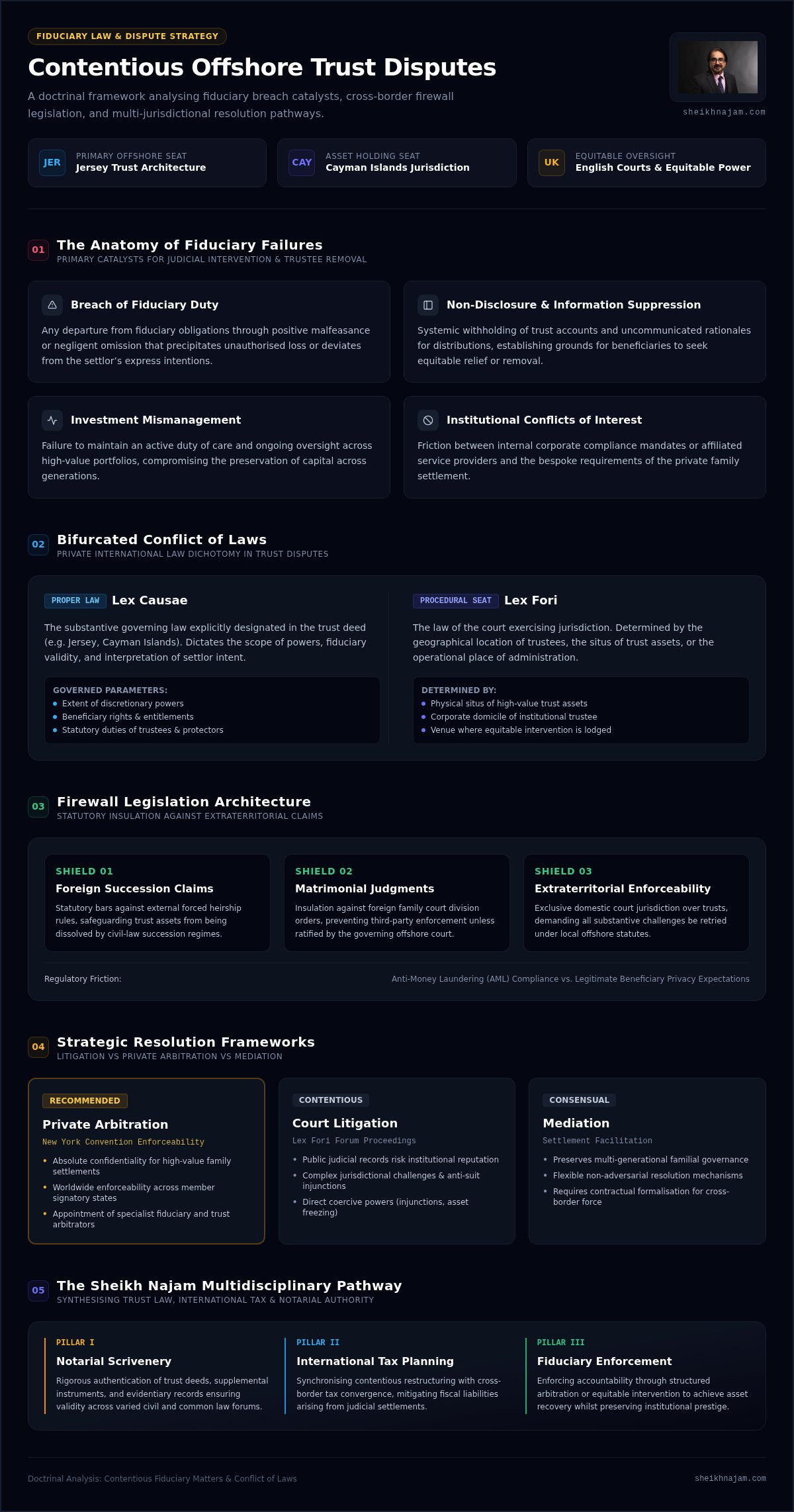
The genesis of most offshore trust disputes lies in the erosion of the fiduciary covenant, a relationship predicated on absolute loyalty and the prudent administration of assets for the benefit of others. These conflicts often manifest as a formal allegation of a breach of fiduciary or statutory duty, where the actions of a corporate trustee or a protector are scrutinised against the rigorous standards of the trust instrument and the governing law of the host jurisdiction. A breach of trust in an offshore context is defined as any departure from the fiduciary’s obligations, whether through a positive act of malfeasance or a negligent omission, that results in an unauthorised loss to the trust fund or a deviation from the settlor's express intentions.
Modern offshore trust structures are inherently complex, often spanning multiple legal systems to provide asset protection and tax efficiency. However, this complexity frequently obscures the primary catalysts for litigation: a systemic lack of transparency regarding trustee decisions, the persistent mismanagement of high-value investment portfolios, and the deliberate exclusion of beneficiaries from material information.
Fiduciary Misconduct and Accountability
The duty of care in high-value asset management is not a static obligation but a dynamic requirement that demands active oversight. Institutional trustees often face profound conflicts of interest, particularly when their internal corporate policies or affiliated service providers clash with the bespoke needs of a private settlement. Non-disclosure remains a primary irritant; when fiduciaries withhold accounts or refuse to provide the rationale for specific distributions, they don't just damage the relationship. They provide the legal standing necessary for beneficiaries to seek judicial intervention or removal of the trustee.
Regulatory Catalysts and Compliance
We've observed a significant shift where regulatory mandates, rather than internal family dynamics, now serve as the primary triggers for offshore trust disputes. The tension between a beneficiary's expectation of privacy and a trustee's mandatory reporting obligations under global AML frameworks creates a volatile legal environment. When a trustee freezes assets or refuses a distribution based on perceived risks, it often prompts a challenge regarding whether the fiduciary is acting out of genuine legal necessity or merely shielding itself from regulatory censure. For a deeper analysis of these pressures, one should consult the financial crime compliance for trusts framework. These compliance failures don't just risk fines; they destabilise the entire trust structure, leading to protracted and costly litigation.
Jurisdictional Complexity: Navigating the Conflict of Laws
The resolution of offshore trust disputes necessitates a profound understanding of the bifurcated nature of private international law, specifically the distinction between the proper law of the trust (the lex causae) and the jurisdiction of the court (the lex fori). Whilst a trust instrument may expressly designate the laws of a specific territory as its governing framework, the procedural venue for litigation is often determined by the physical location of the trustees, the situs of the assets, or the place of administration. This misalignment creates a fertile ground for jurisdictional conflict, particularly when claimants seek to invoke the equitable jurisdiction of the English courts against assets held in a territory with restrictive statutory protections. Such complexities are frequently encountered within the context of international tax planning, where the choice of a trust's seat is as much a matter of regulatory compliance as it is of fiscal efficiency and strategic insulation.
The Doctrine of Forum Non Conveniens
Establishing the most appropriate venue for litigation is a primary tactical hurdle in any cross-border fiduciary conflict. The doctrine of forum non conveniens allows a court to stay proceedings if it's demonstrated that another forum is clearly more suitable for the interests of all parties and the ends of justice. Jurisdictional clauses within the trust deed serve as the first line of defence, yet their enforceability is often challenged when minor or unborn beneficiaries are involved, or when the dispute involves non-arbitrable statutory rights. The selection of a trust's seat must also account for the reach of international tax treaties, as these agreements can inadvertently expose the structure to the scrutiny of onshore revenue authorities during the discovery phase of a public dispute.
Firewall Legislation and Asset Protection
Offshore hubs like the Cayman Islands, under Section 90 of the Trusts Act (2021 Revision), and Jersey, through Article 9 of the Trusts (Jersey) Law 1984, have implemented robust "firewall" provisions designed to exclude the application of foreign law. These statutes mandate that all questions concerning the validity of the trust, the capacity of the settlor, or the fiduciary duties of the trustees are determined exclusively by the law of the home jurisdiction. This creates a significant barrier against foreign forced heirship or matrimonial claims that would otherwise be recognised under English common law principles. Navigating this tension requires a meticulous approach to breach of trust litigation, ensuring that any attempt at asset recovery respects the statutory derogations of the offshore seat. For those managing intricate cross-border structures, it's prudent to discuss these jurisdictional safeguards with a specialist advisor before a dispute crystallises into full-scale litigation.
Strategic Resolution Frameworks: Litigation vs. Arbitration vs. Mediation
The selection of an adjudicative pathway within offshore trust disputes is a decision of profound strategic consequence, requiring a nuanced balance between the desire for judicial finality and the imperative for absolute discretion. Whilst the default recourse often gravitates toward public courts, the sophisticated practitioner must evaluate whether the transparency of a traditional courtroom aligns with the client’s broader reputation management objectives. This choice is frequently complicated by conflict of laws principles, which may dictate that whilst the trust is governed by offshore statutes, the procedural mechanics of resolution are subject to the rules of a different forum, potentially exposing the structure to unintended judicial scrutiny.
Litigation and the High Court
Launching a trust claim within the High Court of England and Wales demands rigorous adherence to the Civil Procedure Rules, particularly when seeking directions under Part 64 or challenging the exercise of trustee discretion. However, the principle of open justice poses a significant risk, as the public nature of these proceedings can lead to the unmasking of sensitive trust assets and settlor intentions. For those involved in multi-jurisdictional estate conflicts, a detailed contentious probate analysis reveals how public litigation can inadvertently invite unwanted regulatory scrutiny or third-party claims, making it a pathway that requires meticulous risk assessment before commencement.
The Efficacy of Private Arbitration
Arbitration has emerged as the preeminent choice for resolving high-value fiduciary conflicts, facilitated by modern statutes in jurisdictions such as the Bahamas and the British Virgin Islands that expressly permit trust arbitration. Arbitration is often favoured amongst HNWIs for its scrupulous privacy, ensuring that sensitive financial disclosures and internal family dynamics remain shielded from the public record. By incorporating bespoke arbitration clauses that bind beneficiaries through "deemed consent" or "direct benefits estoppel," parties can select specialist arbitrators with deep technical expertise in equity and trusts. The resulting awards benefit from the robust enforcement mechanisms of the 1958 New York Convention, which is currently ratified by over 170 nations, providing a level of cross-border finality that court judgments often lack.
Mediation: A Tactical Imperative
Mediation serves as a critical tool for preserving both the financial capital and the relational integrity of a family structure, offering a forum for early neutral evaluation that avoids the binary outcomes of litigation. It's particularly effective for resolving intricate inheritance and will disputes where the underlying issues are as much about perceived inequity as they are about legal technicalities. A strategic mediation session can often bypass years of protracted conflict, providing a cost-effective alternative that prioritises the long-term stability of the trust fund. You may visit Sheikh Najam’s dispute resolution page to explore how these private mechanisms are integrated into a comprehensive fiduciary strategy designed for the elite private client.
Evidentiary Scrivenery and the Role of Notarial Authentication
The evidentiary weight of a document in offshore trust disputes is often the pivot upon which the entire resolution strategy turns. In the absence of rigorous authentication, trust deeds, letters of wishes, and minutes of meetings are vulnerable to challenges regarding their provenance, execution, or the capacity of the signatories. This is where professional notarial services become indispensable; they provide the requisite solemnity and international recognition that ordinary witnessing cannot achieve. By ensuring that every instrument is executed with meticulous precision, parties can mitigate the risk of a court disregarding critical evidence during a high-stakes fiduciary conflict.
Notarial Acts in International Litigation
The doctrine of notarial authenticity grants a document a presumption of validity that's recognised across both civil and common law jurisdictions, a critical factor when evidence must be presented to an offshore court. When preparing statutory declarations or affidavits for use in the Caribbean or the Channel Islands, the involvement of a Notary Public ensures that the instrument meets the exacting standards of the recipient lex fori. Beyond mere signature verification, the Notary performs a vital function in assessing the mental capacity and free will of trust settlors, thereby insulating the structure against future claims of undue influence or lack of capacity. This level of scrutiny is particularly vital in multi-jurisdictional matters where the validity of an entire trust fund may depend on the proven intent of the settlor at the moment of creation.
Scrivenery as a Preventive Measure
Meticulous fiduciary scrivenery serves as a formidable shield, transforming routine administrative records into robust evidentiary instruments that can withstand the scrutiny of offshore trust disputes. It's essential to notarise the corporate acts of underlying companies held within the trust, as this prevents arguments that the structure is a "sham" or that the trustee has failed to maintain the required separation of assets. By engaging a notary public for company documents, fiduciaries can ensure that every resolution and transfer of interest is recorded with absolute precision. This proactive approach to documentation reduces the likelihood of successful breach of trust claims by providing an unassailable audit trail of fiduciary decision-making. To ensure your trust instruments are fortified against jurisdictional challenges, you should secure expert notarial authentication for your global fiduciary records.
The Sheikh Najam Approach: A Multidisciplinary Resolution Pathway
The resolution of offshore trust disputes requires a synthesis of disparate legal and financial disciplines that few practitioners can command simultaneously. It's not enough to possess a singular focus on litigation; the modern fiduciary landscape demands a master advisor who operates at the intersection of trust law, international tax planning, and notarial authority. Sheikh Najam TEP deploys a multidisciplinary model that prioritises the equilibrium between rigorous asset protection and the complex requirements of global regulatory compliance. By integrating these fields, the objective shifts from merely winning a legal argument to securing the long-term integrity of the family office. This methodology ensures that every tactical manoeuvre is informed by a deep understanding of the regulatory environment, thereby insulating the trust fund from future challenges by onshore authorities.
The Strategic Polymath Advantage
A multidisciplinary background informs a superior legal strategy by anticipating the tax consequences of a settlement before the ink is dry on a deed of release. Contentious trust matters often trigger significant Inheritance Tax (IHT) exposures, particularly when a settlement involves the redistribution of assets amongst long-term UK residents under the residency-based reforms of the Finance Act 2025. The approach also addresses the burgeoning complexity of digital asset structuring, where crypto-assets and digital trusts require specialised fiduciary stewardship to prevent loss or regulatory seizure. This layered expertise ensures that every tactical move in a dispute is calibrated against the settlor’s original intentions and the beneficiaries’ future fiscal liabilities. By addressing these modern challenges with academic rigour, the practitioner provides a level of strategic foresight that traditional, siloed legal teams often overlook.
Securing Your Fiduciary Future
When a trust dispute is imminent, the first step is to secure a comprehensive audit of all fiduciary records and notarial instruments to identify potential vulnerabilities. The value of a confidential consultation for high-value matters lies in the ability to formulate a bespoke resolution strategy that avoids the reputational damage of unnecessary litigious exposure. Early intervention allows for the mobilisation of private mediation or arbitration, ensuring that the conflict remains a private matter of equity rather than a public spectacle of discord. This proactive stance is essential for maintaining the prestige of the family legacy whilst navigating the intricacies of cross-border law. You are invited to book a strategic consultation with Sheikh Najam TEP to discuss the specific nuances of your dispute and establish a pathway toward a precise, multidisciplinary resolution.
Fortifying Fiduciary Integrity within Global Legal Architectures
The resolution of offshore trust disputes is not a task for the generalist; it's a strategic exercise that demands a profound mastery of equitable doctrines and cross-border regulatory frameworks. Successful outcomes hinge upon the meticulous synthesis of jurisdictional firewall protections, the evidentiary weight of notarial scrivenery, and the strategic deployment of private arbitration to preserve the sanctity of the family office. By acknowledging the interplay between fiduciary duty and international tax compliance, you position your interests to withstand the scrutiny of the most complex legal challenges. Sheikh Najam, an accredited Trust and Estate Practitioner (TEP) and Notary Public appointed by the Court of Faculties, provides the authoritative command necessary to navigate these intricate landscapes with absolute precision. His expertise in high-value international tax and financial crime compliance ensures that every resolution pathway is both legally robust and fiscally prudent. You deserve a strategy that reflects the elite nature of your affairs. Please consult with Sheikh Najam TEP regarding your offshore trust dispute to secure a resolution that prioritises your legacy and long-term wealth preservation.
Frequently Asked Questions
What are the primary grounds for challenging an offshore trust?
The primary grounds for challenging an offshore trust typically involve allegations of a sham trust, where the settlor never intended to relinquish control, or a breach of fiduciary duty by the trustee. Claimants may also assert that the trust was established through undue influence or that the settlor lacked the requisite mental capacity at the time of execution. These offshore trust disputes often require a rigorous analysis of the trust instrument against the statutory requirements of the governing jurisdiction.
How does the jurisdiction of a trust affect the resolution of a dispute?
The jurisdiction of a trust determines the proper law governing its validity and administration, which may differ from the procedural rules of the court hearing the dispute. Jurisdictions with robust firewall legislation, such as the Cayman Islands or Jersey, often exclude the application of foreign laws regarding forced heirship or matrimonial division. This creates significant tactical hurdles for onshore claimants seeking to enforce a judgment against assets held within these insulated legal frameworks.
Can an offshore trust be challenged for lack of mental capacity?
A trust instrument can be set aside if it's proven that the settlor lacked the necessary mental capacity to understand the nature and consequences of the settlement at the moment of execution. The legal standard for capacity is often high, requiring contemporaneous medical evidence or notarial testimony to rebut the presumption of competence. In contentious fiduciary matters, the absence of a professional assessment at the time of drafting frequently serves as a primary catalyst for litigation.
What is the role of a trust protector in a dispute?
A trust protector serves as a fiduciary or personal office holder with specific powers to oversee the trustee, such as the authority to veto distributions or remove corporate fiduciaries. In a dispute, the protector's role is often scrutinised to determine whether their powers were exercised in good faith and for the benefit of the beneficiaries. If a protector fails to act independently or colludes with a trustee, they may face personal liability for a breach of their specific oversight obligations.
Is mediation compulsory for offshore trust conflicts?
Mediation isn't typically compulsory under offshore statutes, yet courts and arbitral tribunals increasingly mandate or strongly encourage alternative dispute resolution to avoid the costs of a full trial. Many modern trust deeds include deemed consent clauses that require beneficiaries to attempt mediation before initiating formal proceedings. This strategic preference for private resolution is driven by the desire to maintain the confidentiality of the trust's financial affairs whilst preserving the underlying capital from litigious depletion.
How can I recover assets from a trust in a firewall jurisdiction?
Recovering assets from a firewall jurisdiction requires the claimant to initiate fresh proceedings in the courts of that specific territory, as foreign judgments are often not directly enforceable. The claimant must prove a cause of action that's recognised under the local law, such as a fraudulent transfer or a specific breach of trust. This jurisdictional barrier necessitates a multidisciplinary approach that synthesises local statutory protections with international asset tracing techniques to achieve a successful recovery.
What evidence is required to prove a breach of trust?
Proving a breach of trust requires clear evidence of a trustee’s failure to adhere to the terms of the trust deed or their statutory duties of care and loyalty. Essential documentation includes formal accounts, minutes of trustee meetings, and evidence of a causal link between the fiduciary’s conduct and a quantifiable loss to the trust fund. In offshore trust disputes, the burden of proof rests with the claimant to demonstrate that the trustee’s actions constituted more than a mere error in judgment.
How do notarial services support offshore trust litigation?
Notarial services provide the formal authentication required for documents to be admissible in cross-border litigation, ensuring that affidavits and trust instruments are recognised by foreign courts. By verifying the identity and capacity of signatories, a Notary Public prevents technical challenges to the validity of evidentiary records. This process, often involving the Hague Apostille, is essential for maintaining the integrity of the audit trail during complex fiduciary conflicts spanning multiple international legal systems.


Comments