AML Advisory: A Strategic Framework for High-Value Compliance and Governance (2026)

In an era defined by the systematic weaponisation of financial transparency, the mere absence of wrongdoing no longer suffices as a shield against the intrusive gaze of global regulatory bodies. You likely recognise that the traditional, tick-box approach to compliance has become an antiquated liability, particularly as the complexity of multi-jurisdictional reporting continues to escalate in 2026. This article provides an authoritative analysis of how expert aml advisory serves as the essential cornerstone of sophisticated wealth governance, moving beyond reactive survival toward a state of strategic resilience.
We shall examine the integration of international tax planning with modern anti-money laundering protocols, the nuances of digital asset structuring, and the precise methodology required to secure total regulatory alignment whilst meticulously preserving the sanctity of your private reputation. By deconstructing the intersection of financial crime compliance and private wealth management, this framework offers a path to command and control over your most intricate legal landscapes. This discourse establishes a rigorous standard for practitioners and entities who demand absolute precision in the management of their global interests.
Table of Contents
The Evolution of AML Advisory in the 2026 Regulatory Landscape
Core Components of a Comprehensive AML Framework for Private Clients
Strategic Risk Assessment: Identifying Vulnerabilities in Global Asset Structures
Implementing a Robust Governance Framework for International Transactions
The Role of Expert AML Advisory in Preserving Institutional and Private Reputation
The Evolution of AML Advisory in the 2026 Regulatory Landscape
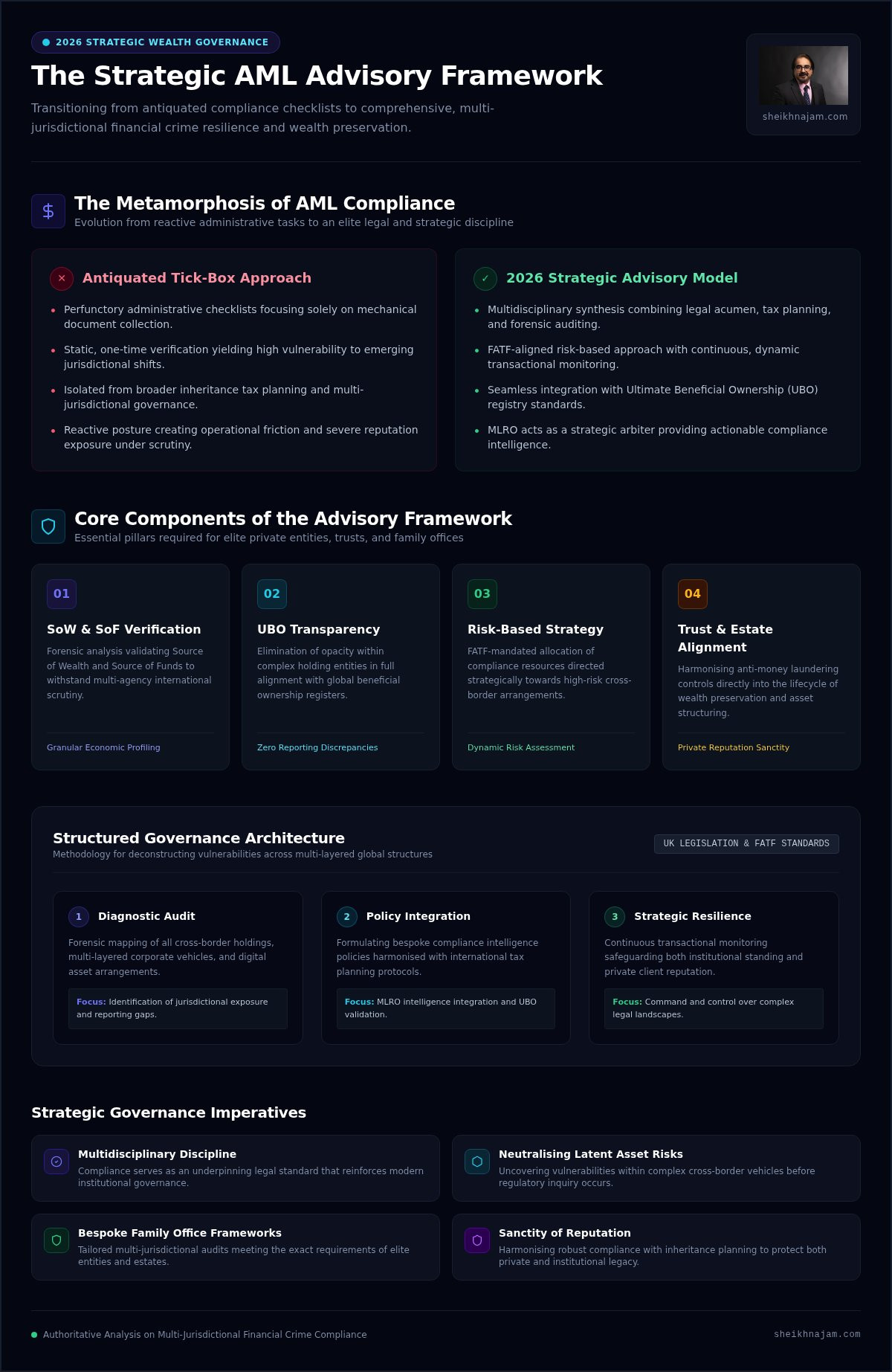
The discipline of aml advisory has undergone a profound metamorphosis, transitioning from a peripheral administrative function into a central pillar of sophisticated legal and regulatory strategy. In 2026, the paradigm shift from rudimentary customer due diligence toward advanced strategic governance is absolute. This evolution reflects the increasing density of fiscal protocols that demand more than mere compliance; they require a proactive, multi-disciplinary approach that synthesises legal expertise, tax planning, and forensic meticulousness. The nexus between international transparency and private wealth management has never been more critical, as the boundaries between domestic oversight and global reporting continue to dissolve.
Defining the Scope of Strategic Compliance
Strategic aml advisory differs fundamentally from routine administrative checking. Whilst the latter concerns itself with the mechanical collection of identity documents, the former operates at the intersection of international trust governance and digital asset structuring. Within private wealth structures, the Money Laundering Reporting Officer (MLRO) serves as a critical arbiter of institutional integrity, tasked with the duty of distilling complex transactional data into actionable compliance intelligence. They ensure every transaction aligns with the risk-based approach mandated by current UK legislation, a requirement that necessitates a granular understanding of the client's global footprint and economic profile. This approach prioritises the identification of high-risk scenarios over generic procedural adherence, transforming the MLRO from a mere gatekeeper into a strategic advisor. Elite practitioners don't just react to laws. They build frameworks that withstand them whilst ensuring that the client's commercial objectives remain unhindered by regulatory friction.
The Increasing Density of Global Reporting Standards
The influence of the Financial Action Task Force (FATF) remains the primary catalyst for the tightening of anti-money laundering compliance standards across the United Kingdom's domestic policy framework. By 2026, the maturity of Ultimate Beneficial Ownership (UBO) registries has eliminated the historical opacity once afforded by complex corporate vehicles, creating an environment where transparency is the default setting. Multi-jurisdictional automatic exchange of information protocols now function with a level of synchronicity that leaves no room for reporting discrepancies or jurisdictional arbitrage. For the high-net-worth individual, this transparency necessitates a governance framework that's both robust and strategically aligned with their broader wealth preservation and inheritance tax planning objectives. This environment demands a level of precision that only multi-disciplinary expertise can provide. High-value compliance is now synonymous with institutional security and the protection of private legacy.
Core Components of a Comprehensive AML Framework for Private Clients
Establishing a robust compliance architecture requires a departure from the perfunctory checklists utilised by standard retail institutions. For high-net-worth individuals, aml advisory must be integrated directly into the lifecycle of trust and estate administration to ensure that every asset transfer or corporate restructuring withstands the most rigorous forensic scrutiny. This framework is predicated on the dual pillars of identification and verification, yet it extends far beyond simple identity verification. It demands a sophisticated understanding of the client's global economic profile and the precise legal mechanisms that govern their holdings.
The FATF risk-based approach guidelines provide the requisite foundation for this methodology, emphasising that resources should be allocated according to the specific vulnerabilities of a structure. Continuous monitoring serves as a vital safeguard, as risk profiles are never static. A shift in jurisdictional stability or a change in the beneficial ownership of a counterparty can instantaneously alter the compliance standing of an entire portfolio. Maintaining an evergreen record of due diligence is not merely a regulatory burden; it's a strategic imperative for the preservation of institutional and private security.
Enhanced Due Diligence for High-Value Transactions
High-value international commercial contracts frequently act as triggers for Enhanced Due Diligence (EDD), necessitating a deeper investigation into the underlying corporate instruments. The role of notarised documentation is paramount in these scenarios, as it provides an immutable layer of authentication that global regulators demand for cross-border transactions. Within our specialist areas, we observe that the failure to properly notarise and apostille key corporate resolutions can lead to catastrophic delays or reputational damage. If you require a detailed review of your current transaction protocols, you may consult our advisory team to ensure absolute precision.
Verifying the Provenance of Wealth
Establishing the legitimacy of wealth requires a clear distinction between the Source of Funds (SoF), which pertains to the specific capital used for a transaction, and the Source of Wealth (SoW), which encompasses the historical accumulation of a client’s entire net worth. For long-standing family trusts, this process involves the meticulous reconstruction of historical records to demonstrate a clear lineage of asset growth. In 2026, documenting the provenance of digital assets presents a unique challenge, requiring the integration of blockchain forensics with traditional legal narratives. Establishing a coherent and verifiable history of wealth is the ultimate defence against the intrusive inquiries of modern financial crime units.
Strategic Risk Assessment: Identifying Vulnerabilities in Global Asset Structures
The interrogation of global asset structures in 2026 requires a level of forensic depth that transcends traditional audit methodologies. Through expert aml advisory, one can identify the subtle "red flags" embedded within complex, multi-layered corporate vehicles, such as the use of nominee shareholders or jurisdictional layering designed specifically to obscure beneficial ownership. These vulnerabilities don't merely threaten regulatory standing; they compromise the fundamental integrity of inheritance tax planning by casting doubt on the legitimacy of asset provenance. Complexity invites risk. It's essential to understand that a robust compliance posture is the primary prerequisite for any successful wealth preservation strategy, ensuring that all holdings remain beyond the reach of punitive regulatory interventions.
The FinCEN advisory on compliance governance remains a definitive touchstone for those seeking to implement independent oversight within their private governance frameworks. This institutional rigour ensures that the strategic management of wealth remains resilient against external financial crime scrutiny. For those managing intricate fiduciary arrangements, our analysis of Financial crime compliance for trusts provides a more granular exploration of these systemic requirements. Establishing a culture of compliance at the highest level of a family office or corporate entity is the only certain method of maintaining long-term reputational security.
Jurisdictional Nuance in International Trusts
Different legal systems interpret "suspicious activity" with varying degrees of stringency, creating significant friction for UK-based beneficiaries of international trusts. The presence of a trust in a "grey-listed" territory often triggers automated reporting obligations under the Common Reporting Standard (CRS), leading to intrusive inquiries into the settlor's historical wealth accumulation. To mitigate these risks, sophisticated advisors often utilise Dutch or other continental holding structures, which provide a stable regulatory environment whilst maintaining compliance efficiency. These structures allow for the consolidation of assets under a single, transparent regime that's recognised for its rigour amongst global financial centres.
Technological Vulnerabilities and Digital Assets
Digital asset structuring must now account for the inherent AML risks of tokenised assets and decentralised finance protocols. Maintaining regulatory alignment requires a meticulous approach to blockchain forensics, ensuring that every digital transfer is mapped and verified against global sanctions lists. The "Travel Rule" in 2026 requires that UK virtual asset service providers transmit specific originator and beneficiary information for all digital asset transfers, regardless of the transaction's value. This mandates a level of transparency that historically didn't exist in the crypto-sphere, making it vital to integrate digital holdings into your broader aml advisory framework to avoid inadvertent compliance failures.
Implementing a Robust Governance Framework for International Transactions
The transition from theoretical risk assessment to operational excellence requires a systematic integration of oversight into every facet of an entity's commercial life. Effective aml advisory serves as the architect of this framework, ensuring that governance is not merely a reactive response to external pressure but an internal standard of institutional weight. For the family office or corporate entity, this involves a five-stage progression toward strategic resilience. The process begins with a comprehensive multi-jurisdictional risk audit to map assets against the evolving regulatory requirements of 2026. This allows for the identification of potential points of friction before they escalate into compliance failures.
Step 1: Conduct a comprehensive multi-jurisdictional risk audit to map every asset, counterparty, and reporting obligation across your global footprint.
Step 2: Formalise written AML policies tailored to the specific family office or entity, eschewing generic templates in favour of bespoke rigour.
Step 3: Establish clear lines of accountability and reporting, ensuring that the designated compliance officer possesses the requisite authority to intervene in transactional flows.
Step 4: Implement rigorous training and awareness for all fiduciaries to ensure they possess the forensic acumen required to identify sophisticated financial crime typologies.
Step 5: Execute regular independent testing of the compliance framework to verify its operational effectiveness and adapt to shifting global standards.
The Role of the Notary in Transactional Integrity
Notarial authentication serves as a primary layer of AML verification, providing an immutable record of corporate intent and identity. In the context of strategic cross-border estate planning, the notary’s role is indispensable for the verification of corporate resolutions intended for global use. This process ensures that documents executed in one jurisdiction carry the requisite legal weight in another, acting as a safeguard against the fraudulent use of corporate instruments. By meticulously verifying the authority of signatories and the legitimacy of the underlying resolutions, the notary provides the high-level assurance that international banks and regulatory bodies demand in 2026.
Fiduciary Duty and Regulatory Liability
The personal liability of trustees and executors has intensified under the latest AML directives, making the implementation of "adequate procedures" a critical legal defence. Fiduciaries are no longer protected by ignorance of a counterparty's origins; instead, they're held to a standard of proactive enquiry. Mitigating executor liability in complex multi-jurisdictional estates requires a documented trail of due diligence that demonstrates a commitment to regulatory alignment. Failure to maintain these standards can result in severe personal repercussions, including significant financial penalties and irreversible reputational damage. To ensure your structures meet these exacting standards, you should secure your governance framework today through expert consultation.
The Role of Expert AML Advisory in Preserving Institutional and Private Reputation
Reputational risk represents the most significant intangible liability facing high-net-worth individuals and institutional entities in the 2026 fiscal epoch. Whilst the pecuniary penalties levied by regulatory bodies are inherently quantifiable, the subtle yet profound erosion of an individual’s standing within the global financial community often carries consequences that are both irreversible and devastating to long-term strategic objectives. Expert aml advisory acts as a critical buffer against this erosion, transforming compliance from a defensive necessity into a proactive instrument of reputational security. This strategic oversight ensures that every facet of an individual’s wealth, from international trust governance to digital asset holdings, is perceived as beyond reproach by global regulators and financial counterparties alike, thereby maintaining the sanctity of one's professional and personal legacy.
Dispute Prevention through Compliance Excellence
A robust framework for anti-money laundering protocols significantly reduces the likelihood of legal friction, particularly in the sensitive areas of contentious probate or trust disputes where asset provenance is often the primary point of contention. When the origin of wealth is meticulously documented and verified through expert aml advisory, the grounds for challenging the legitimacy of a fiduciary arrangement are substantially narrowed, thereby protecting the estate from the costs and delays of litigation. This alignment creates a stable environment where dispute prevention and resolution strategies can be effectively deployed, often utilising mediation to resolve regulatory misunderstandings before they escalate into public or adversarial proceedings. By harmonising compliance with dispute resolution, a practitioner secures the continuity of the estate whilst avoiding the indignity of public scrutiny that often accompanies legal challenges in the modern era.
Securing a Legacy through Strategic Oversight
Positioning compliance as a hallmark of sophisticated wealth management reflects a profound commitment to institutional longevity and the preservation of a private legacy amongst the global elite. A meticulously documented history of compliance serves as a "passport of legitimacy" for future generations, facilitating the seamless transfer of assets across jurisdictions and ensuring that heirs are not burdened by the regulatory failings of their predecessors. In this context, reputational capital is defined as the cumulative trust and credibility an entity or individual commands within the global financial ecosystem, derived from a consistent and verifiable history of regulatory alignment. This capital is the ultimate currency of the 2026 financial landscape, enabling access to elite investment opportunities and securing the family’s position within an increasingly transparent global society.
The logical integration of anti-money laundering protocols into a broader legal strategy represents the ultimate synthesis of law, tax, and compliance. This holistic approach ensures that wealth preservation is not an isolated objective but a direct consequence of rigorous, multi-disciplinary oversight. By adopting the perspective of the "Master Advisor," one can ensure that their most complex affairs are handled with the precision and strategic foresight required to navigate a fragmented regulatory world, where the protection of assets is inextricably linked to the protection of one's name.
Securing Strategic Resilience through Advanced Governance
The evolution of the global regulatory landscape in 2026 demands a definitive shift from reactive compliance to a proactive pillar of wealth governance. We've established that the systematic integration of Source of Wealth verification and rigorous jurisdictional risk audits are essential for protecting both institutional integrity and private legacy. These mechanisms don't just ensure legal alignment; they build the reputational capital necessary for long-term stability in a fragmented financial world. Complexity is no longer a shield, it's a vulnerability that requires methodical oversight.
Expert aml advisory serves as the indispensable link between complex asset structures and absolute regulatory security. Through TEP qualified advisory and a specialised focus on financial crime, our practice provides the multi-disciplinary legal expertise required to handle your most intricate affairs with absolute precision. You can secure your global compliance framework by arranging a consultation with Sheikh Najam TEP. Proactive oversight today ensures your interests remain shielded against the scrutiny of tomorrow, providing the peace of mind that your legacy is built on a foundation of unassailable integrity.
Frequently Asked Questions
What is the primary function of AML advisory for high-net-worth individuals?
The primary function of aml advisory for high-net-worth individuals is to establish a robust governance framework that secures strategic resilience against global regulatory scrutiny whilst meticulously preserving private reputation. It transcends rudimentary identity checks by integrating forensic analysis of asset provenance with sophisticated international tax planning. This proactive approach ensures that every facet of a client's global footprint is aligned with current reporting standards, thereby mitigating the risk of intrusive inquiries or institutional friction in 2026.
How does the risk-based approach differ from traditional compliance?
A risk-based approach differs from traditional compliance by prioritising the identification and mitigation of specific vulnerabilities rather than adhering to a static, universal checklist. Whilst traditional methods focus on perfunctory administrative tasks, the risk-based methodology demands a granular evaluation of jurisdictional risks, complex corporate structures, and the economic profile of counterparties. This dynamic strategy allows fiduciaries to allocate resources effectively, ensuring that high-value transactions receive the level of forensic scrutiny required by contemporary UK legislation.
Can robust AML advisory prevent contentious probate disputes?
Robust aml advisory serves as a vital instrument in the prevention of contentious probate disputes by establishing an immutable record of asset legitimacy and provenance. By documenting the historical accumulation of wealth and the transparency of trust structures, advisors reduce the legal grounds upon which heirs or external parties might challenge the validity of a fiduciary arrangement. This meticulous transparency ensures that the settlor’s intent remains unassailable, providing a clear evidentiary trail that discourages litigation and protects the estate's continuity.
What are the specific AML requirements for international trusts in 2026?
In 2026, the specific requirements for international trusts encompass the absolute transparency of Ultimate Beneficial Ownership (UBO) registries and the synchronised exchange of information under the Common Reporting Standard. Trustees must maintain comprehensive records regarding the settlor, all beneficiaries, and any persons exercising effective control over the trust assets. There is an intensified focus on the forensic verification of the source of wealth, necessitating a documented narrative that accounts for multi-jurisdictional asset movements and reporting obligations.
Why is Source of Wealth (SoW) verification more complex than Source of Funds (SoF)?
Source of Wealth (SoW) verification is significantly more complex than Source of Funds (SoF) because it requires a comprehensive historical reconstruction of an individual’s entire net worth accumulation over several decades. Whilst SoF focuses exclusively on the specific capital utilised for a single transaction, SoW demands forensic evidence of business activities, inheritances, or investment growth that generated the total wealth. This process involves the meticulous collection of historical records, often spanning multiple legal jurisdictions and diverse asset classes.
Is a notary public required for AML verification in international commerce?
A notary public is indispensable for AML verification within the sphere of international commerce, providing a primary layer of authentication that global regulatory bodies demand for cross-border instruments. By verifying the identity of signatories and the authority of corporate resolutions, the notary provides an immutable record of corporate intent that withstands forensic scrutiny. This official authentication acts as a safeguard against fraudulent activity, ensuring that documentation executed in one jurisdiction carries the requisite legal weight in another.
What are the penalties for non-compliance with UK AML regulations for trustees?
The penalties for non-compliance with UK AML regulations are severe, encompassing personal liability for trustees, substantial financial levies, and potential criminal prosecution under the latest directives. Beyond these quantifiable repercussions, the failure to maintain adequate procedures results in irreversible reputational damage, which can lead to the termination of banking relationships and exclusion from elite financial markets. Fiduciaries are held to a standard of proactive enquiry, where ignorance of a counterparty’s origins provides no legal defence.
How does digital asset structuring impact AML compliance obligations?
Digital asset structuring significantly intensifies AML compliance obligations by requiring the integration of blockchain forensics with traditional legal narratives to satisfy the requirements of the 2026 "Travel Rule." This directive mandates that virtual asset service providers transmit specific originator and beneficiary data for all transfers, eliminating the historical anonymity of digital holdings. Consequently, fiduciaries must ensure that tokenised assets are meticulously mapped and verified against global sanctions lists to maintain total regulatory alignment within their broader wealth governance.


Comments