Strategic Mediation for Shareholder Agreement Disputes

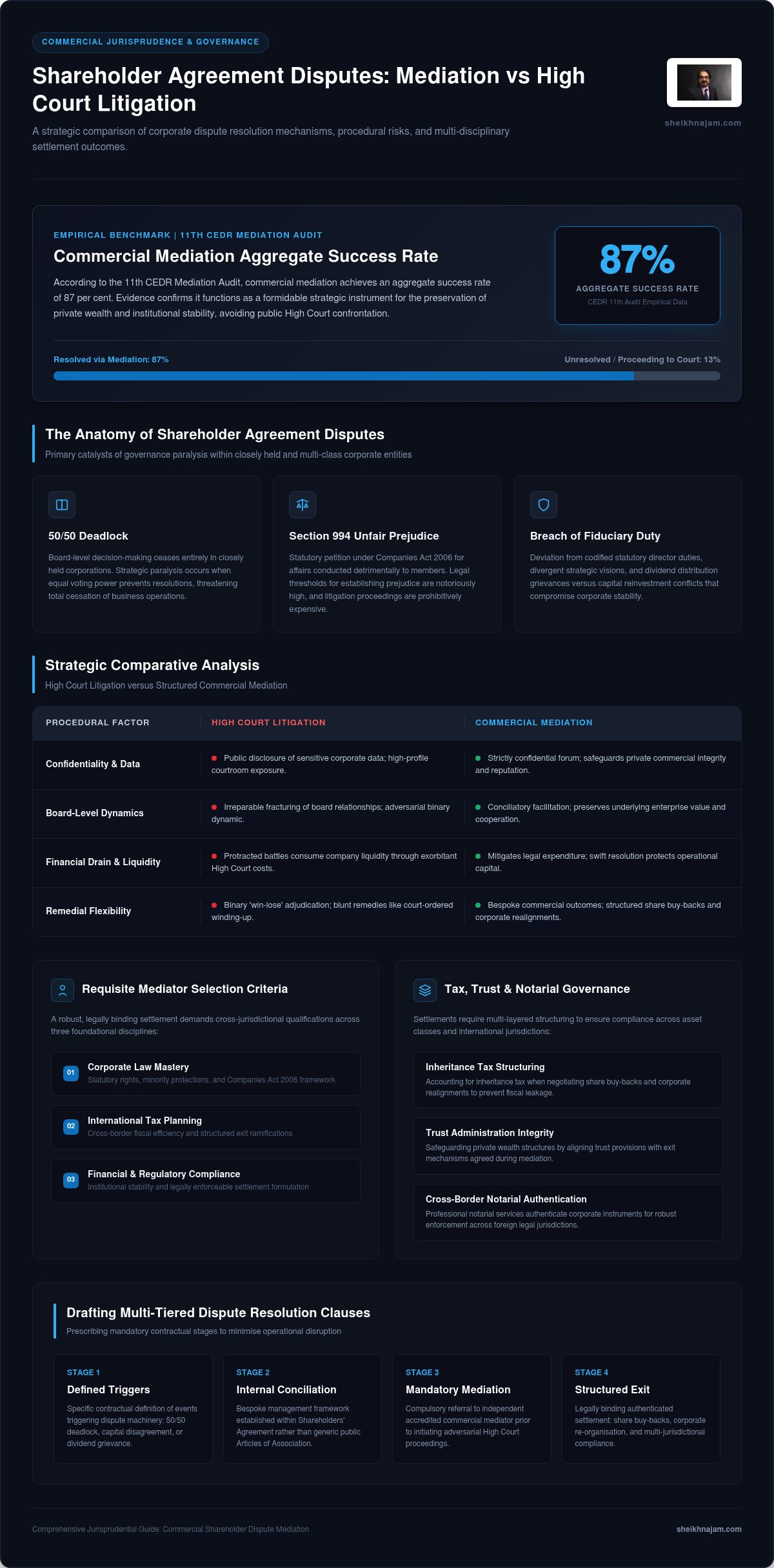
Whilst the visceral instinct of many aggrieved directors is to seek immediate redress through the traditional rigours of High Court litigation, the 11th CEDR Mediation Audit reveals that commercial mediation achieves an aggregate success rate of 87 per cent. This empirical evidence suggests that mediation for shareholder agreement disputes is not merely a conciliatory gesture but a formidable strategic instrument for the preservation of private wealth and institutional stability. You likely recognise that the public disclosure of sensitive corporate data and the irreparable fracturing of board-level relationships represent a cost far exceeding any potential court-ordered award.
It's a reality that protracted legal battles often consume the very liquidity they seek to protect, leaving a trail of operational disruption and tax inefficiencies in their wake. This article provides a comprehensive jurisprudential guide to utilising mediation as a superior alternative to litigation, ensuring that settlements are both legally binding and meticulously structured for regulatory compliance. We shall examine how a multi-disciplinary approach, integrating international tax planning and trust administration, facilitates a structured exit or realignment that safeguards the long-term integrity of your corporate assets.
Table of Contents
The Anatomy of Shareholder Agreement Disputes in Modern Corporate Governance
Mediation versus Litigation: A Strategic Comparison for High-Value Resolution
The Strategic Process of Mediation in Shareholder Conflict Resolution
Drafting Effective Dispute Resolution Clauses in Shareholder Agreements
A Multi-Disciplinary Approach: Integrating Tax, Trust, and Compliance into Resolution
The Anatomy of Shareholder Agreement Disputes in Modern Corporate Governance
High-stakes corporate governance often founders upon the misalignment of shareholder interests, particularly within entities featuring complex, multi-layered shareholding classes. These structures, whilst designed for fiscal efficiency and precise control, frequently become the theatre for divergent strategic visions that can't be easily reconciled. Conflicts often arise from dividend distribution grievances or fundamental disagreements regarding capital reinvestment strategies versus immediate liquidity events. Such fissures don't just stall progress; they actively erode the foundations of sophisticated private wealth structures. Effectively utilising mediation for shareholder agreement disputes allows parties to address these catalysts before they manifest as terminal corporate paralysis, ensuring that the underlying commercial value remains uncompromised by public discord.
Common Triggers: Deadlock, Unfair Prejudice, and Breach of Fiduciary Duty
The legal landscape of shareholder conflict is frequently defined by the 'unfair prejudice' petition under Section 994 of the Companies Act 2006. This statutory mechanism offers redress when a company's affairs are conducted in a manner detrimental to a subset of its members, yet the threshold for establishing prejudice is notoriously high and the proceedings are often prohibitively expensive. In closely held corporations, 50/50 deadlocks represent a unique form of strategic paralysis where board-level decision-making ceases entirely, often leading to a total cessation of operations. When directors deviate from their statutory duties, the resulting breach of fiduciary behaviour doesn't just invite litigation; it jeopardises the very rights of minority shareholders and the integrity of the corporate entity. Mediation provides a confidential, authoritative forum to untangle these knots without the blunt and often destructive force of a court-ordered winding-up or share purchase order.
The Jurisprudential Weight of Shareholder Agreements
Meticulously drafted shareholders' agreements serve as the primary safeguard against the inherent volatility of protracted litigation. Unlike the Articles of Association, which are public-facing and often generic in nature, these bespoke contracts allow for nuanced dispute resolution mechanisms tailored to the specific operational needs of the board. They provide a predictable framework for management, detailing exactly how internal fissures should be addressed and resolved. For international entities or those with cross-border interests, the professional notarial services required for authenticating corporate instruments ensure that any resulting settlement or realignment is robust across multiple jurisdictions. This procedural rigour transforms a simple contract into a sophisticated instrument of corporate stability, providing a clear path from conflict to a legally authenticated resolution.
Mediation versus Litigation: A Strategic Comparison for High-Value Resolution
The traditional adversarial paradigm of the High Court often fails to account for the intricate commercial nuances inherent in high-value corporate structures, where a binary 'win-lose' adjudication may inadvertently trigger the dissolution of a viable enterprise. Whilst litigation remains a necessary instrument for establishing definitive legal precedents, its rigid procedural framework frequently lacks the jurisdictional reach to mandate the creative, tax-efficient remedies required in complex shareholder realignments. The deployment of mediation for shareholder agreement disputes offers a sophisticated alternative, allowing parties to transcend the limitations of statutory remedies in favour of bespoke commercial settlements that preserve the underlying value of the firm. By moving away from the public theatre of the courtroom, directors can engage in a structured negotiation that prioritises the long-term viability of the business over the immediate gratification of a judicial decree.
Cost-Benefit Analysis: Preservation of Corporate Assets
Quantifying the efficacy of mediation requires an analysis that extends beyond simple legal fees to include the 'hidden costs' of management time and operational paralysis. Research indicates that commercial mediation saves UK businesses approximately £5.9 billion annually by mitigating lost productivity and protecting enterprise relationships that would otherwise be decimated by protracted litigation. Institutional investors increasingly favour commercial mediation services because they provide a multi-disciplinary approach to resolution, ensuring that settlements are reached within weeks rather than the multi-year timelines characteristic of the court system. This efficiency is paramount for maintaining investor confidence and ensuring that corporate resources remain focused on strategic growth rather than the friction of internal discord. If you are currently facing such a juncture, discussing your specific resolution requirements with a qualified mediator can illuminate the most asset-protective path forward.
Confidentiality and Privilege: Protecting Sensitive Commercial Data
The 'without prejudice' nature of mediation serves as a robust shield, protecting sensitive board communications and internal financial structures from the public record. This confidentiality is a critical strategic advantage, as it prevents the disclosure of trade secrets or internal fissures that could jeopardise the company's share price or competitive standing. Aligning with the American Arbitration Association's framework for shareholder dispute resolution, elite practitioners ensure that all discussions remain strictly clandestine, fostering an environment where directors can explore radical realignment options without fear of future legal prejudice. This sanctity of process allows for the meticulous management of corporate reputation, ensuring that the resolution of a dispute does not become a catalyst for wider institutional instability.
The Strategic Process of Mediation in Shareholder Conflict Resolution
The methodical selection of a neutral for mediation for shareholder agreement disputes requires a rigorous assessment of their technical pedigree and multi-disciplinary expertise. An effective practitioner must possess not only a profound grasp of corporate jurisprudence but also the financial literacy necessary to deconstruct complex balance sheets, share valuation models, and tax-efficient exit strategies. The preparatory phase is equally critical, involving the meticulous drafting of position statements that transcend mere legal posturing. These documents must identify core commercial objectives and potential areas of compromise, providing the mediator with the necessary data to facilitate a sophisticated resolution. By establishing this analytical foundation, parties ensure that the subsequent negotiation is rooted in commercial reality rather than emotional friction.
Phase-by-Phase Breakdown of a High-Stakes Mediation Day
A high-stakes mediation day commences with opening statements that serve to set a professional and strategic tone for the ensuing dialogue. This phase isn't an opportunity for litigation-style rhetoric but a moment to signal a genuine commitment to a pragmatic settlement. Following this, the process moves into private caucuses, where the mediator meets with each party independently to explore underlying commercial drivers and potential settlement structures. These confidential sessions allow for the identification of the 'strategic pivot', which is the precise moment when the conversation shifts from historical grievances toward future-focused commercial solutions. Whether the outcome is a structured share buy-out or a fundamental realignment of board control, this methodical progression ensures that every option is explored with absolute precision.
The Role of the Mediator in Breaking Deadlock
In environments where former business partners find themselves in an entrenched deadlock, the mediator acts as a strategic facilitator rather than a passive observer. They employ rigorous 'reality testing' techniques to confront parties with the objective risks of litigation, including the potential for public disclosure of sensitive corporate data. This process is particularly vital in multi-jurisdictional disputes, where mediation often interfaces with international commercial arbitration to provide a comprehensive resolution framework. By managing high-emotion environments with a measured, authoritative presence, the mediator bridges the gap between divergent shareholder interests, facilitating a legally binding settlement that accounts for both regulatory compliance and long-term corporate integrity whilst protecting private wealth.
Drafting Effective Dispute Resolution Clauses in Shareholder Agreements
The strategic drafting of dispute resolution clauses is an exercise in institutional foresight, transforming a dormant contractual provision into a robust mechanism for corporate preservation. It's imperative that these clauses define precise trigger events that mandate the commencement of mediation for shareholder agreement disputes, such as a certified board deadlock, a persistent failure to agree on dividend distributions, or a material breach of fiduciary behaviour. Without such specificity, parties often find themselves mired in procedural skirmishes regarding the validity of the mediation request itself, which only serves to exacerbate existing tensions. For the globally mobile professional, these clauses must also specify a clear choice of law and jurisdiction, ensuring that the resolution process remains predictable regardless of the geographic distribution of the shareholders or the company's underlying assets.
Multi-Tiered ADR: From Negotiation to Binding Arbitration
A structured escalation process, often referred to as a multi-tiered Alternative Dispute Resolution (ADR) framework, provides a methodical pathway from informal negotiation to binding resolution. This sequence typically begins with a mandatory period of good-faith executive negotiation, followed by formal mediation, and culminating in arbitration should an impasse persist. Such a framework is particularly effective when dealing with entities where the boundaries between ownership and management are blurred, as seen in arbitration for partnership disputes where comprehensive coverage is required across both corporate and personal interests. By drafting clauses that eliminate jurisdictional ambiguity, directors can ensure that any conflict is contained within a private, authoritative forum rather than spilling into the public record of the courts.
Enforcement and Finality: The Settlement Agreement
The efficacy of the mediation process is ultimately judged by the enforceability of the resulting settlement agreement, which must be drafted with the same meticulousness as the original Shareholders' Agreement. Once signed, this document attains the legal status of a binding commercial contract, yet its weight can be significantly enhanced through the incorporation of consent orders to provide court-backed finality. For settlements involving international share transfers or the re-organisation of cross-border trusts, the role of notarial authentication becomes paramount in ensuring global enforcement. This procedural rigour guarantees that the realignment of interests is not only final amongst the parties but also robust against future regulatory or legal challenges. If you require a bespoke review of your current corporate instruments, contact Sheikh Najam TEP to ensure your dispute resolution framework meets elite standards of precision.
A Multi-Disciplinary Approach: Integrating Tax, Trust, and Compliance into Resolution
The resolution of shareholder conflict is not merely a matter of contractual interpretation; it's a multi-disciplinary exercise that demands a profound understanding of the broader fiscal ecosystem. Realignment of shareholdings often triggers complex interactions with international tax planning, where an ill-conceived exit strategy can result in punitive fiscal liabilities that decimate the very wealth the parties seek to preserve. It's vital to recognise that a mediated settlement isn't a standalone event but a catalyst for significant re-organisation within existing trust structures and estate plans. For high-net-worth families, the movement of equity must be synchronised with long-term wealth preservation objectives to ensure that the immediate resolution of a dispute doesn't create a secondary crisis in inheritance tax exposure. Effectively utilising mediation for shareholder agreement disputes allows for this level of nuanced, real-time financial modelling that traditional litigation simply cannot accommodate.
Tax Mitigation and Wealth Preservation in Settlements
Capital Gains Tax (CGT) triggers represent a significant hurdle during share transfers and corporate exits. Practitioners must rigorously analyse whether a redemption qualifies for capital treatment or if it'll be treated as a dividend distribution, which carries a vastly different tax burden for the recipient. Beyond immediate income and gains, the settlement must be structured to safeguard Business Property Relief (BPR) for inheritance tax purposes. A failure to account for the two-year holding period or the nature of the company's underlying activities during a re-organisation can lead to a 40 per cent inheritance tax charge on assets that were previously exempt. Strategic use of discretionary or interest-in-possession trusts can provide a robust framework for managing these shareholdings for future generations, ensuring that the resolution of today's conflict doesn't compromise the integrity of the family legacy.
Regulatory Compliance and Financial Crime Governance
High-value corporate re-organisations necessitate a rigorous approach to financial crime and AML compliance. Movement of significant corporate assets as part of a settlement requires a level of due diligence that exceeds standard procedural requirements, particularly when dealing with multi-jurisdictional shareholdings. It's essential to maintain the integrity of the settlement by conducting forensic reviews of fund sources and ensuring that every transaction adheres to current regulatory standards. This meticulousness isn't merely a matter of legal obligation; it's a strategic safeguard for the company's reputational standing and long-term stability. For a strategic consultation on your shareholder dispute, contact Sheikh Najam TEP to ensure your resolution is robust across all regulatory and fiscal fronts.
Securing Corporate Stability through Strategic Realignment
The preservation of corporate integrity and the protection of private wealth require more than mere legal advocacy; they demand a multi-disciplinary command over the complex intersections of law, tax, and trust administration. By prioritising mediation for shareholder agreement disputes, directors can navigate internal fissures with the precision and confidentiality that traditional High Court litigation inherently lacks. This strategic approach ensures that every settlement is not only legally binding but also robust across all regulatory and fiscal fronts, safeguarding Business Property Relief and maintaining the sanctity of long-term estate planning.
Sheikh Najam TEP provides a rare synthesis of academic rigour and practical, high-stakes negotiation experience, ensuring your most intricate affairs are managed with absolute meticulousness. It's entirely possible to transform a period of strategic paralysis into an opportunity for a structured, tax-efficient realignment that secures the future of your institution. To discuss how this authoritative framework applies to your specific circumstances, you're invited to Secure a Strategic Consultation with Sheikh Najam TEP. You can move forward with the confidence that your commercial interests are being handled with elite precision.
Frequently Asked Questions
Is mediation for shareholder agreement disputes legally binding in the UK?
A settlement reached through mediation for shareholder agreement disputes becomes legally binding once the parties execute a written settlement agreement. This document functions as a private commercial contract. To ensure its robustness, particularly in international contexts, the agreement often undergoes formal notarial authentication. Whilst the mediator doesn't impose a ruling, the resulting contract is enforceable through the courts as a breach of contract claim if its terms are subsequently ignored.
What happens if mediation fails to resolve the shareholder dispute?
If an impasse persists, the parties typically revert to the secondary mechanisms defined in their dispute resolution clauses, such as binding arbitration or High Court litigation. In sophisticated Med-Arb frameworks, the transition to arbitration is seamless, ensuring that the momentum toward resolution isn't lost. The discussions held during the unsuccessful mediation remain 'without prejudice', meaning they don't serve as evidence in future proceedings, thereby protecting the parties' strategic positions.
How long does the mediation process typically take for a commercial dispute?
The core mediation session generally concludes within one to two days, though the preparatory phase may span several weeks of document review. This timeframe is significantly shorter than the multi-year trajectory of High Court proceedings. According to CEDR data, approximately 87 per cent of commercial mediations settle on the day or shortly thereafter. This efficiency minimises operational disruption and prevents the protracted drainage of corporate liquidity that often accompanies traditional litigation.
Can mediation be used to resolve disputes in a family-owned company?
Mediation is exceptionally effective for family-owned entities where corporate governance intersects with private wealth and inheritance tax planning. It provides a confidential forum to address sensitive internal fissures without risking public disclosure or permanent reputational damage. By integrating trust and estate expertise, the process allows family members to realign their shareholdings in a way that respects both commercial objectives and the long-term integrity of the family's legacy.
Who typically pays for the costs of mediation in a shareholder conflict?
Costs are typically divided equally between the parties, covering the mediator's professional fees and the administrative expenses of the session. However, the final settlement agreement can stipulate an alternative cost-sharing arrangement as part of the negotiated commercial terms. Each party usually remains responsible for their own legal and tax advisory fees. This shared financial commitment to the process often serves as a pragmatic incentive for both sides to reach a swift conclusion.
Can a mediator award damages or order a share buy-back?
A mediator possesses no judicial or quasi-judicial authority to award damages or mandate a share buy-back. Their role is strictly facilitative, aimed at guiding the shareholders toward a mutually acceptable commercial realignment. However, the parties themselves can agree to such remedies within the settlement. This allows for creative solutions, such as tax-efficient share redemptions or trust allocations, which a court lacks the jurisdictional flexibility to order in a binary ruling.
Is mediation compulsory before taking a shareholder dispute to court?
Whilst not strictly compulsory in every instance, UK courts increasingly mandate that parties consider Alternative Dispute Resolution (ADR) under the Civil Procedure Rules. Following recent jurisprudence, such as Churchill v. Merthyr Tydfil, judges have the authority to stay proceedings or order parties to mediate. Unreasonable refusal to engage in mediation for shareholder agreement disputes often results in severe costs sanctions, regardless of the eventual outcome of the substantive legal battle.
How do we select the right mediator for a high-value corporate dispute?
Selecting a mediator for a high-value dispute requires an assessment of their multi-disciplinary pedigree. You should seek a practitioner who demonstrates academic rigour and practical expertise in corporate law, international tax planning, and trust administration. Given the complexity of shareholder realignments, the neutral must be capable of deconstructing intricate financial models and regulatory frameworks. This ensures that the facilitated settlement is robust across all legal and fiscal fronts.


Comments