Arbitration for Partnership Disputes: A Strategic Case Study and Jurisprudential Analysis (2026)

The persistent belief that the public courtroom remains the pre-eminent forum for the resolution of high-stakes commercial disagreements is a strategic fallacy that continues to jeopardise the fiscal and reputational integrity of premier professional partnerships. For the high-net-worth individual, the involuntary exposure of sensitive financial data and the inherent unpredictability of judicial timetables represent more than mere inconveniences; they constitute an existential threat to one’s professional standing and the underlying value of the enterprise. You are likely well aware that the traditional litigation process often lacks the specialist expertise required to parse niche partnership structures, leaving your most intricate commercial arrangements at the mercy of a generalist bench. This article provides a sophisticated examination of how arbitration for partnership disputes serves as a superior governance mechanism, offering a confidential, expert-led path to resolution that prioritises intellectual precision over public spectacle.
We shall conduct a rigorous jurisprudential analysis of the 2026 ICC and JAMS rule updates, including the newly introduced Highly Expedited Arbitration Provisions, to illustrate how a binding award can be secured and enforced internationally whilst ensuring that your most complex affairs remain shielded from the corrosive effects of public scrutiny.
Table of Contents
The Anatomy of High-Value Partnership Disputes
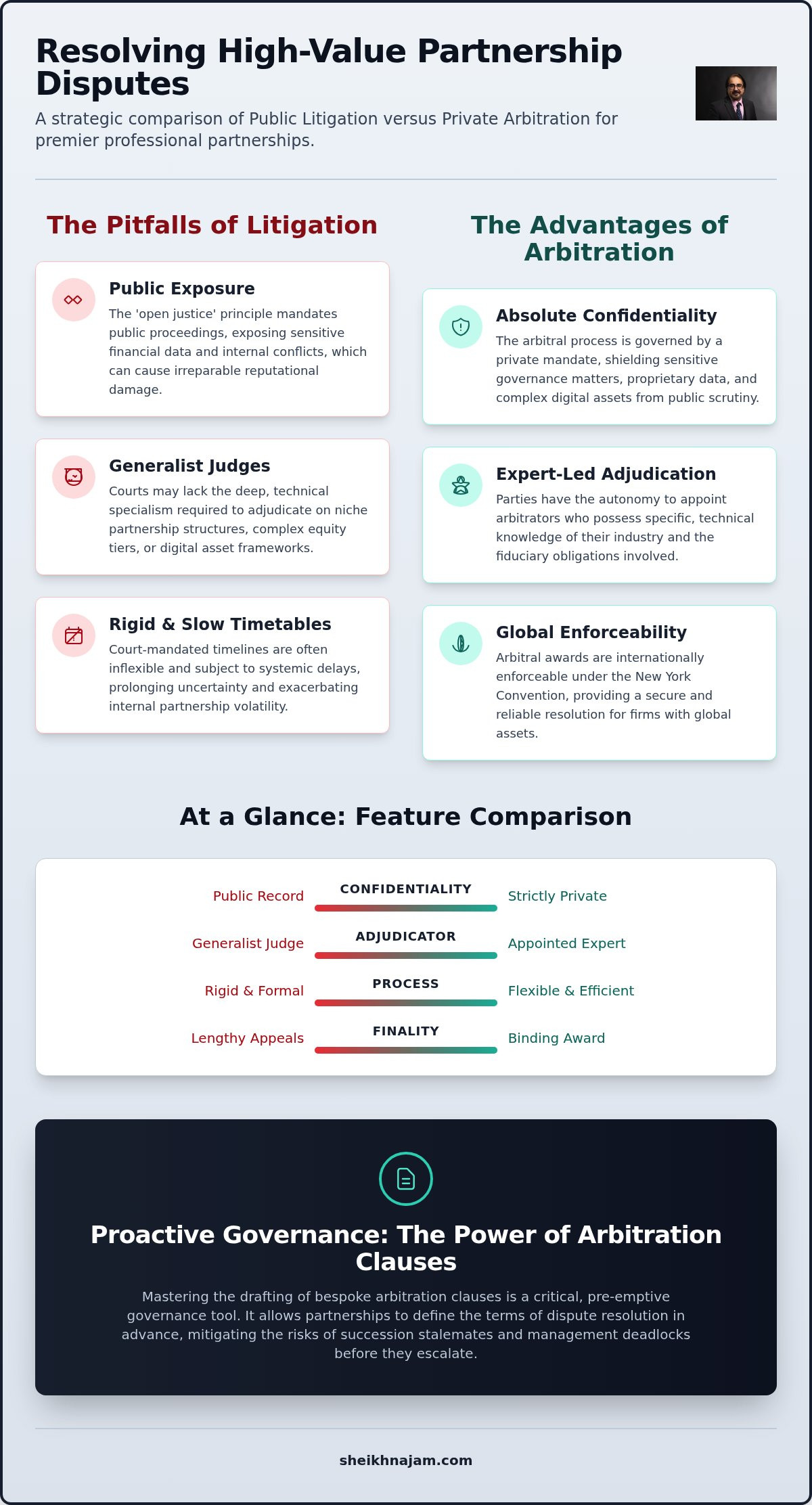
The structural integrity of high-value professional partnerships rests upon a delicate equilibrium of mutual trust and rigorous fiduciary accountability. When this balance is disturbed, the resulting friction often transcends simple contractual disagreement, evolving into a multifaceted legal crisis. Catalysts for such disruption frequently include contentious profit distribution models, succession stalemates in long-standing firms, or management deadlocks that paralyse executive decision-making. In these instances, the decision to pursue what is arbitration rather than traditional litigation doesn't just represent a legal choice; it's a strategic pivot toward discretion. Utilising arbitration for partnership disputes allows senior partners to resolve these volatile internal conflicts without exposing the firm's sensitive financial architecture to the public record.
Fiduciary Obligations and Jurisprudential Friction
The Partnership Act 1890 remains the foundational pillar of British partnership law, yet its application to modern, multi-jurisdictional HNW structures often creates significant legal tension. At the heart of this tension lies the requirement for 'utmost good faith', a standard that demands absolute transparency and loyalty amongst partners. In a public courtroom, proving a breach of this duty requires the disclosure of internal communications and private ledgers, which can cause irreparable damage to the firm's market valuation. Reputational risk is a tangible liability; for elite professional services, the mere perception of internal instability can lead to client attrition and a precipitous decline in institutional prestige.
The Limitations of the Traditional Court System
Generalist commercial courts, whilst capable, often lack the deep technical specialism required to adjudicate the nuances of complex equity tiers or digital asset vesting schedules. The 'open justice' principle, a cornerstone of the English legal system, mandates that court proceedings are generally accessible to the public and the press. This transparency is fundamentally incompatible with the needs of high-net-worth individuals who require absolute privacy for their financial arrangements. Court-mandated timelines are frequently rigid and subject to systemic delays, which only serves to exacerbate partnership volatility. Transitioning to a private forum ensures that the resolution process is managed by an expert who understands the commercial realities of the sector. Those seeking to safeguard their firm’s future should consider professional consultation to explore bespoke dispute resolution frameworks.
The Jurisprudential Superiority of Arbitration for Partnership Resolution
The superiority of the arbitral forum over traditional litigation is most evident in the preservation of commercial sanctity and the precision of the adjudicative outcome. While the definition of arbitration encompasses a range of private adjudicatory processes, its application within the City's elite partnership tiers provides a level of control that the public judiciary simply cannot replicate. The primary strength of arbitration for partnership disputes lies in its inherent confidentiality, which serves as a protective veil for firms whose value is predicated on institutional reputation and proprietary intelligence. Unlike the High Court, where the open justice principle prevails, the arbitral process is governed by a private mandate that ensures sensitive internal governance matters remain strictly between the parties involved. This procedural autonomy extends to the finality of the award; the limited grounds for judicial intervention under the Arbitration Act 1996 provide a degree of certainty that is often absent in the protracted appellate cycles of the court system.
Confidentiality and the Protection of Digital Assets
High-net-worth structures in 2026 increasingly incorporate complex digital asset frameworks and proprietary algorithms that require absolute discretion. Under the legal framework of the 1996 Act, the privacy of the proceedings is a legally enforceable standard that prevents the public disclosure of internal failures or sensitive asset valuations. This level of protection is vital for partnerships managing decentralised financial instruments or private equity interests, where a single public leak could trigger regulatory scrutiny or unwanted market volatility. By opting for a private forum, partners ensure that their commercial integrity remains uncompromised by the voyeurism of the public record. It's a strategic necessity for those managing multi-jurisdictional wealth where privacy is the ultimate currency.
Technical Expertise vs. Judicial Generalism
The strategic advantage of selecting a seasoned Trust and Estate Practitioner (TEP) as an arbitrator cannot be overstated, particularly when navigating the intricate tax implications of a partnership dissolution. Generalist judges, whilst proficient in broad commercial law, may lack the niche multi-disciplinary expertise required to address complex fiduciary duties or the nuances of international tax compliance. Expert Determination is a specific mechanism within the broader dispute resolution landscape where a specialist is appointed to provide a binding decision on a technical or valuation issue. This expert-led approach ensures that the final award is grounded in technical reality rather than generalist judicial interpretation. To ensure your governance structures are robust enough to withstand such scrutiny, you may wish to discuss bespoke dispute resolution frameworks with a qualified advisor who understands the intersection of law and private wealth.
Strategic Case Study: Resolving Multi-Jurisdictional Partnership Conflicts
The efficacy of private adjudication is best demonstrated through the lens of a recent conflict involving a prominent cross-border private equity firm. The dispute emerged between senior partners operating across different sovereign jurisdictions, triggered by a profound impasse regarding the valuation of carried interest and the subsequent discovery of unrecorded digital asset transfers. Allegations of breach of trust and the misappropriation of proprietary investment algorithms threatened to derail the firm's operational stability. In such high-stakes environments, the decision to employ arbitration for partnership disputes isn't merely a procedural choice; it's a defensive measure designed to insulate the firm's global reputation from the predatory nature of public disclosure. The partners recognised that a public airing of these internal governance failures would likely trigger catastrophic client attrition and unwanted regulatory scrutiny.
The Escalation and Selection of the Arbitral Forum
Initial attempts at negotiation failed as the parties remained deadlocked over profit-sharing ratios and the specific vesting schedules of digital holdings. The complexity of the firm's structure necessitated a tribunal that possessed more than a cursory understanding of commercial law. By choosing to bypass the traditional court system in favour of institutional arbitration, the partners were able to select an arbitrator with a multi-disciplinary background in international tax and financial crime. This selection process ensured that the adjudicator could parse the technical nuances of the firm’s offshore trust arrangements whilst maintaining absolute discretion. You can learn more about my specialist areas in dispute resolution to understand how such expert-led forums provide a level of command and control that generalist courts cannot match.
Evidence Management and Final Adjudication
The arbitral process facilitated the management of sensitive cross-border evidence without compromising the stringent regulatory compliance standards of either jurisdiction. Expert witnesses were utilised to clarify the intricate layers of the firm's trust structures, providing the tribunal with the technical clarity required for a precise award. Since the dispute involved significant transatlantic interests, the tribunal’s procedural framework remained cognisant of the Federal Arbitration Act to ensure the eventual award would be robust enough for international enforcement. When considering the merits of arbitration for partnership disputes, the ability to manage cross-border evidence without compromising regulatory compliance remains a primary advantage. The final adjudication didn't just resolve the immediate financial disagreement; it provided a comprehensive roadmap for future partnership governance. This confidential award enabled the firm to restructure its internal fiduciary obligations and secure its digital assets, all whilst the external market remained entirely unaware of the preceding volatility.
Enforceability and Global Compliance in Partnership Arbitration
The definitive advantage of the arbitral forum for multi-jurisdictional partnerships lies in the global portability of the resulting award. Unlike domestic court judgments, which frequently depend on reciprocal treaties that may be inconsistent or entirely absent between specific nations, the New York Convention provides a rigorous framework for enforcement across 172 contracting states as of 2026. For high-net-worth partners managing significant foreign assets or operating with non-domiciled members, this ensures that the resolution reached through arbitration for partnership disputes is a legally binding reality that can be executed with precision across borders. This international reach is particularly critical when a dispute involves the dissolution of equity held in offshore trust structures or the recovery of digital assets situated in varied regulatory environments.
Cross-Border Enforcement Frameworks
Arbitral awards are often easier to enforce globally than court judgments because the grounds for a state to refuse recognition are strictly limited. One of the primary hurdles in international enforcement is the 'Public Policy' exception, where a local court may decline to enforce an award if it's deemed contrary to the fundamental legal principles of that jurisdiction. Navigating these nuances requires a sophisticated understanding of how different seats of arbitration interpret such exceptions. You may find a deeper analysis of these mechanisms in my Strategic Treatise on International Commercial Arbitration. Ensuring that the arbitral process is conducted with absolute procedural integrity from the outset is the only way to mitigate the risk of an award being challenged in a foreign court.
Regulatory Oversight and Financial Crime Prevention
The intersection of partnership dissolution and regulatory compliance is a landscape fraught with risk, especially regarding the transfer of high-value interests. Arbitrators must exercise meticulous due diligence to ensure that asset distributions don't inadvertently facilitate financial crime or breach international sanctions. This is where the multi-disciplinary expertise of a seasoned advisor becomes indispensable, as they must identify and mitigate potential AML risks whilst adjudicating the primary dispute. The UK's stringent regulatory framework ensures that arbitral awards involving the transfer of high-value interests must adhere to prevailing anti-money laundering and counter-terrorism financing standards to remain enforceable. When a partnership dispute involves the death of a senior partner, the process further overlaps with contentious probate, requiring a nuanced understanding of how partnership law interacts with the administration of complex estates. To ensure your international assets are protected through a compliant and enforceable resolution, you should contact my chambers for a strategic consultation.
Implementing Arbitration Clauses: A Pre-emptive Governance Strategy
The transition from reactive conflict management to proactive institutional governance is achieved through the meticulous drafting of bespoke arbitration clauses within the foundational partnership agreement. For the sophisticated firm, relying on generic boilerplate language is a strategic error that fails to account for the unique complexities inherent in high-net-worth structures. A well-constructed clause acts as a definitive framework, defining the scope of potential disputes with absolute clarity to prevent jurisdictional ambiguity. This scope must encompass everything from fundamental financial disagreements and profit distribution models to the more sensitive matters of trustee removal and the variation of international trust instruments. By selecting a specific seat of arbitration, partners can optimise both the procedural efficiency of the resolution and the long-term tax implications of any resulting award. The logical progression from mediation to binding arbitration for partnership disputes within tiered clauses ensures that every attempt at amicable settlement is exhausted before moving to a final, adjudicative phase.
Bespoke Clause Drafting for HNW Partnerships
Modern partnership agreements must evolve to address the distinct challenges of the digital age and the decentralisation of private wealth. This requires clauses that specifically include digital asset disputes and the valuation of proprietary intellectual property within the arbitral mandate, ensuring no asset class remains outside the tribunal's reach. It's equally vital to specify the precise number and technical qualifications of the arbitrators. For instance, requiring that the tribunal includes a Trust and Estate Practitioner ensures that the adjudicators possess the necessary multi-disciplinary expertise to handle complex fiduciary arrangements. If you require assistance in fortifying your firm's governance against future volatility, you may contact Sheikh Najam TEP for strategic dispute prevention advice.
Conclusion: The Strategic Polymath's Approach to Resolution
The adoption of arbitration for partnership disputes represents a deliberate choice for precision, confidentiality, and commercial stability over the inherent unpredictability of the public judiciary. As we've examined throughout this analysis, the traditional court system's lack of technical specialism and the burden of the open justice principle make it an unsuitable forum for the intricate affairs of high-net-worth individuals. The approach provided by Sheikh Najam TEP integrates legal, financial, and regulatory foresight to ensure that disputes are resolved in a manner that prioritises the enterprise's underlying value. In an era of increasing global transparency and complex regulatory oversight, the ability to maintain absolute command and control over internal conflicts is the ultimate hallmark of a sophisticated partnership. To safeguard your commercial interests and ensure a secure, expert-led resolution framework, secure your partnership's future via the contact-8 landing page.
Fortifying Commercial Integrity in a Globalised Landscape
The strategic imperative of utilising arbitration for partnership disputes lies in the synthesis of absolute discretion and technical precision. By bypassing the inherent unpredictability and public exposure of the generalist courts, sophisticated partners ensure that their most complex fiduciary and financial arrangements are adjudicated by specialists who understand the intersection of international tax and trust governance. This approach doesn't just resolve immediate conflict; it preserves the underlying valuation and reputational standing of the firm within the global marketplace. It's a shift from reactive litigation to a proactive governance model that prioritises the long-term stability of the enterprise and its high-net-worth stakeholders.
To navigate these intricate legal landscapes with absolute command and control, you should instruct a specialist in partnership arbitration and multi-disciplinary law. The practice of Sheikh Najam TEP provides a unique depth of expertise in civil and commercial mediation, alongside strategic advisory on financial crime and compliance, ensuring your interests are protected by a TEP-qualified authority. Securing your firm's future requires a meticulous, expert-led framework that stands robust against both internal volatility and external regulatory scrutiny. You can rest assured that your most sensitive commercial affairs are being managed with the precision and gravitas they deserve.
Frequently Asked Questions
Is an arbitration award for a partnership dispute legally binding in the UK?
An arbitral award rendered in the United Kingdom is definitively binding upon all parties involved, possessing the same legal force as a judgment issued by the High Court. Under the statutory framework of the Arbitration Act 1996, such awards are enforceable through the court system, provided the proceedings adhered to the requisite procedural standards. This ensures that the resolution of arbitration for partnership disputes is not merely advisory but a final, legally robust conclusion to the conflict.
How long does it typically take to resolve a partnership dispute through arbitration?
The duration of the arbitral process is contingent upon the complexity of the partnership structure and the specific procedural rules adopted by the parties. Whilst traditional litigation in the commercial courts can extend over several years, arbitration often provides a more streamlined timetable. Under the 2026 ICC Rules, expedited procedures are available for claims below specific thresholds, often resulting in a final award within six to nine months of the initial case management conference.
Can arbitration be used if our partnership agreement does not have an arbitration clause?
Parties may certainly elect to utilise arbitration even in the absence of a pre-existing clause within their foundational partnership agreement. This is achieved through a submission agreement; a bespoke contract where all partners formally consent to refer their current dispute to a private tribunal. This post-dispute election allows partners to secure the benefits of confidentiality and specialist expertise, even if their original governance documents favoured the public court system or remained silent on the matter.
What happens if one partner refuses to participate in the arbitration process?
If a valid arbitration agreement exists, the process can proceed despite the recalcitrance of a single partner. The tribunal possesses the statutory authority to conduct ex parte proceedings, meaning the arbitration continues and a binding award is issued in that partner's absence. This prevents any individual from unilaterally paralysing the resolution process through non-cooperation, ensuring that the firm's operational integrity is maintained whilst a final, enforceable decision is reached by the appointed expert tribunal.
Is arbitration more expensive than going to the High Court for partnership matters?
The fiscal implications of arbitration differ significantly from the public judiciary. Whilst parties must remunerate the arbitrator and the administering institution, the total expenditure often remains lower than protracted High Court litigation. This is primarily due to the limited grounds for appeal and the accelerated timelines, which reduce the cumulative burden of legal fees. In high-value arbitration for partnership disputes, the preservation of the firm's market valuation through confidentiality frequently outweighs the direct costs of the private forum.
Can an arbitrator handle disputes involving international trusts and foreign assets?
An arbitrator with the requisite multi-disciplinary expertise, particularly one holding the TEP designation, is uniquely equipped to adjudicate disputes involving international trust variations and offshore asset structures. Such practitioners possess the technical literacy to parse complex tax implications and fiduciary duties across multiple jurisdictions. This specialist oversight ensures that the distribution of foreign assets is handled with absolute precision, maintaining compliance with both domestic regulations and the international standards governing private wealth holdings.
Is the outcome of a partnership arbitration confidential to the public?
Confidentiality is a foundational pillar of the arbitral process, ensuring that the details of the dispute, the evidence presented, and the final award remain shielded from the public record. Unlike the open justice principle of the High Court, which permits press access to sensitive financial data, arbitration remains a private matter between the parties. This protection is essential for professional practices where the public disclosure of internal governance failures or profit-sharing arrangements could lead to irreparable reputational damage.
How do I choose the right arbitrator for a complex professional practice dispute?
Selecting the appropriate adjudicator requires a focus on multi-disciplinary qualifications that align with the specific technicalities of the dispute. It's advisable to appoint a practitioner who possesses a deep understanding of trust governance, international tax planning, and financial crime compliance. A Trust and Estate Practitioner (TEP) with experience in civil and commercial mediation provides the necessary command and control to navigate intricate partnership structures, ensuring the final award is both jurisprudentially sound and commercially viable.



Comments