The Enforcement of International Arbitration Awards: A Strategic Jurisprudential Analysis

A final arbitral award is not the definitive conclusion of a legal dispute; it's the strategic inception of a rigorous, multi-jurisdictional pursuit for exigible assets. You're likely aware that the prestige of a hard-won tribunal victory remains purely academic whilst a debtor employs sophisticated concealment tactics or navigates the uneven application of the New York Convention. This treatise offers a comprehensive jurisprudential analysis of the mechanisms and legal frameworks governing the international arbitration enforcement of awards, providing the strategic foresight necessary to convert a legal instrument into a definitive court judgment.
We'll examine the complexities of asset seizure, the mitigation of post-award litigation, and the indispensable role of notarial authentication in securing recognition across diverse global jurisdictions. By mastering the intersection of international tax, trust governance, and commercial litigation, the practitioner can ensure that a favourable award results in successful recovery rather than a protracted cycle of procedural frustration. This analysis serves as a masterwork for those seeking absolute precision in the final, and most critical, phase of high-stakes dispute resolution.
Table of Contents
The Jurisprudential Framework: The New York Convention and Beyond
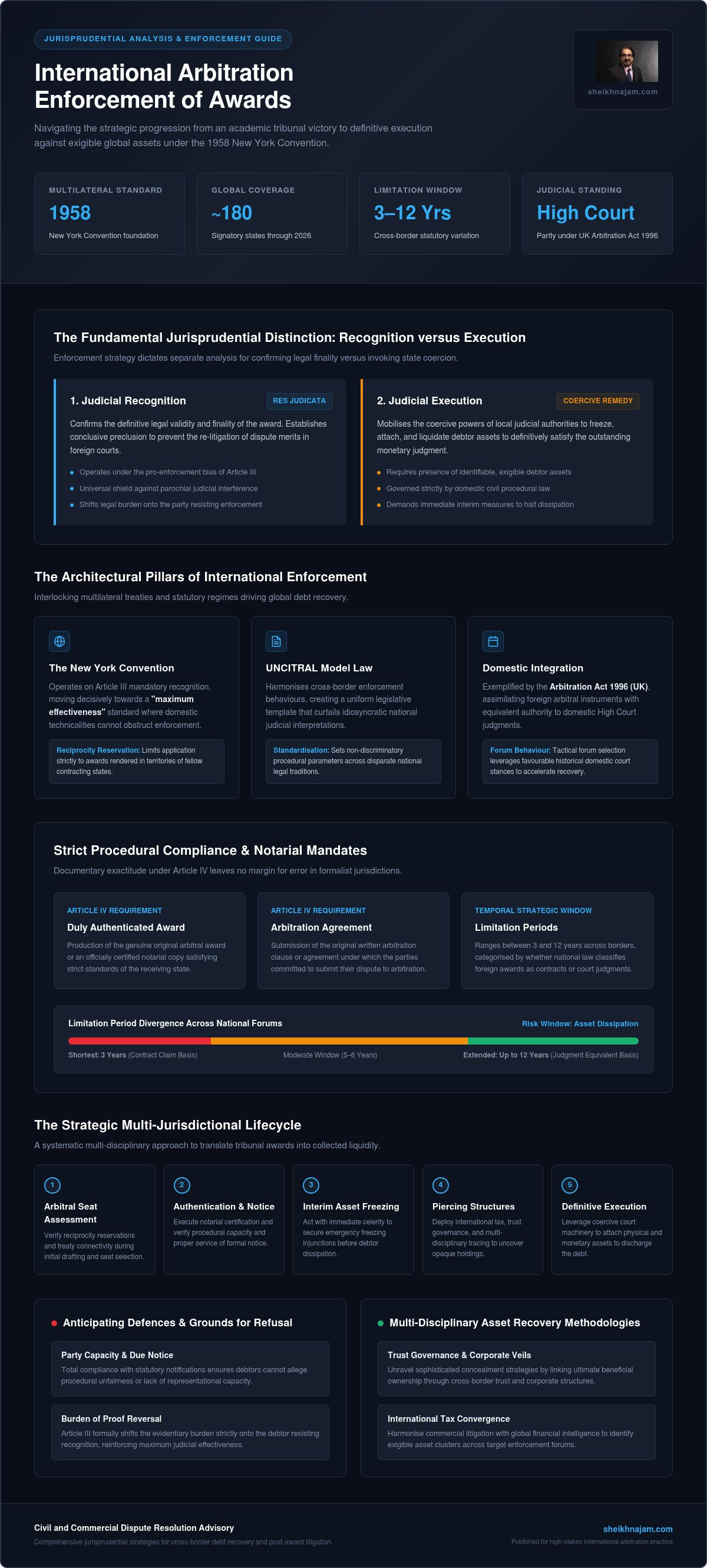
The architectural integrity of global commerce relies upon the predictable application of the New York Arbitration Convention, a multilateral instrument that serves as the definitive cornerstone for the international arbitration enforcement of awards. Whilst the Convention establishes a pro-enforcement bias, the strategic practitioner must navigate the "Reciprocity Reservation," a mechanism whereby contracting states elect to apply the treaty only to awards rendered in the territory of another signatory. This limitation necessitates a meticulous assessment of the seat of arbitration during the drafting phase to ensure the eventual award remains exigible across the desired jurisdictions.
The UNCITRAL Model Law further supports this framework by harmonising national enforcement behaviours, providing a consistent legislative template that reduces the risk of idiosyncratic judicial interpretations. It's essential to distinguish between the recognition of an award, which confirms its status as res judicata, and its actual execution. Recognition prevents the re-litigation of the merits, yet execution requires the coercive power of a local court to seize assets and satisfy the debt. Strategy dictates the venue for both.
The Primacy of the New York Convention
Article III of the Convention imposes a mandatory obligation upon contracting states to recognise arbitral awards as binding and to enforce them in accordance with local procedural rules. This treaty effectively minimises cross-border legal friction by shifting the burden of proof onto the party resisting enforcement. As we progress through 2026, with the number of signatory states approaching 180, the global reach of the Convention provides a nearly universal shield against parochial judicial interference. The evolution of enforcement standards has moved towards a "maximum effectiveness" principle, where courts are increasingly reluctant to permit technicalities to obstruct the realisation of a tribunal's final decision.
National Legislation and Enforceability
In the United Kingdom, the Arbitration Act 1996 facilitates the seamless integration of foreign awards into the domestic legal system, treating them with the same gravity as a judgment rendered by the High Court. This interaction between international treaty obligations and domestic procedural law requires a sophisticated understanding of local practice to avoid unnecessary delays. Successful recovery often hinges on the strategic selection of an enforcement forum based on its historical behaviour towards international instruments. Within the context of civil and commercial dispute resolution, the choice of jurisdiction is as critical as the legal arguments themselves. A master advisor ensures that the domestic procedural rules of the target state are leveraged to accelerate the recognition process whilst simultaneously neutralising any local attempts at obstruction.
Procedural Requirements for Recognition and Notarial Authentication
The transition from a theoretical right to a practical remedy in the international arbitration enforcement of awards demands a level of documentary meticulousness that allows no margin for error. Article IV of the Convention dictates that the party seeking recognition must produce the original award or a duly authenticated copy, alongside the original arbitration agreement. Failure to observe these formalistic requirements can lead to summary dismissal in more rigid jurisdictions. One must consult the UNCITRAL New York Convention guidelines to ensure that the petition meets the non-discriminatory standards required by the treaty.
Strategic timing is equally critical. Limitation periods for the international arbitration enforcement of awards vary significantly across borders, often ranging from three to twelve years depending on the local classification of the award as a contract or a judgment. Early engagement prevents the risk of a time-barred claim and allows for the immediate imposition of interim measures to freeze the debtor's assets. A failure to act with celerity may inadvertently grant the debtor a window to dissipate assets or seek a set-aside order in the seat of arbitration.
The Critical Role of Notarial Services
International courts seldom accept a simple photocopy of a foreign instrument. A rigorous "chain of authenticity" must be established through professional notarial services, ensuring that the award is properly notarised and, where necessary, apostilled for use in foreign courts. The expertise of Sheikh Najam TEP in authenticating global corporate instruments provides the requisite institutional weight to satisfy even the most discerning judicial scrutiny. This meticulous verification process serves as a shield against allegations of forgery or procedural irregularity. If you require absolute precision in the authentication of your legal instruments, you may arrange a formal consultation.
Documentary Precision in Enforcement Petitions
Precision extends to the linguistic integrity of the submission. If the award is not in the official language of the enforcement state, a certified translation is mandatory. This is not a mere clerical task; the translation must be accurate to the point of jurisprudential equivalence. Any ambiguity in the translated text can provide the debtor with a foothold to challenge the award's clarity or scope.
Drafting the enforcement petition also requires a sophisticated cost-benefit analysis of multi-jurisdictional filings. Pursuing a debtor across multiple jurisdictions simultaneously might be tactically sound, yet it demands a command of diverse procedural rules and a layered approach to managing legal costs whilst maximising the probability of successful asset recovery. Every document submitted must be curated to withstand the highest level of adversarial challenge.
Grounds for the Refusal of Enforcement: A Strategic Analysis
Whilst the international arbitration enforcement of awards is generally robust, Article V of the New York Convention provides an exhaustive list of defences that a debtor may deploy to obstruct recognition. These grounds are strictly interpreted, yet they require a proactive counter-strategy from the award creditor to prevent procedural stagnation. Incapacity of the parties or the invalidity of the primary arbitration agreement under its applicable law serves as a primary hurdle for any recovery effort. Similarly, any award that exceeds the specific scope of the submission to arbitration risks partial or total refusal, potentially rendering years of complex litigation moot. The ICSID award recognition and enforcement framework provides a critical parallel for understanding how domestic courts interact with sovereign immunity and certification requirements during these high-stakes challenges.
Navigating Public Policy Challenges
The public policy exception remains the most potent, yet frequently misapplied, defence available to a resisting party. In 2026, courts in pro-arbitration jurisdictions like the United Kingdom maintain an exceptionally high threshold, ensuring that "public policy" isn't used as a back-door for a merits review or a second bite at the apple. Allegations of corruption, bribery, or fraud in the underlying contract must be substantiated with compelling evidence to displace the presumption of enforceability. A master advisor anticipates these challenges by ensuring the underlying transaction is structurally sound and compliant with global regulatory standards long before the final award is rendered, thereby neutralising potential "public policy" objections at their inception.
Procedural Irregularities and Due Process
Article V(1)(d) addresses situations where the arbitral procedure deviates from the parties' agreement or the law of the seat. A lack of proper notice or a violation of the "right to be heard" principle can be fatal to the international arbitration enforcement of awards. To pre-emptively address these due process challenges, the practitioner must ensure meticulous record-keeping during the hearing phase, documenting every procedural opportunity granted to the opposing party. For a deeper analysis of the initial stages of this process, see A Strategic Treatise on International Commercial Arbitration. Strategic foresight during the arbitration itself is the best defence against post-award obstructionism, transforming a vulnerable award into an unassailable judgment.
Multi-Jurisdictional Asset Tracing and Recovery Strategies
The successful international arbitration enforcement of awards frequently hinges upon a sophisticated, multi-jurisdictional asset tracing campaign that transcends mere legal recognition. Whilst a court may recognise the award as a judgment, the actual realisation of funds requires a tactical hunt for exigible assets that have often been obscured through intricate shell structures and nominee arrangements. Piercing the corporate veil is no longer an exceptional remedy but a strategic necessity, requiring the practitioner to demonstrate that the corporate form is being utilised as a mere facade for the debtor's activities. The hunt is relentless. This process is increasingly complicated by the emergence of virtual wealth, where digital asset structuring requires a master advisor who understands the intersection of blockchain technology and traditional enforcement mechanisms.
To prevent the dissipation of assets during the recognition phase, the immediate application for interim measures, such as worldwide freezing orders, is imperative. These coercive instruments preserve the status quo whilst the chain of authenticity is verified by the relevant authorities. Strategy dictates the venue. By securing assets at the earliest possible stage, the creditor neutralises the debtor's ability to engage in post-award asset flight, thereby ensuring the eventual judgment isn't merely a pyrrhic victory.
Identifying and Seizing Shadow Assets
Uncovering assets hidden within international trusts or opaque discretionary structures demands a multi-disciplinary approach, often involving close collaboration with forensic accountants to map the flow of capital across borders. In the High Court, the use of Disclosure Orders provides a powerful mechanism to compel transparency from third parties, such as banks or corporate service providers, who may hold information regarding the debtor's beneficial interests. This methodical accumulation of financial intelligence ensures that the enforcement petition is targeted at tangible value rather than empty corporate shells. Meticulousness is the only path to recovery.
Sovereign Immunity and State Assets
Enforcing awards against sovereign states or state-owned entities introduces the complex layer of sovereign immunity, a doctrine that distinguishes between assets held for jure imperii (sovereign) purposes and those utilised for jure gestionis (commercial) activities. Strategy dictates the selection of enforcement jurisdictions where the definition of commercial property is interpreted broadly, thereby limiting the state's ability to claim immunity over revenue-generating assets. Navigating these diplomatic and legal nuances requires a level of precision that only a seasoned strategist can provide. If you are currently facing challenges in the recovery of a multi-jurisdictional award, you may contact our chambers to discuss a bespoke recovery strategy.
The Strategic Role of Specialist Advisory in Post-Award Litigation
The finality of an arbitral award is often an illusion in the face of a determined debtor. Navigating the post-award legal landscape requires more than just procedural knowledge; it demands the command of a "Master Advisor" who can orchestrate a global recovery operation with absolute precision. Within the paradigm of civil and commercial dispute resolution, the international arbitration enforcement of awards must be treated as a high-stakes convergence of legal, financial, and regulatory disciplines. Fragmented legal teams often fail because they lack the central strategic oversight necessary to anticipate the debtor's next move. The methodology employed by Sheikh Najam TEP prioritises a meticulous synthesis of these diverse fields, ensuring that every legal action is supported by a robust understanding of the debtor's broader economic and reputational vulnerabilities. Meticulousness is the only path to resolution.
The Multi-Disciplinary Advantage
Expertise in international tax planning isn't merely an adjacent competency; it's the lens through which asset recovery strategy must be viewed. A Strategic Polymath identifies the tax implications of asset seizure and the regulatory hurdles of moving funds across borders, preventing the victory from being eroded by unforeseen fiscal liabilities. This level of command is particularly vital in complex scenarios, such as those explored in our analysis of Arbitration for Partnership Disputes, where internal organisational dynamics add another layer of friction to the enforcement process. By coordinating global legal teams from a single point of authoritative expertise, the practitioner maintains the "chain of command" necessary for a swift and decisive resolution. Strategy dictates the outcome.
Securing Your Global Interests
For High-Net-Worth Individuals (HNWIs), the stakes of contentious enforcement extend beyond the immediate financial recovery to include the management of long-term reputational and regulatory risks. Strategic foresight should ideally begin at the drafting of the initial arbitration clause, ensuring that the chosen seat and rules provide the strongest possible foundation for the eventual international arbitration enforcement of awards. If you find yourself holding a significant award that remains unsatisfied, the transition from litigation to recovery requires a shift in mindset from the advocate to the strategist. To ensure your interests are protected with the highest level of academic rigor and practical expertise, you may schedule a strategic consultation with Sheikh Najam TEP to review your global enforcement position.
Advancing Towards Definitive Asset Recovery in 2026
The transition from a favourable tribunal decision to the actual realisation of funds represents the most critical phase of the dispute lifecycle. Success in the international arbitration enforcement of awards demands a rigorous adherence to the "chain of authenticity" through notarial precision, alongside a multi-disciplinary command of global asset tracing and international tax compliance. It's not enough to possess a legal instrument without a proactive strategy to neutralise debtor obstructionism and navigate the jurisdictional nuances of the New York Convention.
The practice of Sheikh Najam TEP, led by a Master of Laws (LL.M) and a recognised Member of the Society of Trust and Estate Practitioners, provides the elite strategic oversight required for such complex international affairs. By integrating expertise in multi-jurisdictional dispute resolution with a sophisticated understanding of digital asset compliance, the firm ensures that your interests are protected with absolute meticulousness. The pursuit of justice shouldn't end at the tribunal's doors; it must culminate in the definitive recovery of your rightful assets. You may Instruct Sheikh Najam TEP for Expert Arbitration and Notarial Advisory to secure your global position.
Frequently Asked Questions
What is the New York Convention’s role in the enforcement of awards?
The 1958 New York Convention serves as the primary multilateral treaty facilitating the international arbitration enforcement of awards by requiring contracting states to recognise and enforce foreign arbitral decisions as binding. It significantly reduces cross-border legal friction by shifting the burden of proof to the party resisting enforcement. Whilst local procedural rules apply, the Convention mandates a pro-enforcement bias, ensuring that awards rendered in one signatory state are exigible in nearly 180 other jurisdictions globally.
Can an international arbitration award be refused enforcement on public policy grounds?
Enforcement may be refused on public policy grounds under Article V(2)(b) of the New York Convention, although the judicial threshold for such a challenge is exceptionally high. In the United Kingdom, courts interpret this exception narrowly to prevent it from becoming a mechanism for a merits review. Refusal typically occurs only when enforcement would violate fundamental principles of justice or morality, such as awards involving proven corruption, bribery, or substantial procedural illegality in the underlying contract.
How long does it typically take to enforce an arbitration award in the UK?
The timeframe for enforcing an award in the United Kingdom typically ranges from several months to over a year, depending on whether the debtor challenges the application. Under the Arbitration Act 1996, an ex parte application for recognition can be processed with relative celerity, yet any subsequent application by the debtor to set aside the order will introduce significant delays. Strategic foresight and immediate application for interim measures are essential to mitigate the impact of protracted litigation.
What documents are required to notarise an arbitral award for international use?
To properly notarise an arbitral award for international use, the practitioner must produce the original award or a duly authenticated copy, alongside the original arbitration agreement. If these instruments are not in the official language of the enforcement jurisdiction, certified translations are mandatory. Sheikh Najam’s notarial services ensure that the chain of authenticity remains unbroken, satisfying the rigorous requirements of foreign courts whilst providing the requisite apostilles or legalisations for multi-jurisdictional validity.
Is it possible to enforce an award against a state-owned entity?
Enforcing an award against a state-owned entity is possible, provided the assets targeted are utilised for commercial purposes rather than sovereign functions. This distinction between jure gestionis and jure imperii is critical, as sovereign immunity often shields assets dedicated to government administration or diplomatic missions. Success requires a sophisticated analysis of the target jurisdiction's immunity laws and the strategic identification of commercial property that falls outside the scope of traditional state protections.
What happens if the debtor conceals assets in an international trust?
When a debtor conceals assets within an international trust, a multi-disciplinary approach involving trust governance and asset tracing expertise becomes imperative. The practitioner may seek Disclosure Orders to compel transparency from third-party fiduciaries or initiate trust disputes to demonstrate that the structure is a mere facade for the debtor's personal wealth. Identifying beneficial interests across borders requires the precision of a master advisor who understands the intersection of international tax planning and commercial litigation.
Can a mediation settlement be enforced as easily as an arbitral award?
A mediation settlement is traditionally enforced as a contract, whereas an arbitral award benefits from the treaty-based recognition of the New York Convention. Whilst the Singapore Convention on Mediation aims to harmonise the enforcement of international mediated settlements, its global adoption is not yet as universal as the 1958 Convention. Consequently, the international arbitration enforcement of awards remains the more robust and predictable mechanism for securing cross-border recovery across a broader range of global jurisdictions.
What are the costs associated with multi-jurisdictional enforcement?
The costs associated with multi-jurisdictional enforcement encompass court filing fees, specialist legal advisory, notarial authentication, and the expenses of certified translations. Additionally, identifying exigible assets often requires investment in forensic accounting and asset tracing services. Whilst these expenditures are significant, they are necessary to convert a theoretical award into tangible recovery. A structured cost-benefit analysis ensures that enforcement efforts are concentrated on jurisdictions with the highest probability of successful and efficient asset seizure.


Comments