A Strategic Guide to Commercial Mediation Services: Navigating Complex Dispute Resolution in 2026

The assumption that the courtroom remains the pre-eminent forum for the resolution of high-value corporate and trust disputes is a dangerous fallacy in the contemporary legal landscape of 2026. As the Civil Procedure Rules further entrench the expectation of alternative dispute resolution, the failure to proactively engage with commercial mediation services represents not merely a tactical oversight but a profound strategic risk to your capital and reputation. You've likely observed that the attrition of public litigation, characterised by escalating costs and the rigid, often unpredictable nature of judicial intervention, frequently undermines the very commercial objectives you seek to protect.
This discourse promises to equip you with the sophisticated insights required to master the strategic nuances of mediation, ensuring that even the most complex multi-jurisdictional conflicts are resolved with meticulous precision. We'll explore the multi-disciplinary foresight necessary to achieve confidential, legally binding settlements that preserve vital commercial relationships whilst maintaining strict alignment with your broader wealth and tax objectives. By examining the latest regulatory shifts and the integration of expert advisory within the mediation framework, this guide provides a comprehensive roadmap for addressing the intricate dispute resolution environment of the modern era.
Table of Contents
The Jurisprudential Shift: Why Commercial Mediation Services are Essential in 2026
Deconstructing the Mediation Framework: Mechanics of Structured Negotiation
How to Strategically Prepare for Commercial Mediation: A Meticulous Methodology
Navigating the Mediation Process: Strategic Conduct and Settlement Protocols
Integrating Mediation into Global Wealth and Corporate Governance
The Jurisprudential Shift: Why Commercial Mediation Services are Essential in 2026
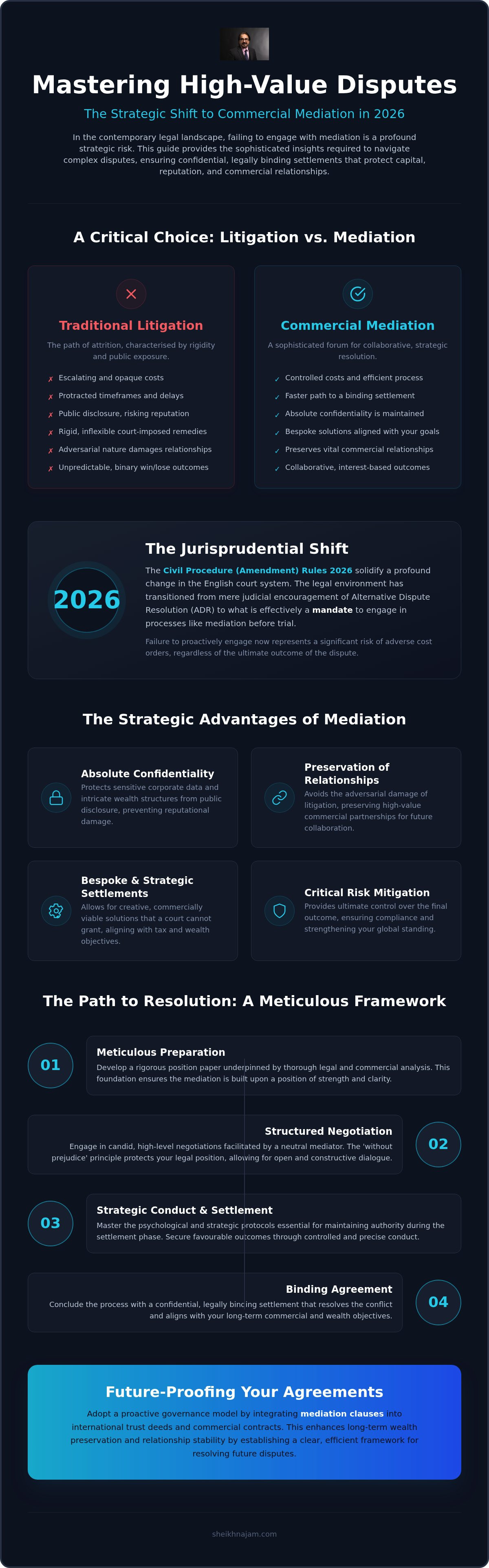
The legal environment of 2026 has transitioned from mere judicial encouragement of Alternative Dispute Resolution (ADR) to what is effectively a mandate within the English court system. This jurisprudential shift, solidified by the Civil Procedure (Amendment) Rules 2026, necessitates a profound re-evaluation of how high-net-worth individuals and corporate entities approach conflict. In this context, commercial mediation services are defined as a structured, confidential process facilitated by a neutral third party who assists participants in reaching a voluntary settlement. Unlike the binary outcomes of the bench, mediation offers a sophisticated forum for collaborative strategic control. Here, the "Strategic Polymath" approach integrates legal, tax, and regulatory foresight to resolve multi-layered conflicts that traditional litigation is ill-equipped to handle.
The Limitations of Traditional Litigation
The attrition of capital and time inherent in protracted court proceedings remains a primary deterrent for sophisticated litigants. Beyond the opaque and escalating costs, the adversarial nature of the court system introduces significant risks regarding public disclosure, which can irrevocably damage sensitive commercial reputations. For those involved in niche industries or complex trust structures, court-imposed remedies often lack the requisite flexibility to address specific operational or fiscal nuances. A judge's decision is strictly limited by the pleadings; however, understanding the mediation process reveals a mechanism capable of transcending these rigid boundaries to find commercially viable paths forward. The public record doesn't care for your brand equity, but the mediation room preserves it with absolute rigour.
Mediation as a Strategic Risk Mitigation Tool
Mediation functions as a critical instrument for risk mitigation by allowing for bespoke settlements that a court simply cannot grant. This is particularly vital when the preservation of high-value commercial relationships and long-standing partnerships is a priority. The process ensures that sensitive corporate data and intricate wealth structures remain protected behind a veil of absolute confidentiality, preventing the reputational fallout associated with public filings. By utilising commercial mediation services, parties can align their resolution with broader strategic objectives, such as inheritance tax planning or digital asset structuring. This ensures that the settlement doesn't merely end the dispute but actively strengthens the entity's global standing. For those seeking a comprehensive approach to resolution, mediation provides the necessary command over the final outcome, ensuring that tax and compliance obligations are met with meticulous precision.
Deconstructing the Mediation Framework: Mechanics of Structured Negotiation
The architecture of commercial mediation services is predicated upon a sequence of meticulously managed stages, designed to transition parties from entrenched adversarial positions toward a mutually acceptable settlement. Central to this framework is the mediator, a neutral facilitator whose authority is derived not from the power to impose a judgment, but from the ability to navigate the complex psychological and legal impasses that define high-value disputes. Whilst the Federal Mediation and Conciliation Service (FMCS) provides a robust model for labour-related disputes, the high-value commercial sector requires a more nuanced, multi-disciplinary framework. This process demands the integration of legal, financial, and regulatory expertise to address the multi-layered nature of modern corporate and trust conflicts.
The "without prejudice" principle serves as the cornerstone of this process, providing a privileged sanctuary where sensitive disclosures regarding international tax compliance or corporate governance can be explored without the risk of future evidentiary prejudice. This protection is critical for the "Strategic Polymath" who must often reveal intricate wealth structures or digital asset configurations to facilitate a realistic settlement. By ensuring that these discussions cannot be used as admissions in subsequent litigation, mediation allows for a level of transparency that is impossible within the rigid, public constraints of the courtroom.
The Preliminary Phase and Mediator Selection
Success is often determined long before the parties enter the room. Selecting a mediator with profound sector-specific expertise, particularly in areas such as contentious probate or financial crime compliance, is essential for maintaining the gravitas of the proceedings. This preliminary phase involves the rigorous drafting of the mediation agreement and the setting of a strategic agenda that reflects both legal and commercial realities. For those navigating these intricate procedural layers, seeking specialist counsel ensures that the mediation agreement is drafted with absolute precision, protecting your interests from the outset.
Plenary Sessions and Private Caucuses
The process typically commences with a plenary session, where each party articulates their primary strategic positions in a formal setting. However, the most substantive progress occurs within private caucuses. In these confidential sub-sessions, the mediator challenges unrealistic expectations whilst exploring the underlying interests that drive the dispute. This layered approach allows for the identification of settlement options that align with broader fiduciary duties and tax objectives, ensuring that the final resolution is both legally sound and commercially advantageous. The mediator's role is to act as a reality check, using their multi-disciplinary insight to dismantle barriers to agreement without compromising their neutrality.
How to Strategically Prepare for Commercial Mediation: A Meticulous Methodology
Success in high-stakes dispute resolution is rarely the product of spontaneous eloquence; rather, it is the result of exhaustive, multi-disciplinary preparation. When engaging commercial mediation services, the practitioner must approach the process with the same level of rigour as a high-court trial, ensuring that every facet of the client's position is fortified by empirical evidence and strategic foresight. This necessitates the assembly of a bespoke team, incorporating tax specialists, regulatory advisors, and forensic accountants to address the technical complexities of the dispute. Central to this methodology is a candid evaluation of the Best Alternative to a Negotiated Agreement (BATNA), which serves as the ultimate benchmark for settlement. A flawed BATNA assessment can lead to the acceptance of sub-optimal terms or, conversely, the rejection of a settlement that would have offered superior capital protection compared to the attrition of continued litigation.
Drafting the Position Paper
The position paper is not merely a summary of grievances; it is a persuasive instrument designed to influence the mediator's perception and challenge the opposing party's confidence. It should be structured logically, incorporating corporate instruments, notarial documents, and expert witness summaries where appropriate. Whilst the Federal Mediation and Conciliation Service (FMCS) offers general resources on conflict resolution, the elite commercial sector requires a document that is authoritative and firm, yet strategically calibrated to invite constructive dialogue. The tone must project a position of strength, signalling that whilst settlement is preferred, the client is fully prepared for the alternative of formal adjudication. Each assertion must be supported by a clear evidentiary trail, leaving little room for ambiguity or misinterpretation by the neutral facilitator.
Financial and Regulatory Due Diligence
In complex trust or corporate mediations, the settlement itself can trigger significant regulatory or fiscal consequences that may not be immediately apparent to those focused solely on the legal merits. It's imperative to conduct a comprehensive financial and regulatory due diligence exercise before entering the room. This involves assessing the impact of potential settlement structures on international tax planning for business owners to ensure that the resolution doesn't inadvertently create tax liabilities or compliance breaches. Additionally, a robust Anti-Money Laundering (AML) advisory and financial crime risk assessment must be integrated into the settlement discussions. This meticulous approach ensures that the final agreement is not only legally binding but also fiscally efficient and fully compliant with global regulatory standards, reflecting the master advisor's commitment to absolute precision in every facet of the resolution process.
Navigating the Mediation Process: Strategic Conduct and Settlement Protocols
The actual engagement with commercial mediation services on the day of negotiation requires a calculated synthesis of professional gravitas and psychological resilience. It's a high-stakes environment where the "Strategic Polymath" must maintain an unwavering position of strength whilst navigating the volatile emotional currents that often characterise multi-jurisdictional trust or corporate disputes. Managing these psychological factors isn't merely about temperament; it's about the deliberate projection of authority to ensure the opposing party recognises the futility of an adversarial stance. This conduct ensures that the focus remains on the strategic alignment of the resolution with your broader wealth and tax objectives. Once a conceptual consensus is reached, the transition from the mediation room to formal legal or notarial implementation must be swift and precise to prevent any post-negotiation attrition or "settler's remorse."
Strategic Communication and Deadlock Management
Impasse is a frequent feature of complex mediations, often occurring when parties reach the limit of their perceived concessions. Overcoming such deadlocks requires the deployment of sophisticated techniques, such as the tactical use of a "mediator's proposal," which provides a neutral benchmark for finalising difficult settlements without either side appearing to capitulate. Maintaining professional gravitas throughout these intense periods is essential; any perceived loss of composure can be interpreted as a strategic weakness. By focusing on core strategic objectives rather than peripheral grievances, the master advisor ensures that the momentum toward resolution is preserved even in the face of significant resistance.
The Settlement Agreement: Precision and Finality
The culmination of a successful mediation is the execution of a binding settlement agreement, a document that must be drafted with absolute meticulousness to ensure immediate enforceability. This agreement should clearly define all obligations, payment timelines, and the specific consequences of non-compliance, leaving no room for future litigation or ambiguity. For cross-border disputes involving complex corporate instruments, the integration of notarial services is paramount, as it provides the necessary authentication for international enforcement of settlement terms across diverse legal systems. Recognising the strategic role of a notary public is vital for ensuring that company documents and settlement protocols carry the weight of law across multiple jurisdictions. To ensure your resolution is fortified with this level of multi-disciplinary precision and global validity, you may wish to consult with a specialist advisor regarding the implementation of your settlement.
Integrating Mediation into Global Wealth and Corporate Governance
The adoption of commercial mediation services should not be viewed merely as a reactive measure to existing conflict; instead, it must be integrated as a proactive component of a robust dispute prevention strategy. Within the sophisticated spheres of global wealth and corporate governance, the inclusion of multi-tiered dispute resolution clauses in international commercial contracts and trust deeds serves as a vital safeguard. These provisions ensure that mediation is the mandatory first port of call, preserving the integrity of the structure whilst preventing the immediate escalation to adversarial proceedings. For multi-jurisdictional disputes where finality is paramount, the concept of 'Med-Arb' offers an elite level of strategic control. This hybrid process, where a neutral third party transitions from a facilitative mediator to a binding arbitrator if a settlement is not reached, provides a streamlined path to resolution. This approach supports long-term wealth preservation and succession planning by providing a structured, confidential environment to resolve internal family or shareholder friction before it threatens the entity’s core stability.
Proactive Dispute Prevention Frameworks
Maintaining the security of a complex estate requires the regular, meticulous review of corporate instruments to mitigate the risk of future litigation. Governance models must be structured to manage the expectations of shareholders and partners with absolute precision, ensuring that precatory or mandatory terms are clearly defined within the foundational documents. Whilst mediation remains the preferred initial path for maintaining relationship capital, the master advisor must also consider the role of international commercial arbitration as a critical fallback mechanism. This ensures that if a voluntary settlement proves elusive, a binding, private adjudication remains available, bypassing the public court system entirely. Such frameworks are essential for those operating amongst various regulatory regimes where the cost of public exposure far outweighs the expense of private, structured resolution.
The Role of the Master Advisor in Resolution
The resolution of a high-value dispute is a defining moment for any family or corporate legacy. It requires a practitioner who operates with total command over the intersection of law, tax, and multi-disciplinary regulation. A meticulously resolved conflict does not just end a disagreement; it reinforces the stability of the entire wealth structure for future generations. By ensuring that every settlement is aligned with broader fiscal and fiduciary duties, the advisor protects the client's global standing against future challenges. For those seeking to secure their interests with this level of academic rigour and strategic foresight, the pathway to resolution begins with expert command. You are invited to arrange a confidential consultation with Sheikh Najam TEP to discuss the integration of these protocols into your governance strategy.
Securing Commercial Stability through Strategic Resolution
The legal landscape of 2026 necessitates a decisive shift from the attrition of reactive litigation toward a model of proactive, multi-disciplinary resolution. Mastering the strategic nuances inherent in commercial mediation services ensures that high-value disputes are resolved with the meticulous precision required to safeguard complex international estates and intricate wealth structures. By integrating notarial authority with specialist expertise in international tax and trust administration, you're empowered to achieve settlements that are both legally binding and fiscally efficient across multiple jurisdictions. Sheikh Najam TEP, as a practitioner appointed by The Court of Faculties, provides the authoritative command and multi-disciplinary strategic advisory required to protect your global standing whilst preserving vital commercial partnerships. It's a pathway that prioritises the long-term stability of your family and corporate legacy over the unpredictable and public nature of court proceedings. Secure your strategic interests through expert mediation. Consult with Sheikh Najam TEP today. By adopting these rigorous protocols, you'll ensure your interests remain resilient amongst the complexities of the modern legal environment.
Frequently Asked Questions
What is the primary difference between commercial mediation and arbitration in the UK?
The fundamental distinction lies in the locus of decision-making authority and the nature of the outcome. In commercial mediation, a neutral facilitator assists the parties in reaching a voluntary, consensual settlement, whereas arbitration involves a private adjudicator who imposes a final, legally binding award. Whilst mediation preserves the parties' autonomy over the resolution, arbitration mirrors the adversarial structure of the court, albeit within a confidential and more flexible procedural framework.
Can a settlement reached through commercial mediation be legally enforced?
A settlement agreement achieved through commercial mediation services is legally enforceable as a binding contract once it is executed in writing by all participating parties. In the event of a subsequent breach, the aggrieved party may seek summary judgment or specific performance through the courts. For international disputes, enforcing these terms often requires the integration of notarial authentication to ensure the agreement's validity and recognition within diverse foreign legal systems.
Is mediation mandatory for commercial disputes under the Civil Procedure Rules 2026?
Whilst mediation is not universally mandatory by statute, the Civil Procedure (Amendment) Rules 2026 empower the courts to order parties to engage in ADR processes. A failure to comply or an unreasonable refusal to mediate now carries significant risk of adverse cost orders, regardless of the litigation's ultimate outcome. The judiciary increasingly views engagement with mediation as a core compliance obligation, reflecting a systemic shift toward the private resolution of complex corporate conflicts.
How long does a typical commercial mediation process take from start to finish?
The duration of the formal mediation session is typically confined to a single day, or occasionally two for high-value multi-party disputes. However, the comprehensive process, including the selection of the mediator, the exchange of position papers, and the performance of multi-disciplinary due diligence, generally spans several weeks. This preparatory phase is essential for ensuring that all legal, tax, and regulatory implications are meticulously addressed before the parties convene to negotiate the final settlement terms.
Are the discussions held during commercial mediation confidential and 'without prejudice'?
All communications within the mediation framework are protected by absolute confidentiality and the "without prejudice" principle. This ensures that any admissions, offers, or disclosures made during the negotiation cannot be utilised as evidence in subsequent litigation or adjudication. Such a privileged environment is vital for the master advisor who must explore sensitive wealth structures or corporate vulnerabilities to facilitate a resolution without compromising their client's broader legal or reputational standing.
What happens if the parties fail to reach an agreement during the mediation session?
If a consensus is not reached during the initial session, the parties remain entitled to proceed with formal litigation or arbitration. It is common for negotiations to continue post-mediation, often facilitated by the mediator through follow-up telephone caucuses or secondary meetings. The insights gained during the structured process frequently lead to a settlement in the weeks following the session, as the parties refine their BATNA assessments based on the information exchanged.
How should I choose the right mediator for a complex multi-jurisdictional dispute?
Selecting the appropriate neutral requires an evaluation of the practitioner's sector-specific expertise and their ability to command respect amongst sophisticated litigants. For multi-jurisdictional conflicts, it is imperative to appoint a mediator who understands the intersection of international tax, trust administration, and financial crime compliance. The practitioner must possess the academic rigour and professional gravitas necessary to navigate intricate regulatory landscapes whilst maintaining the meticulous precision required for high-stakes dispute resolution.
What are the typical costs associated with commercial mediation services in 2026?
The financial investment in commercial mediation services comprises the mediator’s professional fee, venue costs, and the fees for your own multi-disciplinary legal team. Whilst these costs vary based on the dispute's complexity and the mediator's prestige, they are consistently lower than the escalating attrition of protracted court proceedings. Parties are increasingly adopting innovative pricing models, such as flat-fee packages for specific mediation phases, to ensure greater clarity and predictability within their broader corporate governance budgets.



Comments