Strategic Family Trust Structuring in the UK: A Framework for Asset Preservation and Creditor Mitigation

The mere execution of a deed does not, in itself, insulate a family’s legacy from the increasingly aggressive reach of the High Court or the statutory clawback mechanisms of the Insolvency Act 1986. Many sophisticated settlors operate under the precarious assumption that family trust structuring uk is a "set-and-forget" exercise, yet they often find their most cherished assets exposed to matrimonial disputes or business liabilities because the underlying fiduciary governance was insufficient to resist a "sham" or "illusory" trust challenge. You likely recognise that in an era of heightened transparency and the 2026 Trust Registration Service mandates, the distinction between a robust settlement and a vulnerable one lies in the meticulous precision of its ongoing administration.
This analysis offers a sophisticated framework for asset preservation, moving beyond simple tax mitigation to address the multi-disciplinary requirements of modern wealth protection. We shall examine how to align inheritance tax planning with robust creditor shielding, specifically focusing on the "true effect" doctrine following Pugachev and the critical role of notarial authentication in cross-border asset alignment. By the conclusion of this study, you'll understand how to architect a structure that not only survives the 20% entry charge on chargeable lifetime transfers but also withstands the scrutiny of creditors through expert-led fiduciary discipline and strategic foresight.
Table of Contents
The Jurisprudential Foundation of Family Trust Structuring in the United Kingdom
Discretionary Trust Mechanics: Mitigating Creditor Vulnerability
Navigating the 'Sham' Doctrine and Statutory Creditor Challenges
Comparative Analysis of Trust Variations for Wealth Protection
Integrating Multi-Disciplinary Governance: The Sheikh Najam Approach
The Jurisprudential Foundation of Family Trust Structuring in the United Kingdom
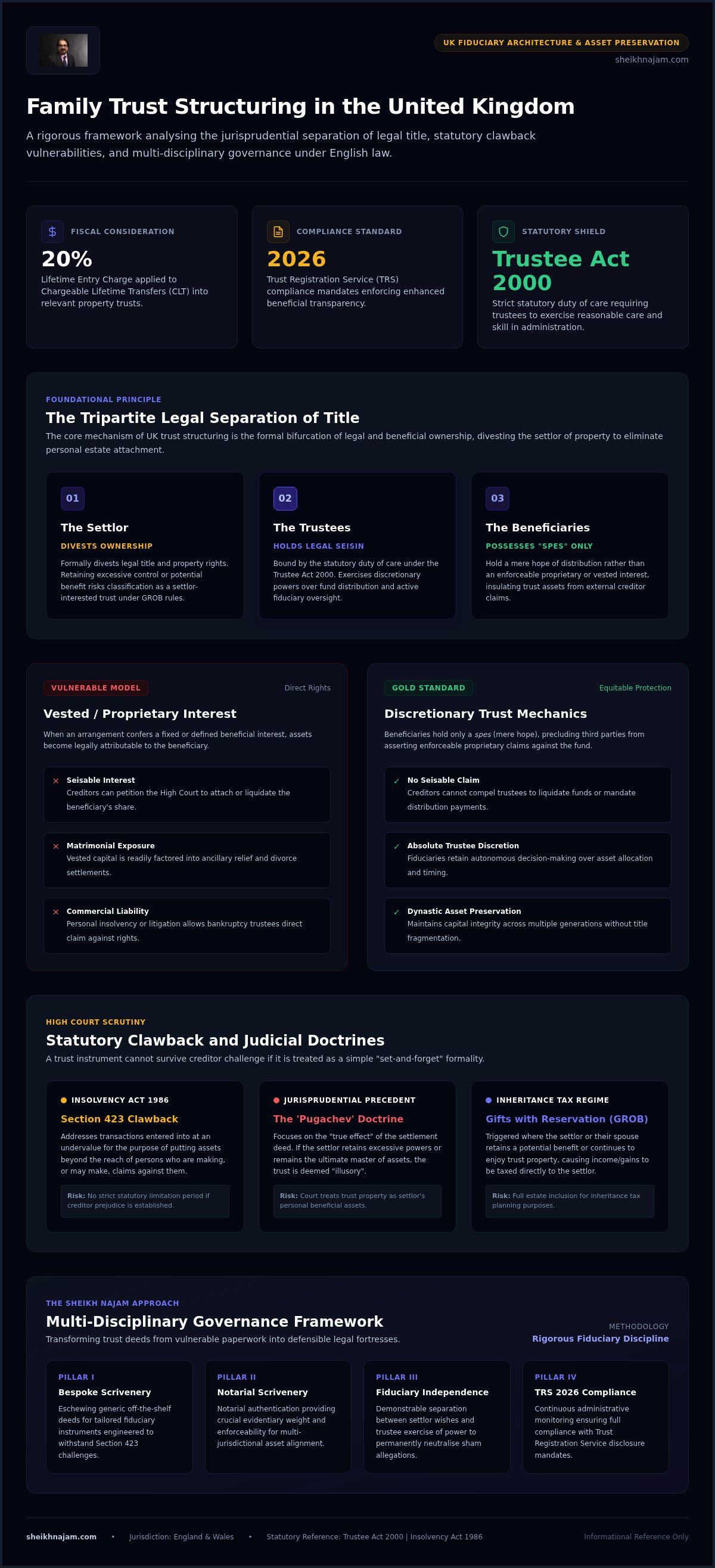
The efficacy of family trust structuring uk is predicated upon the centuries-old equitable principle of the separation of legal and beneficial title. Rather than a mere contractual arrangement, a trust represents a sophisticated fiduciary relationship where the settlor formally divests themselves of assets, transferring the legal seisin to trustees who hold the property for the benefit of a defined class of beneficiaries. This tripartite architecture is not merely a vehicle for succession; it is a strategic barrier. By isolating the legal ownership from the enjoyment of the assets, a properly constituted trust ensures that the underlying wealth is no longer part of the settlor's personal estate, thereby limiting exposure to future claims.
Under the Trustee Act 2000, trustees are bound by a rigorous statutory duty of care, requiring them to exercise such care and skill as is reasonable in the prevailing circumstances. This professionalisation of the fiduciary role is essential when defending a structure against aggressive litigation or regulatory inquiry. Generic, "off-the-shelf" trust instruments frequently lack the requisite nuance to survive judicial scrutiny, particularly when creditors invoke Section 423 of the Insolvency Act 1986 to allege a transaction at an undervalue. A bespoke framework, however, integrates specific protections that account for the settlor’s unique risk profile and the long-term objectives of the family lineage.
The Strategic Objective of Wealth Preservation
Effective structuring demands a delicate equilibrium between maintaining family liquidity and ensuring the long-term integrity of the capital. By employing sophisticated discretionary trust mechanics, a settlor can ensure that no single beneficiary possesses a vested interest that a creditor could potentially attach to or seize. This lack of a proprietary right is the cornerstone of asset protection. In the current 2026 fiscal environment, a settlor-interested trust is defined as an arrangement where the settlor or their spouse retains a potential benefit, which causes the trust income and gains to be taxed as the settlor’s own whilst the assets remain subject to the Gifts with Reservation of Benefit (GROB) regime for inheritance tax.
Fiduciary Duty as a Shield
The robustness of a trust is often determined by the quality of its scrivenery and the subsequent conduct of its fiduciaries. Meticulous drafting ensures that the trustees’ powers are clearly defined, yet sufficiently flexible to adapt to changing regulatory landscapes. This high-level precision is a hallmark of specialist areas of trust and estate planning, where the integration of notarial authentication provides an additional layer of evidentiary weight. When a trust is managed with academic rigor and multi-disciplinary expertise, it ceases to be a mere document; it becomes an impenetrable legal fortress. Such discipline prevents the structure from being dismissed as a sham, ensuring the family's legacy remains secure against both domestic and international challenges.
Discretionary Trust Mechanics: Mitigating Creditor Vulnerability
Within the sophisticated architecture of family trust structuring uk, the discretionary trust is widely regarded as the preeminent mechanism for shielding capital from the volatility of personal or commercial litigation. The legal efficacy of this structure is derived from the fact that no beneficiary holds a vested or proprietary interest in the trust fund. Instead, they possess what is known in English equity as a spes, or a mere hope of being considered for a distribution at the absolute discretion of the trustees. Because the assets do not belong to the beneficiary in any legally seisable sense, a personal creditor cannot compel the trustees to liquidate the fund or divert distributions to satisfy outstanding debts.
The resilience of these arrangements is frequently tested by the rigorous standards of Section 423 of the Insolvency Act 1986, which empowers the court to set aside transactions entered into at an undervalue if the subjective purpose was to prejudice the interests of creditors. Unlike other insolvency provisions that rely on specific lookback periods, Section 423 carries no statutory limitation, meaning a trust could potentially be challenged years after its inception if the initial transfer was tainted by a desire to defeat claimants. To mitigate this risk, practitioners utilise detailed letters of wishes to guide trustee behaviour whilst maintaining a clear legal distance between the settlor’s intent and the trustees’ ultimate autonomy.
The Mechanics of Asset Sequestration
Trustees must operate with an unimpeachable "arm’s length" discipline to ensure the structure is not perceived as a mere extension of the settlor’s personal bank account. During periods where a beneficiary faces insolvency or litigation, the trustees can exercise their powers to pause distributions entirely, effectively sequestering the assets within the fiduciary shell. The integration of a protector can further enhance this oversight, providing a check on fiduciary conduct without compromising the trust’s integrity, provided their powers are carefully drafted as fiduciary rather than personal. Maintaining such standards is essential for those who wish to secure their legacy through professional advisory.
Creditor Rights vs. Trustee Discretion
Whilst creditors may attempt to subrogate themselves to a beneficiary’s position, they generally cannot step into the shoes of an individual who has no fixed right to the capital. The court's ability to intervene is limited to instances where a trustee has acted in bad faith or failed to consider the relevant class of beneficiaries. Establishing a trust well before any liability arises remains the most potent defence, as it provides contemporaneous evidence that the primary motive was long-term succession rather than creditor evasion. This strategic foresight prevents the legal vulnerabilities often explored in discussions regarding a Breach of Trust: Guide for HNWIs (2026), ensuring the structure remains robust under aggressive scrutiny.
Navigating the 'Sham' Doctrine and Statutory Creditor Challenges
The integrity of any framework for family trust structuring uk is perpetually contingent upon the authenticity of its execution. Under the definitive standard established in Snook v London and West Riding Investments Ltd, a trust is deemed a sham if both the settlor and the trustees possess a common subjective intention to create an appearance of legal rights that differ from the actual rights they intended to confer. This bilateral deceptive intent is a high evidentiary hurdle for creditors to clear, yet it underscores the necessity for absolute administrative discipline. If a settlor continues to treat trust assets as personal property, the court may pierce the fiduciary veil, rendering the entire structure void ab initio.
Distinction must also be made between a fraudulent sham and an "illusory trust," a doctrine reinforced by JSC Mezhdunarodniy Promyshlenniy Bank v Pugachev. In such instances, the trust documentation may be genuine, but the retention of excessive personal powers, such as unfettered rights of revocation or absolute vetoes over trustee distributions, suggests that beneficial ownership never truly departed the settlor. Such arrangements are effectively treated as bare trusts, leaving the capital vulnerable to direct attachment by judgment creditors. This distinction is a critical nuance in family trust structuring uk, as it separates a resilient legacy from an illusory façade.
Section 423 of the Insolvency Act: The Fraudulent Transfer Risk
Unlike the standard five-year look-back periods associated with transactions at an undervalue under Section 339, Section 423 of the Insolvency Act 1986 imposes no statutory limitation period. The court's focus is squarely on the "purpose test": whether the settlor’s subjective intent was to put assets beyond the reach of a person who is making, or may at some time make, a claim. Whilst legitimate tax planning utilises statutory reliefs to minimise fiscal liability, illegal asset concealment involves the deceptive manipulation of ownership to frustrate the lawful claims of creditors. The absence of a defined time limit means that even a decade-old settlement can be unpicked if the requisite prejudicial intent is proven.
Defending the Integrity of the Trust
To insulate a settlement from these challenges, it's vital to employ independent, professional fiduciaries who exercise genuine discretion over various types of trust recognised under UK law. Meticulous record-keeping and regular fiscal reviews serve as contemporaneous evidence of the trust’s separate legal identity. Key administrative practices include:
Formal trustee resolutions documented in meeting minutes.
The maintenance of separate trust bank accounts and ledgers.
Clear separation between personal and trust-related correspondence.
The use of notarial authentication provides a definitive, internationally recognised record of the settlor’s intent at the moment of inception. This level of evidentiary discipline is a core component of strategic dispute prevention and resolution, ensuring that the structure isn't just a paper exercise but a robust legal reality.
Comparative Analysis of Trust Variations for Wealth Protection
The selection of a specific vehicle within the taxonomy of family trust structuring uk is a decision of profound consequence, necessitating a meticulous assessment of the asset class and the specific risk profile of the beneficiaries. Whilst the discretionary trust remains the preeminent choice for creditor mitigation due to its lack of vested interests, the Life Interest Trust, or Interest in Possession (IIP) trust, offers a more structured approach for testamentary planning. An IIP trust grants a specific beneficiary, often a surviving spouse, the immediate right to the income generated by the trust or the right to enjoy the assets, such as a family residence, whilst the underlying capital is preserved for remaindermen. This ensures the capital is shielded from the survivor's potential future liabilities, including remarriage or care costs, though it offers less protection against the life tenant's own creditors compared to discretionary arrangements.
Conversely, the Bare Trust represents the most rudimentary form of settlement, where the trustee holds legal title but the beneficiary has an absolute, immediate right to both capital and income. From a perspective of asset preservation, Bare Trusts are largely deficient; since the beneficiary is the absolute owner for tax and legal purposes, the assets fall squarely within their estate and are fully accessible to their judgment creditors.
The Property Protection Trust (PPT) in Context
In the landscape of residential estate preservation, the Property Protection Trust is frequently utilised to secure a "Right to Occupy" for a spouse whilst ensuring the property eventually passes to descendants. Under the 2026 fiscal regime, practitioners must be cognisant that the Residence Nil-Rate Band (RNRB) of £175,000 remains frozen through April 2031 and is only available where the property is closely inherited. Discretionary structures do not automatically qualify for this relief unless an absolute interest or an Immediate Post-Death Interest (IPDI) is established. Consequently, balancing the 6% periodic charges on relevant property against the potential loss of the RNRB requires a high degree of mathematical and legal precision.
Structuring for Business and Digital Assets
The professionalisation of family trust structuring uk now extends to the burgeoning field of digital asset sequestration. Succession planning for crypto-assets and content royalties requires more than mere legal drafting; it demands technical alignment regarding private key custody and fiduciary access. Similarly, for business owners, the April 2026 reforms to Business Property Relief (BPR) introduce a £1,000,000 combined cap for 100% relief, with excess assets attracting a 50% relief rate. Navigating these thresholds requires the expertise of a Private Client Solicitor: A Strategic Legal Perspective on Wealth Preservation (2026) who can integrate corporate-held trusts to separate operational business risks from the family’s core wealth.
To ensure your specific asset portfolio is structured with this level of multi-disciplinary rigor, you may instruct our firm to conduct a comprehensive structural review.
Integrating Multi-Disciplinary Governance: The Sheikh Najam Approach
The architecture of family trust structuring uk must transcend the traditional boundaries of private client law to incorporate the rigorous demands of financial crime and regulatory compliance. Fiduciary governance within the elite legal landscape requires a synthesis of disciplines; it's no longer sufficient to merely draft a deed without considering the international regulatory landscape. As a specialist practitioner holding the TEP designation and serving as an English Notary Public appointed by the Court of Faculties, my approach ensures that every instrument is not only valid under English equity but also holds the evidentiary weight required for cross-border asset alignment. Notarial scrivenery provides a layer of authentication that's internationally recognised, making the structure resilient to challenges in diverse jurisdictions whilst ensuring that the settlor’s intent remains beyond reproach.
Positioning a trust within a broader, multi-jurisdictional wealth preservation strategy requires a profound understanding of both domestic statutes and global transparency standards. This multi-disciplinary rigor prevents the "administrative laxity" that often serves as the catalyst for contentious probate or trust disputes. By treating the trust as a dynamic legal entity rather than a static document, fiduciaries can proactively manage risks related to asset sequestration and creditor mitigation. Such a framework is essential for high-net-worth individuals whose affairs intersect with complex corporate holdings and international tax obligations.
Compliance as a Pillar of Security
The implementation of the Money Laundering and Terrorist Financing (Amendment) Regulations 2026 has introduced a new de minimis exemption for non-taxable express trusts holding assets below £10,000 with a gross annual income not exceeding £5,000. Whilst this provides relief for smaller settlements, the Trust Registration Service (TRS) remains a central pillar of transparency for the majority of high-value structures. Trustees must ensure registration within the statutory 90-day window to maintain compliance and avoid the penalties associated with administrative negligence. Professional compliance serves as the definitive bulwark against regulatory challenges and judicial inquiries into the trust’s operational legitimacy.
A Legacy of Strategic Precision
The 2026 reforms to Business Property Relief and Agricultural Property Relief, which introduced a combined £1,000,000 ceiling for 100% inheritance tax relief, necessitate a fundamental reappraisal of existing settlements. Holistic fiduciary management involves more than the initial creation of a trust; it requires a commitment to regular structural audits to ensure alignment with such evolving legislative shifts. By integrating tax planning, notarial authentication, and dispute mitigation, the Sheikh Najam approach transforms the trust into a dynamic instrument of preservation. This meticulousness ensures that your legacy isn't merely preserved on paper but is actively defended against the complexities of the modern legal environment.
Securing the Fiduciary Future: A Mandate for Strategic Rigor
The preservation of generational wealth amidst a volatile legal landscape requires far more than the standard execution of a deed; it demands a sophisticated integration of equitable principles and statutory compliance. As we've explored, the efficacy of family trust structuring uk is contingent upon the maintenance of an unimpeachable separation between legal and beneficial title, reinforced by the autonomous exercise of trustee discretion. By eschewing the vulnerabilities of "illusory" structures and adhering to the rigorous evidentiary standards required to defeat "sham" allegations, a settlor ensures that their legacy remains resilient against both creditor encroachment and judicial scrutiny.
To achieve this level of multi-disciplinary precision, one must engage with a practitioner who operates at the intersection of private wealth and international regulatory standards. As a TEP Accredited Specialist, an expert in contentious probate and trust disputes, and a Notary Public appointed by the Court of Faculties, I provide the authoritative oversight necessary to navigate these intricate landscapes. I invite you to instruct Sheikh Najam TEP for expert trust structuring and wealth preservation to ensure your most complex affairs are handled with absolute precision. Your family's future security deserves the weight of institutional expertise and strategic foresight.
Frequently Asked Questions
Can a family trust protect my assets if I am already being sued?
A transfer of assets into a trust whilst litigation is active or imminent is highly vulnerable to a statutory clawback under Section 423 of the Insolvency Act 1986. The court focuses on the subjective purpose of the transaction; if the intent was to prejudice the interests of a claimant, the transfer may be set aside. Legitimate family trust structuring uk requires proactive implementation well before any specific creditor threat manifests to ensure the structure remains robust.
What is the difference between a sham trust and a legitimate asset protection structure?
The fundamental distinction lies in the commonality of deceptive intent. A sham trust requires both the settlor and the trustee to intentionally present a façade to third parties whilst never intending to adhere to the trust's terms. Conversely, a legitimate structure involves a genuine transfer of legal title and the rigorous exercise of fiduciary duties. Maintaining administrative discipline and formal trustee meetings is essential to demonstrate that the trust is a functional legal reality.
How much control can I retain over assets placed in a UK discretionary trust?
Retaining excessive personal control is a precarious strategy that may lead to the arrangement being classified as an illusory trust. For a discretionary trust to be effective, the settlor must genuinely divest themselves of the assets, allowing the trustees to exercise independent discretion. Whilst a non-binding letter of wishes can guide the fiduciaries, the formal power to revoke or direct trust assets often results in the structure being pierced by creditors or tax authorities.
Are assets held in a family trust exempt from inheritance tax in 2026?
Assets within a discretionary trust are not exempt but are instead subject to the relevant property regime. In 2026, transfers exceeding the frozen £325,000 nil-rate band attract a 20% entry charge, followed by periodic principal charges of up to 6% every ten years. Strategic family trust structuring uk aims to align these fiscal obligations with long-term preservation goals, ensuring that inheritance tax planning doesn't compromise the overarching objective of robust asset protection.
Can a creditor challenge a trust transfer made several years ago?
Under Section 423 of the Insolvency Act 1986, there's no statutory limitation period for challenging a transaction at an undervalue. Whilst standard bankruptcy rules often look back five years, a creditor can apply to set aside a trust transfer from a decade ago if they can prove the settlor's purpose was to put assets beyond their reach. This underscores the necessity of establishing clear, documented motives for wealth preservation at the moment of the trust's inception.
What role does a Notary Public play in the creation of a family trust?
An English Notary Public, appointed by the Court of Faculties, provides a superior level of authentication for trust documentation. This process involves verifying the identity and capacity of the settlor whilst providing a contemporaneous record of their intent. Notarial scrivenery is particularly vital for multi-jurisdictional structures, as it ensures that the trust's foundational documents are globally recognised and possess high probative value in the event of a future legal challenge or trust dispute.
Can a trust protect my family home from being sold to pay business debts?
Correctly structured trusts can isolate a family home from the risks associated with commercial ventures. By transferring the property into a discretionary trust before any business liabilities crystallise, the home is no longer part of the settlor's personal estate. Since the beneficiaries possess no seisable proprietary interest, business creditors generally cannot compel the sale of the residence. This sequestration is a core component of professional estate planning designed to safeguard essential family assets.
What happens to a family trust if one of the trustees becomes incapacitated?
The incapacity of a trustee doesn't cause the trust to fail, as the structure is designed for fiduciary continuity. Most bespoke trust deeds contain specific administrative provisions for the removal and replacement of an incapacitated trustee by a protector or the remaining fiduciaries. In the absence of such clauses, Section 36 of the Trustee Act 1925 provides a statutory mechanism to appoint a successor, ensuring that the management of the trust remains uninterrupted and legally compliant.


Comments