Notarising a Statutory Declaration: The Definitive Legal Execution Guide

A single omitted phrase mandated by the Statutory Declarations Act 1835 can instantly unravel months of cross-border corporate structuring or contentious estate administration. Flawlessly notarising a statutory declaration requires far more than witnessing an execution; it demands rigorous capacity assessment, strict adherence to statutory verbiage, and uncompromising verification to withstand sovereign scrutiny.
You already know the frustration of confronting foreign registries or institutional counterparties that threaten to reject essential documentation over minute procedural discrepancies, ambiguous drafting, or conflation with sworn affidavits. When significant international transactions depend upon evidentiary truth, you cannot afford the administrative paralysis or reputational risks associated with defective execution.
This legal execution guide will give you total clarity on the procedural mechanisms, evidential standards, and international authentication pathways governing declarations under United Kingdom law. We examine the exact phrasing required by statute, distinguish declarations from affidavits, and outline the precise protocol required to secure universal legal validity through apostille legalisation and consular certification.
Table of Contents
The Legal Doctrine of Statutory Declarations and Notarial Authentication
Statutory Declarations, Affidavits, and Oaths: A Doctrinal Comparison
Prerequisites for Execution: Capacity, Due Diligence, and Identity Verification
How to Notarise a Statutory Declaration: The Five-Stage Procedural Protocol
Instructing a Public Notary for High-Value and Cross-Border Declarations
The Legal Doctrine of Statutory Declarations and Notarial Authentication
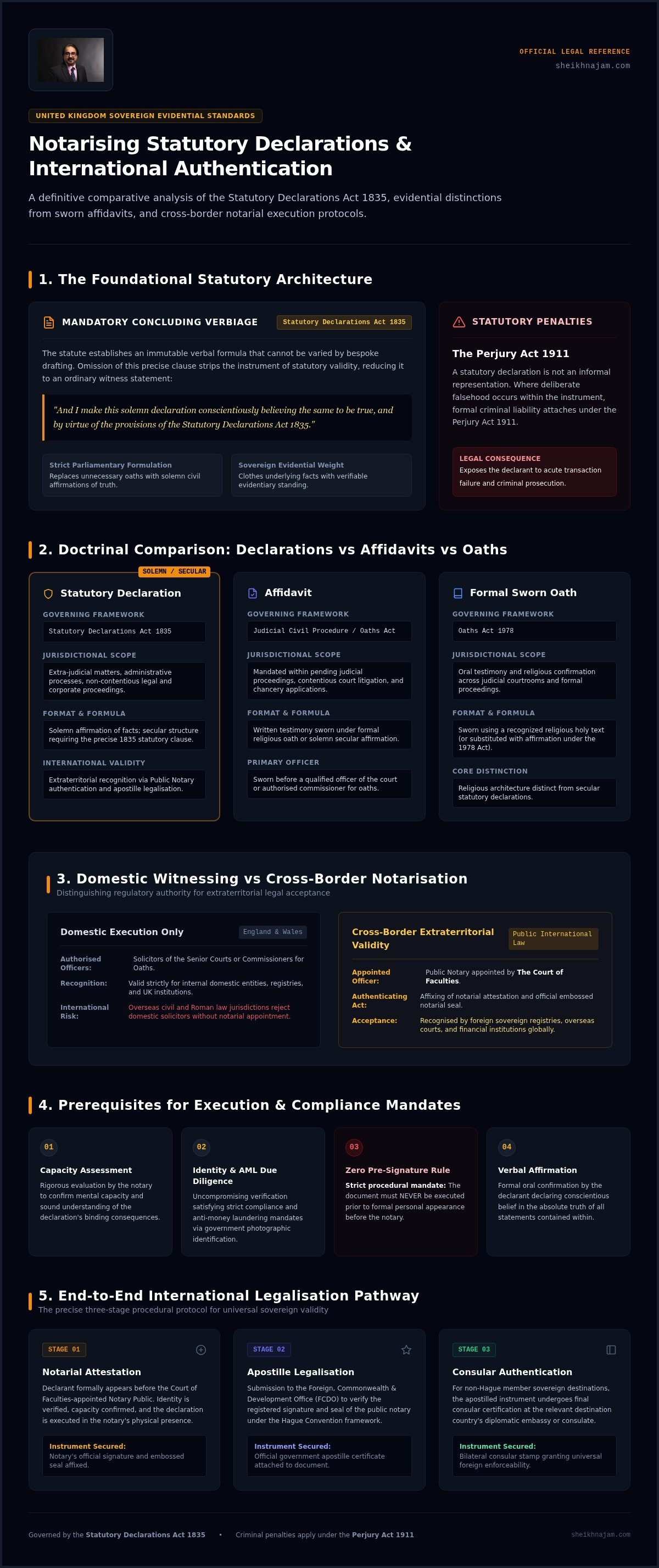
Under United Kingdom law, a statutory declaration constitutes a solemn, legally binding written statement of truth prescribed by parliamentary enactments. Unlike informal representations or ordinary contractual representations, it is an instrument of sovereign evidential weight. The practice of notarising a statutory declaration elevates this private assertion into a universally verifiable public act, clothing the underlying facts in legal certainty that overseas courts, registries, and financial institutions demand.
Precision matters. Defective drafting or the absence of strict statutory formalities does not simply render the instrument voidable; it exposes the declarant to acute transaction delays and severe evidential failure. Where deliberate falsehood occurs, criminal liability attaches under the Perjury Act 1911. Proper notarial intervention ensures every statutory element stands impervious to technical contestation.
The Statutory Declarations Act 1835 and Modern Formalities
The foundational bedrock of this instrument remains the Statutory Declarations Act 1835. The statute replaced many unnecessary oaths with solemn declarations, establishing a strict verbal formula that cannot be varied by bespoke contractual drafting or loose affirmations. To retain statutory enforceability, the instrument must conclude with precise statutory verbiage:
Mandatory concluding declaration:"And I make this solemn declaration conscientiously believing the same to be true, and by virtue of the provisions of the Statutory Declarations Act 1835."
Omission of this formulaic clause strips the document of its statutory character, reducing it to an unsworn witness statement incapable of commanding cross-border recognition.
Domestic Recognition Versus Cross-Border Extraterritorial Validity
For strictly domestic applications within England and Wales, a solicitor or commissioner for oaths may witness a declaration. However, cross-border commercial transactions, international asset transfers, and foreign court filings operate under entirely different legal paradigms. Overseas jurisdictions, grounded in civil or Roman law traditions, do not recognise the authority of ordinary domestic legal practitioners to authenticate public documents.
International registries routinely reject documents that lack the signature and embossed seal of an appointed Public Notary. When notarising a statutory declaration for extraterritorial use, the notary acts as an internationally recognised public officer. The notarial act confers authenticity under public international law and bilateral legal frameworks, verifying identity, legal capacity, and formal execution to guarantee unimpeachable acceptance abroad.
Statutory Declarations, Affidavits, and Oaths: A Doctrinal Comparison
Legal practitioners frequently witness clients conflating statutory declarations, affidavits, and sworn oaths. While each mechanism creates formal evidential weight, their procedural applications, religious or secular architectures, and governing frameworks diverge sharply. Selecting the incorrect instrument invariably invites judicial refusal or cross-border rejection.
The distinction rests upon judicial versus administrative function. An affidavit represents written evidence given on oath, sworn before a qualified officer of the court using a religious holy book, or affirmed under the Oaths Act 1978. Affidavits are traditionally mandated within pending judicial proceedings, contentious litigation, or specific chancery applications. Conversely, the Statutory Declarations Act 1835 governs extra-judicial matters where no formal court dispute exists but where solemn affirmation of facts remains legally indispensable.
Evidentiary Distinctions and Jurisdictional Scope
Notarising a statutory declaration serves distinct administrative, corporate, and private wealth purposes. These instruments form the foundation of non-contentious legal confirmations across domestic and global arenas:
Corporate and commercial mandates: Directors' confirmations of solvency, cross-border share transfer verifications, and compliance with the Economic Crime and Corporate Transparency Act 2023.
Intellectual property and proprietary rights: Patent and trademark assignments, patent priority claims, and authorship attestations filed with national intellectual property offices.
Civil status and estate administration: Evidence of single status for overseas marriages, identity reconciliations, and private wealth structuring involving probate declarations.
When legal disputes cross international boundaries, executing the wrong form can paralyze your transaction. To confirm the precise instrument required by foreign registries, you may contact our notarial team to review the underlying jurisdictional requisites.
The Perjury Act 1911 and Penalties for False Statements
Some declarants assume an unsworn statutory declaration carries lesser legal consequences than a sworn affidavit. That assumption is profoundly incorrect. Under Section 5 of the Perjury Act 1911, knowingly and wilfully making a statement false in a material particular within a statutory declaration constitutes a serious criminal offence, carrying severe penalties including substantial fines and imprisonment.
An authenticating Public Notary does not verify the subjective veracity of the declarant's personal assertions. The notary's sworn duty requires rigorous verification of the declarant's identity, full legal capacity, and complete comprehension of the document. If any indication of duress, cognitive incapacity, or fraudulent intent emerges, the notary must decline attestation. Notarising a statutory declaration therefore provides counterparty assurance that the declarant understood the profound criminal implications of their solemn statement.
Prerequisites for Execution: Capacity, Due Diligence, and Identity Verification
Authenticating a statutory instrument is not an administrative rubber-stamping exercise. Prior to notarising a statutory declaration, a Public Notary must conduct exhaustive customer due diligence, evaluate mental capacity, and ensure complete freedom from external duress. These rigorous preliminaries protect the instrument against future contentious challenges and insulate the underlying transaction from regulatory nullification.
Modern notarial practice operates under stringent statutory obligations. Compliance with the Money Laundering and Terrorist Financing (Amendment) Regulations 2026 mandates independent electronic and physical verification before attestation can proceed. The authenticating officer must be satisfied of both legal identity and lawful authority.
Verifying Individual Identity and Legal Standing
To establish identity to the standard demanded by receiving jurisdictions, every declarant must produce original, valid documentation:
Primary photographic identification: A current biometric passport or national identity card containing verified cryptographic data.
Proof of residential domicile: An original utility bill, council tax demand, or regulated bank statement dated within the preceding three months.
Representative authority: Where an individual executes a declaration under a registered Lasting Power of Attorney or general power, the formal instrument must be inspected to verify subsistence and unrevoked agency.
Where an instrument serves overseas purposes, such as satisfying a Commonwealth statutory declaration requirement for migration, insurance claims, or estate vesting, linguistic comprehension is vital. If the declarant is not fluent in English, a professional interpreter must translate the document, ensuring genuine understanding before execution.
Corporate Declarations and Institutional Authority
When an officer executes a statutory instrument on behalf of an enterprise, verifying individual identity represents merely the initial step. Corporate execution mandates an exhaustive review of institutional capacity and statutory representation.
The notary scrutinises the company's memorandum and articles of association, certificate of incorporation, and the public register at Companies House. Under reforms introduced by the Economic Crime and Corporate Transparency Act 2023, identity verification for Persons with Significant Control (PSCs) forms an essential component of corporate compliance. Notarising a statutory declaration for commercial transactions requires board minutes or an explicit power of attorney evidencing the signatory's actual authority. Without verified institutional authority, foreign commercial registries and sovereign banking institutions will promptly reject the instrument.
How to Notarise a Statutory Declaration: The Five-Stage Procedural Protocol
Achieving universal legal recognition demands strict adherence to an exacting procedural workflow. Any deviation from statutory sequencing can immediately invalidate the instrument. When notarising a statutory declaration, practitioners follow a rigorous five-stage protocol designed to satisfy both domestic statutory benchmarks and foreign judicial scrutiny.
The cardinal rule of execution admits no exception: the instrument must never be signed prior to your formal appearance before the notary. Premature execution strips the notary of their statutory duty to witness the signature contemporaneously, requiring the document to be redrafted entirely.
Drafting, Verbal Affirmation, and Execution
The procedural sequence begins long before the physical impression of the seal:
Stage 1 (Textual review): The drafting must incorporate verbatim the statutory formula prescribed under the schedule to the 1835 Act, ensuring that every exhibit is distinctly paginated and identified.
Stage 2 (Formal appearance): The deponent presents the unexecuted declaration alongside verified identification credentials during a formal in-person appointment.
Stage 3 (Solemn verbal affirmation): The notary formally administers the statutory declaration. The deponent audibly affirms: "I do solemnly and sincerely declare that the contents of this my declaration are true."
Stage 4 (Physical execution): The deponent signs the instrument directly before the authenticating notary, initialling any alterations, erasures, or accompanying exhibits.
The Notarial Certificate, Facultative Records, and Sealing
Following execution, the Public Notary enters Stage 5 by appending a bespoke notarial certificate. Rather than relying on simple endorsements, the certificate formally certifies the deponent's identity, capacity, and voluntary submission. The notary signs the act, affixes their unique embossed or engraved seal, and enters the complete record into their permanent protocol register in accordance with the Notaries (Conduct and Discipline) Rules. For an exhaustive doctrinal analysis of formal attestation mechanics, review our reference guide on how to notarise documents.
Extraterritorial Authentication: Apostille and Consular Legalisation
For cross-border utility, notarising a statutory declaration represents the initial foundation of legalisation. If the receiving jurisdiction is a signatory to the Hague Apostille Convention of 1961, the notarised declaration proceeds to the Foreign, Commonwealth & Development Office (FCDO). The FCDO appends an Apostille certificate, verifying the authenticity of the notary's signature and registered seal.
Where destination states sit outside the Hague framework, documents must undergo secondary consular legalisation. This necessitates physical presentation to the destination state's embassy or high commission for sovereign attestation. To arrange seamless execution and cross-border legalisation without administrative rejection, instruct our notarial practice today.
Instructing a Public Notary for High-Value and Cross-Border Declarations
For high-net-worth individuals, family offices, and multinational enterprises, notarising a statutory declaration serves as an indispensable risk-mitigation safeguard rather than a mere procedural chore. When multi-jurisdictional assets, offshore holding companies, or substantial trust funds are involved, defective execution risks immediate freeze orders, transactional failure, and costly litigation. Retaining an authenticating officer appointed by The Court of Faculties ensures your documentation commands unequivocal institutional standing across foreign courts, sovereign land registries, and international financial institutions.
Appointed notaries hold a distinct constitutional office recognised internationally under the law of nations. By integrating rigorous notarial authentication directly with private client advisory, principals insulate their cross-border affairs against procedural contestation.
Strategic Integration with Estate Planning and Asset Preservation
Statutory declarations rarely exist in isolation; they are foundational instruments within international wealth structures, foreign probate, and cross-border succession. Administering an international estate frequently requires executory declarations confirming lawful entitlement under foreign wills, survivorship across multi-jurisdictional accounts, or lineage validation for civil law forced heirship regimes.
Similarly, declarations serve a vital evidential role in establishing beneficial ownership, mitigating tax exposure, and repatriating overseas capital. Clients seeking cohesive governance across international tax planning, trust administration, and contentious probate can explore the full scope of our advisory services through the Sheikh Najam specialist areas directory.
Initiating Formal Notarial Instruction
Seamless execution depends upon systematic preparation prior to formal appointment. To prevent administrative friction, instructing counsel or principals must assemble comprehensive instruction dossiers before appearing for attestation:
Foreign legal requisitions: Written instructions, drafting templates, or procedural mandates issued by receiving foreign registries, sovereign departments, or overseas legal counsel.
Substantive declarations and exhibits: Unexecuted statutory instruments accompanied by original, clearly indexed supporting exhibits requiring notarial identification.
Due diligence documentation: Certified photographic identification and proof of address for all declarants, together with relevant corporate governance records where institutional execution is required.
When notarising a statutory declaration destined for sovereign jurisdictions abroad, preliminary scrutiny ensures complete statutory compliance before execution. You can initiate your formal legal review by arranging an appointment via our formal consultation scheduling system or directly accessing tailored advice through our official contact portal.
Executing Your Instrument with Absolute Procedural Precision
Meticulous adherence to the Statutory Declarations Act 1835 and comprehensive capacity verification ensure your statements remain unassailable against contentious domestic challenge. When notarising a statutory declaration for cross-border asset governance or foreign commercial registries, procedural exactitude transforms an ordinary private assertion into an enduring public instrument recognised under international law.
Navigating sovereign legal requisitions, corporate authority mandates, and Hague Apostille certification demands seasoned legal oversight. As a Public Notary appointed by The Court of Faculties of the Archbishop of Canterbury and an accredited Trusts and Estates Practitioner (TEP) with STEP, Sheikh Najam provides specialist national advisory across complex cross-border wealth, contentious probate, and international notarial matters. Protect your private wealth structures and institutional transactions against operational delay or foreign rejection; schedule a formal notarial consultation to ensure your statutory instruments achieve total legal efficacy.
Frequently Asked Questions
What is the difference between a statutory declaration and an affidavit under United Kingdom law?
An affidavit is a formal written statement sworn on oath using a holy text or affirmed under the Oaths Act 1978, typically mandated for court litigation or contentious tribunal proceedings. Conversely, a statutory declaration is an extra-judicial statement made under the Statutory Declarations Act 1835. Both instruments possess equivalent evidential weight, but receiving authorities prescribe their use based on whether an active judicial dispute exists.
Can a statutory declaration be signed in advance of meeting the Public Notary?
No, you must never sign the instrument prior to your formal notarial appointment. The authenticating notary must physically or digitally witness the contemporaneous act of execution to certify that you signed freely and with full capacity. Pre-signed documents breach fundamental notarial rules, requiring the declarant to print and execute an unblemished version in the direct presence of the notary.
Why do foreign government registries insist on notarisation rather than solicitor certification?
Foreign registries operate under civil law doctrines or international private law conventions that recognise public notaries as sovereign authenticating officers. While domestic solicitors hold authority to witness signatures locally, their status isn't recognised extraterritorially. Appointed by The Court of Faculties, a Public Notary maintains an internationally registered seal and signature, ensuring the instrument possesses cross-border evidential validity across overseas ministries, judicial registries, and banking institutions.
What specific statutory wording must be included in a valid statutory declaration?
Under the Statutory Declarations Act 1835, every declaration must conclude with statutory phrasing confirming the declarant's belief in its truth. The mandatory formula states: "And I make this solemn declaration conscientiously believing the same to be true, and by virtue of the provisions of the Statutory Declarations Act 1835." Substituting this wording with discretionary or contractual verbiage invalidates the instrument's statutory standing.
How do I obtain an apostille for a notarised statutory declaration for use overseas?
After notarising a statutory declaration, the instrument is submitted to the Foreign, Commonwealth & Development Office (FCDO) for Hague Apostille certification. The FCDO inspects the notary's signature and seal against its central register, appending an official apostille certificate confirming authenticity. For non-Hague nations, the document requires secondary consular legalisation through the destination state's embassy before achieving legal effect.
What identity documentation must be produced during a notarial appointment?
Declarants must produce valid government-issued photographic identification, preferably a current biometric passport or national identity card. In addition, notaries require proof of residential address dated within the past three months, such as an official bank statement or utility invoice. These checks satisfy statutory obligations under United Kingdom anti-money laundering regulations and assure foreign receiving bodies of proper identity verification.
Can a statutory declaration be executed on behalf of a corporate entity or limited company?
Yes, an authorised corporate officer, such as a company director or registered attorney, can execute a declaration on behalf of a corporate entity. The executing officer must present proof of corporate standing alongside certified board minutes or an operative power of attorney evidencing delegated signing authority. When notarising a statutory declaration for commercial transactions, this due diligence prevents jurisdictional challenges regarding institutional capacity.
What criminal liabilities arise if false statements are made in a statutory declaration?
Making a knowingly false statement in a statutory declaration constitutes a serious criminal offence under Section 5 of the Perjury Act 1911. Deponents who intentionally include untruthful affirmations face statutory prosecution, which can result in substantial financial penalties and terms of imprisonment. The legal consequences mirror those of false witness testimony given under sworn oath before a court of law.


Comments