How to Notarise Documents: The Definitive Legal Reference for 2026

A notarial seal is not an administrative formality; it represents an official judicial act establishing cross-border evidential validity through sovereign public faith. When cross-border transactions or multi-jurisdictional estates encounter foreign registries, fiduciaries frequently ask what constitutes the lawful process to notarise documents for international enforcement. It's an acute point of commercial friction, as conflating domestic solicitor certification with true notarial attestation routinely precipitates fatal evidential rejections, frozen transactions, and protracted cross-border delays.
Flawless execution demands absolute clarity regarding foreign evidentiary standards and institutional doctrine. This reference details the procedural protocols and statutory requirements governing document authentication under UK notarial law, equipping legal counsel and principals to eliminate transnational voidability. Across the following sections, we examine the crucial distinction between private attestation and acts in public form, assess the strict jurisdictional mandates governing electronic execution, and establish the requisite coordination between notarial certification, Hague apostilles, and consular legalisation.
Table of Contents
What Does It Mean to Notarise Documents? The Legal Foundations of Authentication
Which Instruments Require You to Notarise Documents for International Recognition?
The Procedural Protocol: How to Notarise Documents Step-by-Step
Key Pitfalls and Structural Risks in Cross-Border Document Notarisation
Instructing a Specialist Notary Public: Strategic Considerations for Private and Corporate Affairs
What Does It Mean to Notarise Documents? The Legal Foundations of Authentication
Under private international law, notarial authentication constitutes the highest tier of legal verification recognised across sovereign borders. While municipal legal systems rely upon simple signature witnessing or administrative solicitor certification for domestic filings, cross-border judicial authorities and overseas registries routinely dismiss unauthenticated domestic instruments. When commercial entities and private clients seek to notarise documents for transnational enforcement, they invoke a distinct regime of sovereign public faith. Without this formal intervention, foreign tribunals can't ascertain execution veracity, rendering transactions susceptible to immediate procedural voidability.
The Office of the Notary Public and Public Faith
In England and Wales, notaries public derive their statutory authority through appointment by the Court of Faculties of the Archbishop of Canterbury, regulated under enactments spanning from the Ecclesiastical Licences Act 1533 to the Legal Services Act 2007. The evolved role of a notary public is not that of a private legal adviser, but of an independent, impartial public officer holding sovereign delegated authority. Central to this office is the civil doctrine of fides publica, or public faith. Under this doctrine, a notarial act carries an inherent legal presumption of absolute truth regarding the facts certified. Foreign courts treat the notary's official seal and signature not as mere partisan testimony, but as verified judicial confirmation of identity, legal capacity, and volitional execution.
Essential Differences Between Notarisation, Certification, and Witnessing
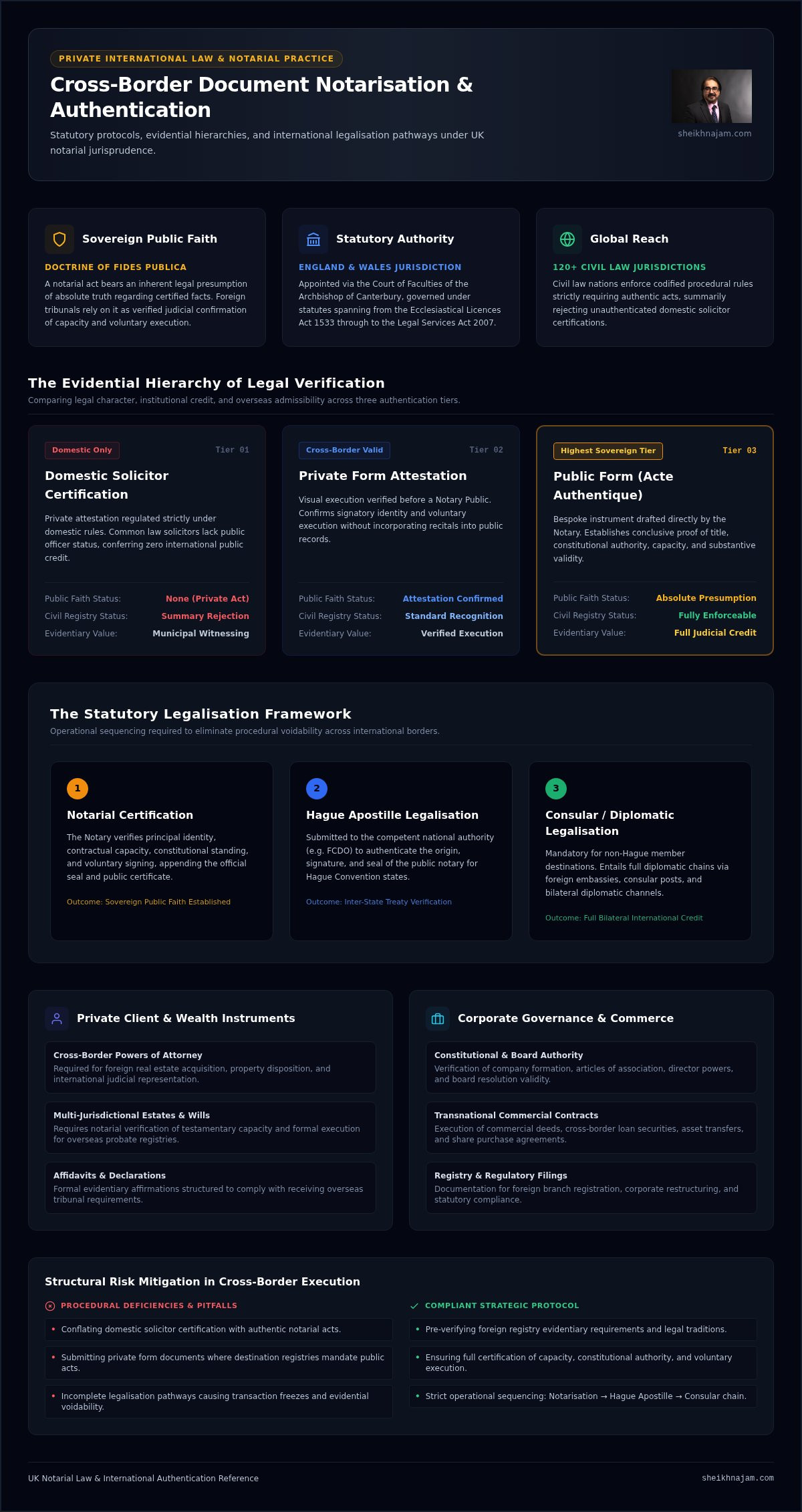
Commercial friction frequently arises when distinguishing domestic certifications from authentic notarial acts. A solicitor's certification remains a private attestation, governed purely by domestic professional regulations and devoid of international public credit. Civil law jurisdictions, operating under codified procedural rules, consistently reject solicitor signatures because common law solicitors lack public officer status.
English notarial jurisprudence establishes a definitive division between structural evidentiary tiers:
Private Form Attestation: Verifies the visual execution of an instrument before the notary, confirming identity and voluntary signature without incorporating the substantive recitals into a public record.
Public Form Authentication (Acte Authentique): A bespoke instrument drafted directly by the notary, certifying title, constitutional authority, capacity, and substantive legal validity.
Fiduciaries managing international affairs shouldn't conflate these standards. Attempting to deploy private solicitor attestations where receiving registries mandate authentic public instruments guarantees summary administrative rejection abroad.
Which Instruments Require You to Notarise Documents for International Recognition?
Cross-border recognition pivots upon the legal tradition of the destination state. Common law jurisdictions routinely accept private affidavits verified under domestic statutory declarations acts. Conversely, civil law jurisdictions, governing over 120 nations worldwide, enforce codified procedural systems where unauthenticated private deeds possess zero evidentiary status. To successfully notarise documents destined for overseas enforcement, legal counsel must categorise instruments according to the strict substantive prerequisites of the receiving registry, distinguishing personal wealth structures from corporate governance scrivenery.
Private Client Instruments: Powers of Attorney, Wills, and Affidavits
Cross-border powers of attorney for real estate acquisition, foreign property disposition, or judicial representation demand rigorous notarial intervention. A civil law land registry will summarily reject an instrument executed without a formal notarial certificate establishing contractual capacity and comprehension. Similarly, contentious multi-jurisdictional successions require meticulous swearing of affidavits and foreign probate oaths. In cross-border private wealth governance, complex testamentary arrangements and cross-border wills and successions necessitate exacting notarial verification to ensure distribution clauses withstand scrutiny before overseas succession tribunals.
Corporate and Commercial Instruments: Resolutions, Articles, and Commercial Contracts
In transnational commerce, notaries don't merely witness signatures; they examine structural capacity. Cross-border mergers, banking establishment, and restructuring demand authenticated corporate dossiers that prove both constitutional authority and direct factual provenance. Before foreign ministries recognise corporate standing, the notary must interrogate underlying company registers, establishing that the signatory possesses active legal authority under the articles of association.
Instruments routinely subjected to formal corporate scrivenery include:
Certificates of Good Standing: Independent notarial certification verifying active Companies House registration, director identities, and solvent statutory standing.
Corporate Board Minutes and Shareholder Resolutions: Formal public acts authenticating unanimous approvals for transnational acquisitions, borrowing facilities, or subsidiary creation.
Cross-Border Commercial Agreements: Execution verification of high-value distribution deeds, cross-guarantees, and intellectual property transfers.
Director Appointments and Authorisation Deeds: Validating signatory credentials to satisfy mandatory compliance mandates abroad.
Following execution, these commercial instruments frequently require submission to the Foreign, Commonwealth & Development Office for Legalisation Office document legalisation via an apostille. Ensuring flawless procedural adherence at the attestation stage prevents devastating commercial standstills. If your organisation faces intricate overseas filing mandates, you can consult a specialist notarial practitioner to pre-empt statutory defects.
The Procedural Protocol: How to Notarise Documents Step-by-Step
Executing an international instrument requires strict compliance with a sequential, tripartite framework. When practitioners notarise documents destined for overseas enforcement, procedural deficiencies at any juncture can render the entire instrument void ab initio. The process demands pre-execution evidential vetting, physical attestation, and coordinated statutory legalisation.
Pre-Execution Diligence: Identity Verification and Capacity Assessment
Rigorous scrutiny precedes the affixation of any seal. The notary must verify identity via unexpired government photographic identification and recent proof of address, complying with statutory anti-money laundering mandates. Crucially, the practitioner conducts an independent assessment of legal capacity, volitional intent, and understanding. For corporate entities, the notary reviews constitutional documentation, Companies House registers, and board resolutions to confirm that the appearing officer holds active authority to bind the commercial entity.
The Formal Execution: Attestation, Sealing, and the Notarial Act
Execution requires formal personal attendance. Even with emerging electronic frameworks, Faculty Office rules mandate that the notary must be physically present within the national jurisdiction of England and Wales when executing a notarial act. The practitioner attests the execution, records the details within their official notarial register, and binds the instrument using specialized eyelets or archival ribbons secured under an embossed, wet-ink wafer seal. This physical bonding permanently protects the document against fraudulent page substitution or posthumous alteration.
Post-Execution Requirements: Apostille and Consular Legalisation Protocols
Once attested, the document must be legalised to guarantee sovereign mutual recognition. The exact post-execution pathway depends entirely upon whether the destination country belongs to the international legalisation treaty:
The Hague Apostille Route: For the 129 member states contracting to the HCCH Apostille Convention (such as Canada, the People's Republic of China, and Vietnam), the instrument requires only a secondary apostille certificate issued by the Foreign, Commonwealth & Development Office (FCDO), verifying the signature, capacity, and seal of the notary public.
Consular Legalisation (Non-Hague Jurisdictions): Where the receiving state is not a convention party (such as the UAE, Qatar, or Kuwait), the instrument requires a rigorous four-stage chain: notarial execution, FCDO verification, diplomatic legalisation at the destination state's accredited embassy, and final verification by the Ministry of Foreign Affairs within the receiving country.
Mastering this sequencing ensures seamless transactional progress, allowing corporate officers and private fiduciaries to notarise documents with absolute evidential finality.
Key Pitfalls and Structural Risks in Cross-Border Document Notarisation
Cross-border document rejections rarely stem from simple administrative oversights; they arise from substantive structural defects that compromise legal efficacy. When commercial enterprises or private individuals attempt to notarise documents without rigorous pre-execution auditing, foreign land registries, commercial courts, and financial institutions summarily refuse filing. Executing incomplete drafts, appending unauthorised handwritten revisions, or altering binding ribbons constitutes immediate grounds for invalidation. Such procedural failures leave cross-border corporate reorganisations stalled, foreign asset transfers paralysed, and significant transactions exposed to fatal voidability.
Inadequate Identification and Defective Corporate Authority
A primary catalyst for rejection involves defective agency within corporate instruments. Affixing a notarial certificate without confirming that a director holds express constitutional power under the company's articles of association invites catastrophic exposure. In jurisdictions governed by strict civil codes, actions executed without an express, board-mandated authority lack binding force. Modern compliance frameworks also mandate rigorous verification of ultimate beneficial ownership. Where a signatory's authority derives from complex holding tiers or overseas trust structures, failing to substantiate the unbroken chain of delegation renders the notarial act legally defective.
Jurisdictional Mismatches, Translations, and Drafting Inconsistencies
Linguistic and structural misalignments present severe risks during transnational authentication. Overseas registries frequently mandate dual-language formatting or formal translation by verified professional linguists before accepting an instrument. If legal counsel attempts to notarise documents using pure common law drafting conventions for submission to a civil law court, systemic friction inevitably follows. Common law indemnity covenants or equitable remedies don't translate directly into civil code doctrines, and uncoordinated phrasing creates substantial ambiguities that invite adverse foreign judicial interpretations.
Pre-empting these structural exposure points requires authoritative legal oversight before instruments reach execution. If your transaction involves high-stakes commercial covenants or multi-jurisdictional private wealth governance, instruct our specialist notarial practice today to safeguard your documentation against transnational invalidity.
Instructing a Specialist Notary Public: Strategic Considerations for Private and Corporate Affairs
Authenticating cross-border instruments shouldn't be treated as an isolated administrative formality at the conclusion of a deal. When executed within high-value international contexts, notarial authentication serves as a foundational risk-mitigation safeguard. Deploying an integrated legal and notarial practitioner ensures that documentary form, fiduciary obligations, and jurisdictional nuances align before execution occurs. This comprehensive oversight pre-empts costly contentious litigation, insulating transactions against procedural challenges in overseas forums.
Mitigating Transactional Exposure Through Multi-Disciplinary Oversight
Cross-border asset protection, international tax planning, and multi-jurisdictional estate administration require harmonious scrivenery. A standalone notary unfamiliar with trust disputes or fiduciary structures might successfully verify a signature, yet leave substantive provisions vulnerable to foreign probate disputes or forced heirship challenges. By synthesising notarial office credentials appointed by the Court of Faculties with rigorous estate and trust credentials (such as TEP accreditation), the practitioner evaluates how each clause operates across both domestic and overseas legal systems. Exploring our unified specialist legal practice areas demonstrates how this multidisciplinary perspective shields estate instruments and corporate arrangements from hostile foreign challenges.
Preparing for Execution: Assembly of the Evidential Portfolio
A seamless appointment hinges upon the meticulous compilation of the evidential portfolio. Before an appearer can formally notarise documents, the practitioner must examine the complete transactional architecture to ensure statutory compliance across every relevant jurisdiction.
Principals and instructing solicitors should assemble the following portfolio prior to execution:
Original Primary Documents: Pristine, unexecuted clean drafts alongside underlying agreements, avoiding prior informal marks or initialling.
Direct Receiving Directives: Specific procedural instructions issued directly by the foreign receiving notary, registry, or ministry detailing mandatory formatting or linguistic requirements.
Statutory Verification Credentials: Valid original photographic passports, recent residential utility proofs, and corporate registry extracts confirming active authority.
Constitutional Foundations: For corporate attendances, certified articles of association, shareholder registers, and written board resolutions authorizing the specific signatory.
When parties seek to notarise documents for sophisticated international structures, early engagement avoids costly logistical missteps. Principals and corporate legal counsel managing high-value transnational portfolios are invited to arrange a consultation with our practice to ensure impeccable evidentiary execution.
Achieving Evidentiary Finality Across Foreign Jurisdictions
Navigating the mandate to notarise documents transcends routine administrative compliance; it constitutes the definitive legal safeguard protecting cross-border transactions against transnational voidability. Whether structuring complex cross-border commercial transactions or executing multi-jurisdictional private wealth dispositions, absolute procedural precision remains non-negotiable. Establishing sovereign public faith, distinguishing authentic acts from private attestations, and adhering methodically to Hague Convention or consular verification chains ensures foreign registries and judicial tribunals accept your instruments without friction.
As a Notary Public appointed by the Court of Faculties of the Archbishop of Canterbury and a qualified Trust and Estate Practitioner (TEP), our practice delivers exacting standards of scrivenery compliant with international treaty obligations and diplomatic directives. We unite fiduciary governance with robust authentication protocols, eliminating procedural vulnerabilities before execution takes place. To protect your commercial interests and secure seamless global recognition for your legal portfolio, arrange a notarial consultation today.
Frequently Asked Questions
What is the difference between having a document certified and having it notarised?
Certification by a solicitor merely confirms that a photocopy represents a true likeness of an original or that an identity was witnessed for domestic administrative purposes, whereas notarial authentication constitutes an official judicial act of international public faith. A notary independently investigates the underlying legal capacity, volitional intent, and substantive veracity of the transaction. Consequently, foreign courts and overseas registries recognise authentic notarial acts while summarily rejecting domestic solicitor certifications because they don't carry sovereign public credit.
Why do foreign authorities require a notary public rather than a solicitor?
Foreign jurisdictions require a notary public because notaries hold recognised status under private international law as impartial public officers endowed with sovereign delegated authority. Solicitors act primarily as partisan legal representatives whose domestic certifications don't carry presumptive evidentiary weight overseas. The civil doctrine of fides publica ensures that an instrument bearing a notary's official seal and signature enjoys immediate judicial recognition across civil and common law territories without requiring independent extrinsic proof of authenticity.
Can a notary public notarise documents written in a foreign language?
Yes, a notary public can notarise documents drafted in a foreign language, provided the notary can establish comprehension of the instrument's legal nature and verify that the appearer understands its binding obligations. The practitioner may satisfy this duty through professional fluency in the foreign tongue or by requiring an official translation from a verified professional translator. The notary's certificate will explicitly record whether the instrument was executed in dual-column translation or certified via an accredited linguist.
What is an Apostille certificate, and does every notarised document require one?
An apostille is an official certificate issued by the Foreign, Commonwealth & Development Office that validates the authenticity of the notary's signature, capacity, and official seal for international use. Not every notarised instrument requires an apostille, as common law states or jurisdictions with bilateral treaties may accept the notarial seal directly. However, instruments destined for the 129 member states of the Hague Apostille Convention universally demand this statutory validation to achieve legal standing.
What forms of identification must be presented to notarise documents in the UK?
Appearers must present valid government-issued photographic identification alongside definitive proof of residential address to properly notarise documents. Acceptable photographic proofs include an unexpired passport, national identity card, or photographic driving licence. Address verification requires an original utility bill, council tax statement, or bank statement issued within the preceding three months. For complex transactions, enhanced client due diligence may mandate supplementary evidence regarding the legitimate source of wealth and transnational beneficial ownership structures.
Is it legally permissible to notarise documents remotely via digital means in the UK?
Electronic notarisation is permissible under strict regulatory parameters, but it remains subject to rigorous statutory limitations governed by the Faculty Office of the Archbishop of Canterbury. The executing notary public must be physically present within England and Wales during the appointment, even if digital platforms verify the remote signatory. Furthermore, English deeds don't permit remote witnessing under domestic property statutes, and numerous foreign civil law registries routinely reject electronically notarised instruments entirely.
How does a notary verify the corporate capacity of a company director?
A notary verifies corporate capacity by conducting independent searches of official registrar records and examining constitutional documents before execution occurs. The practitioner inspects Companies House filings to confirm active corporate registration, unencumbered director appointments, and statutory solvency. Crucially, the notary cross-references the entity's articles of association and requires formal board resolutions or powers of attorney, guaranteeing the executing officer holds genuine constitutional mandate to bind the commercial enterprise abroad.
What constitutes a notarial act in public form versus private form?
A notarial act in private form entails authenticating an appearer's voluntary signature on a pre-drafted document via an attached notarial certificate, confirming identity and personal appearance. Conversely, an act in public form (known civilly as an acte authentique) is drafted directly by the notary as an official public instrument. The notary confirms not only identity, but certifies substantive legal capacity, constitutional standing, and transaction legality, retaining the permanent original within their archival protocol.


Comments