The Doctrine of Testamentary Forgery: A Strategic Guide to Challenging a Will in the United Kingdom (2026)

What if a will bears a signature that appears genuine, but the surrounding documents, witness accounts or circumstances raise doubts? For anyone researching “challenging a will for forgery uk”, the issue is rarely handwriting alone. The question is whether the evidence, considered as a whole, casts sufficient doubt on the document’s authenticity.
It is understandable to worry that an emotionally charged family dispute could lead to substantial costs without a successful outcome. Forgery allegations call for careful evidence-gathering and measured judgement, particularly if the estate may be distributed before the dispute is resolved. This guide explains the evidential burden, practical steps and factors that may affect a claim, without suggesting that any result is guaranteed. It focuses on the law of England and Wales. The rules may differ in other parts of the UK.
The guide covers document authentication, forensic handwriting evidence, the role of a caveat and ways to resolve a dispute through negotiation or mediation before litigation becomes necessary. Sheikh Najam TEP advises on contentious probate and complex trust and estate matters. The aim is to help you assess the evidence and understand how a considered strategy may protect your position.
Table of Contents
The Legal Framework for Challenging a Will for Forgery in the UK
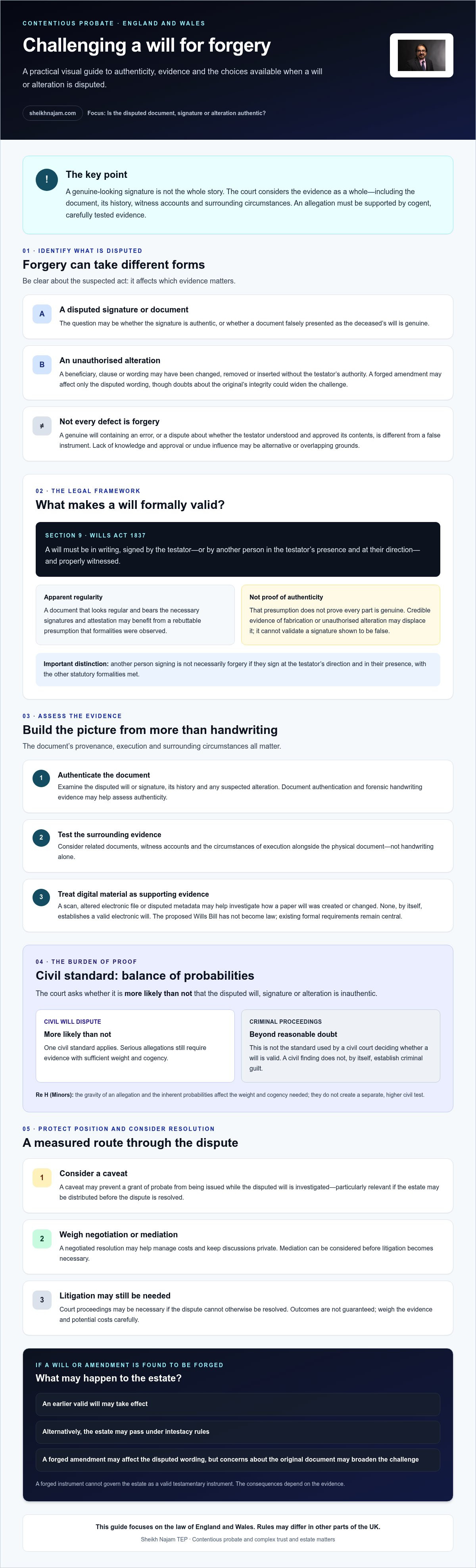
A will has legal effect only if it meets the applicable formal requirements and represents the deceased’s own testamentary act. In England and Wales, section 9 of the Wills Act 1837 requires a will to be in writing, signed by the testator, or by another person in the testator’s presence and at their direction, and properly witnessed. For foundational context on what is a valid will, the key distinction is between a genuine document that may have been made improperly and a document falsely presented as the deceased’s will.
In a forgery dispute, the central question is whether the disputed document, signature or alteration is authentic. A forged signature is not the only possible form of fraud. Someone might alter an executed will by changing a beneficiary, removing a clause or inserting wording without the testator’s authority. That is different from a genuine will containing an error or a dispute about whether the testator understood and approved its contents. Each possibility calls for careful examination of the document and its history.
Section 9 also informs the presumption of due execution. If a document appears regular on its face and bears the necessary signatures and attestation, the court may presume that the formalities were observed. This is a rebuttable evidential presumption, not proof that every part of the document is genuine. Credible evidence of fabrication or unauthorised alteration may displace it. The presumption cannot validate a signature shown to be false.
The Definition of a Forged Will
Forgery ordinarily concerns a false instrument represented as genuine, rather than a document that is merely mistaken or defective. A signature made by another person is not necessarily forged: section 9 permits another person to sign at the testator’s direction and in their presence, provided the other statutory formalities are met. By contrast, an unauthorised signature or alteration may call authenticity into question even if the rest of the document appears regular.
Digital records can add evidential complexity, but they do not create a new route to validity. A scanned copy, altered electronic file or disputed metadata may help an investigation into how a paper will was created or changed. None, by itself, establishes a valid electronic will. The proposed Wills Bill has not become law, so the existing formal requirements remain central.
The Gravity of the Allegation
Forgery is among the most serious allegations in contentious probate because it implies deliberate dishonesty, not simple error. The court will closely examine the document’s provenance, execution and surrounding circumstances, and will expect cogent evidence. Separate criminal consequences may arise if the conduct meets the relevant statutory requirements. A civil finding that a will is invalid does not, by itself, establish criminal guilt.
If a purported will is found to be forged, it cannot govern the estate as a valid testamentary instrument. The consequences depend on the evidence: an earlier valid will may take effect, or the estate may pass under intestacy rules. A forged amendment may affect only the disputed wording, although questions about the original document’s integrity could widen the challenge. Accordingly, challenging a will for forgery uk requires careful authentication and a clear understanding of the suspected act and its possible legal effect.
The Evidentiary Burden: Proving Fraudulent Execution
A forgery allegation in civil proceedings must be established on the balance of probabilities. The court asks whether it is more likely than not that the disputed will, signature or alteration is inauthentic. This is not the criminal standard of proof, which requires guilt to be established beyond reasonable doubt. A civil court deciding whether a will is valid does not find someone “guilty” of forgery.
That distinction does not make the evidential task easy. In Re H (Minors), the House of Lords confirmed that there is one civil standard, not a separate, elevated standard for serious allegations. The gravity of an allegation and the inherent probabilities of the circumstances nevertheless affect how much weight and cogency the evidence must carry. “High degree of probability” should not be mistaken for a higher legal test. It describes the strength of evidence that may be needed to satisfy the balance of probabilities in a serious case.
The Civil Standard and the Evidential Threshold
Alleging deliberate falsification is different from identifying an irregularity or clerical error. A mismatch in handwriting may warrant investigation, but it does not, by itself, prove who wrote the signature or whether the testator authorised another person to sign. In Face v Cunningham, the court’s approach has been cited in connection with the evidential burden once sufficient doubt has been raised about authenticity. Its application depends on the particular evidence and should not be treated as an automatic reversal in every dispute. Build a coherent, evidence-led case before commencing proceedings rather than relying on suspicion or family disagreement.
Contemporaneous and Circumstantial Evidence
A sound assessment usually brings together several sources rather than treating handwriting comparison as conclusive. Relevant material may include:
Earlier wills and drafts, instructions to advisers, correspondence and reliable evidence of the deceased’s testamentary intentions around the date of execution.
Attesting witnesses’ accounts of signing, presence and execution, where they can be identified and are available, together with any contemporaneous file notes or communications.
The document’s provenance and physical features. If an electronic file is relevant, available metadata or version history may also help. Digital material must be authenticated and interpreted in context.
Events surrounding the will’s discovery or production, including unexplained control of the original or inconsistent accounts. A beneficiary’s interest is relevant context, not proof of wrongdoing.
Criminal consequences are a separate question. The Forgery and Counterfeiting Act 1981 is relevant to criminal offences concerning forged instruments, but a probate court’s civil decision does not itself establish criminal liability. Anyone challenging a will for forgery uk should keep the civil validity issue distinct from any potential criminal investigation.
Where the evidence involves disputed documents, witness accounts and digital records, authentication needs to be considered as a whole. Sheikh Najam TEP advises on contentious probate and complex estate disputes. Read the firm’s contentious probate enquiry details when considering how to assess a potential claim.
Distinguishing Forgery from Other Grounds of Will Validity
A will may be challenged on more than one ground, but each allegation addresses a different legal question. Forgery concerns whether the document, signature or alteration is authentic. Lack of knowledge and approval asks whether the testator understood and accepted the contents of a genuine document. Undue influence concerns whether coercion overbore the testator’s independent decision-making. Lack of testamentary capacity concerns their ability to make a valid will at the relevant time. Pleading grounds in the alternative may be appropriate where the evidence supports more than one explanation or is incomplete, but each ground needs a proper factual basis.
Forgery and Lack of Knowledge and Approval
Lack of knowledge and approval may be more viable than forgery where the signature appears genuine but circumstances raise doubt about whether the testator knew what the will said. If suspicious circumstances surround preparation or execution, the person propounding the will must satisfy the court that the testator knew and approved its contents. This is not an automatic transfer of the burden simply because relatives object. The evidential question depends on the circumstances and the evidence as a whole. For example, an unexplained change benefiting the person who arranged the will may warrant close scrutiny, but it does not, by itself, prove fraud or lack of approval.
Let the evidence guide the choice and formulation of grounds. An allegation of forgery carries particular forensic and reputational consequences. Unsupported assertions can undermine credibility and increase litigation risk. A contentious probate specialist can assess whether the available material supports a forgery claim, an alternative validity challenge or both. Sheikh Najam’s specialist dispute areas include contentious probate and will disputes.
Undue Influence, Capacity and Strategic Risk
Forgery and undue influence may arise within the same family circumstances, but they are not interchangeable. A relative might allegedly pressure a testator to change their wishes while a separate concern arises that a signature or clause was fabricated. The first issue requires evidence of coercion that overbore the testator’s free will; the second requires evidence about the document’s authenticity. “Moral command” or dependence may be relevant context, but neither alone establishes undue influence.
Capacity may also be raised where medical records, communications or witness accounts create a genuine question about the testator’s ability to understand the act of making a will. It does not prove forgery, and a person lacking capacity is not necessarily the victim of a fabricated document. Assess each ground against its own evidential requirements.
For anyone challenging a will for forgery uk, the strategic decision is not to advance every conceivable allegation. It is to identify which claims the evidence can responsibly support. Forgery allegations may require document examination and detailed witness evidence, increasing complexity and costs. Other grounds also carry litigation risk and may fail if the evidence is insufficient. A disciplined assessment before proceedings can help focus the dispute on the strongest properly arguable case.
The Procedural Roadmap for a Forgery Challenge
A forgery challenge calls for prompt action, but each step should be guided by evidence rather than assumption. If a grant of probate has not yet issued, entering a caveat at the Probate Registry may temporarily prevent it from being issued while the disputed will is investigated. A caveat does not determine validity or resolve the dispute. It may be challenged and should not be treated as a substitute for progressing the claim.
Preserving and Examining the Document
If possible, secure the original will, keep it in its existing condition and avoid writing on it, marking it or handling it unnecessarily. A qualified forensic document examiner may compare the disputed signature with reliable, independently sourced examples of the deceased’s handwriting. The examination may consider line quality, pen movement, stroke formation and signs of hesitation, alongside the document’s physical condition. No single feature is conclusive.
Useful comparison material may include dated bank, legal or personal documents bearing signatures accepted as genuine. Their provenance and proximity to the date of the disputed will matter. An examiner’s report can be a significant part of the evidential file, but its conclusions must be considered alongside witness accounts, the will’s history and other contemporaneous records.
Caveat, Pre-Action Steps and Resolution
Once initial evidence has been gathered, the next step is usually to set out the challenge clearly to the parties concerned. A letter of claim should identify the will or provision in dispute, explain the factual and legal basis of the concern, and request relevant information or documents. There is no separate, universally applicable “Contentious Probate Pre-Action Protocol”; pre-action conduct is governed by the relevant general procedural requirements. A well-framed letter can clarify the issues and give the parties an opportunity to resolve them before proceedings.
There is no strict statutory time limit for challenging a will’s validity on the ground of forgery, but delay can create serious practical difficulties, particularly if the estate is distributed or evidence becomes harder to obtain. The equitable doctrine of laches should not be assumed to apply automatically. The effect of delay depends on the circumstances and the remedy sought. Seek advice promptly rather than relying on the absence of a fixed deadline.
If discussions do not resolve the dispute, a claim may proceed to court, including the High Court where appropriate. Litigation requires the evidence to be organised and tested; it does not guarantee that the will will be invalidated. Mediation may offer a private route to settlement, but it cannot replace a judicial decision where the parties cannot agree. Sheikh Najam TEP advises on contentious probate and dispute resolution. Read about mediation and arbitration for dispute resolution, or contact Sheikh Najam about a will dispute to discuss the evidence and possible next steps in challenging a will for forgery uk.
Strategic Resolution of Contentious Probate Disputes
Deciding whether to litigate should follow a disciplined assessment of the evidence, the estate’s position and the outcome sought. Court proceedings may be necessary where authenticity is firmly disputed or the parties cannot agree, but a trial brings cost, delay and uncertainty. The article’s general estimates put contentious probate litigation reaching trial at £30,000 to over £100,000 per party. These figures are not a prediction of the cost of any individual case. The court also has discretion over costs, so it does not automatically follow that one side will pay all of the other’s costs.
Mediation offers another route. A neutral mediator can help the parties test their positions and explore settlement without requiring a public trial. This may help preserve privacy and limit further damage to family relationships, although confidentiality is not an absolute guarantee and mediation cannot compel agreement. The right approach depends on the evidence, the parties’ objectives and whether a negotiated resolution can protect the estate and beneficiaries’ interests.
A Multi-Disciplinary Approach to Resolution
Sheikh Najam TEP advises on contentious probate, complex estate matters, international tax and trusts, and financial crime and compliance. This range of services can help bring document authentication, financial context and any cross-border dimensions into a coherent strategy rather than treating them as isolated issues. Where assets or beneficiaries span jurisdictions, international tax planning may also be relevant to the estate’s position after the dispute. Its application depends on the facts and jurisdictions involved.
A measured approach to negotiation can help the parties address the evidence and risks directly, without escalating allegations beyond what the material supports. For anyone challenging a will for forgery uk, the decision to settle or proceed should reflect a realistic appraisal of the evidence, potential recovery, and the costs and consequences of continuing.
After a Will Is Declared Invalid
If the disputed will is declared invalid, the next step is to establish which instrument governs the estate. An earlier valid will may take effect; if there is no valid will, the estate is generally administered under the rules of intestacy. The outcome should be confirmed in light of the judgment, any earlier testamentary documents and the estate’s circumstances. Where international assets or tax considerations arise, specialist planning may be needed before redistribution is implemented.
For a considered assessment of the evidence, resolution options and implications for the estate, schedule a consultation with Sheikh Najam TEP.
Protect Your Position with a Measured Strategy
A credible forgery challenge depends on more than suspicion. It requires a disciplined assessment of authenticity, reliable evidence and a clear understanding of any alternative grounds that may apply. The route to resolution should also be proportionate to the strength of the case, with mediation considered where it may resolve the dispute privately and preserve important family relationships.
For anyone considering challenging a will for forgery uk, early strategic advice can help clarify the evidential issues, procedural options and potential consequences before positions become entrenched. Sheikh Najam TEP advises on contentious probate, international trust disputes, and financial crime and compliance, supporting a considered approach to complex estate matters.
If you are concerned about a will’s authenticity, contact Sheikh Najam TEP to discuss your contentious probate matter. A careful appraisal of the documents and circumstances can provide a sound basis for deciding what to do next.
Frequently Asked Questions
How much does it cost to challenge a will for forgery in the UK?
Costs depend on the evidence, the procedural steps required and whether the dispute reaches trial. General estimates put court fees for issuing a contentious probate claim at around £650 to £695, with a trial hearing fee of approximately £1,000 to £1,300. A handwriting expert’s report may range from £800 to £5,000. A case proceeding to trial may cost £30,000 to over £100,000 per party. These are not estimates for an individual case.
Can I challenge a will if probate has already been granted?
Yes. A grant does not necessarily prevent a challenge to the will’s validity, but matters can become more complicated, particularly if the estate has already been distributed. A caveat prevents a grant from being issued, so it is not a remedy once probate has been granted. Obtain advice promptly about available court steps and whether assets can still be traced or recovered. Delay may materially affect practical options.
What evidence do I need to prove a signature on a will is forged?
You need evidence capable of showing that the signature is not genuine or was not authorised, assessed on the civil balance of probabilities. A forensic document examiner may compare the disputed signature with reliable examples of the deceased’s known handwriting, considering features such as line quality and stroke formation. Earlier wills, dated documents, witness accounts, solicitor records and evidence about how the will was created may also be relevant. No single discrepancy proves forgery by itself.
How long does a forgery challenge typically take to resolve?
There is no standard timetable for a forgery challenge. Resolution may depend on how quickly the will and relevant records can be obtained, whether witnesses are available, the time needed for expert examination and whether the parties can reach agreement. A negotiated resolution may conclude sooner than contested court proceedings, but timing cannot be guaranteed. If probate has not yet been granted, consider prompt advice about a caveat while the evidence is assessed.
What happens to the estate if the will is found to be a forgery?
If the court finds the purported will invalid, it cannot govern distribution as a valid testamentary instrument. An earlier valid will may then take effect. If there is no earlier valid will, the estate will generally be distributed under the intestacy rules. A forged amendment may raise a narrower question about the alteration’s effect, depending on the evidence and the court’s decision. The estate’s administration may need to be reconsidered accordingly.
Can I be held liable for costs if my forgery challenge is unsuccessful?
Yes. The general approach in civil litigation is that the unsuccessful party may be ordered to pay the successful party’s costs. However, costs in probate disputes are subject to the court’s discretion, and the outcome depends on the circumstances and conduct of the case. Before proceeding, assess the evidence, likely costs and potential recovery carefully. Do not advance an allegation of fraud solely on suspicion or family disagreement.
Is it possible to resolve a forgery dispute through mediation?
Yes. Mediation allows the parties to discuss the evidence and potential settlement with the assistance of a neutral mediator, without asking a judge to determine the dispute at trial. It may help preserve family relationships and keep sensitive discussions out of public court proceedings. Mediation is confidential subject to applicable exceptions, and it cannot compel settlement. If no agreement is reached, court proceedings may still be required to resolve the will’s validity.
What is the time limit for contesting a will on the grounds of fraud?
There is no strict statutory time limit for challenging a will’s validity on grounds of forgery, but that does not mean delay is safe. Evidence may become harder to obtain, and distribution of the estate can create further complications. Act promptly to investigate and protect your position. This differs from a claim under the Inheritance (Provision for Family and Dependants) Act 1975, which generally has a six-month limit from the grant of probate.


Comments