UK Double Taxation Treaties: Optimising Global Tax Efficiency
- S Najam
- 18 hours ago
- 12 min read

The prevailing assumption that private international wealth is inherently shielded by bilateral agreements is a profound fallacy that frequently results in catastrophic fiscal leakage for the ill-advised. You likely recognise that as your global footprint expands across disparate jurisdictions, it's often the case that the sheer density of overlapping regulatory frameworks creates a jurisprudential labyrinth where even minor misinterpretations of residency 'tie-breaker' rules can trigger significant, unintended fiscal liabilities. This comprehensive analysis serves as a definitive guide to UK Double taxation treaties/conventions, providing the precise legal frameworks necessary to mitigate double taxation on global dividends and capital gains. By examining the rigorous protocols of treaty invocation and the strategic alignment of international trusts, we offer the clarity required to navigate multi-jurisdictional obligations with absolute certainty. We shall explore the critical nuances of beneficial ownership, the impact of the Multilateral Instrument (MLI), and the indispensable role of notarial verification in securing the integrity of cross-border estates.
Table of Contents
Navigating the Architecture of UK Double Taxation Treaties and Conventions
The Jurisprudential Mechanism of Bilateral Fiscal Protocols and the MLI
Resolving Dual Residency Conflicts via Treaty Tie-Breaker Rules
Strategic Application in International Estate and Trust Administration
Professional Governance: Invoking Treaty Relief and Notarial Authentication
Navigating the Architecture of UK Double Taxation Treaties and Conventions
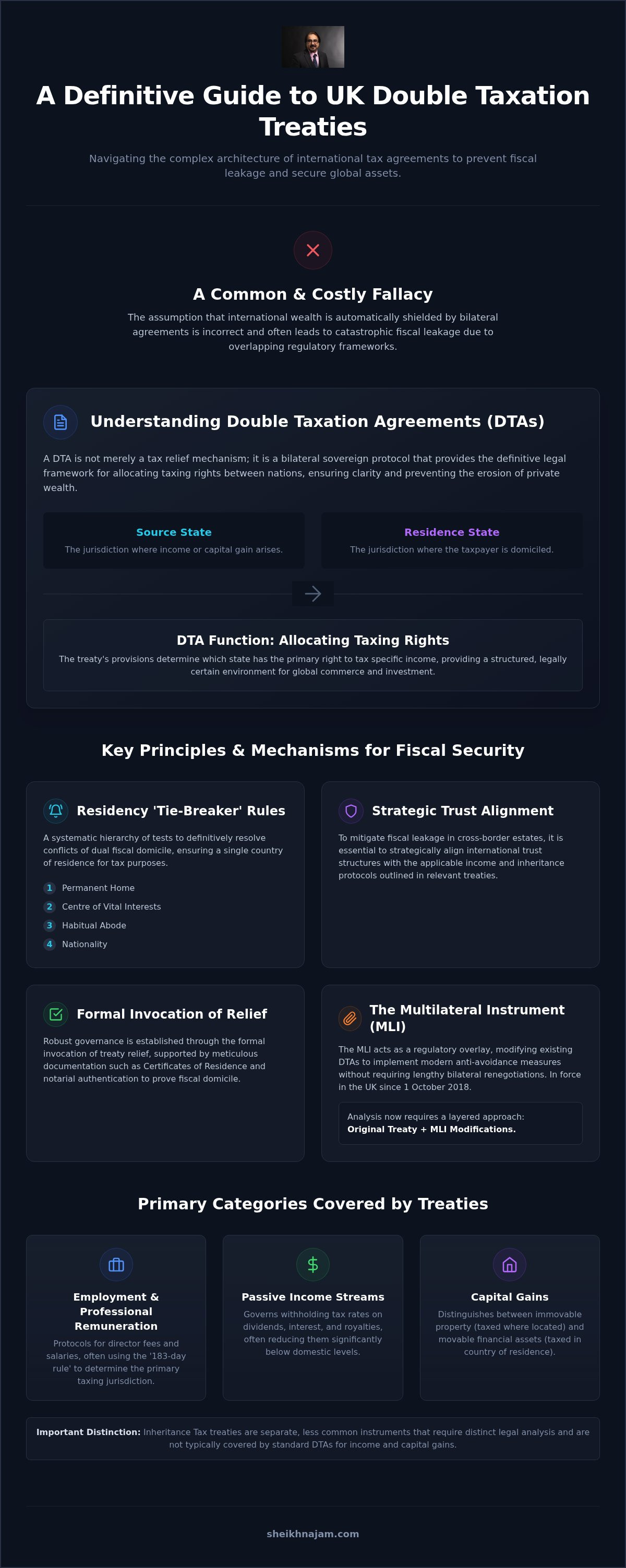
A Double Taxation Agreement (DTA) isn't merely a tax relief mechanism; it's a bilateral sovereign protocol of profound legal significance. These instruments serve as the definitive framework for determining which of two competing nations possesses the primary right to levy tax on a specific stream of income or capital gain. To understand What is Double Taxation?, one must view it as the overlapping of fiscal claims that, without the intervention of UK Double taxation treaties/conventions, would inevitably lead to the confiscatory erosion of private wealth. These protocols are indispensable for high-net-worth individuals, facilitating the fluid movement of capital whilst providing the legal certainty required for sophisticated international tax planning. Treaty supremacy is absolute. By allocating taxing rights between the 'Source' state, where the income arises, and the 'Residence' state, where the taxpayer is domiciled, DTAs provide a structured environment for global commerce.
The Legal Basis of Bilateral Fiscal Protocols
The integration of these treaties into the UK's domestic legal order is achieved through the mechanism of Statutory Instruments, which grant the treaty provisions legal force. In scenarios where a conflict arises between the UK's domestic tax statutes and the specific articles of a treaty, the treaty provisions generally maintain supremacy. This hierarchical structure ensures that the UK's international commitments remain robust. Most modern agreements are heavily influenced by the OECD Model Tax Convention, reflecting an evolving global consensus on transparency and the prevention of fiscal evasion. The meticulous drafting of these documents allows for a precise application of law, though the complexity of their interaction with domestic rules requires constant vigilance.
Primary Categories of Taxable Events Covered
The scope of UK Double taxation treaties/conventions typically encompasses a broad spectrum of taxable events, categorised by the nature of the income generated. This systematic classification ensures that every asset class is addressed with jurisprudential rigor.
Employment and Professional Remuneration: Protocols dictate the taxation of director fees and professional salaries, often employing the '183-day rule' to determine the primary taxing jurisdiction.
Passive Income Streams: Detailed articles govern the withholding tax rates applied to dividends, interest, and royalties, frequently reducing these rates significantly below domestic defaults.
Capital Gains: Treaties distinguish between gains derived from immovable property, which usually remains taxable in the country where the property is situated, and movable financial assets, which are typically taxed in the country of residence.
Whilst most conventions focus on income and capital gains, it's vital to recognise that inheritance tax treaties are separate, rarer instruments that require distinct legal analysis. Navigating these overlapping layers of regulation is a prerequisite for maintaining global fiscal efficiency.
The Jurisprudential Mechanism of Bilateral Fiscal Protocols and the MLI
The evolution of the global fiscal landscape has necessitated a transition from static bilateralism to a dynamic, multilateral framework. Since its entry into force in the UK on 1 October 2018, the Multilateral Instrument (MLI) has served as a sophisticated mechanism for updating 'Covered Tax Agreements' without the protracted requirement for individual state-level renegotiation. For the sophisticated practitioner, interpreting UK Double taxation treaties/conventions now requires a simultaneous analysis of the original treaty text and the specific reservations and notifications adopted by both contracting jurisdictions. This layered approach ensures that historical protocols are brought into alignment with contemporary standards of international tax transparency amongst participating nations.
The Impact of the Multilateral Instrument (MLI)
The MLI functions as a regulatory overlay, introducing standardised anti-avoidance measures into historical conventions that predate modern transparency requirements. It's imperative to consult the 'Synthesised Texts' published by HMRC, as these documents weave together the original articles with the MLI modifications to provide a coherent legal standing for specific jurisdictions. The administrative burden of verifying whether a treaty partner has matching notifications shouldn't be understated. The MLI serves as a synchronised legal mechanism designed to swiftly update the global tax treaty network to combat base erosion and profit shifting.
Anti-Abuse Provisions and Substance Requirements
Central to this modernisation is the Principal Purpose Test (PPT), a subjective criterion that empowers tax authorities to deny treaty benefits if one of the principal purposes of an arrangement was to obtain such benefits. This shift from mechanical application to purposive scrutiny means that 'letterbox' companies and artificial conduits lack the requisite 'substance' to withstand regulatory challenges under 2026 standards. Substance is no longer optional. Wealth structures must demonstrate genuine economic activity and management control to align with the OECD Model Tax Convention standards. Ensuring your international holdings meet these rigorous 'Beneficial Ownership' thresholds is paramount for preserving fiscal integrity. If you require a detailed audit of your current jurisdictional footprint, discussing your cross-border arrangements with a seasoned advisor ensures compliance with these evolving standards. Mastery of these UK Double taxation treaties/conventions ensures that global capital remains protected from the volatility of shifting regulatory tides.
Resolving Dual Residency Conflicts via Treaty Tie-Breaker Rules
Dual residency occurs when two sovereign states claim the right to tax an individual's worldwide income based on their respective domestic laws. In the UK, the Statutory Residence Test (SRT) serves as the foundational mechanism for determining residency status. However, for globally mobile high-net-worth individuals, satisfying the SRT doesn't preclude a simultaneous residency claim from another jurisdiction. It's a dangerous misconception, often propagated by less rigorous advisors, that residency is a matter of personal election. It isn't. It's a matter of law. When such conflicts arise, the provisions of UK Double taxation treaties/conventions provide a mandatory 'tie-breaker' hierarchy to resolve the dispute and assign fiscal domicile to a single state.
The Tie-Breaker Hierarchy: A Strategic Breakdown
The resolution process follows a rigid, sequential hierarchy. Tax authorities don't skip steps; they move through the tests until a definitive result is achieved. This methodical approach ensures that the individual's fiscal centre of gravity is identified with absolute precision.
Permanent Home: The primary inquiry focuses on where the individual has a permanent home available to them. This requires more than mere ownership; it necessitates a dwelling of a permanent nature, kept and reserved for their use at all times.
Centre of Vital Interests: Should a permanent home exist in both states, or neither, the focus shifts to the individual's 'centre of vital interests'. This is an exhaustive evaluation of personal, social, and economic ties, including family relations, political activities, and the place of business management.
Habitual Abode and Nationality: If the centre of vital interests remains indeterminate, the 'habitual abode' test examines where the individual spends the majority of their time. If this, too, fails to provide clarity, nationality becomes the deciding factor.
Dual Residency and the Non-Dom Framework
The interaction between treaty residency and the UK Non-Dom Rules is particularly intricate. A taxpayer might be resident in the UK under the SRT but 'treaty non-resident' due to the tie-breaker tests. This status significantly impacts the application of the remittance basis and the taxation of foreign-sourced income. Managing these transitions for professionals moving amongst global financial centres requires meticulous planning. HMRC's residence and domicile enquiries are increasingly invasive, demanding contemporaneous evidence, such as diary entries, travel logs, and membership records, to support any claim of non-residency. Professional representation is essential to ensure that these complex protocols are invoked with absolute precision, protecting the estate from redundant fiscal demands.
Strategic Application in International Estate and Trust Administration
Whilst the United Kingdom maintains an extensive network of over 130 income tax agreements, the jurisprudential landscape for inheritance tax (IHT) is markedly different. The relative scarcity of IHT-specific UK Double taxation treaties/conventions, with only ten such bilateral agreements currently in force, presents a significant risk of redundant taxation for high-net-worth estates. This discrepancy necessitates a sophisticated approach to global wealth devolution. It ensures that foreign situs assets aren't subjected to confiscatory levies by both the UK and the jurisdiction of origin. Strategic International Tax Planning is therefore not merely an elective benefit but a structural necessity for the preservation of multi-generational capital.
Mitigating Inheritance Tax in Multi-Jurisdictional Estates
The primary mechanism for resolving IHT conflicts lies in the 'Situs' rules, which dictate which sovereign state possesses the primary right to tax a specific asset based on its physical or legal location. In the absence of a dedicated IHT treaty, executors must rely on unilateral relief provisions within UK domestic law to credit foreign taxes against the UK liability. This is particularly vital for non-domiciled individuals. Without precise treaty invocation, their worldwide estates risk exposure to UK IHT once they've met the 'deemed domicile' threshold. Meticulous structuring of foreign assets can effectively ring-fence wealth, provided the interaction between domestic statutes and bilateral protocols is managed with absolute precision.
Trust Governance and Cross-Border Fiscal Neutrality
International trusts often find themselves at the centre of complex fiscal disputes due to conflicting definitions of trust residency. UK Double taxation treaties/conventions play a critical role in determining the fiscal domicile of a trust, which in turn dictates the taxation of its underlying income and gains. Failure to align trust governance with these protocols can lead to 'dry' tax charges, where a tax liability arises in one jurisdiction without a corresponding cash distribution to the beneficiaries. Managing the flow of capital amongst disparate treaty jurisdictions requires a deep understanding of:
The 'Beneficial Ownership' status of trust income.
The impact of treaty-based withholding tax reductions on global dividends.
The strategic use of 'treaty-resident' entities within a trust structure to ensure fiscal neutrality.
Effective administration requires more than administrative competence; it demands a masterly command over the intersection of trust law and international fiscal policy. To ensure your global succession strategy remains robust against shifting regulatory standards, secure an elite review of your estate's treaty compliance and protect your legacy from redundant fiscal erosion.
Professional Governance: Invoking Treaty Relief and Notarial Authentication
The assumption that relief under UK Double taxation treaties/conventions is an automatic entitlement remains one of the most prevalent and costly misconceptions in global fiscal management. In reality, these protocols are passive instruments that remain dormant until formally invoked through meticulous administrative filings. For the high-net-worth individual or the international entrepreneur, the burden of proof rests entirely upon the taxpayer to demonstrate eligibility. This requires a proactive stance, where treaty benefits are explicitly claimed within annual tax returns or via specific jurisdiction-dependent applications. Failure to adhere to these procedural mandates often results in the forfeiture of relief, leading to significant, and entirely avoidable, fiscal leakage. It's a matter of rigorous governance, not mere accounting.
The Administrative Protocol for Claiming Relief
HMRC provides various mechanisms for claiming relief, most notably through 'Form DT' and its jurisdictional variants. These documents act as the formal petition for the application of reduced withholding rates or the elimination of dual tax claims. Timing is of the essence; statutory limitations often restrict the ability to make retrospective claims, meaning that delayed action can permanently extinguish a taxpayer's right to recovery. A Certificate of Residence is a mandatory evidentiary requirement issued by HMRC to certify an individual's or company's UK fiscal domicile for the purpose of claiming reduced withholding tax on international dividends. Without this verified standing, foreign tax authorities are legally entitled to apply domestic default rates, which are frequently substantially higher than those negotiated under bilateral conventions.
Notarial Authentication for Global Fiscal Compliance
Beyond mere tax filings, the successful invocation of treaty benefits often hinges on the external recognition of UK legal documents by foreign fiscal regimes. This is where notarial services become indispensable to the sophisticated practitioner. A Notary Public provides the necessary strategic authentication, verifying corporate standing, identities, and the validity of powers of attorney required for cross-border tax representations. In many civil law jurisdictions, a simple signature is insufficient; documents must be apostilled or legalised to carry evidentiary weight. Expert authentication ensures that your international legal instruments are beyond reproach, facilitating seamless compliance with foreign regulatory standards.
This multi-disciplinary intersection of notarial verification and fiscal strategy is particularly critical for International Tax Planning for Business Owners. Managing a global enterprise requires more than just financial oversight; it demands a command over the legal formalities that underpin international commerce. By integrating notarial rigor with sophisticated tax advisory, one ensures that global wealth structures aren't only efficient in theory but also robust and enforceable in practice across every jurisdiction of operation. This level of meticulousness provides the security that elite clients require in an increasingly transparent global market.
Securing Your Global Fiscal Legacy Through Strategic Command
The mastery of UK Double taxation treaties/conventions isn't merely a matter of compliance; it's a fundamental pillar of sophisticated wealth preservation. You've seen that the transition from static bilateralism to the dynamic scrutiny of the Multilateral Instrument (MLI) demands an active, rather than passive, approach to fiscal governance. Success in the international arena requires the precise resolution of residency conflicts and the strategic alignment of trust structures with evolving global standards. It's imperative to recognise that the preservation of capital requires a multi-disciplinary approach that transcends simple accounting.
Sheikh Najam TEP offers unparalleled expertise in complex cross-border probate and estate administration, ensuring that your multi-jurisdictional affairs are managed with absolute jurisprudential rigour. By combining specialist advisory on global tax compliance and financial crime with strategic notarial authentication for international legal instruments, we provide the command necessary to navigate the most intricate fiscal landscapes. Don't leave your legacy to the vagaries of overlapping tax regimes. Secure a strategic consultation for your international tax affairs with Sheikh Najam TEP and ensure your global interests are protected with meticulous precision. Your path to absolute fiscal efficiency starts here.
Frequently Asked Questions
Do UK double taxation treaties apply automatically to my foreign income?
Relief under UK Double taxation treaties/conventions isn't granted automatically and requires a formal claim through your annual self-assessment or specific jurisdictional applications. Taxpayers must demonstrate their eligibility by providing evidence of their tax residency and the nature of the income in question. HMRC typically requires a Certificate of Residence to verify your status before granting relief on foreign dividends. Neglecting these administrative protocols often leads to redundant taxation that remains unrecoverable due to statutory time limits.
Can a double taxation convention protect my estate from UK Inheritance Tax?
Protection from UK Inheritance Tax is only available through a specific subset of ten bilateral agreements dedicated to capital taxes. Whilst the UK has over 130 income tax treaties, the scarcity of IHT-specific conventions means that many estates must instead rely on unilateral relief provisions. Strategic inheritance tax planning is essential to ensure that foreign situs assets are credited correctly against UK liabilities, preventing the confiscatory erosion of an international estate's total value.
What happens if I am considered a tax resident in two different countries simultaneously?
When two nations claim taxing rights, the 'tie-breaker' provisions within the relevant treaty are invoked to assign a single fiscal domicile. This process overrides domestic residency tests, such as the UK's Statutory Residence Test, to prevent the same income from being taxed twice. The determination follows a rigid legal hierarchy, ensuring that the individual's global income is only subject to the primary taxing rights of one jurisdiction, whilst the other state provides a credit or exemption.
What is the difference between a tax treaty and a tax information exchange agreement?
A double taxation convention focuses on the allocation of taxing rights to prevent redundant levies, whereas a Tax Information Exchange Agreement (TIEA) is primarily a transparency mechanism. TIEAs facilitate the exchange of financial data between authorities to combat tax evasion but don't provide relief from taxation itself. For high-net-worth individuals, understanding this distinction is vital, as a TIEA increases regulatory visibility without offering the fiscal protections found in a comprehensive bilateral tax treaty.
How do the 'tie-breaker' rules in a treaty actually work in practice?
Tie-breaker rules function through a sequential hierarchy of tests designed to identify an individual's primary centre of gravity. The authorities first examine the location of a permanent home, followed by the 'centre of vital interests', which evaluates personal and economic ties. If these remain indeterminate, the habitual abode and, ultimately, nationality serve as the final arbiters. Each stage requires contemporaneous evidence, as residency is a matter of legal fact rather than personal preference or election.
Is it necessary to have my tax residency documents notarised for use abroad?
Notarial authentication is frequently a mandatory requirement when presenting UK residency certificates or corporate standing documents to foreign tax authorities. In many jurisdictions, particularly those within civil law systems, a simple HMRC document lacks the necessary evidentiary weight without a Notary Public's seal. Sheikh Najam TEP provides specialist notarial services to authenticate these instruments, ensuring they are legally recognised abroad. This verification is essential for successfully invoking treaty benefits and securing reduced withholding tax rates.
How has the Multilateral Instrument (MLI) changed existing UK tax treaties?
The Multilateral Instrument (MLI) has modernised existing UK Double taxation treaties/conventions by overlaying standardised anti-abuse provisions without the need for individual bilateral renegotiation. Its primary impact is the introduction of the Principal Purpose Test (PPT), which allows authorities to deny treaty benefits if an arrangement's main objective was tax avoidance. Consequently, international structures must now demonstrate genuine economic substance and beneficial ownership to withstand the rigorous scrutiny mandated by these contemporary global transparency standards.
Can I choose which country's tax treaty is more favourable for my business?
Treaty benefits are determined by the legal reality of residency and economic substance rather than a taxpayer's preference for a specific jurisdiction's rates. Attempting to 'choose' a treaty through artificial conduits is classified as treaty shopping, a practice now strictly prohibited under the MLI's anti-abuse frameworks. Wealth structures must possess a legitimate commercial rationale and management control in a jurisdiction to qualify for its treaty protections. Professional advisory ensures your global footprint remains compliant whilst naturally optimising fiscal efficiency.


Comments