UK Non-Dom Rules: Key Tax Planning Insights
- S Najam
- 12 hours ago
- 12 min read

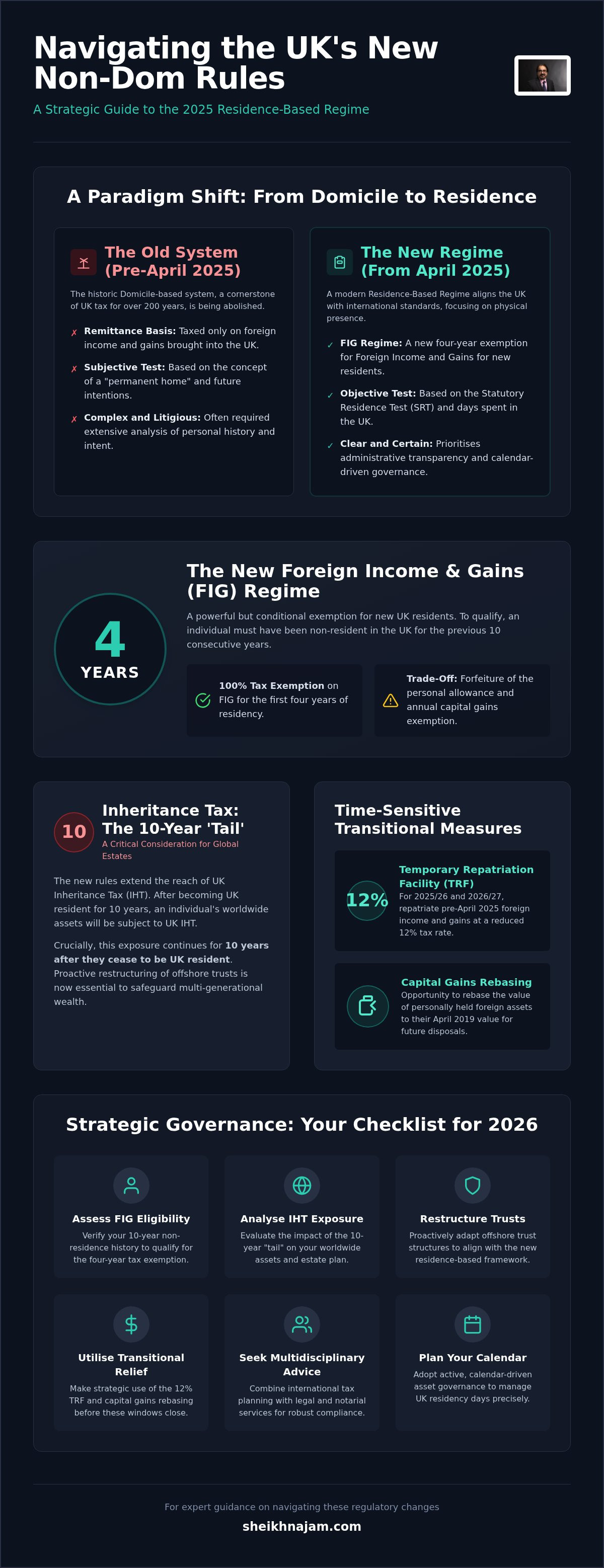
The traditional concept of domicile, which served as the cornerstone of British fiscal policy for over two centuries, has been irrevocably dismantled, necessitating a fundamental shift in how high-net-worth individuals govern their global estates. As the 2026/27 tax year approaches, the transition from domicile-based to residence-based taxation represents a paradigm shift that demands more than mere compliance; it requires a sophisticated structural pivot. You likely recognise that the abolition of the remittance basis and the introduction of the new four-year FIG regime have created an environment of profound uncertainty, particularly regarding the exposure of offshore trusts to UK inheritance tax. Understanding the nuances of the UK Non-Dom Rules is no longer an elective exercise for the internationally mobile elite but a mandatory requirement for the preservation of multi-generational wealth.
This article provides the expert jurisprudential insights necessary to master these complexities, ensuring your global assets remain protected under the new residence-based framework. We shall examine the strategic utilisation of the Temporary Repatriation Facility (TRF) at its current 12% rate, the implications of the 10-year inheritance tax "tail," and the rigorous reporting standards mandated for 2026. By the conclusion of this analysis, you'll possess a clear framework for global tax efficiency and the meticulous oversight required to secure your legacy against the current regulatory volatility.
Table of Contents
The Evolution of UK Fiscal Policy: From Domicile to Residence
The cessation of the remittance basis on 6 April 2025 marks the most significant upheaval in British private client law since the nineteenth century. For over two hundred years, the concept of Domicile (law) served as the primary arbiter of tax liability for those with international ties, offering a regime predicated on the subjective intent to remain in a territory indefinitely. This era has ended. The transition to the Residence-Based Regime (RBR) replaces these nuanced, often litigious inquiries into a taxpayer’s "permanent home" with the clinical, objective metrics of physical presence. For those navigating the UK Non-Dom Rules in 2026, this shift represents a move from passive status management to active, calendar-driven asset governance.
The 2026 landscape requires a multidisciplinary approach to wealth preservation that transcends traditional accounting. It's a period defined by the intersection of statutory compliance and global transparency, where the historic protections of non-domiciled status have been stripped away in favour of a system that prioritises residence as the sole nexus for taxation. This evolution demands that high-net-worth individuals (HNWIs) reassess their global footprints with absolute precision, ensuring that every day spent within the jurisdiction is accounted for under the new fiscal architecture.
The Jurisprudential Shift in UK Taxation
The jurisprudential weight of this change lies in the abandonment of the common law doctrine of domicile in favour of the Statutory Residence Test (SRT). Whilst domicile required an exhaustive analysis of an individual's background and future intentions, the new framework prioritises transparency and administrative certainty. This alignment with global reporting standards reflects a broader international trend towards the harmonisation of tax residency rules. It's no longer sufficient to maintain a conceptual "home" abroad; the 2026 landscape demands a rigorous oversight that accounts for the intersection of notarial verification, trust law, and tax compliance. Globally mobile professionals must now contend with a system that treats residency as a binary state, determined by quantitative data rather than qualitative intent.
A New Era for Globally Mobile Individuals
The primary cohorts affected by these reforms include HNWIs and international executives who have historically relied on the remittance basis to shield foreign income and gains. Success in this new environment depends on the strategic timing of arrivals and departures, as the "tail" of UK tax exposure now extends far beyond the date of physical relocation. Integrating international tax planning into a broader estate governance strategy is essential for those who wish to avoid the pitfalls of the 10-year residence rule. It's a period that requires the oversight of a strategic polymath who can reconcile the demands of UK fiscal policy with the complexities of global wealth preservation. Careful planning ensures that the transition to the UK Non-Dom Rules doesn't result in the inadvertent exposure of multi-generational assets to the UK's expanded tax net.
The FIG Regime: Navigating the Four-Year Exemption Framework
The introduction of the Foreign Income and Gains (FIG) regime on 6 April 2025 represents a departure from the historical complexities of the remittance basis. Under the new UK Non-Dom Rules, qualifying individuals benefit from a 100% exemption on their foreign income and gains for the initial four years of UK tax residency. This relief is absolute; provided the criteria are met, funds may be brought into the UK without incurring the punitive charges associated with the previous system. However, this simplicity is contingent upon the forfeiture of the personal allowance and the annual capital gains tax exemption. It's a trade-off that requires careful quantitative analysis to ensure that the loss of these allowances doesn't outweigh the benefits of the FIG relief for those with modest foreign income.
The 10-Year Non-Residency Requirement
Eligibility for this four-year window is strictly reserved for those who have maintained 10 consecutive years of non-UK residency prior to their arrival. As outlined in the official government technical note, this threshold is a rigid, objective metric that leaves no room for the subjective interpretations of intent that once governed domicile. For returning residents, the burden of proof is significant. One must secure meticulous administrative and notarial records to evidence non-residency across multiple jurisdictions. Double taxation treaties often play a decisive role here, particularly in determining the precise commencement of UK residency when cross-border professional duties overlap. Without robust documentation, the risk of falling outside the FIG criteria is substantial.
Optimising the Four-Year Window
The four-year FIG period offers a vital, albeit brief, opportunity for the structural reorganisation of global assets. Strategic distributions from non-resident trusts should be prioritised within this timeframe to capitalise on the 100% relief. There's also a critical interplay with Overseas Workday Relief (OWR), which remains available for the first three years of residency for those performing duties abroad. As we approach 2026, individuals who arrived early in the transition must begin preparing for the fiscal cliff of year five, when worldwide income becomes fully taxable. Those seeking to fortify their position against future liabilities may find it prudent to discuss their long-term governance structure with a qualified practitioner. This proactive preparation ensures that the transition to full UK taxation is managed with the precision that multi-generational wealth demands.
Inheritance Tax (IHT) and the Strategic Use of Trusts
The transformation of Inheritance Tax (IHT) from a domicile-centric model to a residence-based framework represents a profound shift in the fiscal exposure of international estates. Under the revised UK Non-Dom Rules, the determining factor is now a ten-year residency threshold. Once an individual has been resident in the UK for at least ten of the previous twenty tax years, their worldwide estate falls within the scope of IHT. This exposure isn't terminated immediately upon departure. A ten-year "tail" ensures that worldwide assets remain subject to UK IHT for a decade after the individual ceases to be a UK resident. This extension necessitates a radical re-evaluation of exit strategies, as the mere act of relocation no longer provides immediate relief from the 40% charge on global assets.
Excluded Property Trusts in the 2026 Landscape
The status of Excluded Property Trusts remains a focal point of jurisprudential debate amongst practitioners. Whilst trusts established by non-domiciled individuals prior to 6 April 2025 generally retain their excluded property status, this "grandfathering" is fragile. Any subsequent variation of the trust deed or addition of property after this date may inadvertently compromise its protected status, as detailed in the official UK government guidance on non-dom tax rules. Within the context of the updated UK Non-Dom Rules, these offshore structures are increasingly scrutinised, requiring a meticulous audit of trust administration to prevent the loss of historic exemptions and the complications of contentious probate.
Multi-Jurisdictional Estate Mitigation
Effective estate governance in 2026 demands the integration of international wills that reconcile the conflicting succession laws of multiple territories. The strategic application of double taxation treaties is equally vital, particularly in mitigating the impact of the ten-year residence tail. For the modern HNWI, estate planning must also encompass digital asset structuring, ensuring that cryptographic assets and virtual holdings are governed by robust legal instruments. The execution of these international trust instruments requires professional notarial services to ensure cross-border validity and compliance. This multidisciplinary oversight is essential for those seeking to protect multi-generational wealth from the expanded reach of the UK's residence-based inheritance tax.
Transitional Facilities: TRF and Strategic Rebasing
The transition away from the historic remittance basis necessitates a strategic engagement with the transitional provisions enacted to facilitate the repatriation of offshore wealth. Within the framework of the updated UK Non-Dom Rules, the Temporary Repatriation Facility (TRF) serves as a critical mechanism for the liquidation of historical foreign income and gains. This facility is not merely an administrative convenience but a time-bound fiscal opportunity. For the tax years 2025/26 and 2026/27, the applicable rate is fixed at 12%, rising to 15% in the 2027/28 period. Navigating this window requires a meticulous deconstruction of "mixed funds," where historical capital, income, and gains have become inextricably intertwined over decades of non-UK residency.
The Mechanics of the Temporary Repatriation Facility
Identifying qualifying foreign income and gains (FIG) requires an exhaustive audit of offshore accounts that often span multiple jurisdictions and financial institutions. Unlike the standard remittance basis, which often triggered complex "ordering rules" and punitive tax rates, the TRF offers a simplified, albeit rigorous, pathway for the 2026/27 tax year. Documentary evidence is paramount; HMRC compliance demands a transparent trail of the funds' origins prior to 6 April 2025. The fiscal benefit of the 12% rate is self-evident when contrasted with the 45% additional rate of income tax, yet the administrative complexity of isolating these funds from post-2025 income should not be underestimated. It's a calculated risk assessment where the certainty of a reduced rate must be balanced against the rigour of full disclosure.
Rebasing Strategies for Capital Assets
For those who have previously utilised the remittance basis, the ability to rebase personally held foreign assets to their value as of 5 April 2019 offers a significant shield against future capital gains tax (CGT) liabilities upon disposal. This election is particularly advantageous for illiquid assets or property portfolios that have seen substantial appreciation over the last several years. Determining the optimal timing for asset disposal requires a multidisciplinary perspective, considering the interaction between UK CGT and available foreign tax credits under various bilateral treaties. The authentication of these 2019 valuations often necessitates the involvement of professional notarial services to ensure that the valuation records are robust enough to withstand the scrutiny of future regulatory inquiries or trust disputes. This level of meticulousness is the hallmark of sophisticated wealth governance.
To ensure your repatriation strategy is both compliant and fiscally optimised, you may wish to consult our specialist advisory team for a bespoke assessment of your global holdings.
Advanced Governance: Multidisciplinary Advisory for 2026
The paradigmatic shift in UK Non-Dom Rules necessitates a governance structure that is as resilient as it is compliant, moving beyond isolated tax considerations towards a comprehensive wealth preservation model. As we approach 2026, the 200-year-old reliance on domicile has been replaced by a framework that demands the intervention of a Strategic Polymath; a practitioner capable of reconciling international tax planning with the rigours of financial crime and AML governance. This multidisciplinary approach ensures that private wealth structures are not only fiscally optimised but are also fortified against the increasing transparency requirements of the modern regulatory landscape. Success in this era depends upon the meticulous deconstruction of global holdings, ensuring that every facet of the estate is aligned with the latest statutory protocols whilst maintaining the flexibility required for international mobility.
Financial crime and AML governance are no longer peripheral concerns for the high-net-worth individual; they are the bedrock upon which secure estates are constructed. Ensuring that succession planning remains robust amidst changing fiscal protocols requires a proactive audit of all underlying trust instruments and corporate vehicles. This level of oversight provides the security and precision necessary to reassure sophisticated families that their most complex affairs are being handled with absolute multi-disciplinary expertise, preventing the inadvertent exposure of assets to regulatory scrutiny or litigation.
Notarial Services in Global Tax Structuring
Within the sphere of global tax structuring, the role of notarial authentication has become a critical component of cross-border compliance. Authenticating international trust deeds and powers of attorney is not a mere administrative formality; it is a vital safeguard that ensures the global validity of estate planning documentation. A public officer appointed by The Court of Faculties provides the necessary veracity to corporate instruments, allowing for the seamless recognition of legal documents across multiple jurisdictions. This strategic role is essential for verifying the integrity of complex instruments, ensuring that the transition to the new residence-based regime is supported by robust, authenticated evidence that can withstand the scrutiny of foreign authorities and judicial bodies alike.
Securing Your Future Wealth Framework
Developing a bespoke governance model for globally mobile families requires an authoritative command of both legal theory and practical negotiation. One must address the potential for a breach of trust within complex estates, particularly where multi-jurisdictional assets are involved. As the 2026 reporting standards loom, the necessity of a strategic review of your current wealth framework cannot be overstated. To ensure your legacy is protected with the precision and gravitas it deserves, you are invited to Consult with Sheikh Najam TEP for a comprehensive strategic review of your international affairs. This proactive engagement is the definitive step towards securing your global estate against the volatility of the evolving fiscal landscape.
Fortifying Your Global Estate for the 2026 Fiscal Transition
The dismantling of the historic domicile-based system necessitates a proactive and sophisticated response from the internationally mobile elite. As we've explored, the transition to the new UK Non-Dom Rules demands a rigorous deconstruction of global asset structures to mitigate the expanded reach of residence-based inheritance tax and the 10-year exposure tail. Success in this new era is predicated on the strategic utilisation of transitional facilities, such as the Temporary Repatriation Facility, alongside the robust authentication of international trust instruments. Precision in these matters isn't merely an administrative requirement; it's the bedrock of multi-generational wealth preservation.
To ensure your assets remain protected against these regulatory shifts, you're invited to Secure a Strategic Consultation with Sheikh Najam TEP. As a TEP Accredited Specialist, expert in cross-border inheritance tax, and an appointed Notary Public, I provide the meticulous oversight required to govern your most complex affairs with absolute precision. Aligning your estate with the 2026 standards today ensures that your legacy remains secure within an increasingly transparent global framework. Taking these definitive steps now provides the clarity and security your family's future demands.
Frequently Asked Questions
What is the primary difference between the old non-dom rules and the 2026 regime?
The fundamental distinction lies in the transition from a domicile-based system to a residence-based framework, effectively abolishing the 200-year-old remittance basis. Under the UK Non-Dom Rules effective from April 2025, tax liability is determined by objective residence metrics rather than subjective intent. This shift necessitates a structural pivot for high-net-worth individuals, as long-term residency now triggers worldwide taxation on income, gains, and inheritance, regardless of one's historical ties to a foreign jurisdiction.
How does the four-year FIG regime apply to new arrivals in the UK?
New arrivals who haven't been UK residents for the preceding ten consecutive years may claim 100% relief on foreign income and gains for their first four years of residency. This FIG regime allows for the repatriation of these funds without additional UK tax charges, provided an election is made. It replaces the complex remittance basis with a binary exemption. However, individuals must forgo their personal allowance and capital gains tax exemption to benefit from this four-year window.
Can I still protect my offshore assets from UK inheritance tax using a trust?
Protecting assets via trusts has become significantly more complex, as Inheritance Tax (IHT) is now a residence-based charge rather than a domicile-based one. Whilst Excluded Property Trusts established before 6 April 2025 may retain certain protections, these are subject to stringent grandfathering rules. Long-term residents who meet the 10-out-of-20-year residency test will find their worldwide assets, including those within certain trust structures, increasingly vulnerable to the UK's 40% IHT charge and the subsequent ten-year tail.
What is the Temporary Repatriation Facility and how long does it last?
The Temporary Repatriation Facility (TRF) is a transitional mechanism allowing former remittance basis users to bring historical foreign income and gains into the UK at a reduced tax rate. This facility is available for a three-year period commencing 6 April 2025. For the 2025/26 and 2026/27 tax years, a 12% rate applies, increasing to 15% for the 2027/28 tax year. It represents a strategic opportunity to regularise offshore wealth before standard rates apply.
Do I need to be non-resident for ten years to qualify for the new tax breaks?
Yes, a ten-year period of non-UK residency is a mandatory prerequisite for individuals seeking to qualify for the new four-year FIG regime. This objective threshold ensures that the tax breaks are reserved strictly for genuine new arrivals or those who have been absent from the UK for a decade. Evidence of this non-residency must be robust, often requiring notarial verification of international records to satisfy HMRC’s rigorous compliance standards during the application process.
How do double taxation treaties affect my status under the new UK rules?
Double taxation treaties remain vital instruments in determining a taxpayer’s treaty residence and mitigating the risk of dual exposure across multiple jurisdictions. These bilateral agreements provide tie-breaker rules that can override domestic legislation in specific circumstances, particularly regarding the commencement of residency. For the internationally mobile, these treaties are essential for protecting global income streams and ensuring that the transition to the new UK Non-Dom Rules doesn't result in punitive, overlapping tax liabilities.
What happens to my pre-2025 foreign income if I bring it to the UK in 2026?
Bringing pre-2025 foreign income into the UK during the 2026/27 tax year allows you to utilise the Temporary Repatriation Facility at the preferential 12% rate. This is a significant reduction from standard income tax rates, which can reach 45%. However, you must meticulously identify and isolate these funds from post-2025 income within mixed fund accounts. Failure to provide a transparent audit trail may result in the loss of this transitional relief and trigger full UK taxation.
Why is notarial authentication important for my international tax planning?
Notarial authentication is indispensable for ensuring the legal validity and cross-border recognition of international trust deeds, powers of attorney, and corporate instruments. As a public officer appointed by The Court of Faculties, a notary provides the necessary verification that foreign authorities and HMRC require for complex estate structures. This authentication is a cornerstone of robust governance, providing the certainty needed to manage multi-jurisdictional affairs and defend against potential trust disputes or regulatory inquiries.


Comments