Cross-Border Estate Planning: Strategic Guide for HNWIs
- S Najam
- 12 minutes ago
- 12 min read

The assumption that a standard domestic will suffices for a global portfolio isn't just optimistic; it's a profound strategic failure that invites the very fiscal leakage high-net-worth individuals seek to avoid. You've likely felt the persistent anxiety that your multi-jurisdictional assets remain vulnerable to conflicting succession laws or the punitive reach of double taxation. Engaging a premier cross-border estate planning expert is no longer a matter of administrative preference; it's a rigorous requirement for those whose interests span multiple sovereign territories and legal traditions.
You'll learn to master the complexities of multi-jurisdictional wealth preservation by identifying the specific competencies required in an elite practitioner. This guide examines the essential intersection of private wealth law, notarial authentication, and international tax strategy. We'll outline how to achieve a seamless, unified global estate structure whilst ensuring your documents command recognition from foreign notaries and courts alike. By the conclusion, you'll possess the framework to mitigate inheritance tax across all territories and secure absolute certainty for your legacy.
Table of Contents
The Imperative for Specialised Cross-Border Estate Planning Expertise
Cross-border estate planning is the strategic management and distribution of a global asset portfolio across multiple jurisdictions where legal systems are often in direct and irreconcilable conflict. For high-net-worth individuals, relying on a standard domestic will is a precarious strategy that frequently results in legal gridlock or significant fiscal leakage. Engaging a seasoned cross-border estate planning expert is essential to synthesise these disparate legal requirements into a single, functional architecture that protects wealth across borders. Conflict of Laws, in the context of private international law, is the set of rules that determines which jurisdiction's law governs a legal matter involving foreign elements. The necessity of a unified strategy can't be overstated, as it provides the only reliable defence against the unpredictability of foreign probate courts.
Understanding Multi-Jurisdictional Legal Conflicts
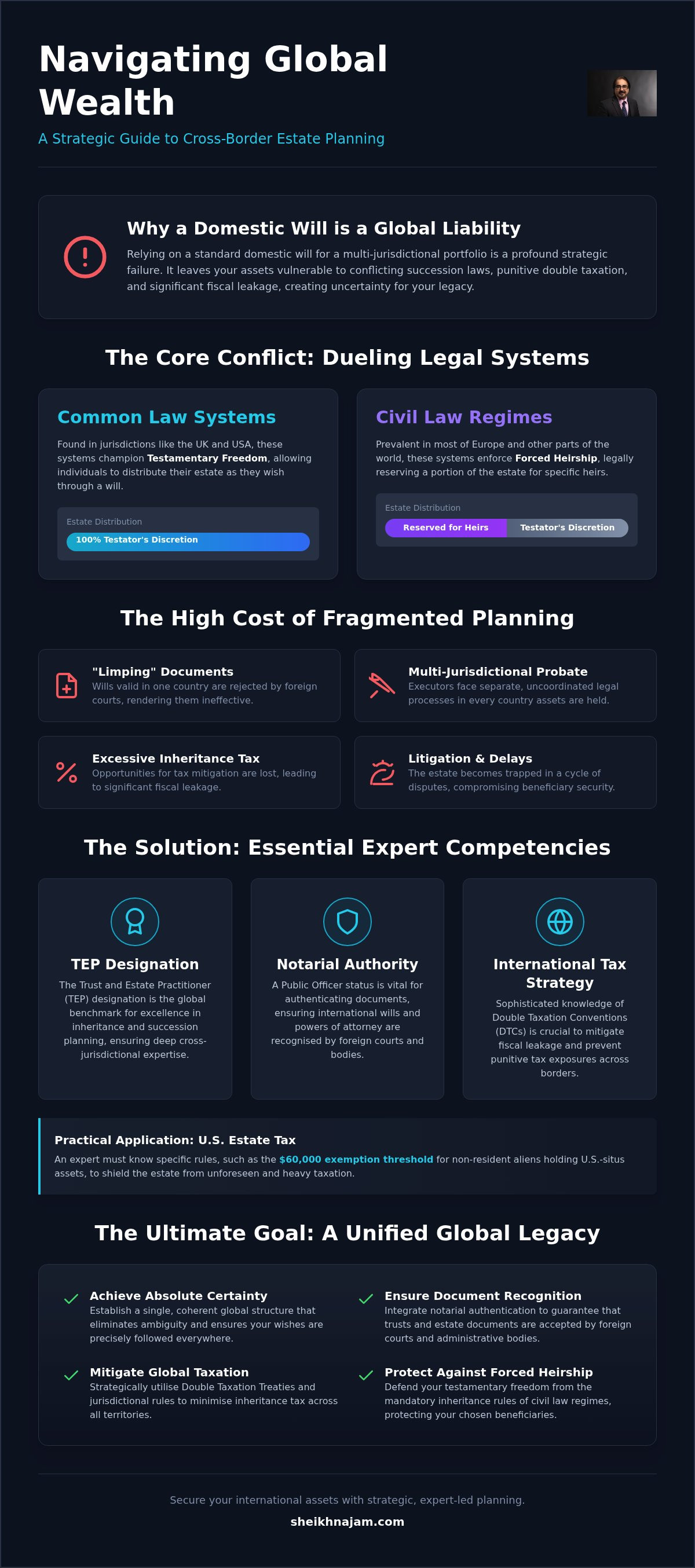
The primary tension in international succession lies between Common Law systems, which generally uphold testamentary freedom, and Civil Law regimes that enforce "forced heirship" provisions. Under forced heirship, a fixed portion of the estate is legally reserved for specific heirs, regardless of the testator's wishes expressed in a will. This conflict is further complicated by the EU Succession Regulation (Brussels IV), which permits individuals to elect the law of their nationality to govern their entire estate, though this choice must be meticulously documented to be recognised by foreign notaries. Whether the lex situs (law of the place where the property is situated) or the lex domicilii (law of the domicile) takes precedence depends entirely on the classification of the assets as moveable or immoveable property.
The Consequences of Fragmented Planning
Fragmented planning often produces "limping" documents, which are instruments that are legally valid in the United Kingdom but are rejected by foreign courts or notaries due to formal or substantive defects. This lack of coordination leads to the administrative nightmare of multi-jurisdictional probate, where executors must navigate separate, uncoordinated legal processes in every territory where assets are held. Such inefficiency doesn't just delay the transfer of wealth; it creates opportunities for excessive international inheritance tax liabilities that could have been mitigated through structured planning. Without a unified global strategy, the estate risks being trapped in a cycle of litigation and bureaucratic delay, ultimately compromising the security of the beneficiaries. For those seeking to protect complex global interests, exploring our specialist areas of expertise is the first step toward achieving legal certainty.
Essential Competencies: What to Seek in a Cross-Border Expert
Selecting an advisor to manage a global wealth portfolio requires a discerning evaluation of specific, high-level credentials that transcend domestic legal practice. A preeminent cross-border estate planning expert must hold the Trust and Estate Practitioner (TEP) designation, which serves as the internationally recognised benchmark for excellence in inheritance and succession matters. This qualification ensures the practitioner possesses the academic depth and practical experience to navigate the divergent legal traditions of multiple jurisdictions. The expert's status as a Public Officer, appointed by the Court of Faculties to provide notarial services, is indispensable for the authentication and legalisation of instruments that foreign jurisdictions will recognise as valid. This multi-disciplinary foundation allows for the precise execution of international wills and powers of attorney whilst ensuring compliance with the stringent formal requirements of civil law notaries.
Sophistication in international fiscal protocols is equally paramount, particularly regarding the strategic application of Double Taxation Conventions (DTCs) and Treaty Relief. For example, an advisor must be intimately familiar with U.S. international estate tax rules, notably the $60,000 exemption threshold for non-resident aliens with U.S.-situs assets, to prevent punitive tax exposures. Beyond mere compliance, the practitioner must offer robust dispute resolution expertise in contentious probate. This ensures that the estate is "future-proofed" against potential litigation arising from conflicting jurisdictional claims or beneficiary disputes. If you require such a meticulous approach to your global affairs, you may wish to discuss your requirements with a specialist.
The Multi-Disciplinary "Strategic Polymath" Model
High-net-worth individuals operate within a complex ecosystem where private wealth law, regulatory compliance, and fiscal strategy intersect. An elite advisor functions as a "Strategic Polymath," synthesising these fields to provide holistic oversight of global interests. This is particularly vital for entrepreneurs who require sophisticated international tax planning to align their corporate structures with their personal succession objectives. The ability to manage both non-contentious administration and high-stakes contentious probate ensures that every facet of the estate remains under professional command, regardless of the challenges that may arise during the devolution of assets.
Modern Competency: Digital Asset Structuring
As the global HNWI population diversifies its holdings, the ability to structure digital assets like cryptocurrencies and NFTs across borders has become a critical competency. An expert must understand the intricate compliance requirements and the evolving regulatory frameworks that govern these holdings in different territories. This includes a profound grasp of financial crime and Anti-Money Laundering (AML) implications, ensuring that complex structures remain transparent and compliant with international standards. Managing the secure and legal transfer of digital wealth requires a level of technical and legal precision that only an authority operating at the vanguard of the profession can provide.
Navigating International Tax and Succession Frameworks
The interaction between UK Inheritance Tax (IHT) and foreign succession duties requires a level of precision that only a seasoned cross-border estate planning expert can provide. Whilst the UK Nil-Rate Band remains frozen at £325,000 until April 2028, the exposure for global estates often exceeds this threshold, triggering a 40% charge on the surplus value of the estate. Strategic application of Double Taxation Treaties is essential to claim unilateral or treaty relief, ensuring that wealth isn't eroded by duplicate fiscal demands from competing jurisdictions. The distinction between domicile and residence is the fulcrum upon which these liabilities rest, as domicile often determines the global reach of a state’s taxing authority over both immoveable and moveable assets.
Fiscal Efficiency in Global Wealth Transfers
To mitigate these risks, sophisticated structures such as international trusts or specific corporate vehicles are frequently utilised for long-term wealth preservation. For instance, Using a Dutch Holding Company for UK Residents can provide a robust layer of protection against "Situs" tax risks in territories like France or the United States. In the U.S. specifically, the federal estate tax exemption for non-resident aliens is limited to $60,000 for U.S.-situs assets, making proactive structuring vital. Navigating the recent abolition of the UK non-domicile regime, which reportedly contributed to an estimated 16,500 millionaires leaving the country in 2025, requires a meticulous reassessment of remittance basis changes to safeguard assets against shifting regulatory sands.
Succession Governance and the International Will
The architecture of succession itself must be chosen with care, weighing the "One Global Will" approach against the "Multiple Situate Wills" strategy. Whilst a single will provides centralisation, multiple wills tailored to specific jurisdictions often expedite probate by complying directly with local formal requirements and the lex situs. When opting for a unified instrument, it must meet the stringent criteria for International Wills as defined by the Washington Convention of 1973. This ensures that the document is recognised as formally valid in all signatory states, effectively bypassing the procedural hurdles and notarial rejections that frequently obstruct the recognition of foreign testamentary dispositions in civil law territories.
The Strategic Integration of Notarial and Trust Services
The strategic integration of notarial acts with trust administration represents the apex of multi-disciplinary wealth preservation, requiring the command of a cross-border estate planning expert who understands the intersection of global law and administrative protocol. This process begins with the drafting of international instruments specifically designed to meet the formal requirements of foreign jurisdictions, thereby ensuring they're not summarily rejected by civil law notaries. Authenticating powers of attorney for use in foreign property transactions is a critical second step, as these documents must possess the requisite legal weight to be recognised by land registries in territories such as France, Italy, or Spain. Without this notarial foundation, even the most meticulously drafted will may falter at the point of execution.
The subsequent stage involves the meticulous legalisation and Apostille processes, which provide the necessary verification for global document recognition under the Hague Convention of 1961. Finally, establishing trust structures that strictly comply with the Hague Trust Convention of 1985 ensures that these vehicles remain resilient across borders, whilst providing a robust framework that civil law jurisdictions can interpret. This layered approach prevents the "limping" document scenario discussed previously, providing a unified front against administrative obstruction and ensuring that the donor’s intent is translated into enforceable legal reality across all relevant territories.
Notarial Authentication for Global Instruments
The role of a Notary Public for Company Documents is vital when managing the international commercial interests of an estate, particularly when assets are held through corporate shells. Notarial verification is equally indispensable for Lasting Powers of Attorney intended for use abroad, as foreign authorities require a high degree of certainty regarding the donor’s capacity and the instrument's authenticity. Authenticating corporate resolutions for international subsidiaries ensures that the transition of control remains seamless and legally sound, preventing a vacuum of authority that could invite litigation or regulatory intervention.
Trust Governance and Compliance Frameworks
Effective governance requires a profound understanding of Financial Crime Compliance for Trusts to ensure that all structures remain above reproach in an era of heightened global scrutiny. Trustees must balance their fiduciary duties with the divergent requirements of multi-jurisdictional contexts to avoid inadvertent breaches of trust that could lead to personal liability or the dissolution of the structure. By structuring trusts to survive challenges in both common law and civil law courts, the practitioner ensures the long-term viability of the wealth preservation strategy. If you seek to fortify your international holdings through this integrated approach, you should contact our specialist team today.
Securing Your Global Legacy: The Sheikh Najam TEP Advantage
The practice of Sheikh Najam TEP occupies a singular position within the national legal landscape, operating as a multi-disciplinary authority at the nexus of private wealth law, international tax, and notarial services. For the high-net-worth individual, the value of a meticulous, academic approach to high-stakes legal matters cannot be overstated; it's the difference between a legacy that's contested and one that's secured. By engaging a cross-border estate planning expert who possesses both the TEP designation and the authority of a Public Officer appointed by the Court of Faculties, you ensure that your global assets are governed by a unified and resilient strategy. This meticulousness isn't merely an administrative preference; it's a strategic necessity for those whose interests span multiple sovereign territories and legal traditions.
Proactive Dispute Resolution and Contentious Probate
The hallmark of a sophisticated estate structure is its ability to withstand scrutiny in foreign courts whilst preventing internal family discord. Our practice provides the strategic foresight required to navigate High-Value Contentious Probate and complex inheritance litigation. We employ "defensive drafting" techniques to mitigate future will disputes, ensuring that every instrument is robust enough to survive challenges across both common and civil law jurisdictions. When conflicts do arise, mediation serves as a prestigious and confidential mechanism to resolve multi-jurisdictional inheritance conflicts without the reputational and financial costs of protracted court battles. Key elements of our dispute prevention strategy include:
Rigorous verification of testamentary capacity and intent to pre-empt validity challenges.
Alignment of international wills with local forced heirship mandates to prevent statutory claims.
Strategic use of trust structures to provide a level of asset protection that transcends national borders.
Engaging Global Expertise
Total peace of mind is achieved when every facet of your international wealth is aligned with current global regulations and tax protocols. We encourage you to Review Specialist Areas for jurisdictional needs that require absolute precision. Whether you require digital asset structuring, international tax planning, or the authentication of complex trust documents, our practice provides the command and control necessary for intricate legal landscapes. The first step toward securing your global legacy is a comprehensive audit of your existing arrangements. You may Schedule a Strategic Consultation via Calendly to ensure your affairs are handled with the precision they deserve. It's time to move beyond fragmented planning and embrace a unified, global estate structure.
Fortifying Your Multi-Jurisdictional Wealth Architecture
The preservation of global wealth across divergent legal systems demands a level of meticulousness that transcends traditional legal boundaries. You've seen how the intersection of private wealth law, notarial authentication, and international tax strategy forms the essential foundation for a resilient estate. By identifying a cross-border estate planning expert who holds both TEP accreditation and a Public Officer appointment by the Court of Faculties, you ensure your affairs are managed with the academic rigor and strategic foresight necessary to prevent fiscal leakage and legal gridlock. Such an advisor operates at the vanguard of the profession, synthesising complex regulatory requirements into a single, functional architecture.
A unified global structure is the only reliable defence against the complexities of forced heirship and the punitive reach of double taxation. Every international instrument must be drafted with notarial recognition in mind to ensure its validity remains unquestioned by foreign courts and administrative bodies. To move from fragmented planning to total legal certainty, you're invited to secure your global legacy by scheduling a strategic consultation with Sheikh Najam TEP. Taking this proactive step today provides the security and multi-disciplinary command required for your family's long-term peace of mind and the successful devolution of your legacy.
Frequently Asked Questions
What exactly is a cross-border estate planning expert?
A cross-border estate planning expert is a specialist legal practitioner who synthesises private wealth law, international tax strategy, and notarial authentication to manage assets across multiple jurisdictions. This professional operates at the intersection of conflicting legal systems, such as common law and civil law, to ensure a unified global estate structure. By engaging such an expert, high-net-worth individuals mitigate the risks of double taxation and ensure their testamentary dispositions are recognised by foreign courts and administrative bodies.
Why do I need an international will if I already have a UK will?
A standard UK will may be formally valid under English law but could be rejected by foreign notaries or registries due to strict local formal requirements or the lex situs rule. International wills, drafted according to the Washington Convention of 1973, provide a standardised form that signatory states must recognise. This prevents the administrative burden of uncoordinated probate and protects against the scenario where a will is valid in one territory but void in another.
Can a UK notary public help with my property in Spain or France?
A UK notary public, particularly one appointed by the Court of Faculties, is essential for authenticating powers of attorney and deeds intended for use in foreign property transactions. These jurisdictions require a high degree of certainty regarding a donor’s capacity and the instrument’s authenticity before they'll permit the transfer of immoveable assets. The notary facilitates the legalisation and Apostille processes, ensuring that the document commands recognition from foreign land registries and notarial offices.
How do double taxation treaties protect my international inheritance?
Double taxation treaties are bilateral agreements that allocate taxing rights between sovereign states to prevent the same asset being taxed twice upon death. These protocols allow an estate to claim unilateral or treaty relief, effectively offsetting foreign succession duties against UK Inheritance Tax liabilities. Without the strategic application of these treaties, global portfolios risk severe fiscal leakage, as the UK's standard 40% rate on assets above the nil-rate band could be compounded by foreign levies.
What are the risks of forced heirship for UK nationals with foreign assets?
Forced heirship rules in civil law jurisdictions mandate that a specific portion of the estate must pass to protected heirs, such as children, regardless of the testator’s wishes. For UK nationals accustomed to testamentary freedom, this can lead to the involuntary disinheritance of preferred beneficiaries or the fragmentation of family wealth. Proactive structuring, potentially utilising the EU Succession Regulation (Brussels IV) to elect the law of nationality, is required to bypass these rigid local mandates.
How does the TEP qualification differ from a standard solicitor?
The Trust and Estate Practitioner (TEP) designation is the global gold standard for specialists in inheritance and succession matters, requiring rigorous academic and practical demonstration of expertise. While a standard solicitor may handle general probate, a TEP-accredited professional possesses deep, multi-disciplinary knowledge of complex trust administration and international tax strategy. This qualification ensures the practitioner is equipped to manage the intricate legal nuances of high-net-worth estates that span multiple jurisdictions and regulatory frameworks.
Can digital assets be included in a cross-border estate plan?
Digital assets, including cryptocurrencies and private keys, must be integrated into a comprehensive estate plan to ensure their secure and legal transfer. These holdings present unique challenges regarding jurisdictional location and the application of financial crime and AML compliance. A cross-border estate planning expert provides the technical and legal precision required to structure these assets within a global framework, ensuring beneficiaries can access and inherit digital wealth without administrative obstruction or security breaches.
What is the role of the Hague Trust Convention in estate planning?
The Hague Trust Convention of 1985 provides a critical framework for the recognition of trusts in jurisdictions that don't traditionally recognise the trust concept, such as many civil law countries. It establishes rules for determining the law applicable to a trust and ensures that its legal effects are respected across borders. Incorporating this convention into the structuring process allows a practitioner to create resilient wealth preservation vehicles that survive challenges in both common and civil law courts.


Comments