Strategic International Corporate Tax Planning & Structuring
- S Najam
- 1 day ago
- 12 min read

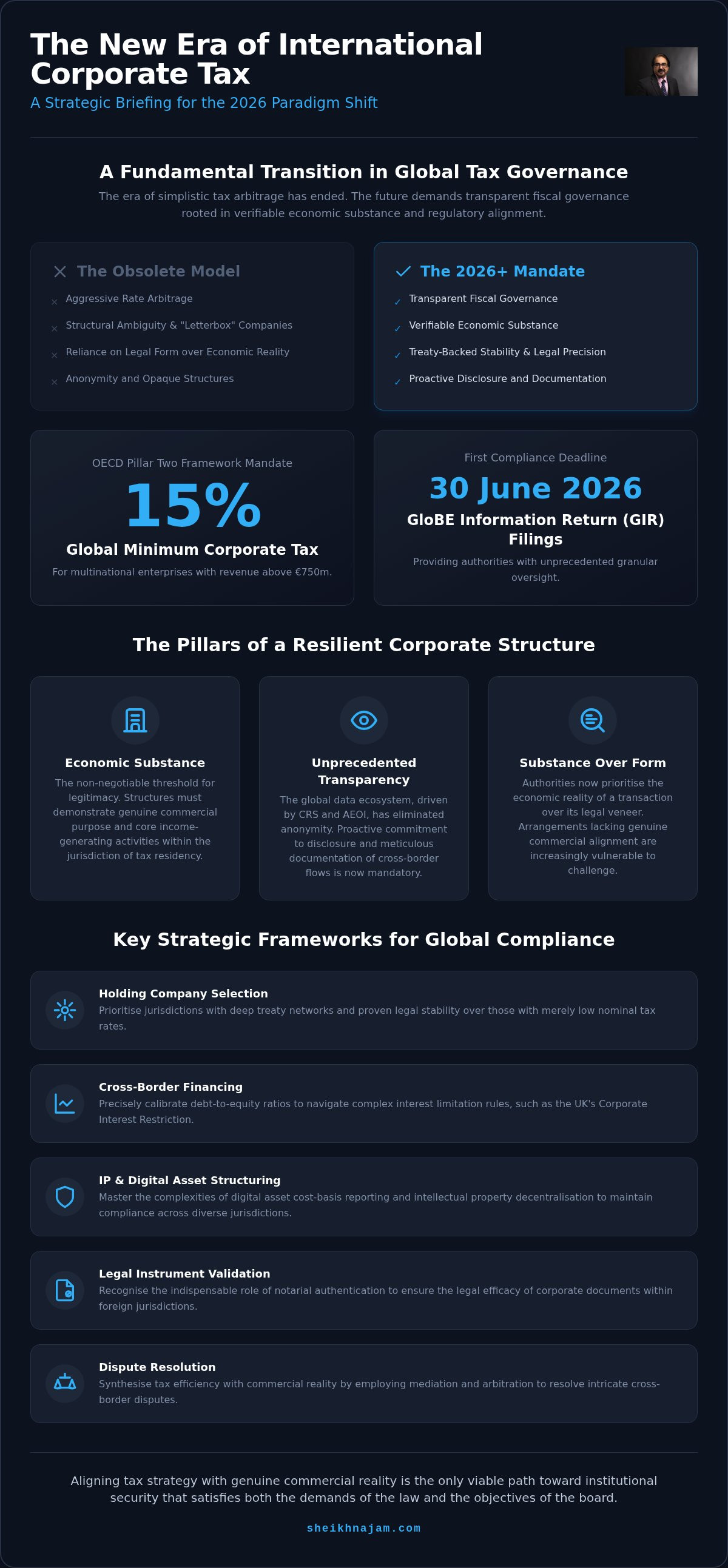
The era of simplistic international tax arbitrage has reached its definitive conclusion, replaced by a regime where legal substance and transparency are the only viable currencies of corporate legitimacy. In an environment defined by the OECD's Pillar Two framework and the first GloBE Information Return filings due by 30 June 2026, the margins for structural ambiguity have vanished entirely. You've likely realised that the escalating complexity of multi-jurisdictional tax treaties, coupled with the looming spectre of aggressive audits by national authorities, has rendered traditional offshore models not only obsolete but actively hazardous to your commercial interests.
This article offers a sophisticated analysis of International Corporate Tax Planning and Structuring, providing the precise legal mechanisms and strategic foresight necessary to navigate this shifting global tax architecture. We'll examine how to cultivate a robust corporate structure that mitigates double taxation whilst ensuring every entity maintains the rigorous economic substance required by contemporary regulatory standards. By aligning your tax strategy with your genuine commercial reality, we'll outline a path toward institutional security that satisfies both the demands of the law and the objectives of the board. We'll explore the integration of digital asset reporting and the evolving requirements for beneficial ownership verification to ensure your global operations remain beyond reproach.
Table of Contents
The Paradigm Shift in International Corporate Tax Planning (2026)
Structural Frameworks for Global Tax Efficiency and Substance
Navigating Cross-Border Intellectual Property and Digital Asset Structuring
The Imperative of Regulatory Compliance and Notarial Authentication
Strategic Advisory for Multi-Jurisdictional Corporate Governance
The Paradigm Shift in International Corporate Tax Planning (2026)
The fiscal environment of 2026 represents a profound recalibration of the global order. The implementation of the OECD Pillar Two framework, which mandates a 15% global minimum tax for large-scale multinational enterprises, has effectively dismantled the traditional pillars of aggressive rate arbitrage. This transition necessitates a sophisticated approach to International Corporate Tax Planning and Structuring, where legal precision and regulatory alignment are paramount. Modern tax planning is no longer an optional pursuit of efficiency; it's a strategic legal necessity for the resilient enterprise. We're witnessing a decisive move from the historical focus on tax mitigation toward a model of transparent fiscal governance rooted in the foundational principles of international taxation. The landscape is unforgiving. It demands absolute precision.
Authorities now prioritise the economic reality of a transaction over its mere legal veneer. This "substance over form" doctrine has become the primary lens through which tax inspectors evaluate multi-jurisdictional arrangements. For the sophisticated practitioner, this means that every corporate instrument must reflect a genuine commercial purpose that aligns with the broader objectives of International Tax Planning. Structures that lack this fundamental alignment are increasingly vulnerable to challenge, regardless of their technical compliance with individual domestic laws.
The Evolution of Global Fiscal Transparency
The maturing of the Common Reporting Standard (CRS) and the Automatic Exchange of Information (AEOI) has created a global data ecosystem where anonymity is an impossibility. By June 2026, the first GloBE Information Return (GIR) filings provide tax authorities with an unprecedented level of granular oversight into corporate structures. This data-rich environment has fundamentally altered the behaviour of multinational enterprises, compelling a shift toward holistic compliance. Maintaining a robust reputation now requires a proactive commitment to disclosure and the meticulous documentation of all cross-border flows.
Economic Substance: The New Threshold for Validity
Physical presence and local management have become the non-negotiable thresholds for structural legitimacy. Tax authorities across the globe have intensified their scrutiny of "letterbox" companies, seeking to invalidate structures that exist only on paper. To secure a legally robust corporate structure, entities must demonstrate that core income-generating activities are performed within the jurisdiction of tax residency. This requires qualified personnel, physical assets, and the actual exercise of executive control. Aligning tax residency with actual business activity is the only viable method to mitigate the risk of aggressive audits and ensure long-term stability.
Structural Frameworks for Global Tax Efficiency and Substance
The architectural integrity of a multi-jurisdictional enterprise depends upon the sophisticated selection of holding company locations, a process that transcends the mere identification of nominal tax rates. In the current regulatory climate, the efficacy of International Corporate Tax Planning and Structuring is inextricably linked to the depth of a jurisdiction's treaty network and its underlying legal stability. The strategic deployment of intermediate holding companies remains a critical mechanism for the legitimate mitigation of withholding taxes on cross-border yields, yet such vehicles must be supported by genuine operational autonomy. One must also navigate the intricate landscape of cross-border financing, where interest limitation rules, such as the UK's Corporate Interest Restriction, necessitate a precise calibration of debt-to-equity ratios to preserve fiscal efficiency.
Choosing between transparent and opaque entities for international tax purposes requires a profound understanding of how different jurisdictions classify corporate instruments. A "Strategic Polymath" approach ensures that the chosen entity type aligns with the commercial objectives of the parent organisation whilst remaining resilient against the scrutiny of diverse revenue authorities. Should you require a detailed evaluation of your current arrangements, you may request a formal consultation to discuss the nuances of your corporate architecture.
Holding Company Jurisprudence and Treaty Access
Assessing the suitability of a jurisdiction involves a rigorous analysis of UK Double taxation treaties/conventions to ensure that treaty benefits are both accessible and defensible. The implementation of the Principal Purpose Test (PPT) has introduced a subjective layer of complexity; tax authorities may now deny treaty benefits if it is reasonable to conclude that obtaining such a benefit was one of the principal purposes of the arrangement. This shift underscores the necessity of adhering to broader OECD international tax standards, where the focus has pivoted sharply toward ensuring that holding companies possess sufficient physical and decision-making substance to justify their presence within a specific territory.
Hybrid Mismatch Arrangements and Anti-Avoidance
The complexity of UK and international anti-hybrid legislation presents a significant challenge for structures involving entities that are treated differently across borders. These hybrid mismatch rules are designed to neutralise tax advantages arising from such disparities, such as double deductions or deduction without inclusion. Managing these regulations requires a meticulous review of how each entity in a chain is classified by relevant authorities. Proactive strategies must be employed to avoid the inadvertent creation of hybridities, thereby precluding the imposition of substantial penalties and ensuring that the corporate structure remains a model of legal and fiscal rectitude.
Navigating Cross-Border Intellectual Property and Digital Asset Structuring
The legal decentralisation of intellectual property (IP) within a globalised economy represents one of the most intricate facets of modern International Corporate Tax Planning and Structuring. Intangible assets are no longer tethered to a single jurisdiction by mere registration; instead, their fiscal validity depends on where the underlying value is genuinely cultivated. Structuring IP holding vehicles requires a meticulous alignment with research and development incentives, ensuring that the legal architecture supports the commercial reality of innovation. Valuation principles for the cross-border transfer of these intangible assets must remain beyond reproach, typically adhering to the arm's length principle to withstand the forensic scrutiny of multiple revenue authorities.
Establishing a resilient framework for these assets involves more than just identifying favourable rates. It requires a deep understanding of the jurisprudential shifts occurring in major financial centres. Whilst the United Kingdom maintains its own rigorous standards, one must also account for the U.S. Department of the Treasury's International Tax Policy when structuring assets that interact with American markets, particularly regarding the 2026 digital asset reporting mandates. This multi-disciplinary approach ensures that your intangible portfolio is both tax-efficient and legally defensible.
Intellectual Property Nexus and Development
Complying with the "Nexus Approach" is the non-negotiable standard for accessing IP-related tax benefits in the post-BEPS era. This doctrine mandates that tax advantages are only available to the extent that the taxpayer can demonstrate significant economic activity and direct R&D expenditure within the relevant jurisdiction. Relocating corporate intellectual property is a delicate manoeuvre that often triggers substantial exit taxes. It's imperative to conduct a comprehensive legal audit before any such transition to ensure that the move is both commercially justified and fiscally sustainable. Ownership must be backed by demonstrable decision-making substance to survive the "substance over form" tests now favoured by global authorities.
Corporate Digital Asset Structuring
The integration of corporate digital asset holdings, ranging from cryptocurrency portfolios to participation in Decentralised Autonomous Organisations (DAOs), demands a new level of legal and financial precision. As of 1 January 2026, final regulations mandate that brokers report the cost basis for digital asset sales and dispositions, a move that aligns these instruments with traditional financial securities. Establishing a robust legal framework for Digital Asset Structuring is essential to ensure compliance with intensifying financial crime and anti-money laundering (AML) standards. This proactive approach ensures that your digital portfolio remains a secure, compliant, and transparent component of your broader corporate architecture.
The Imperative of Regulatory Compliance and Notarial Authentication
A sophisticated fiscal strategy remains a mere theoretical exercise unless it's supported by legally authenticated instruments that command recognition across borders. The technical success of International Corporate Tax Planning and Structuring is fundamentally dependent upon the practitioner's ability to navigate the intersection of tax law and notarial jurisprudence. Every corporate resolution, power of attorney, or deed of assignment must be executed with a level of precision that satisfies the most exacting foreign legal standards. Without this rigorous authentication, even the most elegantly designed structure risks being disregarded by external revenue authorities or financial institutions during the onboarding process.
Managing financial crime compliance, specifically Anti-Money Laundering (AML) and Know Your Customer (KYC) protocols, has become an integral component of modern tax governance. These requirements are no longer secondary considerations; they're the primary filters through which all international corporate activity is viewed. To ensure your multi-jurisdictional instruments are beyond reproach, you should consult with a specialist notary and tax advisor to secure the necessary legal certifications.
Notarial Verification for Multi-Jurisdictional Transactions
The role of the Notary Public is critical in facilitating the legal recognition of international structures. Foreign tax authorities often require apostilled or legalised documents to verify the standing of a corporate entity or the authority of its signatories. As of 2026, revised AMLA regulations in jurisdictions such as Switzerland require notaries to conduct mandatory KYC checks, including beneficial ownership verification, for all company formation notarisations. This reflects a global trend where the notary acts as a gatekeeper of institutional integrity. Integrating this level of oversight into your corporate governance lifecycle ensures that every instrument is not only valid but also compliant with the specific regulatory nuances of the target jurisdiction.
Global Tax Compliance and Reporting Standards
Adhering to International Tax Planning and Compliance for Globally Mobile Individuals is essential for directors and shareholders who operate across multiple territories. The implementation of mandatory disclosure rules, such as DAC6 in the European Union and its global equivalents, has created a regime where tax-sensitive arrangements must be reported with absolute transparency. Maintaining a robust audit trail for every multi-jurisdictional corporate decision is no longer a choice; it's a fiduciary duty. A comprehensive approach to International Corporate Tax Planning and Structuring must include a rigorous reporting strategy to mitigate the risks of non-compliance. This documentation must be meticulously organised to withstand the scrutiny of future audits, ensuring that the commercial rationale for every structural component is clearly evidenced and legally substantiated.
Strategic Advisory for Multi-Jurisdictional Corporate Governance
The synthesis of tax efficiency with long-term commercial stability represents the zenith of International Corporate Tax Planning and Structuring. A static approach to fiscal arrangements is no longer sufficient in an era of rapid regulatory flux. Instead, the resilient enterprise requires a model of dynamic governance that integrates legal, financial, and notarial expertise into a single, cohesive strategy. This multi-disciplinary oversight ensures that the corporate architecture isn't just compliant at the point of inception but remains robust against future legislative shifts. For the high-net-worth business owner, this bespoke advisory is the only method to secure a legacy whilst navigating the intricate requirements of global transparency and institutional accountability. It's the voice of the seasoned expert, operating at the crossroads of several complex fields, that provides the command and control necessary to manage these high-stakes environments with absolute precision.
Dispute Prevention and Resolution in Tax Structuring
Proactive governance necessitates the inclusion of formal mechanisms for Dispute Prevention and Resolution within the corporate framework. International tax disputes are rarely confined to revenue audits; they often intersect with broader commercial disagreements or contentious probate and trust issues in family-owned corporations. In these instances, the strategic use of mediation and arbitration provides a private, expert-led alternative to the public and often unpredictable nature of multi-jurisdictional litigation. By embedding these resolution clauses into shareholder agreements and trust deeds, the practitioner safeguards the structural integrity of the enterprise against internal and external disruptions. This methodical approach to conflict ensures that commercial reality and legal form remain in perfect alignment, even during periods of transition or disagreement amongst stakeholders.
Bespoke Structuring for Private Wealth Holders
The intersection of private wealth and corporate governance requires a tailored approach that accounts for the specific residency and domicile status of the ultimate beneficial owners. Integrating the latest UK Non-Dom Rules into corporate ownership models is a critical exercise for international business families seeking to optimise their global exposure. This alignment is particularly vital for succession planning, where the use of trusts and estates must be meticulously calibrated to ensure a seamless transition of control across generations. Every decision must be weighed against the potential for future regulatory changes, ensuring that the structure remains both tax-efficient and legally beyond reproach. Given the high stakes involved in these multi-layered arrangements, requesting a specialist consultation is a prudent step for those whose affairs demand absolute precision and multi-disciplinary foresight. This is the hallmark of elite legal advisory, where tradition and institutional weight meet sharp, strategic focus.
Securing Your Global Corporate Legacy in a Transparent Era
The transition to a global tax regime defined by the 2026 OECD Pillar Two standards demands a fundamental shift from reactive mitigation to proactive, substance-based governance. We've explored how the efficacy of your International Corporate Tax Planning and Structuring now rests upon the precision of your legal instruments and the demonstrable economic reality of your multi-jurisdictional operations. Whether you're navigating the complexities of digital asset cost-basis reporting or seeking to authenticate corporate resolutions for foreign tax authorities, the intersection of tax law and notarial jurisprudence is where true institutional security is found. It's no longer enough to merely comply with the letter of the law; you must embody its spirit through rigorous documentation and strategic foresight.
As a TEP Accredited International Tax Specialist and an appointed public officer for notarial affairs, I provide the multi-disciplinary oversight required to manage these high-stakes environments with absolute precision. My expertise in digital asset and financial crime compliance ensures that your global architecture remains resilient against the scrutiny of diverse revenue authorities. Secure a Specialist Advisory Consultation with Sheikh Najam TEP to align your corporate governance with the demands of the modern regulatory landscape. Your journey toward a legally robust and commercially stable future is a pursuit of excellence that deserves the highest level of professional command.
Frequently Asked Questions
What are the primary objectives of international corporate tax planning in 2026?
The contemporary objectives of International Corporate Tax Planning and Structuring have shifted from aggressive rate arbitrage toward the establishment of transparent fiscal governance and institutional stability. Practitioners now prioritise the alignment of corporate structures with genuine commercial reality whilst ensuring absolute compliance with the OECD's Pillar Two mandates. This approach secures the enterprise against the risks of aggressive audits and ensures that all cross-border transactions are supported by verifiable legal and economic substance.
How does the OECD Pillar Two impact mid-sized multinational corporations?
Whilst Pillar Two primarily targets large-scale enterprises with a 15% global minimum tax, mid-sized entities aren't immune to its systemic influence. Approximately 140 countries have adopted this framework, creating a global standard that influences how national authorities evaluate all multi-jurisdictional structures. Mid-sized firms often face increased reporting burdens and must ensure their subsidiary arrangements don't inadvertently trigger top-up taxes in jurisdictions that have implemented the Global Anti-Base Erosion rules.
What is the significance of "substance" in avoiding double taxation?
Economic substance is the non-negotiable threshold for accessing the benefits of double taxation treaties. To mitigate the risk of being taxed in multiple jurisdictions, a company must demonstrate that its core income-generating activities occur within its territory of tax residency. This requires physical assets, qualified employees, and the actual exercise of executive control. Without such substance, authorities may invoke the Principal Purpose Test to deny treaty benefits and impose punitive tax assessments.
Can digital assets be effectively integrated into a global corporate tax structure?
Digital assets can be integrated into a corporate framework through rigorous Digital Asset Structuring that accounts for evolving global reporting standards. As of 1 January 2026, final regulations mandate that brokers report the cost basis for digital asset dispositions, aligning these holdings with traditional financial instruments. A sophisticated structure must address the unique valuation challenges and AML compliance requirements associated with cryptocurrency and NFT portfolios to ensure they remain a transparent component of the corporate estate.
How does notarial authentication support the validity of an international tax plan?
Notarial authentication provides the essential legal bridge that allows corporate instruments to be recognised by foreign revenue authorities and financial institutions. A Notary Public, acting as an appointed public officer, verifies the standing of entities and the authority of signatories, ensuring that powers of attorney and corporate resolutions meet stringent international standards. This process is vital for satisfying the 2026 Swiss AMLA regulations and similar global mandates regarding beneficial ownership transparency and institutional integrity.
What are the risks of ignoring hybrid mismatch rules in cross-border structuring?
Ignoring hybrid mismatch rules exposes a corporation to the neutralisation of tax advantages and the imposition of substantial penalties for double non-taxation. These regulations are designed to prevent entities from claiming deductions in two jurisdictions or a deduction without a corresponding inclusion of income. Failure to account for differing legal classifications across borders can result in the automatic denial of tax relief, undermining the fiscal efficiency of the entire multi-jurisdictional structure and triggering forensic regulatory scrutiny.
How can a business owner manage tax implications when relocating corporate headquarters?
Managing the relocation of corporate headquarters requires a meticulous analysis of exit taxes and the potential for dual residency under various domestic laws. One must ensure that the move is driven by genuine commercial objectives to satisfy the "substance over form" doctrine favoured by authorities like HMRC. This involves documenting the transfer of functions, assets, and risks with absolute precision to avoid the inadvertent triggering of capital gains or deemed disposal charges during the transition.
Why is mediation preferred over litigation for international corporate disputes?
Mediation and arbitration are preferred for international corporate disputes because they offer a private, expert-led environment that preserves commercial confidentiality and institutional reputation. Unlike public litigation, which can be unpredictable and lengthy across multiple jurisdictions, these alternative resolution methods allow parties to reach a settlement that reflects the technical nuances of tax law and commercial reality. This strategic approach ensures that complex disagreements are resolved with the precision and gravitas required for high-value corporate affairs.


Comments