Global Tax Compliance: A Guide for Mobile Professionals
- S Najam
- 5 minutes ago
- 12 min read

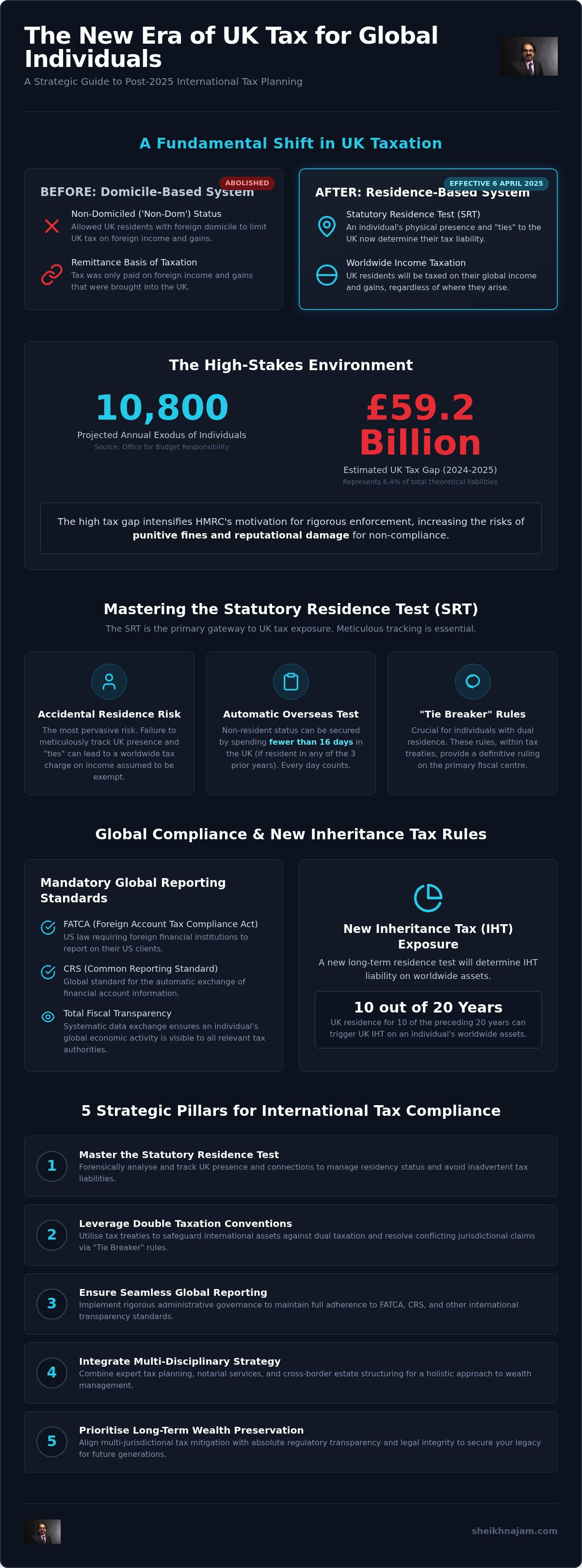
The abolition of the centuries-old non-domiciled tax status on 6 April 2025 has fundamentally dismantled the traditional fiscal architecture for the world's most mobile elite. With the Office for Budget Responsibility projecting an annual exodus of 10,800 individuals following these reforms, the margin for error in jurisdictional positioning has effectively vanished. You're likely aware that the transition to a residence-based system, governed by the intricate Statutory Residence Test, has transformed international movement into a high-stakes legal exercise where even 16 days of presence can trigger unforeseen liabilities. This comprehensive analysis of International Tax Planning and Compliance for Globally Mobile Individuals offers the strategic foresight required to mitigate the risks of double taxation and inadvertent residence. We'll examine the 10-out-of-20-year long-term residence test for inheritance tax, the August 2026 HMRC updates on treaty relief, and the precise mechanisms needed for multi-jurisdictional wealth preservation. By synthesising legal rigor with fiscal precision, this guide ensures your global affairs remain beyond regulatory reproach whilst securing your legacy for future generations.
Table of Contents
Navigating the Jurisprudential Landscape of Global Mobility
The fiscal environment of 2026 represents a definitive watershed for the private client, as the abolition of traditional domicile-based taxation in the United Kingdom has necessitated a profound re-evaluation of how wealth is structured across borders. This evolution has necessitated a broader conceptualisation of the globally mobile individual, encompassing a spectrum that ranges from the agile digital nomad to the multi-national executive whose fiscal footprint spans multiple continents simultaneously. For these parties, the strategic importance of early fiscal intervention during the relocation process cannot be overstated. It's often the case that failing to address jurisdictional shifts before they occur results in the crystallisation of exit taxes or the inadvertent triggering of wealth levies that could've been mitigated through prior structural adjustment. Identifying these primary risks, alongside potential reporting failures, is the first step in maintaining International Tax Planning and Compliance for Globally Mobile Individuals.
The Interplay of National Sovereignty and Global Tax Standards
National tax laws do not exist in isolation but rather within a complex web of principles of international taxation that seek to harmonise reporting whilst maintaining sovereign authority over revenue collection. The Organisation for Economic Co-operation and Development (OECD) continues to exert a dominant influence on this landscape, driving the global adoption of transparency measures that leave little room for opaque asset holding. Within the 2026 regulatory climate, fiscal transparency is defined as the systematic, automated exchange of financial data between jurisdictions to ensure that an individual's global economic activity is visible to every relevant tax authority. This coexistence of local statutes and international norms requires a sophisticated understanding of how treaty benefits may be claimed without infringing upon the domestic requirements of each jurisdiction.
The Cost of Inaction: Penalties and Reputational Risks
Punitive fines and severe reputational damage frequently accompany non-compliance, jeopardising future commercial ventures or family legacies. With the UK's overall tax gap estimated at £59.2 billion for the 2024-2025 tax year, representing 6.4% of total theoretical liabilities, the impetus for HMRC to recover revenue through rigorous enforcement has never been greater. Accidental residence remains the most pervasive risk for the unwary, where a failure to meticulously track "ties" under the Statutory Residence Test leads to a worldwide tax charge on income that the individual assumed was exempt. Strategic benefits of professional international tax planning include the prevention of such dual-residency traps and the establishment of a robust compliance trail. Absolute International Tax Planning and Compliance for Globally Mobile Individuals requires a proactive, multi-disciplinary approach that anticipates these pitfalls long before a tax return is ever finalised, ensuring that wealth preservation is never compromised by administrative oversight.
The Statutory Residence Test and Domicile: Foundations of UK Tax Liability
Establishing UK tax liability requires a forensic application of the Statutory Residence Test (SRT), a multi-tiered framework that determines residency based on quantitative presence and qualitative connections. For those navigating International Tax Planning and Compliance for Globally Mobile Individuals, the SRT is the primary gateway to UK fiscal exposure. Since the abolition of the non-domiciled status on 6 April 2025, the significance of the "Tie Breaker" rules in tax treaties has intensified, particularly when an individual maintains dual residence and requires a definitive ruling on their primary fiscal centre. The 2026 outlook confirms that the remittance basis of taxation has been entirely supplanted by a residence-based system, necessitating a rigorous audit of global income streams to ensure full transparency with HMRC.
The Mechanics of the Statutory Residence Test
The test functions through a hierarchical sequence, beginning with the Automatic Overseas Test, which can grant non-resident status if an individual spends fewer than 16 days in the UK (if resident in one of the three prior years) or 46 days (if not). Conversely, the Automatic UK Test triggers residency if one spends 183 days or more in the country or maintains a primary home here. When these conclusive tests aren't met, the Sufficient Ties Test evaluates complexity through personal and professional links, such as family ties or available accommodation. Split Year Treatment remains a vital mechanism for managing transition periods, allowing for the bifurcation of a tax year when an individual arrives in or departs from the UK, provided specific criteria are satisfied. Professional oversight is required to ensure these days are tracked with absolute precision, as even a minor miscalculation can result in a worldwide tax charge.
Domicile of Origin, Choice, and Deemed Domicile
Whilst residence dictates annual income tax, domicile remains the arbiter of global inheritance tax liability. The legal persistence of a domicile of origin is formidable; effectively altering it to a domicile of choice requires a demonstrable, permanent severance of ties with the former jurisdiction. Under the post-2025 regime, the concept of "deemed domicile" has been refined into a 10-out-of-20-year residence test, where reaching this threshold brings the individual’s worldwide estate into the scope of UK Inheritance Tax. Strategic planning for UK Non-Dom Rules now focuses on this residence-based transition and the potential for long-term wealth preservation. For clients with American interests, aligning these UK determinations with U.S. international taxpayer rules is essential to prevent conflicting jurisdictional claims. Ensuring your status is precisely categorised requires a bespoke professional consultation to avoid the severe fiscal consequences of accidental residency.
Optimising Cross-Border Wealth through Double Taxation Conventions
The strategic deployment of Double Taxation Conventions (DTCs) is a critical component of International Tax Planning and Compliance for Globally Mobile Individuals, as these bilateral agreements provide the necessary legal framework to resolve competing jurisdictional claims. Whilst domestic statutes, such as those governed by the UK Statutory Residence Test, establish the initial basis for liability, treaties often possess the authority to override national law to prevent the confiscatory effects of dual taxation. For the high-net-worth individual with income streams spanning dividends, royalties, and capital gains, the interaction between treaty-based exemptions and local filing requirements must be managed with absolute precision. Failing to correctly invoke treaty relief can lead to an effective tax rate that significantly erodes global asset value, particularly in the context of reverse hybrid entities or complex trust structures. It's essential to recognise that treaty benefits aren't self-executing but require formal election and rigorous documentation to withstand the scrutiny of revenue authorities.
Interpreting Treaty Provisions for Private Wealth
The "Tie-Breaker" clause remains the definitive mechanism for resolving residence disputes, moving through a hierarchical sequence that evaluates the individual’s permanent home, centre of vital interests, habitual abode, and ultimately, their nationality. Effective wealth management requires the optimisation of withholding taxes on international dividends and royalties, ensuring that treaty-reduced rates are correctly applied at source to maintain fiscal efficiency. A Double Taxation Convention serves as a bilateral legal instrument designed to allocate taxing rights between sovereign states, thereby preventing the same income or capital from being subjected to fiscal levies in two jurisdictions simultaneously. This allocation of rights is not automatic; it requires formal claims and, in many instances, the provision of certificates of residence issued by the relevant tax authorities to validate the taxpayer's standing.
Estate and Gift Tax Treaties: Preserving Global Legacies
The preservation of a multi-generational legacy necessitates a profound understanding of how UK Double Taxation Treaties extend to estate and gift taxes, which are often distinct from income tax conventions. These treaties are vital for mitigating the 40% UK inheritance tax charge on worldwide assets for those who have met the long-term residence thresholds discussed previously. Consider the resolution of a multi-jurisdictional estate conflict where assets held in a civil law jurisdiction were potentially subject to both local succession duties and UK inheritance tax; through the forensic application of treaty-based credits, the double liability was successfully extinguished. Such results are only achievable through a multi-disciplinary approach that synthesises international treaty law with the specific nuances of each jurisdiction's domestic probate and tax codes, ensuring that the transition of wealth remains seamless and compliant.
Regulatory Compliance and the Governance of International Assets
The architecture of global fiscal oversight in 2026 is defined by a state of radical transparency, where the automatic exchange of financial information has rendered the concept of "offshore" obsolete in a regulatory sense. The Foreign Account Tax Compliance Act (FATCA) and the Common Reporting Standard (CRS) represent the twin pillars of this environment, compelling financial institutions to transmit data across borders with mechanical regularity. For those engaged in International Tax Planning and Compliance for Globally Mobile Individuals, this shift necessitates a transition from reactive filing to proactive governance. For instance, the FBAR filing threshold for those with American interests remains a total value of non-US financial accounts exceeding $10,000 at any point in the calendar year. Maintaining meticulous records for HMRC and international tax authorities is the only viable defence against the aggressive data-matching algorithms now employed by revenue services. This rigorous administrative discipline ensures that every asset, whether held in a traditional trust or a private investment vehicle, is accounted for within the global reporting framework.
Automated Information Exchange and Private Wealth
The Common Reporting Standard has profoundly impacted offshore accounts by removing the veil of jurisdictional secrecy that historically characterised high-value asset holding. Absolute transparency is now a prerequisite for asset disclosure; any discrepancy between reported global income and the data received via automated exchange can trigger immediate audits. Managing the administrative burden of annual compliance requires a systematic approach to record-keeping that documents the source of wealth and the tax-paid status of capital. It's no longer sufficient to rely on annual returns alone. A continuous audit trail must be maintained to demonstrate adherence to both domestic statutes and international standards, thereby mitigating the risk of being ensnared in financial crime or anti-money laundering inquiries.
Digital Asset Structuring for the Mobile Professional
The fiscal governance of digital assets and cryptocurrencies has matured significantly by 2026, with most jurisdictions now possessing clear frameworks for the taxation of tokens and decentralised finance (DeFi) returns. Tax implications vary wildly; some nations categorise crypto-assets as capital property, whilst others view them through the lens of income or currency gains. Achieving International Tax Planning and Compliance for Globally Mobile Individuals in this space demands legal integration into a broader private wealth and estate plan to ensure that these assets are both compliant and accessible to future generations. Proactive disclosure through channels like the Worldwide Disclosure Facility is essential for individuals with previously unreported digital gains. To ensure your international holdings are fully aligned with the latest regulatory mandates, you should request a comprehensive compliance audit of your global portfolio.
Multi-Disciplinary Advisory for the Globally Mobile Private Client
The management of high-value cross-border interests demands far more than mere accounting; it requires a polymathic synthesis of legal, fiscal, and administrative disciplines that few practitioners possess the breadth to navigate simultaneously. A master advisor must operate at the intersection of several complex fields to ensure that every facet of a client’s global footprint is harmonised, preventing the disjointed advice that often leads to regulatory friction. This holistic approach is the bedrock of robust International Tax Planning and Compliance for Globally Mobile Individuals, where the objective is not only the mitigation of tax but the absolute security of the entire estate architecture through meticulous governance. By integrating trust administration with official authentication, the practitioner provides a shield against the volatility of shifting international mandates.
The Strategic Role of the Notary Public
The Notary Public, appointed by the Court of Faculties, serves as a vital public officer whose role in authenticating corporate and personal instruments for global use is indispensable to the international elite. The interplay between professional notarial services and fiscal compliance is often the decisive factor in whether an international instrument is accepted by foreign revenue authorities or judicial bodies. By providing official authentication, the notary ensures the legal validity of documentation across disparate legal systems, thereby underpinning the structural integrity of cross-border wealth transfers. This level of official verification is particularly crucial when establishing residency status or executing complex digital asset transfers that require a high degree of institutional trust.
Dispute Resolution in Multi-Jurisdictional Estates
Multi-jurisdictional estates are inherently prone to conflict, particularly when the nuances of trust administration or the interpretation of complex wills collide with the varying legal traditions of multiple nations. Mediation and arbitration offer a private, prestigious alternative to the public spectacle of contentious probate, allowing families to resolve disagreements with academic precision and the necessary confidentiality. Protecting assets from a potential breach of trust within intricate family structures requires a master advisor who can navigate both the deep academic theory and the high-stakes reality of multi-party negotiation. Securing the future involves the meticulous drafting of International Wills and Lasting Powers of Attorney that remain valid across borders, providing the final layer of protection for a legacy built on strategic foresight. To align these protective measures with your broader objectives, you may organise a consultation to develop a truly holistic wealth strategy.
Securing Jurisdictional Stability in an Era of Radical Transparency
The definitive shift towards a residence-based fiscal regime in the United Kingdom has rendered historical wealth structures obsolete, necessitating a more rigorous approach to International Tax Planning and Compliance for Globally Mobile Individuals. Success in this new environment demands a forensic application of the Statutory Residence Test alongside the strategic invocation of Double Taxation Conventions to prevent the erosion of international asset value. By synthesising academic rigor in multi-disciplinary legal practice with the official authority of an Appointed Public Officer and Trust and Estate Practitioner (TEP), you can ensure your global footprint remains beyond regulatory reproach. This level of meticulous governance is essential for those seeking complex cross-border wealth preservation that withstands the scrutiny of modern automated information exchange. It's possible to maintain your mobility whilst ensuring that your legacy is shielded from inadvertent liabilities. To begin this essential process, you should secure your global fiscal future by arranging a strategic consultation with Sheikh Najam TEP. Taking proactive control of your jurisdictional positioning today provides the ultimate security for your family’s prosperity in the decades to come.
Frequently Asked Questions
What is the primary difference between tax residence and domicile for a globally mobile individual?
Residence is a statutory concept determined by physical presence and personal ties within a specific tax year, whereas domicile is a common law concept reflecting an individual's permanent home and long-term intentions. Under the 2026 regime, residence dictates your annual income tax obligations, whilst domicile remains the arbiter of global inheritance tax liability. This distinction is fundamental to International Tax Planning and Compliance for Globally Mobile Individuals, as one may be resident without being domiciled.
How does the Statutory Residence Test determine my UK tax obligations in 2026?
The Statutory Residence Test functions as a hierarchical framework of automatic tests and the Sufficient Ties Test to quantify an individual’s UK fiscal presence. For the 2026/2027 tax year, these thresholds remain strictly enforced; with four or more UK ties, as few as 16 days of presence can trigger full UK residency. It's no longer a matter of simple day-counting but a multi-factorial analysis of family, accommodation, and work ties that dictates your worldwide tax exposure.
Can a Double Taxation Treaty completely eliminate my liability in one jurisdiction?
A Double Taxation Convention serves to allocate taxing rights between nations rather than granting a blanket exemption from all fiscal duties. Whilst a treaty may grant exclusive taxing rights to one jurisdiction or provide a credit for tax paid elsewhere, it doesn't absolve the taxpayer from rigorous reporting obligations. Effective International Tax Planning and Compliance for Globally Mobile Individuals requires a formal claim for treaty relief, often supported by a certificate of residence, to ensure income isn't depleted by dual levies.
What are my reporting obligations under the Common Reporting Standard (CRS)?
Under the Common Reporting Standard, your financial institutions are legally mandated to automatically transmit details of your accounts, including balances and investment income, to the relevant tax authorities. As a taxpayer, your primary obligation is the absolute disclosure of all offshore interests on your annual tax return to ensure consistency with the data HMRC receives. Discrepancies identified through this automated exchange can trigger comprehensive audits or financial crime investigations if the source of wealth remains unverified.
How are digital assets and cryptocurrencies taxed for individuals moving between countries?
Digital assets are generally taxed based on the residency of the holder, though the specific classification as capital gains or income varies significantly by jurisdiction. Moving between countries can trigger exit taxes on unrealised crypto gains or change the applicable rate of tax on decentralised finance yields. Proactive digital asset structuring is required to align these holdings with the legal frameworks of both the departure and arrival nations, ensuring that global mobility doesn't lead to unintended tax crystallisation.
Is it possible to change my domicile of origin to avoid UK inheritance tax?
Altering a domicile of origin requires a demonstrable and permanent severance of ties with one’s home country alongside the acquisition of a domicile of choice elsewhere. This isn't merely a matter of relocation; it involves a forensic shift in personal and professional interests that withstands judicial scrutiny. However, under the post-2025 rules, 10 years of UK residence will result in deemed domicile for inheritance tax purposes, regardless of whether a domicile of choice has been established abroad.
What role does a Notary Public play in international tax planning and asset protection?
A Notary Public acts as an appointed public officer who provides official authentication and certification for international legal instruments, ensuring their validity in foreign jurisdictions. In the context of tax planning, notarial services are essential for authenticating trust deeds, powers of attorney, and corporate documents required by international tax authorities. This official verification provides a layer of asset protection by ensuring that the legal architecture of an estate is recognised and respected across sovereign borders.
How can I mitigate the risk of double taxation on an international inheritance?
Mitigation is achieved through the forensic application of estate tax treaties or unilateral relief mechanisms that provide credits for foreign succession duties against UK inheritance tax. This requires a multi-disciplinary approach to probate and estate administration, ensuring that the timing of asset distributions and the payment of local levies are perfectly synchronised. Utilising international wills and specialised trust structures can further delineate jurisdictional boundaries, preventing conflicting claims from multiple revenue services on the same testamentary assets.


Comments