Inheritance Litigation Solicitors London: A Treatise on Contentious Probate and Estate Disputes

Updated: Aug 26
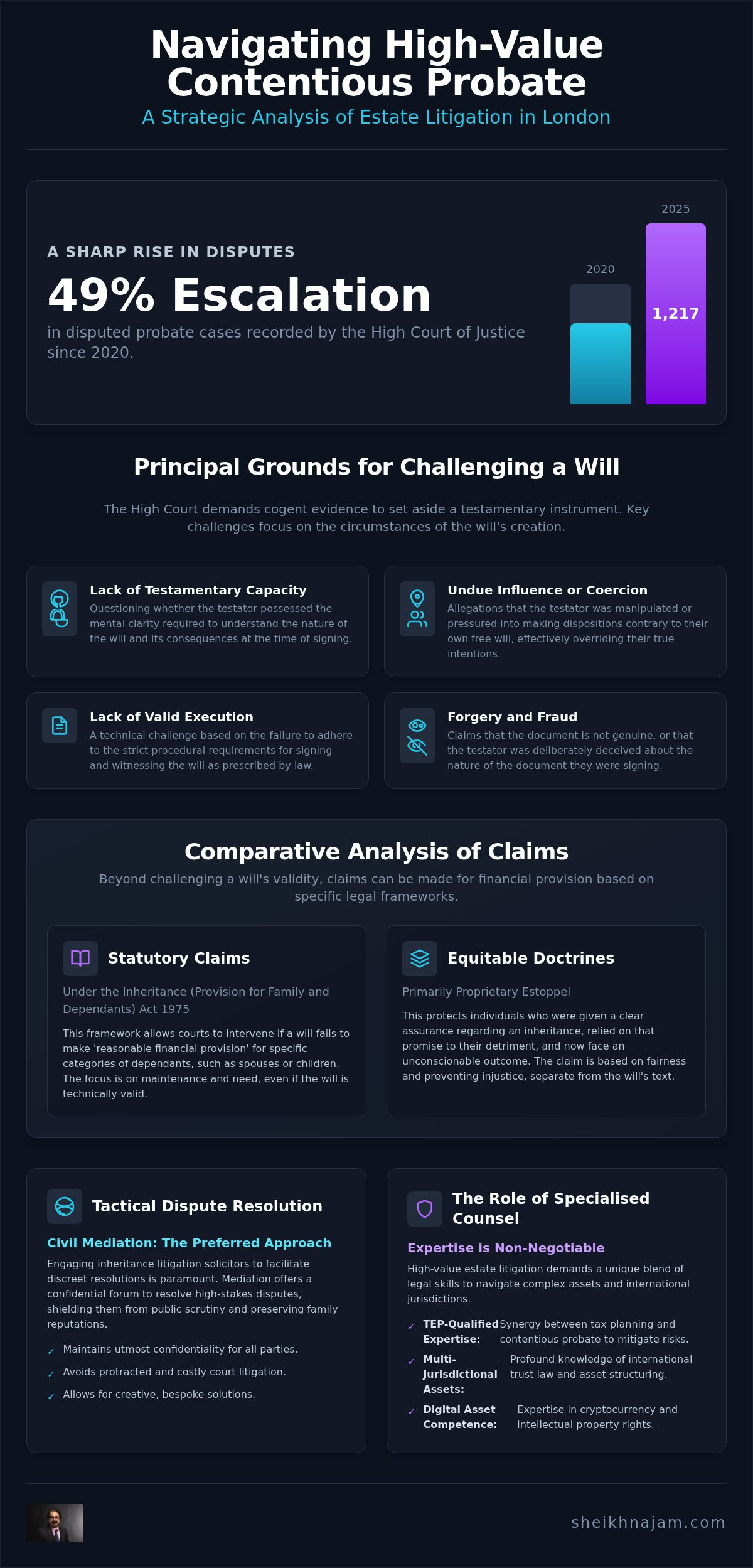
In 2025, the High Court of Justice recorded an unprecedented 1,217 disputed probate cases, which represents a significant 49 per cent escalation in such conflicts since 2020. This precipitous rise in testamentary disputes necessitates the engagement of preeminent inheritance litigation solicitors London who possess the academic rigor and strategic foresight required to manage high-value estates. You likely understand that it's the preservation of a family's reputation and the protection of multi-jurisdictional assets that require a level of discretion and technical precision transcending standard legal practice.
This article provides a comprehensive reference guide to the formidable complexities of contentious probate and the specific procedural demands of the London jurisdiction. We shall evaluate the substantive merits of potential claims, the strategic deployment of mediation and arbitration, and the rigorous legal frameworks employed to secure a rightful inheritance whilst maintaining the utmost confidentiality for all parties involved. By examining the interplay between the Inheritance Act 1975 and the evolving landscape of digital asset structuring, this treatise offers the clarity needed to resolve even the most intricate estate challenges.
Table of Contents
The Anatomy of Inheritance Litigation in London: A Strategic Overview
Inheritance litigation represents a sophisticated multidisciplinary legal conflict that extends far beyond simple probate disputes. It requires a profound understanding of trust law and the principles of equity to manage the competing interests of beneficiaries and executors. For those seeking high-value contentious probate in London, the stakes often involve multi-jurisdictional assets and complex fiduciary duties. Professional inheritance litigation solicitors London must navigate these waters with absolute precision, distinguishing clearly between technical challenges to a will's validity and substantive claims for financial maintenance.
A central distinction exists between challenges to the validity of a testamentary instrument and claims for financial provision. Whilst the former focuses on the technical or mental capacity surrounding the will's execution, the latter often relies upon the Inheritance (Provision for Family and Dependants) Act 1975. This statutory framework allows the court to intervene if an estate fails to provide reasonable financial maintenance for certain dependants, even if the will itself is technically flawless. It's a strategic exercise in balancing testamentary freedom against social and familial obligations, requiring a practitioner who can weigh the merits of a claim against the potential for protracted litigation.
The Escalation of Contentious Probate amongst London HNWIs
The City of London serves as a focal point for the 'Great Wealth Transfer,' where trillions in assets are shifting between generations. This transition is rarely seamless. Complex family structures, including multiple marriages and blended households, often lead to conflicting expectations that manifest as legal challenges. The integration of digital assets, such as cryptocurrency portfolios and intellectual property rights, further complicates the modern litigation landscape. These intangible assets require a level of technical and regulatory expertise that traditional firms may lack. The rise in property values across the capital has also heightened the financial stakes, making even modest estates the subject of intense legal scrutiny.
London as a Global Centre for Estate Dispute Resolution
The High Court of Justice in London remains the preeminent forum for resolving multi-jurisdictional inheritance conflicts. Its role in setting global precedents for probate law ensures that decisions made here resonate across international borders. London is the preferred jurisdiction for high-net-worth individuals because it offers a predictable, rigorous, and highly specialised legal environment. Engaging inheritance litigation solicitors London who possess specific fiduciary expertise is essential for those managing estates with global footprints. The court's meticulous approach to equity and trusts provides a level of security that few other jurisdictions can replicate, ensuring that the intentions of the deceased are balanced against the rigorous demands of justice.
Principal Grounds for Challenging Testamentary Instruments
The initiation of a formal challenge against a testamentary instrument is a rigorous legal undertaking that requires a profound comprehension of historical precedents and contemporary judicial standards. Within the London jurisdiction, the High Court demands cogent evidence before it'll set aside a will that appears valid on its face. For those engaging inheritance litigation solicitors London, the strategy often begins with a meticulous audit of the circumstances surrounding the document's execution. This process isn't merely about personal dissatisfaction with a legacy; it's a technical examination of whether the testator's true intentions were legally captured. Readers may find additional depth on this subject in our companion piece regarding the Strategic Navigation of Will Disputes in London: A Private Wealth Perspective.
Banks v Goodfellow and the Doctrine of Mental Capacity
The primary benchmark for assessing a testator's mental state remains the landmark 1870 case of Banks v Goodfellow. This authority establishes that testamentary capacity necessitates that the testator understands the nature of the act and its effects, comprehends the extent of the property being bequeathed, appreciates the moral claims of potential beneficiaries, and remains free from any mental disorder that might pervert their sense of right or dictate their testamentary dispositions. When dealing with elderly or infirm clients, prudent practitioners adhere to the 'Golden Rule,' which suggests that a medical practitioner should witness the will to provide a contemporaneous assessment of capacity. This intersection of medical diagnostics and legal findings is often the pivot upon which high-value disputes turn, especially when dementia or other cognitive impairments are alleged.
The Evidentiary Burden in Undue Influence Claims
Proving undue influence is one of the most formidable challenges in estate litigation because the burden of proof rests entirely on the person making the allegation. The High Court makes a sharp distinction between mere 'persuasion,' which is legally permissible, and 'coercion,' which vitiates the testator's free will. Because coercion rarely happens in the presence of witnesses, inheritance litigation solicitors London must frequently rely on a mosaic of circumstantial evidence, such as sudden changes in long-standing testamentary patterns or the isolation of the testator by a primary beneficiary. Executors defending these claims must be prepared to demonstrate the testator's independence, often through records of private meetings where no beneficiaries were present. Those seeking initial guidance on challenging an executor or assessing the validity of a will should recognise that these claims require absolute evidentiary precision. Those navigating these treacherous waters may find clarity through a bespoke assessment of their testamentary concerns.
Beyond capacity and influence, a will may be set aside for a lack of knowledge and approval, where the testator simply didn't understand the contents of the document they signed. Similarly, allegations of forgery or fraud represent the most serious tier of challenge, involving criminal implications and necessitating expert forensic handwriting analysis. Each of these grounds requires a distinct tactical approach to ensure the integrity of the estate is preserved or restored.
Comparative Analysis: Statutory Claims vs Equitable Doctrines
Beyond the technical validity of a will, high-value estate disputes often pivot on whether the distribution of assets is legally sufficient or reflects prior commitments made by the deceased. Expert inheritance litigation solicitors London must therefore conduct an immediate assessment of whether a client's interests are better served through statutory claims or equitable remedies. Whilst a will challenge seeks to invalidate a document, these claims accept the document's existence but contest its outcome. Navigating these concurrent paths requires a sophisticated understanding of the specific limitation periods and evidentiary standards that govern the London courts.
The 1975 Act: Reasonable Financial Provision
The Inheritance (Provision for Family and Dependants) Act 1975 serves as a critical statutory safety net for those left without adequate support. Eligibility is strictly defined, encompassing surviving spouses, civil partners, children, and any individuals who were being maintained by the deceased immediately prior to death. In high-value London estates, the court applies a dual standard. Surviving spouses are entitled to 'reasonable financial provision' regardless of whether it's required for their maintenance, often mirroring the division of assets in matrimonial proceedings. For other claimants, the 'maintenance standard' applies, focusing on what's required for their daily living according to their station in life.
Under Section 3 of the Act, the court evaluates a complex matrix of factors, including the financial resources and needs of the claimant, any obligations the deceased had towards them, and the size and nature of the net estate. Whilst the official probate application process establishes the initial administrative framework, the issuance of the Grant also triggers the strict six-month limitation period for initiating these statutory claims. Missing this window can be fatal to a claim, making early engagement with inheritance litigation solicitors London an absolute necessity for protecting one's future security.
Proprietary Estoppel: The Shield of Equity
Where the 1975 Act provides a statutory remedy, proprietary estoppel offers an equitable shield against unconscionable outcomes. This doctrine is frequently invoked in disputes involving family businesses or substantial property portfolios where a testator promised an inheritance in exchange for years of service or financial sacrifice. To succeed, a claimant must demonstrate a clear promise, a detrimental reliance upon that promise, and an outcome so unfair that equity must intervene. Unlike the rigid six-month limit of the 1975 Act, estoppel claims are governed by the principle of laches, though they remain subject to the court's discretion regarding delay.
In the London jurisdiction, these cases often involve complex agricultural or commercial enterprises where the express terms of a valid will are found to be at odds with long-standing familial agreements. Proprietary estoppel has the power to override a will entirely, effectively compelling the estate to honour the promise made. This multidisciplinary approach ensures that the strategic polymath can deploy both statutory and equitable tools to secure a just resolution, balancing the letter of the law against the demands of conscience.
Tactical Dispute Resolution: Mediation, Arbitration, and Authentication
While the High Court remains the ultimate arbiter of testamentary truth, the strategic practitioner recognises that the resolution of high-value estate disputes often occurs far from the public gallery. Managing the financial and reputational risks associated with contentious probate requires a sophisticated deployment of alternative dispute resolution mechanisms. For inheritance litigation solicitors London, the objective is frequently to secure a client's rightful legacy whilst maintaining the absolute discretion that private wealth demands. This tactical approach often involves the strategic use of Part 36 offers, which serve to exert pressure on opposing parties by creating significant cost consequences if a settlement isn't reached before trial.
The Fiduciary Advantage of Mediation
Civil and commercial mediation provides a confidential forum where complex family dynamics can be addressed with a level of nuance that traditional litigation cannot accommodate. A court's powers are strictly defined by statute and precedent, yet mediation allows for the creation of bespoke settlements that can include the restructuring of trusts or the distribution of non-probate assets. The role of the mediator isn't to impose a judgment but to act as a neutral facilitator, helping parties navigate the emotional undercurrents that often fuel inheritance conflicts. By prioritising mediation, inheritance litigation solicitors London can protect their clients from the unpredictable nature of trial outcomes and the potential for irreparable damage to family reputations.
International Notarial Acts in Contentious Probate
The global nature of London-based estates necessitates a multi-disciplinary approach to evidence, particularly when assets or beneficiaries are located in foreign jurisdictions. Arbitration emerges as a bespoke procedural alternative for complex trust conflicts, offering a private, expert-led resolution path that mirrors the rigour of the High Court without its public exposure. This international dimension requires the specific expertise of a Notary Public to authenticate foreign wills, powers of attorney, and other vital testamentary instruments. An Apostille serves as a formal certificate of authenticity issued by the Foreign, Commonwealth & Development Office, ensuring that a legal document executed in one jurisdiction is recognised as valid within another for the purposes of international inheritance litigation. Such meticulous attention to authentication is essential for maintaining the integrity of cross-border estate administration. If you require absolute precision in these matters, you may consult our experts for mediation and arbitration services tailored to high-value estates.
The Role of Specialised Legal Counsel in High-Value Contentious Probate
The resolution of high-stakes estate conflicts requires more than just adversarial skill; it demands a profound synthesis of legal, fiscal, and fiduciary expertise. Engaging inheritance litigation solicitors London who possess the TEP designation ensures that the practitioner operates at the highest global standard of trust and estate practice. This professional qualification, awarded by the Society of Trust and Estate Practitioners, signifies a level of technical proficiency that is essential when navigating the intersection of complex family dynamics and substantial private wealth. In the City of London, where estates often comprise intricate corporate holdings and international trusts, the role of the solicitor evolves into that of a master advisor who provides absolute command over the litigation landscape.
The Multidisciplinary Approach: Tax, Trust, and Litigation
A sophisticated defence against a will challenge often begins with an audit of the deceased's inheritance tax planning and trust structures. There is a powerful synergy between tax mitigation strategies and litigation avoidance; a well-structured estate, supported by contemporaneous notarial evidence, is significantly more resilient to claims of undue influence or lack of capacity. As a sole practitioner with global academic standing, the Strategic Polymath offers a level of discrete, high-level command and control that large, impersonal firms cannot match. This individualised focus allows for the seamless integration of digital asset structuring into the broader dispute resolution strategy, ensuring that cryptocurrency portfolios and intellectual property are managed with the same rigour as traditional real estate.
The value of this multidisciplinary approach lies in its ability to anticipate the moves of opposing parties whilst maintaining the integrity of the estate's tax position. Effective inheritance litigation solicitors London don't merely react to claims; they proactively shape the legal environment to favour a discreet and equitable resolution. This involves a meticulous analysis of fiduciary duties and the potential for mediation to preserve family assets that might otherwise be depleted by protracted court battles.
Engaging a London Inheritance Litigation Specialist
Moving from the awareness of a dispute to formal professional instruction is a critical transition that requires decisive action. Early intervention is the most effective way to mitigate the risks associated with contentious probate, particularly given the strict six-month limitation periods governing statutory claims. An initial consultation serves as a rigorous assessment of the merits of your case, providing a strategic roadmap for either litigation or mediation. This process ensures that every action taken is grounded in academic precision and a deep understanding of the High Court's procedural requirements. If you're facing a complex testamentary challenge, you should consult with Sheikh Najam TEP for expert inheritance litigation advice in London to secure your rightful position with absolute confidentiality and expertise.
Securing the Fiduciary Future: Strategic Resolution of Estate Conflicts
The successful navigation of high-value estate disputes in the City of London necessitates a sophisticated synthesis of legal precision and strategic foresight. We've examined how the intersection of mental capacity standards and equitable doctrines requires a multidisciplinary approach that transcends standard legal practice. Engaging inheritance litigation solicitors London ensures that your interests are protected by a practitioner who understands the nuanced interplay between statutory mandates and the preservation of multi-jurisdictional wealth. By prioritising discrete resolution through mediation or arbitration, you can effectively shield your family's reputation and institutional weight from the undesirable exposure of public litigation.
Sheikh Najam TEP provides this essential command and control, leveraging his specialist Trust and Estate Practitioner qualification and his standing as a Notary Public appointed by The Court of Faculties. His expertise in high-stakes mediation and the authentication of international testamentary instruments offers a level of security and meticulousness that is vital for complex affairs. You can proceed with the assurance that your most intricate legal challenges are being managed with absolute academic rigour and professional precision.
Instruct Sheikh Najam TEP for Strategic Inheritance Litigation in London to secure your legacy and achieve a resolute, expert-led outcome.
Frequently Asked Questions
What are the primary legal grounds to contest a will in England and Wales?
The primary legal grounds to contest a testamentary instrument include a lack of testamentary capacity, lack of valid execution, undue influence, and fraudulent calumny. Each ground necessitates a rigorous evidentiary standard to overcome the presumption of validity afforded to a properly executed document. Practitioners must meticulously evaluate the circumstances of the will's creation to determine if the testator's true intentions were subverted by cognitive impairment or external coercion.
How long do I have to bring a claim under the Inheritance Act 1975?
A claim initiated under the Inheritance (Provision for Family and Dependants) Act 1975 must be issued within six months from the date the Grant of Probate or Letters of Administration is issued. This strict statutory window is rarely extended by the court, making immediate consultation with inheritance litigation solicitors London essential for protecting a claimant's standing. Delaying the commencement of proceedings beyond this period often results in the loss of the right to seek reasonable financial provision.
What is the difference between contentious probate and inheritance litigation?
Contentious probate refers specifically to disputes regarding the validity of a testamentary document or the formal administration of a deceased person's estate. Inheritance litigation serves as a broader umbrella term that encompasses statutory claims for financial provision and equitable doctrines such as proprietary estoppel. Whilst the terms are often used interchangeably in casual discourse, the latter reflects a more multidisciplinary approach to estate conflicts involving trusts and complex property rights.
Can a will be challenged if the testator was suffering from dementia or lack of capacity?
A will may be challenged if the testator lacked the requisite mental capacity at the time of execution, a standard governed by the four-limb test in Banks v Goodfellow. Medical evidence of dementia is significant, but the court ultimately makes a legal finding based on the testator's ability to understand the extent of their assets and the moral claims upon them. The presence of a cognitive disorder doesn't automatically invalidate a will if the testator experienced a lucid interval during execution.
What role does a Notary Public play in London inheritance disputes involving foreign assets?
A Notary Public facilitates the authentication of legal instruments and powers of attorney required for the administration of multi-jurisdictional estates. In London disputes, this role is vital for ensuring that foreign testamentary documents meet the evidentiary requirements of the High Court, often involving the procurement of an Apostille for international recognition. This expertise ensures that evidence gathered from abroad is legally robust and admissible within the English jurisdiction.
Is mediation compulsory for will disputes within the London High Court?
Whilst mediation isn't strictly compulsory, the Civil Procedure Rules and the High Court strongly encourage Alternative Dispute Resolution to resolve estate conflicts. An unreasonable refusal to participate in mediation can result in severe cost sanctions, even for the prevailing party, as the court seeks to preserve estate assets from unnecessary depletion. Most sophisticated litigants prefer this confidential route to avoid the reputational damage associated with a public trial.
How are legal costs typically allocated in high-value probate litigation?
In high-value probate litigation, the general rule is that the unsuccessful party is ordered to pay the costs of the victor. However, the court maintains discretion to order that costs be paid out of the estate if the dispute was caused by the testator's own actions or if the circumstances necessitated a judicial inquiry. Engaging expert inheritance litigation solicitors London is crucial for managing these cost risks through strategic Part 36 offers and meticulous case preparation.
What is proprietary estoppel and how does it apply to inheritance claims?
Proprietary estoppel is an equitable doctrine that prevents a property owner from going back on a promise made to another party who relied on that promise to their detriment. Within inheritance claims, it allows the court to enforce a promised legacy, such as an interest in a family business, even if the written will stipulates a different distribution. Success requires proving that an unconscionable outcome would result if the deceased's promise were not honoured by the estate.


Comments